December 24, 1843: What a Delightful Boy

Published in 1843, it’s the figgy pudding of Christmas stories.  Don’t go until you get some.  Just one tasty scene for your merriness:

(Scrooge has been visited by the three ghosts on Christmas Eve, and he awakens the following morning.)

“I don’t know what day of the month it is!” said Scrooge. “I don’t know how long I’ve been alastair-sim-as-scrooge-at-windowamong the Spirits. I don’t know anything. I’m quite a baby. Never mind. I don’t care. I’d rather be a baby. Hallo! Whoop! Hallo here!”

He was checked in his transports by the churches ringing out the lustiest peals he had ever heard. Clash, clang, hammer, ding, dong, bell. Bell, dong, ding, hammer, clang, clash! Oh, glorious, glorious!

Running to the window, he opened it, and put out his head. No fog, no mist; clear, bright, jovial, stirring, cold; cold, piping for the blood to dance to; golden sunlight; heavenly sky; sweet fresh air; merry bells. Oh glorious, glorious!

“What’s today?” cried Scrooge, calling downward to a boy in Sunday clothes, who perhaps had loitered in to look about him.

“Eh?” returned the boy, with all his might of wonder.

“What’s today, my fine fellow?” said Scrooge.

“Today!” replied the boy. “Why, Christmas Day.”

“It’s Christmas Day!” said Scrooge to himself. “I haven’t missed it. The Spirits have done it all in one night. They can do anything they like. Of course they can. Of course they can. Hallo, my fine fellow?”

“Hallo!” returned the boy.

“Do you know the Poulterer’s, in the next street but one, at the corner?” Scrooge inquired.

“I should hope I did,” replied the lad.

“An intelligent boy!” said Scrooge. “A remarkable boy! Do you know whether they’ve sold the prize Turkey that was hanging up there? Not the little prize Turkey, the big one?”

“What, the one as big as me?” returned the boy.

“What a delightful boy!” said Scrooge. “It’s a pleasure to talk to him. Yes, my buck!”

“It’s hanging there now,” replied the boy.

“Is it?” said Scrooge. “Go and buy it.”

“Walk-er!” exclaimed the boy.

“No, no,” said Scrooge, “I am in earnest. Go and buy it, and tell ’em to bring it here, that I may give them the direction where to take it. Come back with the man, and I’ll give you a shilling. Come back with him in less than five minutes, and I’ll give you half-a-crown!”

The boy was off like a shot. He must have had a steady hand at a trigger who could have got a shot off half so fast.

“I’ll send it to Bob Cratchit’s!” whispered Scrooge, rubbing his hand, and splitting with a laugh. “He shan’t know who sends it. It’s twice the size of Tiny Tim. Joe Miller never made such a joke as sending it to Bob’s will be!”

scrooge1

scrooged-1988-3

December 23, 2009: Kids Say the Darnedest Things

Reality television reached new heights in October of 2009, as viewers around the world were tethered to their sets by the saga of the “Balloon Boy.” It started shortly before noon when Richard Heene, a Fort Collins, Colorado, handyman, dabbling scientist and father of three boys, called the Federal Aviation Administration to report that a large balloon that had been tied in his family’s backyard  had gotten loose and taken flight. Heene was certain his six-year-old son Falcon had crawled aboard the craft before its takeoff. Heene also phoned a local TV station, requesting a helicopter to track the balloon, and his wife Mayumi called 911.

The homemade dirigible was soon being pursued by two Colorado National Guard helicopters and by search-and-rescue personnel, as well as reporters, on the ground. A runway at Denver International Airport was shut down as the balloon traveled into its flight path. The runaway blimp finally touched down in a Colorado field after a joyride of some 50 miles. Rescue officials quickly discovered the balloon was empty, prompting fears that poor little Falcon Heene had plummeted from on high during the flight. A ground search was initiated. But later that afternoon, Richard Heene made an oops! statement that the boy had been found safe at home, where he supposedly had been hiding.

Conspiracy theorists came out of the woodwork all afternoon and into the evening, voicing their suspicions that the entire incident had hoax written all over it. Then dear little blabbermouth Falcon Heene told his parents during a live interview on CNN: “You guys said we did this for the show.”

In November, Richard Heene pleaded guilty to a felony charge of attempting to influence a public official to initiate a search-and-rescue mission which in turn would attract media attention, frowned on in Colorado; Mayumi Heene pleaded guilty to a misdemeanor count of making a false report. Falcon Heene pleaded guilty to being a sniveling six-year-old dupe (permissible under Colorado law). They confessed that they staged the incident in an attempt to get their own reality TV show, having gotten the entertainment bug when previously appearing on a program, called “Wife Swap.”

On December 23, 2009, the Heenes were sentenced to perform community service not involving flying objects, and ordered to pay $36,000 in restitution for the search effort. Falcon, it is rumored, will have his own reality TV show, “Throw Your Parents Under the Bus.”


wcfields2

December 14, 1977: You Are the Dancing King

He was just another juvenile delinquent in a television sit-com, before he became a superstar playing a nobody by day who blossoms at night on the dance floor.  John Travolta strutted his stuff as Tony Manero, a paint-store clerk who dons a dashing white suit to ride the disco craze out of his dead-end existence in Saturday Night Fever. The film premiered on December 14, 1977, already guaranteed success thanks to its soundtrack, released months before the movie.

The disco songs recorded by the Bee Gees (including “Stayin’ Alive”) were all over the pop charts, sparking intense interest in the film before its release, with the film then popularizing the entire soundtrack after its release – the first (and certainly not the last) use of cross-media marketing.

 The movie follows Tony’s foray into the Manhattan world of flashing lights and sweaty bodies. Disco and the culture of the disco era also star in the movie – the symphonic orchestration over a steady beat and disciplined choreography, the high style in clothing, and the sexuality of it all.

“Travolta on the dance floor is like a peacock on amphetamines,” said movie critic Gene Siskel, who bought Travolta’s famous white suit at a charity auction. “He struts like crazy.”

The film had an R-rating when it was originally released in 1978. Several years later it was edited down to PG  to make it more “family-friendly” and suitable for television.

A Practical Gift Idea

Just trying to help. This one’s about sticking pins in little dolls to get what you want.

December 12, 1937: Is That a Snake in Your Fig Leaf?

Mae West was certainly not a stranger to controversy. But on December 12, 1937, she brought her outrageous humor to radio and in less than a half hour managed to get herself banned from the air waves for good – or at least, as it turned out, for a dozen years until finally invited to perform on Perry Como’s Chesterfield Supper Club in 1950.

The vehicle of Mae’s descent into disgrace was ventriloquist Edgar Bergen’s radio show The Chase and Sanborn Hour. She went on the show to promote her latest movie, Every Day’s a maewHoliday, and playing herself, appeared in two sketches with Charlie McCarthy. As usual she was all wit and double entendre, referring to Charlie in the first sketch as “all wood and a yard long” and commenting that his kisses gave her splinters.

But it was the second sketch that started the phones ringing. Mae played Eve and Don Ameche was Adam in the Garden of Eden.  Charlie McCarthy entered as the snake and the dialog got dicey.

Eve: Listen, what are you — my friend in the grass or a snake in the grass?

Snake: But, forbidden fruit.

Eve: Are you a snake or are you a mouse?

Snake: I’ll — I’ll do it [hissing laugh].

Eve: Now you’re talking. Here — right in between those pickets.

Snake: I’m, I’m stuck.

Eve: Oh — shake your hips. There, there now, you’re through.

Snake: I shouldn’t be doing this.

Eve: Yeah, but you’re doing all right now. Get me a big one. I feel like doin’ a big apple.

For days after the broadcast, the studio received calls and letters labeling the show immoral and obscene. Women’s clubs and Catholic groups went after the show’s sponsor for “prostituting” their services and being far from good to the last drop. The Federal Communications Commission weighed in, finding the broadcast “vulgar and indecent.”

Standing a little less than tall, NBC personally blamed West for the incident and banned her (and the mention of her name) from their stations. It was not the content of the skit (which the network had provided), but the way she delivered it. Charlie McCarthy and Don Ameche escaped punishment.  Just like in the Bible, it was all Eve’s fault.


December 3, 1926: Lords of the Rings

German -born Heinrich Friedrich August Ringling and Marie Salome Juliar of France tied the knot back in the mid-19th century. Theirs was a rather productive union in the offspring department, bringing the world seven sons and a daughter.

Five of the brothers – August, Otto, Alfred, John, and Charles, who died on December 3, 1926 – were entertainers of sorts, performing skits and juggling routines in town halls and other local venues around the state of Wisconsin. They called themselves the “Ringling Brothers’ Classic and Comic Concert Company.” In 1884, they teamed up with a well-known showman, Yankee Robinson to create a one-ring circus that toured the Midwest. It was a good season for the Ringling Brothers; not so much for Yankee Robinson who died halfway through it.

The Ringlings did another circus in 1887, bigger and better, if you accepted its name: “Ringling Brothers United Monster Shows, Great Double Circus, Royal European Menagerie, Museum, Caravan, and Congress of Trained Animals.”

In 1889, they purchased railroad cars and parade equipment, allowing them to move around farther and faster, playing larger towns every day, substantially increasing their profits. On a real roll, they purchased the Barnum & Bailey Circus, running both circuses until they merged them into the Ringling Brothers Barnum and Bailey Circus – skipping right over two rings to become a three-ringer, modestly known as the Greatest Show on Earth.

December 2, 1941: Here’s Looking at You, Kid *

World War II had engulfed most of Europe and refugees everywhere were searching for the exits. The most popular way out was through Lisbon, Portugal, but getting there was a bit of a do. A long, roundabout refugee trail led desperate refugees from Paris to Marseilles, across the Mediterranean to Algeria, then by train or auto or even by foot across northern Africa to Casablanca in French Morocco.

Once in Casablanca, those with enough cash or influence could scare up exit visas and scurry off to Lisbon, then the Americas. Ah, but those unlucky ones, those without means, would wait in Casablanca “and wait and wait and wait.”

casablanca2

Picture yourself in an open-air city market, dripping with intrigue, teeming with black marketeers, smugglers, spies, thieves, double agents, and assorted ne’er-do-wells, all loudly engaged in their business activities. And of course there’s the aforementioned refugees attempting to deal and double-deal their way out. It’s December 2, 1941. The news spreads quickly through the market that two German couriers on their way to Casablanca have been murdered. They were carrying “letters of transit” allowing the bearers to travel freely around German-controlled Europe and to neutral Portugal. You better believe these papers are to kill for.

Now walk into a cafe owned by an American expatriate named Rick. It’s the place in Casablanca where everybody and everything eventually show up. And right on cue, the letters of transit do, in the possession of Ugarte, the town weasel. And so does everyone else who is anyone else: There’s Czech resistance leader, Victor Lazlo, Norwegian Ilsa Lund (Rick’s former lover), nasty German Major Strasser, Vichy syncophant Louis Renault, rival club owner and black marketeer Senor Ferrari, Sam the piano player, and a cast of, if not thousands, dozens. Of course, all of this is taking place not in Casablanca but on the lot of Warner Brothers studio in Hollywood, California.

The story line is well-known by most movie-goers, and the cast is like one large dysfunctional family. If you haven’t seen Casablanca during its first seven decades, chances are you never will. But if you have, you’ll probably see it again and again. And you probably have your favorite scene. Maybe it was this one:

* No.5 on the AFI list of top movie quotes

November 29, 1924: Don’t Shoot the Soprano

Giacomo Puccini, who died on November 29, 1924, was a giant in Italian opera, unrivaled in orchestration and a sense of theater. Passion, sensuality, tenderness, pathos and despair infused such operas as Manon Lescaut, La Bohème, Madama Butterfly, and Turandot.

Tosca was one of Puccini’s greatest operas, but it seems to have taken on a bit of a curse, like that Scottish play whose title shall not be uttered in the theater. More things have evidently gone awry in Tosca than in any other opera.  A few vivid examples:

Exit Stage Left . . . Exit Damnit: In Act II of a performance of Tosca featuring Maria Callas in the title role, Tosca stabs her tormentor Scarpia, and then leaves the stage. After doing the deed, Callas who suffered from myopia but couldn’t wear contact lenses wandered the stage, unable to find her way out. Baritone Tito Gobbi, our Scarpia, while lying dead, tried to discreetly point out the exit, but started laughing so much that both his laughing and his pointing were obvious to the audience. The next morning, newspapers raved about his memorable portrayal of Scarpia’s death.

They Shoot Divas, Don’t They?: In another performance, a firing squad is called upon to execute Tosca’s lover Mario in the final act. The players were instructed to enter and shoot the person they found onstage, and then to exit with the principals. But when the players got onstage, they discovered two people and didn’t know which one to shoot. They aimed at one then the other as both principals said not to shoot them. They finally chose Tosca, but when they shot her, Mario keeled over dead. They stood there, further bewildered; they had been told to exit with the principals but neither of the principals were exiting. Mario remained lifeless while Tosca tried to shoo them away. Finally, when Tosca jumped to her death from the castle parapet, they seized the opportunity to exit with at least one principal, and they jumped after her, adding immeasurably to the tragedy.

Follow the Bouncing Diva: Tosca’s leap to her death  from the parapet of the Castel Sant’Angelo is the dramatic conclusion to the opera. Various methods have been employed to keep the jumping soprano safe; usually a mattress does the trick. In a Lyric Opera of Chicago performance,  stage hands replaced the usual mattress with a trampoline to provide added safety for a British soprano. They also added some unintended encores as Tosca bounced back into view several times.


November 26, 1865: O Frabjous Day

On a summer afternoon boat trip in the early 1860s the Reverend Charles Lutwidge Dodgson told the three Liddell sisters – Lorina, Alice and Edith – a story that featured a bored little girl named Alice who goes looking for an adventure. The girls loved the story, and ten-year-old Alice asked Dodgson to write it down for her. In November of 1864, Dodgson gave Alice the handwritten manuscript of the story called Alice’s Adventures Under Ground, with his own illustrations, dedicated as “A Christmas Gift to a Dear Child in Memory of a Summer’s Day”.

A year later on November 26, 1865, he gave the book to the world with a new title, Alice’s Adventures in Wonderland, published under the pseudonym Lewis Carroll.  The book in which Alice falls down a rabbit hole into a world filled with outlandish anthropomorphic characters was not a big success at the time; it has since become a giant of “children’s” literature and Lewis Carroll’s language and logic have become fixtures in modern culture and literature.

Alice as depicted by Rev. Dodgson

“I can’t explain myself, I’m afraid, sir,” said Alice, “because I’m not myself, you see.”

From the original by Tenniel
From the original by John Tenniel

“Begin at the beginning,” the King said, very gravely, “and go on till you come to the end: then stop.”

Alice by Arthur Rackham

“Would you tell me, please, which way I ought to go from here?”
“That depends a good deal on where you want to get to,” said the Cat.
“I don’t much care where –” said Alice.
“Then it doesn’t matter which way you go.”

alice charles pears
Alice by Charles Pears

They drew all manner of things — everything that begins with an M . . . such as mousetraps, and the moon, and memory, and muchness — you know you say things are much of a muchness.

Alice by Charles Robinson

The hurrier I go, the behinder I get.

Alice by George Soper

The rule is, jam tomorrow and jam yesterday-but never jam today

Alice by Harry Rountree

alice disney
By Disney Studios

Speak roughly to your little boy
and beat him when he sneezes!
he only does it to annoy,
because he knows it teases!

By Mervyn Peake
By Mervyn Peake


November 11, 1817: If You Believe This You’ll Swallow Anything

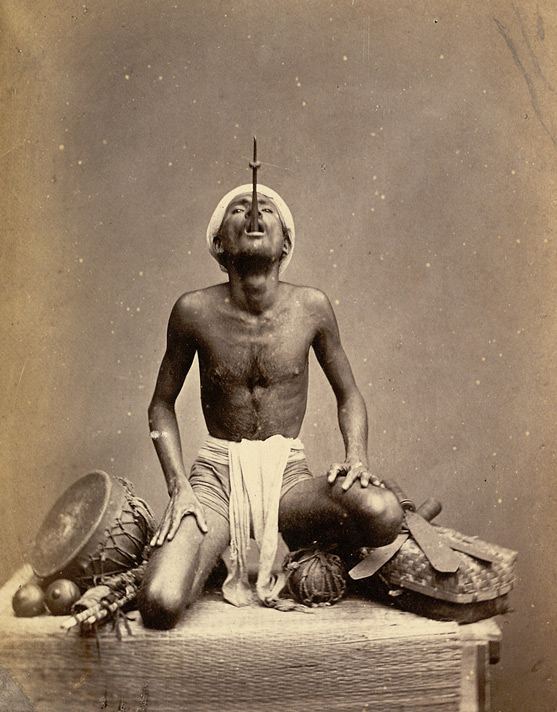
When New Yorkers paid their $1 admission price to enter St. John’s Hall swordon November 11, 1817, they were prepared to be amazed. And amazed they were, by an Indian juggler Ramo Sammee (also known as Senna Samma or Samaa because to Americans all Indian names sound alike).

What New Yorkers witnessed that day was not just another juggling act; no, Ramo stupefied the spectators by swallowing a sword. Now Indian street performers had been swallowing swords for centuries — along with climbing ropes into mid-air and staring down cobras –but this was a first for this continent. Sword swallowing in this country presented its own kind of danger as demonstrated later that month by the announcement that Ramo would be swallowing a new sword of American manufacture as “a substitute for the one lately stolen from him by some villain.”

Ramo continued to swallow that sword and others, gaining a certain fame, until his death in 1850. Live by the sword . . .

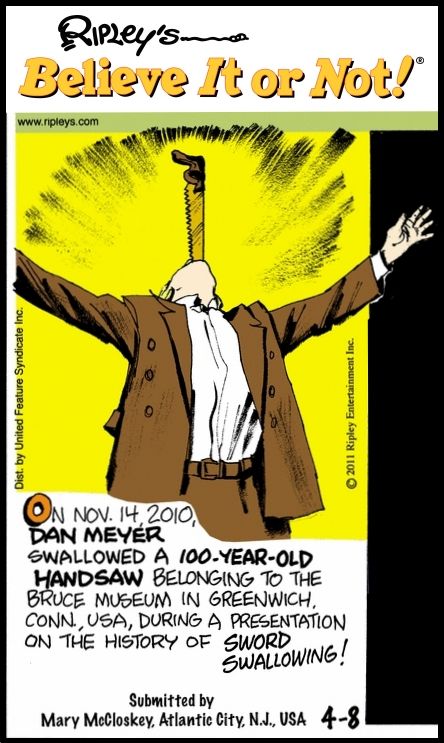
Those who followed Ramo, particularly in this country, sought to distinguish themselves with longer swords, multiple swords, hot swords, cutlasses, bayonets and even glowing neon Star-Wars swords.

The Sword Swallowers Association International (yes, there is one) reports that there are fewer than a dozen professional sword swallowers actively performing today. That led the association to create World Sword Swallowers Day (yes, there is one) “to honor and celebrate these courageous and daring performers” and to bring together dozens of amateurs and professionals for a sword swallowing extravaganza. The celebrations help raise funds for the Injured Sword Swallowers Relief Fund (yes, there are injuries).

And occasional deaths. But — mea culpa for misleading you — Ramo Sammee did not die by the sword.

November 6, 1982: Antifreeze and Old Lace

In Arsenic and Old Lace, a delightfully dark stage play adapted into a movie by Frank Capra, Mortimer Brewster (Cary Grant) has an eccentric family that includes two brothers – one of whom thinks he’s Theodore Roosevelt digging the Panama Canal in the basement, the other a killer who’s had plastic surgery to make him look like Boris Karloff – and two spinster aunts who have taken to murdering lonely old men by poisoning them with home-made elderberry wine laced with arsenic, strychnine, and “just a pinch” of cyanide. Generally, poisoners aren’t as sweet as these two old ladies.

Take the case of Shirley Allen, arrested on November 6, 1982, charged with murdering her sixth husband Lloyd. Shirley certainly wasn’t as sweet as the two old ladies, nor nearly as successful. Her first attempt at poisoning was believed to be an early husband, Joe Sinclair, back in 1968. When his coffee began to taste odd, he didn’t buy the idea that it was the newest flavor of the month, reasoning that Juan Valdez Free Trade Almond Praline Decaf should not give him internal injuries.  Joe went to the police, but no charges were filed. He filed for divorce, however.

Another husband, John Gregg, was not so lucky. He died a year after he married Shirley. He must have sensed that something was amiss because he changed the beneficiary of his insurance policy shortly before he died. Shirley got nothing. As you might guess, she was miffed. A pink-haired, large-bosomed barfly was rather happy, however.

Lloyd Allen was Shirley’s sixth husband. He began to complain of a strange taste in his beer. When Shirley said that it was an iron supplement that would put a tiger in his tank, Lloyd believed her and promptly died. This time she was named as beneficiary of a $25,000 life insurance, but alas her daughter told police about the doctored beers. Toxicology reports confirmed that Lloyd’s body tissue contained a lethal amount of ethyl glycol – antifreeze. Shirley went to prison for life. She was never allowed to work in the prison cafeteria.