MAY 24, 1626: FOR TWO GUILDERS MORE, WE’LL THROW IN QUEENS

In what is often called the greatest real estate deal ever, Peter Minuit bought Manhattan from native Americans on May 24, 1626, for goods valued at 60 guilders. Popular history identifies these goods as baubles, bangles and bright shiny beads (celebrated in song by Alexander Borodin in his String Quartet in D, routinely hummed on special Dutch occasions, since the words were not written until 1953 for the musical Kismet which in Dutch means “we could have bought the Brooklyn Bridge for a wedge of cheese had it been built.”)


The actual figure of 60 guilders was determined in the seventeenth century using a Dutch version of Generally Recognized Accounting Practices (GRAP) – known back then as Chicanery (C). In 1846, a New York historian converted this figure to dollars and came up with an amount of $24. Since then, people have regularly tried to update the $24 amount to today’s dollars. But as Edwin G. Burrows and Mike Wallace pointed out in their history of New York,”[A] variable-rate myth being a contradiction in terms, the purchase price remains forever frozen at twenty-four dollars.” Nevertheless people continue to point out what those baubles were worth in today’s dollars, euros or guilders. All the results are rather boring.


The transaction is often viewed as one-sided and beneficial to the Dutch, although some evidence suggests that Minuit actually purchased the island from a traveling beaver hide salesman who happened to be passing through and who had never heard of, let alone owned, Manhattan. At about the same time, Minuit was involved in another land purchase, that of Staten Island, for much more mundane goods such as kettles and cloth and garden tools (hence the phrase “we’ll buy Manhattan, the Bronx and Staten Island too.”)

Strangely enough, the aforementioned Brooklyn Bridge (remember that?) was opened to traffic on this very day in 1883.  And a Dutch tourist bought it for 100 guilders from a New York cabbie who claimed to be a full-blooded Manhattan Indian.


MAY 23, 1701: HERE’S LOOKING AT YOU, KIDD

William “Captain” Kidd was a Scottish sailor who was tried and executed for piracy on May 23, 1701. Some modern historians consider his reputation unjust, suggesting that Kidd acted only as a privateer, not a pirate. A pirate plundered ships; a privateer, under government authorization,  plundered ships belonging to another government. (See the difference?) Pirate or privateer, Kidd was among the most famous of his lot and one of the handful that people today can name – unusual because he was not the most successful nor the most bloodthirsty. Perhaps it’s because he did bury treasure, an important undertaking for any pirate worth his sea salt.

Several English nobles engaged Kidd to attack pirates or French vessels, sharing his earnings for their investment. He had substantial real estate holdings in New York, a wife and children, a membership in an exclusive club.   In short, he was respectable. But, foolish man, he decided to engage in one more privateering mission. Kidd set sail for Madagascar and the Indian Ocean, then a hotbed of pirate activity, but found very few pirate or French vessels to take. About a third of his crew died of diseases, and the rest were getting out of sorts for the lack of plunder. In 1697, he attacked a convoy of Indian treasure ships, an act of piracy not in his charter. Also, about this time, Kidd killed a mutinous gunner named William Moore by hitting him in the head with a heavy wooden bucket, also a no-no.

In 1698, he and his men took an Armenian ship loaded with satins, muslins, gold, and silver. When this news reached England, it confirmed Kidd’s reputation as a pirate, and naval commanders were ordered to “pursue and seize the said Kidd and his accomplices” for acts of piracy.

Pursued, seized, and hanged he was.   After his death, the belief that Kidd had left a large buried treasure contributed considerably to the growth of his legend. This belief made its contributions to literature in Edgar Allan Poe’s “The Gold-Bug”, Washington Irving’s The Devil and Tom Walker, and Robert Louis Stevenson’s Treasure Island. It also gave rise to never-ending treasure hunts in Nova Scotia, Long Island in New York, and islands off Connecticut and in the Bay of Fundy.

MAY 22, 1856: SENATORS WILL BE SENATORS

It all started in the Senate chamber in 1856 when Senator Charles Sumner, a Massachusetts Republican, addressed the Senate on the explosive issue of whether Kansas should be admitted to the Union as a slave state or a free state. Three days later on May 22 the “world’s greatest deliberative body” became a donnybrook fair.

In his speech entitled “Crime Against Kansas,” Sumner identified two Democratic senators as the principal culprits in this crime—Stephen Douglas of Illinois and Andrew Butler of South Carolina. In a little bit of overkill, Sumner called Douglas to his face a “noise-some, squat, and nameless animal . . . not a proper model for an American senator.”  Andrew Butler, who was not present at the time, received an even more elaborate characterization.  Mocking the South Carolina senator’s image as a chivalrous Southerner, the Massachusetts senator charged him with taking “a mistress . . . who, though ugly to others, is always lovely to him; though polluted in the sight of the world, is chaste in his sight—I mean,” added Sumner, “the harlot, Slavery.”

Representative Preston Brooks was a fellow South Carolinian to Butler. He read a certain amount of ridicule into the remarks, and he took great umbrage on Butler’s behalf.  In one of the Senate’s most dramatic moments ever, Brooks stormed into the chamber shortly after the Senate had adjourned for the day, where he found Sumner busily attaching his postal frank to copies of his “Crime Against Kansas” speech.

Brooks claimed that if he had believed Sumner to be a gentleman, he might have challenged him to a duel.  Instead, he chose a light cane of the type used to discipline unruly dogs. Moving quickly, Brooks slammed his metal-topped cane onto the unsuspecting Sumner’s head.   As Brooks struck again and again, Sumner rose and staggered helplessly about the chamber, futilely attempting to protect himself.  After a very long minute, it ended with Sumner lying unconscious. As Sumner was carried away, Brooks walked calmly out of the chamber without being detained by the stunned onlookers.  Overnight, both men became heroes in their home states.

Surviving a House censure resolution, Brooks resigned, was immediately reelected, and promptly died at age 37.  Sumner recovered slowly and returned to the Senate, where he remained for another 18 years. But the incident symbolized the breakdown of civility and reason in the capital and serves as a reminder to current legislators to always play nice with one another.

MAY 21, 1819: DON’T TAKE ANY WOODEN BICYCLES

     In 1819, the first bicycle in the U.S. appeared in New York City.  And it started a craze that was to overtake the city for the rest of the summer. Actually it was a sort of a bicycle. It didn’t have any pedals. And you didn’t sit on it. It did have two wheels, but no one called it a bicycle. People variably called it a “velocipede” (Latin for fast foot), “swift walker,” “hobby horse” or its most popular name “dandy horse,” referring to the dandy who usually rode it.

     The dandy horse and the craze that it caused had been imported from London, although the contraption was actually invented in Germany. It was propelled by the rider pushing along the ground with the feet as in regular walking or running. The front wheel and handlebar assembly were hinged to allow steering. One major drawback of the dandy horse was that it had to be made to measure, manufactured to conform with the height and the stride of its rider. And it had wooden wheels which were okay for the smooth pavement of the city but any other surface made for an extremely uncomfortable ride.

     The dandy horse fad was short-lived. Perhaps it was the constant ridicule or the rocks thrown by ruffians. And with riders preferring the smooth sidewalks to the rough roads, many pedestrians began to feel threatened by the machines. As a result, laws were quickly enacted prohibiting their use on sidewalks.

     It was another 40 years before velocipedes came back into fashion – equipped this time around with pedals – when a French company began to mass-produce them. The French design was sometimes called the boneshaker, since it was also made entirely of wood and was still a very uncomfortable ride.

MAY 20, 1899: LEADFOOTED IN THE BIG APPLE

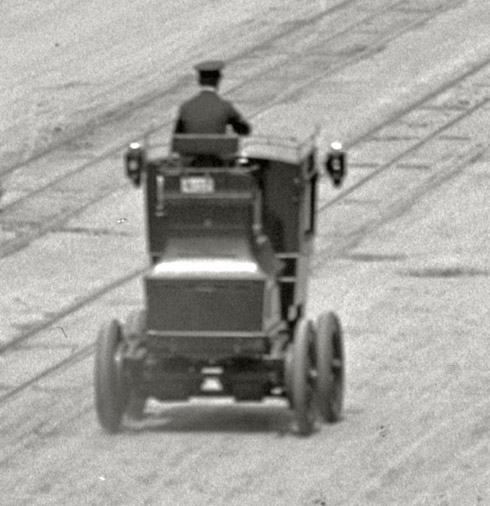
     Jacob German, a New York City taxi driver, earned the dubious distinction of being the first person to be cited for speeding in the United States when he was pulled over for barreling down Lexington Avenue in Manhattan. The scofflaw was “clocked” at a speed of 12 miles per hour by a police officer who, with persistent pedaling of his bicycle, managed to overtake him. German was imprisoned in the East 22nd Street station house. He did not have to surrender his registration and license because there were no such things in 19th century New York.

     The speed limit was claimed to be (although it was not posted) 8 mph on straights and 4 mph through turns. German was driving an electric vehicle. Records don’t indicate whether or not he was on duty or carrying a fare.

     A fair number of drivers have been issued speeding tickets since. The US Census Bureau tells us that 100,000 people per day are cited for speeding in the United States. At an average fine of $150 per ticket, that’s $15 million daily, a nice source of income for various municipalities – particularly in Ohio where the most tickets are issued (followed by Pennsylvania and New York). And certainly an award must go to tiny Summersville, WV. The town, with a population of 3,200, gave out 18,000 to 19,000 speeding tickets annually.

Texas claims the ticket for the fastest speed – 242 mph in a 75 mph zone. That driver was not pulled over by a police officer on a bicycle.

MAY 19, 1910: A COMET BY THE TAIL

It was a rough day for planet Earth back in 1910. People were nervous – no, downright scared, on the verge of panic – as if the Mayan calendar had foretold the end of world – only worse. Halley’s Comet (or Toscanelli’s Comet, if you prefer) was coming to town. The returning comet first became visible back in August of 1909, when it was a good 480 million miles away from Earth.

The chance to see a comet should be a cause for celebration, and for astronomers, it was a great opportunity. With more powerful telescopes and more advanced techniques, they were able to learn more than had ever been revealed about comets before. That was the good news. The potentially bad news was that this particular pass of the comet was going to be a close one, a frighteningly close one. As a matter of fact, the Earth would pass through the tail of the comet.

This was not particularly welcome news to a lot of folks. And even worse, scientists had discovered that a gas known as cyanogen, a deadly poison, was present in the composition of the tail, and while they assured the public that the gas would be much too diffuse to have any effect during Earth’s pass through the tail, many people still panicked and assumed the worst. It didn’t help at all when The New York Times reported that the French astronomer and author Camille Flammarion believed that the cyanogen “would impregnate the atmosphere and possibly snuff out all life on the planet.”

In a somewhat misguided attempt to allay fears, noted astronomer Sir John Herschel said that the whole comet could be squeezed into a suitcase. The New York Times stated that he was clearly talking nonsense because he had failed to state who would do the packing. “Experience teaches that mighty little can be packed in a suitcase by any man. It takes a woman to pack one properly.” The flippant article suggested that it would be better to leave the comet where it is in order for everyone to feel safer.

They didn’t. Doomsayers said that the comet would cause massive tides across the Americas as the Pacific emptied itself into the Atlantic. Charlatans sold comet pills that would supposedly protect against the effects of the poison. Churches held all night prayer vigils.

Finally, on May 19, with the world holding its collective breath, the Earth passed through the comet tail uneventfully.  And it is comforting, in hindsight, to know that the world did not come to an end in 1910.

MAY 18, 1896: MORE WOLFBANE, VAN HELSING?

What’s in a title? Had a certain Gothic horror novel been published under its original title, The Un-dead, would it have achieved legendary status, becoming the iconic depiction of the most infamous character in supernatural fiction? Or would it have remained just a good adventure story, like many others popular throughout the 1880s and 1890s, invasion literature, in which fantastic creatures threaten the British Empire?

Bram Stoker’s novel, retitled just before its May 18, 1896, release as Dracula, tells the story of the Count’s attempt to relocate from Transylvania to England, and his subsequent battle with a group of men and women led by Professor Abraham Van Helsing. Although it was not an immediate bestseller, reviewers were liberal in their praise, placing Stoker in the company of Mary Shelley and Edgar Allan Poe.  And it certainly made more of a splash than his previous work, The Duties of Clerks of Petty Sessions in Ireland.   Stoker’s and Dracula‘s status have grown steadily in the last hundred and some years, inspiring countless books, plays and movies – reaching a standing that even the Twilight series was unable to kill. Over 200 films have featured Dracula in a major role, a number second only to Sherlock Holmes. Arguably the classic portrayal remains the one by Bela Lugosi in 1931.

Bela Lugosi, Frank Langella, Christopher Lee

What manner of man is this, or what manner of creature is it in the semblance of man?

When the Count saw my face, his eyes blazed with a sort of demonaic fury, and he suddenly made a grab at my throat.

My revenge has just begun! I spread it over centuries and time is on my side.

For one who has not lived even a single lifetime, you’re a wise man, Van Helsing (from the movie).

Listen to them. Children of the night. What music they make.

May 17, 1620: Round and Round She Goes

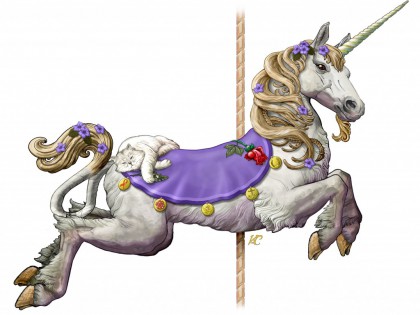
An English traveler happened upon an unusual contraption while passing through what is present-day Bulgaria on May 17, 1620. It was a circular device with seats attached to its perimeter. Children were tethered to the seats and the whole device turned round and round. The Englishman approached the device hoping to save these poor tykes. But as he drew near he heard their squealing and laughter. They were not being punished; they were being entertained. The Englishman’s account of this marvelous contraption is the earliest reference to what ultimately became known as the carousel — or merry go-round to those who disdain the French.

Carousels became popular throughout Europe a century later and in the United States a bit later. These carousels featured carved horses and other fanciful animals — zebras, lions, tigers, unicrons, dragons. At first they were powered by animals or people then eventually by steam engines and finally electricity. Gears and cranks gave the animals their familiar up and down motion.

Today the carousel is mostly favored by those too young or too timid to brave the more heart-pounding rides such as roller coaster, tilt-a-whirl, and loop-the-loop.

Carousels Not Heart-Pounding?

MAY 16, 1988: ONE MAN’S TRASH

trashcan

In 1984, the Laguna Beach Police Department learned from unnamed sources that one Billy Greenwood had a little home-based business selling illegal drugs. An investigator asked the neighborhood’s regular trash collector to turn over to police the plastic garbage bags he collected from the front of Greenwood’s house. In the garbage, the investigator found tell-tale signs of drug use. Using that information, police obtained a warrant to search Greenwood’s home. Lo and behold, when officers searched the house, they found cocaine and marijuana along with dirty dishes and other signs of poor housekeeping. Greenwood was promptly arrested.


California courts ruled that searching the trash was a no-no under both federal and state law. The matter found its way to the U.S. Supreme Court.  On May 16, 1988, the Court reversed lower courts and ruled by a 6–2 vote that no warrant was necessary to search the trash because Greenwood had no reasonable expectation of privacy having put it right out on the curb like that.  No matter that he had put the trash in opaque plastic bags whose contents could not be seen without opening and that he expected it to be on the street only a short time before being taken to the dump.  The Court said it was “common knowledge” that garbage at the side of the street is “readily accessible to animals, children, scavengers, snoops, and other members of the public,” none of whom might have search warrants. Not only that, Greenwood had left the trash there expressly so that the trash collector, a perfect stranger, could take it, and do with it as he pleased.


In dissent, Justice Brennan reasoned that the possibility the police or other “unwelcome meddlers” might rummage through the trash bags “does not negate the expectation of privacy in their contents any more than the possibility of a burglary negates an expectation of privacy in the home.”  Under existing law, the bags could not have been searched without a warrant if Greenwood had been carrying them around in public. Merely leaving them on the curb for the garbage man to collect, Brennan argued, should not be found to remove that expectation of privacy any more than leaving an unattended bag in an airport terminal would. “Scrutiny of another’s trash is contrary to commonly accepted notions of civilized behavior.”


And one person’s trash is another person’s treasure.

MAY 15, 1482: TOSCANELLI’S COMET

Paolo Toscanelli, born in 1397, was your typical Italian Renaissance Man, dabbling in everything from astronomy to mathematics to philosophy to cartography. He rubbed elbows (and influenced) the likes of Leonardo da Vinci and Christopher Columbus. In fact, that fickle finger of fate could have just as easily pointed at Paolo instead of Columbus.

As we all know, Christopher Columbus as a boy used to sit on the docks in Genoa watching ships slowly disappear over the horizon. While all the other boys sitting on the docks attributed this phenomenon to the ships falling off the edge of the world, Christopher determined that ships were gradually disappearing because the world was actually round. A fairy tale, of course. Columbus knew the world was round because Paolo Toscanelli told him it was round. Toscanelli even gave Columbus a map (a flat map admittedly) that showed Asia to the left on the other side of the Atlantic. Neither of them had reckoned on that other continent lying in-between. Yet Columbus got an October holiday and a city in Ohio while Toscanelli got squat.

Another near miss for Paolo was his observation of a comet in 1456. Although Paolo was the first to identify it, it remained known only as the Comet of 1456 until 300 years later when English astronomer Edmond Halley predicted its 1759 return and got naming rights.

Paolo died on May 15, 1482, ten years before Columbus sailed the ocean blue and some 350 years before “Halley’s” Comet did an encore.

Over the Rainbow

She threw her arms around the Lion’s neck and kissed him, patting his big head tenderly. Then she kissed the Tin Woodman, who was weeping in a way most dangerous to his joints. But she hugged the soft, stuffed body of the Scarecrow in her arms instead of kissing his painted face, and found she was crying herself at this sorrowful parting from her loving comrades.

Glinda the Good stepped down from her ruby throne to give the little girl a good-bye kiss, and Dorothy thanked her for all the kindness she had shown to her friends and herself.

Dorothy now took Toto up solemnly in her arms, and having said one last good-bye she clapped the heels of her shoes together three times saying, “Take me home to Aunt Em!

Lyman Frank Baum, born in Chittenango, New York, on May 15, 1856 (died 1919), was best known for writing The Wonderful Wizard of Oz, although he wrote a total of 55 novels, 83 short stories, over 200 poems, and made many attempts to bring his works to the stage and screen.

In 1897, after several abortive early careers, Baum wrote and published Mother Goose in Prose, a collection of Mother Goose rhymes written as prose stories, and illustrated by Maxfield Parrish. The book was a moderate success, allowing Baum to quit his door-to-door sales job and devote time to his writing. In 1899, Baum partnered with illustrator W. W. Denslow, to publish Father Goose, His Book, a collection of nonsense poetry. The book was a success, becoming the best-selling children’s book of the year. Then in 1900, the duo published The Wonderful Wizard of Oz to critical acclaim and financial success.   The book was the best-selling children’s book for two years after its initial publication.

Oz was a popular destination long before the famous 1939 screen version of the book.  A  musical  based closely upon the book,  the first to use the shortened title “The Wizard of Oz”, opened in Chicago in 1902, then ran on Broadway for 293 performances.   Baum went on to write another 13 Oz novels.

Baum’s intention with the Oz books, and other fairy tales, was to tell American tales in much the same manner as the Brothers Grimm and Hans Christian Andersen , modernizing them and removing the excess violence.  He is often credited with the beginning of the sanitization of children’s stories, although his stories do include eye removals, maimings of all kinds and an occasional decapitation.

Most of the books outside the Oz series were written under pseudonyms. Baum was variously known as Edith Van Dyne, Laura Bancroft, Floyd Akers, Suzanne Metcalf, Schuyler Staunton, John Estes Cooke, and Capt. Hugh Fitzgerald.

Baum wrote two newspaper editorials about Native Americans that have tarnished his legacy because of his assertion that the safety of white settlers depended on the wholesale genocide of American Indians. Some scholars take them at face value, others suggest they were satire. Decide for yourself.

The Pioneer has before declared that our only safety depends upon the total extermination of the Indians. Having wronged them for centuries we had better, in order to protect our civilization, follow it up by one more wrong and wipe these untamed and untamable creatures from the face of the earth. In this lies safety for our settlers and the soldiers who are under incompetent commands. Otherwise, we may expect future years to be as full of trouble with the redskins as those have been in the past.