

Those Peruvians must have thought the world was coming to an end  when the volcano blew its top in 1600 (February 19). In Europe, they were certain the end was near quite a few years earlier. In fact, in 1524 you couldn’t swing a virgin without hitting a prophet of doom. They all pretty much agreed that 1524 was curtains and that a Noah-like deluge would be responsible, thanks to a conjunction of major planets in Pisces (the water sign) — Mercury, Venus, Mars, Jupiter and Saturn, being the culprits along with the sun.
As far back as 1499, astrologer Johannes Stoeffler had identified the exact day of the giant flood as February 20, 1524. His authority on the matter was such that more than a hundred pamphlets were written and published on his prediction.
George Tannstetter, of the University of Vienna, was one of the few astrologers who disagreed with the other Cassandras. Drawing up his own horoscope, he discovered that he would live well beyond 1524, and therefore the world would keep on turning. He was pretty much dismissed as a village idiot and ignored.
In response to the many dire predictions, worried Europeans set about building boats. Arks were everywhere. One over-achieving would-be Noah, a German Count von Iggleheim, built himself a three-story ark, no doubt with some grand purpose in mind. When, on February 20, the predicted rain sputtered into a brief, inconsequential shower, the mobs awaiting the deluge grew restless, then piqued, and finally they ran amok, stoning the Count to death in the process. For the Count and a few hundred others killed in the melee, it was the end of the world (just as it was for those Peruvians who thought it would be entertaining to watch the volcano explode).
Stoeffler, who somehow escaped the angry mobs, went back to the drawing board and came up with a new doomsday date in 1528. His perseverance, however, did not set afloat any more arks.
Maybe not the End of the World, But Certainly the End of His Cornfield
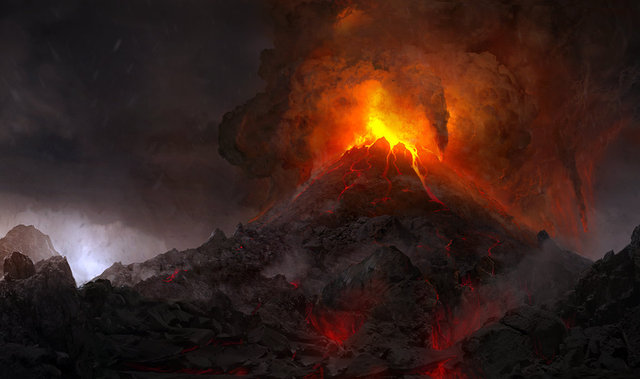
For weeks the folks living in a small village 200 miles west of Mexico City had been hearing thunder when there wasn’t a cloud in the sky. Then on the afternoon of February 20, 1943, Dionisio Pulido, a farmer who was tending to his cornfield, heard an unfamiliar hissing sound. There was also an unusual smell, like that of rotten eggs. As he stood there, a lump appeared in the ground nearby. It got steadily bigger, swelling to become a dome some seven feet across and seven feet high. A fine gray dust was rising from a fissure in the dome, and the hissing had become loud and continuous.
The dome continued to grow rapidly. By nightfall it was spewing flames a half a mile high, bursting and falling back toward the ground like a fireworks display. Dionisio and hs family escaped the spewing volcano as it began its 9 years of activity, erupting until 1952. When its temper tantrum was over, it had left a cone 1,391 feet high, destroyed an area of 90 square miles, and completely buried two towns.
The volcano, known as Paricutin, is now dormant, and the area has become a major tourist attraction with hordes of hikers scaling the dome in search of grilled corn.



 Wretched Richard's Almanac