

On this day in 1925 in the forward-looking State of Tennessee, it became a crime for a teacher in any public school or college to teach any theory that contradicted the Bible’s account of man’s creation. Wouldn’t you know it, within two months, a Dayton, Tennessee, high school science teacher and trouble-maker, John T. Scopes went right on ahead and taught his students that man descended from a lower order of animals, monkeys no less. This was, of course, the infamous theory of evolution.
Scopes was indicted, and later convicted, in what became known as the Monkey Trial. The trial, broadcast on radio, gained national attention, and brought together two of the biggest names in the nation, William Jennings Bryan for the prosecution and Clarence Darrow for the defense. Bryan chastised evolutionists for teaching children that humans were but one of precisely 35,000 species of mammals and that human beings were descended “not even from American monkeys, but from old world monkeys.” Darrow volunteered his services to the defense because he “realized there was no limit to the mischief that might be accomplished unless the country was aroused to the evil at hand.”
Scopes was fined $100, but the verdict was later overturned. Darrow called the case “the first of its kind since we stopped trying people for witchcraft.” This was almost a hundred years ago. Thank goodness we’ve gained a lot of insight since then.
My Kingdom for a Bic
Pedro I a 14th century king of Castile was one of the first monarchs who could write, and he had very nice penmanship. That didn’t prevent him from being stuck with the moniker Pedro the Cruel for various transgressions, real and imagined. His greatest sin seems to have been his hatred for the monks, a hatred which was returned in kind. When Pedro died by the dagger of his illegitimate brother on March 23, 1369, his place in history was left to those monks who could also write. And they proved that their pens were mightier than his scepter. Good penmanship can only take one so far.
The Game Show That Wouldn’t Die
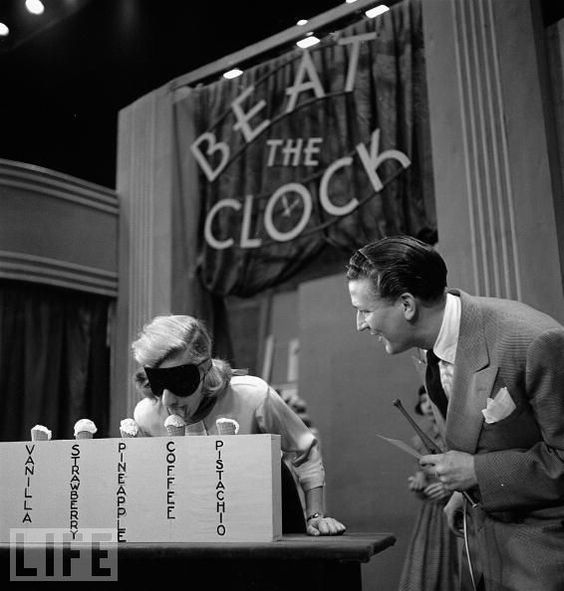 Beat the Clock made its CBS debut on March 23, 1950, hosted by Bud Collyer. It ran until 1961. It rose from the dead in 1969 as The New Beat the Clock, running until 1974. It reappeared in 1979 as The All-New Beat the Clock, and later as All-New All-Star Beat the Clock.
To win, contestants had to “solve problems” within a certain time limit which was counted down on a madly-ticking giant clock. If they succeeded, they “beat the clock”; if they didn’t, “the clock beat them.” And they died.


 Wretched Richard's Almanac