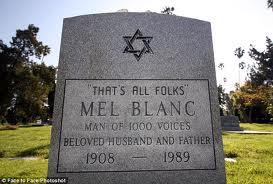
MAY 30, 1908: THAT’S ALL FOLKS

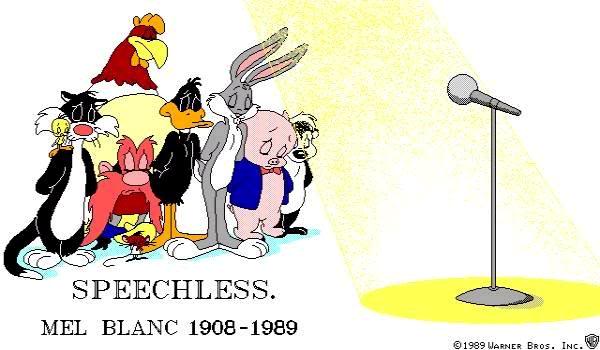
Although Mel Blanc, “the Man of a Thousand Voices,” is most often remembered as the voice of Bugs Bunny, Porky Pig, Daffy Duck, Woody Woodpecker, Tweety Bird, Sylvester, Yosemite Sam, Speedy Gonzales, Foghorn Leghorn, Pepé Le Pew, the Tasmanian Devil and many of the other characters from theatrical cartoons and Hanna-Barbera’s television cartoons, he had a long career as a comedian and character actor in radio and television. He was born on May 30, 1908, and died in 1989.

Blanc was a regular on The Jack Benny Program in various roles, and appeared on many other shows (Fibber McGee and Molly, Great Gildersleeve, Abbott and Costello, Burns and Allen), including his own which ran from September 1946 to June 1947. In the Jack Benny radio show he was Carmichael, the irascible polar bear who guarded the comedian’s underground vault; his outspoken parrot; his violin teacher, Monsieur Le Blanc; his Mexican gardener, Sy; and even his Maxwell automobile.

Blanc was easily the most prolific voice actor in the history of the industry and the first to be identified in the ending credits. In his 60-year career, he helped develop nearly 400 characters and provided voices for some 3,000 animated cartoons. During the cartoon heydays of the 1940’s and 50’s, he voiced 90 percent of the Warner Brothers cartoon empire. As movie critic Leonard Maltin said, “It is astounding to realize that Tweety Bird and Yosemite Sam are the same man!”

A gem from The Jack Benny Program:

MAY 12, 1812: POETRY WITHOUT NAUGHTY WORDS

Edward Lear, born in England in 1812, was a true dabbler — artist, illustrator, musician, author, poet. Starting off his career as an illustrator, he was employed to illustrate birds and animals first for the Zoological Society and then for Edward Stanley, the Earl of Derby, who had a private menagerie. He also made drawings during his journeys that later illustrated his travel books. and illustrations for the poetry of Alfred Lord Tennyson. As a musician, Lear played the accordion, flute, guitar, and piano (not simultaneously). He also composed music for a number of Romantic and Victorian poems, most notably those of Tennyson.

Lear is remembered chiefly for his work as a writer of literary nonsense. He might easily have been given the title Father of the Limerick for bringing the much maligned form into popularity (without the raunchiness that later found its way into the form). In 1846, he published A Book of Nonsense, a volume of limericks that went through three editions. In 1871 he published Nonsense Songs, Stories, Botany and Alphabets, which included his most famous nonsense song, The Owl and the Pussycat, which he wrote for the children of the Earl of Derby.

Lear’s nonsense books were successful during his lifetime, but he found himself fighting rumors that he was just a pseudonym and that the books were actually written by the Earl of Derby. Conspiracy theorists cited as evidence the facts that both men were named Edward, and that Lear is an anagram of Earl. A few even suggested he was born in Kenya, not England.

The Owl and the Pussy-cat went to sea
In a beautiful pea green boat,
They took some honey, and plenty of money,
Wrapped up in a five pound note.
The Owl looked up to the stars above,
And sang to a small guitar,
‘O lovely Pussy! O Pussy my love,
What a beautiful Pussy you are,
You are,
You are!
What a beautiful Pussy you are!’

Pussy said to the Owl, ‘You elegant fowl!
How charmingly sweet you sing!
O let us be married! too long we have tarried:
But what shall we do for a ring?’
They sailed away, for a year and a day,
To the land where the Bong-tree grows
And there in a wood a Piggy-wig stood
With a ring at the end of his nose,
His nose,
His nose,
With a ring at the end of his nose.

‘Dear pig, are you willing to sell for one shilling
Your ring?’ Said the Piggy, ‘I will.’
So they took it away, and were married next day
By the Turkey who lives on the hill.
They dined on mince, and slices of quince,
Which they ate with a runcible spoon;
And hand in hand, on the edge of the sand,
They danced by the light of the moon,
The moon,
The moon,
They danced by the light of the moon.

Naughty Words Without Poetry

Stand-up comedian, social critic, satirist, actor, writer/author George Carlin was born on May 12, 1937 (died 2008). Noted for his black humor as well as his thoughts on politics, the English language, psychology, religion, and various taboo subjects, he won five Grammy Awards for his comedy albums. Carlin and his classic “Seven Dirty Words” comedy routine were central to the 1978 U.S. Supreme Court case in which the justices affirmed the government’s power to regulate indecent material on the public airwaves.

In his own words:

george

Swimming is not a sport. Swimming is a way to keep from drowning. That’s just common sense!

Honesty may be the best policy, but it’s important to remember that apparently, by elimination, dishonesty is the second-best policy.

george-carlin2

The very existence of flamethrowers proves that sometime, somewhere, someone said to themselves, “You know, I want to set those people over there on fire, but I’m just not close enough to get the job done.”

Religion has convinced people that there’s an invisible man…living in the sky, who watches everything you do every minute of every day. And the invisible man has a list of ten specific things he doesn’t want you to do. And if you do any of these things, he will send you to a special place, of burning and fire and smoke and torture and anguish for you to live forever, and suffer and burn and scream until the end of time. But he loves you. He loves you and he needs money.
April 20, 1935: Splish Splash, Snooky Was Taking a Bath

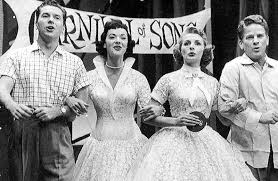
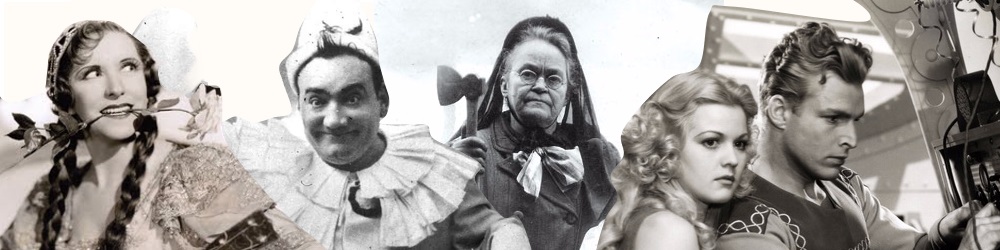
A music staple of the 40s and 50s, Your Hit Parade, made its radio debut on April 20, 1935. It lasted for nearly 25 years before being done in by rock and roll music – and perhaps Snooky Lanson. It began as a 60-minute program with 15 songs played in a random format, and eventually moved to television where the seven top-rated songs of the week were presented each week in elaborate production numbers requiring constant set and costume changes.  The list of top songs was compiled through a closely guarded top secret algorithm that involved record sales, quarters plunked into jukeboxes, shoplifted sheet music and the divination of an unidentified mystic in Memphis, Tennessee.

Dorothy Collins , Russell Arms, Snooky Lanson and Gisèle MacKenzie were top-billed during the show’s peak years. And Lucky Strike cigarettes starred throughout its run.

As the rock and roll era took over, the program’s chief fascination became seeing a singer like Snooky Lanson struggle with songs like Splish Splash and Hound Dog.

Would Snooky Make a Good Macbeth

Although Shakespeare’s Macbeth was written in 1606, the first record of a performance was at the Globe Theater on April 20, 1611, although chances are there were  a few out-of-town tryouts earlier.  Shakespeare’s tragedy is one of the most performed and one of the shortest.  It has in its 413-year history made a lot of contributions to the English culture and picked up some interesting baggage.  One of the most noted of the latter is the Macbeth curse: speaking the name of the play in the theater is inviting a grim reckoning.  It is always referred to as “the Scottish play.”  No one knows exactly why there is a curse, but it has been suggested that the witches’ spells used in the play were real. They were taken from a book on demonology written by King James I, either to suck up to the king or to poke fun at his belief in witchcraft. Were some unfortunate to slip up and utter the word Macbeth, he or she must immediately leave the room, turn around three times, spit, say Donald Trump, then beg to be re-admitted.

“Double, double, toil and trouble, fire burn and cauldron bubble.”  No, Snooky would make a better witch.

February 3, 1882: You’re a Big One, Aren’t Ya

A rather large sales transaction took place on February 3, 1882: Flamboyant showman and circus entrepreneur P.T. Barnum purchased his largest performer, a single-named star who stood ten feet at the shoulders, Jumbo. Jumbo of course was an elephant, a very big elephant. He was born in the Sudan and took a rather circuitous journey north to Germany, France and finally England and the London Zoo, where he resided for 17 years, becoming famous for giving rides to zoo visitors.

Londoners were not happy about the sale. The Zoological Society was up in arms. 100,000 schoolchildren petitioned Queen Victoria to halt the sale. A lawsuit was filed against the zoo. The zoo attempted to renege on the sale, but the court sided with Barnum.

The deal was a bonanza for Barnum. He exhibited Jumbo to huge crowds at Madison Square Garden, recovering the entire cost of his investment in three weeks. With Jumbo as its main attraction, the circus earned $1.75 million for the season.

Jumbo’s circus career would be short-lived, however. In 1885, he was struck by a train and died within minutes.

What’s in a Name

While jumbo as an adjective is used today to describe everything from CDs to shrimp, the word did not have that meaning when the London zookeeper association gave it to the big fellow. Its derivation could be Indian from jambu (pronouced jumboo) a tree that grows on a mythical island whose fruits were said to be as big as elephants or Swahili from jambo (hello) or jumbe (chief). It is safe to say it has no relation to jambalaya or gumbo.

Never Forget Elephants

Although Jumbo is arguably the most famous elephant, there are many, many others who might be in the running — circus elephants, movie elephants, rescue elephants, war elephants, zoo elephants, pet elephants (Charlemagne, Pope Leo X and Henry III all had one), gift elephants (Ronald Reagan and Jimmy Carter both received one),  and very naughty elephants.  Here’s a portrait gallery from which you may choose your own favorites.

From the top: Tusko (world’s meanest elephant), Babar, Thomas Nast’s GOP, Horton, Dumbo.

He-e-e-y Abbott

Radio’s Kate Smith Hour was a mainstay during the 30s and 40s. On February 3, 1938, the comedy duo of Bud Abbott and Lou Costello made their first radio outing on the program and became regular performers. They first performed their classic “Who’s on First?” the following month.

abbott-costelloThe former vaudevillians quickly became major stars in radio, followed by movies and television. They left the Kate Smith show after two years to star in their own radio program, as well as a Broadway revue, The Streets of Paris, and their first film, One Night in the Tropics, in which, although cast in supporting roles, they stole the show with several classic comedy routines and cemented their film careers.

Universal Pictures signed them to a long-term contract. Their second film, Buck Privates, made them box-office stars and in the process saved Universal from bankruptcy. In most of their films, the plot was not much more than a framework that allowed them to reintroduce comedy routines they had first performed on stage. Universal also added glitzy production numbers to capitalize on the popularity of musical films, featuring such performers as the Andrews Sisters, Ella Fitzgerald, Martha Raye, Dick Powell and Ted Lewis and his Orchestra. The Andrews Sisters hits “Boogie Woogie Bugle Boy” and “I’ll Be With You In Apple Blossom Time” were both introduced in Buck Privates.

During the following years, Abbott and Costello “met” many other movie legends – Frankenstein, Dracula, the Wolf Man, the Invisible Man, Captain Kidd, Dr. Jekyll and Mr. Hyde, the Mummy, the Killer (Boris Karloff).  And they traveled throughout the world (and beyond): in a Harem, in the Foreign Legion, Lost in Alaska, Mexican Hayride, Mars, and Africa Screams, which featured both Clyde Beatty and Frank Buck as themselves. They made a total of 36 films.

On television, they frequently hosted the Colgate Comedy Hour and had their own syndicated television program.


They dissolved their partnership in 1957, with Lou making sporadic appearances until his death in 1959.  Bud died in 1974.

January 23, 1919: Nothing in Moderation

He got his first job in television by showing up for an audition wearing apercydovetonsils barrel and shorts. From there his career took off during a ten-year period that carried him from obscurity to stardom, the ride getting steadily wilder and crazier. Although someone else held the title Mr. Television, Ernie Kovacs, born on January 23, 1919, certainly left his imprint on the medium, influencing such shows to come as Saturday Night Live, Sesame Street, Laugh-In, Captain Kangaroo, and the Today Show.

Often referred to as television’s surrealist, the cigar-smoking, poker-playing Hungarian-American comedian could be counted on for the unusual if not the bizarre in any of his many television outings.

One of his first shows, Three to Get Ready, was the first regularly scheduled early morning (7 a.m.) show in a major market, proving that people would watch TV at this unlikely hour. Although the program was billed as news and weather, Kovacs presented it in his own style. If rain was in the weather forecast, Kovacs would get on a ladder and pour water down on the person reading the report. He auditioned goats for a local theater performance, visited a downtown Philadelphia restaurant in a gorilla suit, wrestled a jaguar, and discovered a man who had come through the earth from China to emerge from a construction pit. The program ran for two years before being preempted by a network early morning offering, The Today Show.

Other shows included It’s Time for Ernie, his first network series; Ernie in Kovacsland, a summer replacement for Kukla, Fran and Ollie; and The Ernie Kovacs Show, featuring characters such as poet Percy Dovetonsils, bumbling magician Matzoh Heppelwhite, Frenchman Pierre Ragout, and the Nairobi Trio. He also hosted the Tonight Show twice a week and had a short stint as a celebrity panelist on What’s My Line?, where he strove more for humor than insight. (When Henry J. Kaiser, the founder of the automobile company, was the program’s mystery guest, and the panel had established that the mystery guest’s name was synonymous with an automobile brand, Kovacs asked, “Are you – and this is just a wild guess – but are you Abraham Lincoln?”

A movie career followed his move to California in 1957 with character roles in such films as Operation Mad Ball; Bell, Book and Candle; Wake Me When It’s Over; Sail a Crooked Ship; and Our Man in Havana.

Kovacs was at the peak of his career when he was killed in a late-night automobile accident on his way home from one of the many parties that had become part of his life in California. The inscription on his tombstone reads “Ernie Kovacs 1919 – 1962 — Nothing In Moderation.”


Ale, Ale, the Taster’s Here

It is noted in a dusty record book in the bowels of Oxford University that on January 23, 1617, a certain John Shurle was appointed to the position of ale taster for the university. Now we have your attention. Where can I get myself such an appointment, you’re thinking. Back in the 1600s in England you could easily have got yourself such an appointment; there were many ale-tasting positions throughout the country. Today not so easy; there are only four ale tasters in all of England.

The position of ale taster (also referred to variously as ale conner, ale kenner or ale founder) has been around for a good 700 years. The incumbent of the office was required to visit breweries on the days of their brewing to examine beer and ale (and bread as well) to make certain they were good and wholesome and fairly priced. Each brewery was to pay for this service with a gallon of strong ale and two gallons of beer.

You would have thought this would be a position folks fought for, but in reality it wasn’t that popular. The taste was not uniformly pleasant; bad batches were frequent. The ale taster was often required to fine brewers for irregularities and was therefore not the most popular person around.

And some ale tasters didn’t actually taste the stuff. They tested it by sitting in a puddle of it and judging its quality by how sticky it was when they stood up.

January 18, 970: The Mice That Roared

On an island in the Rhine River near the German village of Bingen am Rhein, there’s a structure known as Mäuseturm, the Mouse Tower.  The tower was first erected by the Romans, and in 968 it was restored by Hatto II, the Archbishop of Mainz.  It has, if you choose to believe it, a curious history which features the untimely death of the Archbishop on January 18, 970.

Hatto was not one of Germany’s nicer guys. Aided by archers and crossbowmen, he used his tower to extract “tolls” from passing ships, all in all a lucrative sideline to his religious duties. He also filled his barns with grain in anticipation of a future rainy day which soon came in the form of a famine. The nearby peasants ran out of food and you know who was ready to sell it to them at prices they could not afford. Naturally, the peasants were not a happy lot, and Hatto got wind of a possible rebellion. Hatto assembled the peasants at his castle and promised to feed them.  He sent the hungry but now happy peasants to an empty barn to wait for the food he would bring.  But when Hatto and his servants arrived at the barn, they were not armed with food. Hatto ordered the barn doors locked, and immediately set the barn on fire. Hearing the screams from inside, Hatto was said to have remarked: “Hear the mice squeak!”

Hatto’s amusement was short-lived. When he returned to his castle, he was set upon by thousands of mice. With the mice in pursuit, Hatto fled the castle and crossed the river to his tower, in hopes that the mice would drown if they followed. They didn’t. They swarmed the island, gnawed their way through the tower door, and — well, as a poet described it:

They have whetted their teeth against the stones,
And now they pick the bishop’s bones;
They gnawed the flesh from every limb,
For they were sent to punish him!

The Kid’s Got Talent?

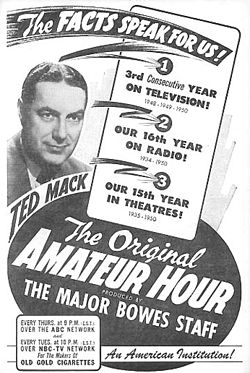
As the program began, the spinning of a wheel would determine the contestants’ order of appearance. As the wheel spun, Ted Mack would chant the magic words: “Round and round she goes, and where she stops nobody knows.” It was January 18, 1948, and The Original Amateur Hour, episode number one, was on the air. And each week, we would be informed how many episodes had aired. The final broadcast in 1970 was number 1,651.

Ted Mack brought the Amateur Hour to television from radio where it amateurhourhad been a fixture for over a decade under the command of Major Edward Bowes. Mack’s television version was one of only six shows to appear on all four major TV networks – ABC, CBS, NBC, and DuMont. (the others were The Arthur Murray Party; Down You Go; The Ernie Kovacs Show; Pantomime Quiz; and Tom Corbett, Space Cadet).

Contestants were often singers and other musicians, although acts included jugglers, tap dancers, baton twirlers, and such. The television audience voted for their favorites by postcard or by calling JUdson 6-7000. Winners returned for another appearance, and three-time winners became eligible for the annual championship and the chance to win a $2000 scholarship.

During 22 years on television, you might guess that the program would discover a throng of celebrities, but you’d be wrong. Gladys Knight, Ann-Margret, Irene Cara, and Tanya Tucker were a few of the handful of future stars. Pat Boone was a winner, but his appearances caused a bit of a tempest in a TV pot. After his winning appearances, it was discovered that he had appeared on the rival program Arthur Godfrey’s Talent Scouts, and was therefore not an “amateur” singer. Boone was booted from the program, but his fame was already a given, and within a few years he was hosting his own variety show The Pat Boone Chevy Showroom (Ted Mack was never a guest).

Elvis Presley, on the other hand, was turned down for the show.

APRIL 21, 1986: SEEMS LIKE WE STRUCK OUT

Notorious gangster Al Capone moved to Chicago in 1919 where he built a career in gambling, alcohol, and prostitution rackets, eventually becoming Chicago’s go-to guy in the world of crime. He oversaw his various enterprises from a suite at the Lexington Hotel until his arrest in 1931.  He died in 1947.

The Lexington Hotel outlasted Capone by a good many years. In the 1980s, a construction Al-Capone-psd53402company undertook a renovation of the historic hotel. While surveying the building, the company made some unusual discoveries, including a shooting range and an elaborate series of hidden tunnels connecting to taverns and brothels and providing escape routes should the Chicago police get frisky and raid Capone’s headquarters. Most intriguing of all was a secret vault beneath the hotel, where rumor had it, Capone hid vast sums of his ill-gotten gains.

These discoveries were just too tempting for “investigative reporter” Geraldo Rivera to let pass by.  So on April 21, 1986, Geraldo planned to open the vault on live TV in a much ballyhooed special, The Mystery of Al Capone’s Vaults. What would the two-hour media event reveal? Piles of plunder? Bodies of Capone competitors? Jimmy Hoffa? Judge Crater? Among those who stood by Geraldo as the whole world watched were a medical examiner and agents of the Internal Revenue Service, lending the entire undertaking an aura of grim importance.

The vault was opened, and there . . . ? A lot of dirt and a couple of empty bottles. Geraldo did his best to snatch something out of the rubble, suggesting to 30 million disappointed viewers that the bottles were exciting because they had been used for bathtub gin during Prohibition. A nice try, but he summed up the evening by saying: “Seems like we struck out.”

April 20, 1935: Splish Splash, Snooky Was Taking a Bath

A music staple of the 40s and 50s, Your Hit Parade, made its radio debut on April 20, 1935. It lasted for nearly 25 years before being done in by rock and roll music – and perhaps Snooky Lanson. It began as a 60-minute program with 15 songs played in a random format, and eventually moved to television where the seven top-rated songs of the week were presented each week in elaborate production numbers requiring constant set and costume changes.  The list of top songs was compiled through a closely guarded top secret algorithm that involved record sales, quarters plunked into jukeboxes, shoplifted sheet music and the divination of an unidentified mystic in Memphis, Tennessee.

Dorothy Collins , Russell Arms, Snooky Lanson and Gisèle MacKenzie were top-billed during the show’s peak years. And Lucky Strike cigarettes starred throughout its run.

As the rock and roll era took over, the program’s chief fascination became seeing a singer like Snooky Lanson struggle with songs like Splish Splash and Hound Dog.

December 31, 1920: Don’t Go Near the Indians

New Year’s Eve, aka the seventh day of Christmas, is the day we shuck off this year with a lot of over the top partying, letting mirth run rampant before we face the sobering of the coming year. Two of the more noble New Year’s Eve traditions are Drinking and the making of Resolutions. The former is often accomplished with Wassail, a bowl of spiced ale around which folks gather and drink to each other’s health until someone gets sick.  The latter is the solemn promise we make to the empty Wassail bowl never to drink again. Mark Twain on resolutions: “Next week you can begin paving hell with them as usual. Yesterday, everybody smoked his last cigar, took his last drink, and swore his last oath. Today, we are a pious and exemplary community. Thirty days from now, we shall have cast our reformation to the winds and gone to cutting our ancient short comings considerably shorter than ever. We shall also reflect pleasantly upon how we did the same old thing last year about this time.” ~Mark Twain

A proper resolution might go something like this: I hereby resolve to read Wretched Richard’s Almanac every day so that I might be well informed, sophisticated and attractive. And I will recommend it to all my friends so they too might be well informed, sophisticated and attractive.

The seventh ghost of Christmas enjoyed his wassail while regaling Scrooge with the painful memory of his Junior Prom when the girl of his dreams broke their date because her grandmother died, she had a hangnail or she was grounded for misbehaving with the captain of the football team — take your pick.  True Love celebrated in his or her predictable fashion with a gifts of the avian persuasion, to be specific seven swans a-swimming.  That’s a bird count of 28 thus far.  No, make the 27; one of the calling birds made the mistake of calling the cat.

About Those Indians

It was 1949 and executives at Republic Pictures had a brainstorm – let’s take that nice clean-cut guy hanging around the studio and make him a cowboy – maybe even a singing cowboy – he’ll be a God-fearing American hero of the Wild West, wearing a white Stetson hat; he’ll love his faithful horse (platonic, of course); and maybe he could have a loyal sidekick who shares his adventures. We’ll call him the Arizona Cowboy (Arizona isn’t already taken, is it?) And so Rex Allen, born December 31, 1920, came to a silver screen near you,  joining such singing cowboys as Roy Rogers and Gene Autry. His horse was Koko, and his comic relief sidekick was Buddy Ebsen (later Slim Pickens). He rode out of the West just as the West was losing interest for moviegoers. He did get a quick 19 movies in the can (and a comic book) before the genre played out. And in 1954, he starred in Hollywood’s last singing western. Then, like other cowboy stars, he rode into the sunset and onto TV in a series called Frontier Doctor. Allen had written and recorded a number of the songs featured in his movies. He continued recording, and in 1961, had a hot country single with a song called “Don’t Go Near The Indians,” featuring the Merry Melody Singers. The song told the story of a young man who disobeys his father’s titular advice and develops a relationship (platonic, of course) with a beautiful Indian maiden named Nova Lee. The father reveals a deep dark secret out of the past: his biological son was killed by an Indian during one of those skirmishes between the white man and a nearby tribe. In retaliation, he kidnapped an Indian baby and raised him as his son who grew up to be you-know-who. And there’s another jaw-dropping secret: Nova Lee is the boy’s biological sister! (But poppa, it’s purely platonic; our kids won’t be imbeciles.) They don’t write them like that anymore. Rex Allen turned in his spurs in 1999 at the age of 79.  

December 26, 1921: Hi Ho, Stevarino

But first, hi ho second day of Christmas, because that is today to those who prolong the season through Christmastide.  For True Love, it is the opportunity to give two birds, turtle doves to be precise.  And just as practical as that partridge.

Meanwhile Scrooge is visited by the second ghost of Christmas who conducts a review of the many less than loving names his mother called soon-to-be-born Ebeneezer while in labor.

Hi Ho, Stevarino

Although Steve Allen, born December 26, 1921, was a musician, composer, actor, comedian, and writer, he is best known for his career in television. He first gained national attention as a guest host on Arthur Godfrey’s Talent Scouts and then became the first host of The Tonight Show, initiating the format that television talk shows would follow from then on.

Moving from late night to prime time television, he hosted numerous game and variety shows, most notably The Steve Allen Show, going head to head with Ed Sullivan and Maverick on Sunday evenings. It was there he developed the man on the street interviews which featured Don Knotts, Tom Poston and Louis Nye among others.

Allen was a comedy writer and author of more than 50 books, both fiction and nonfiction, including Dumbth, a commentary on the American educational system, and Steve Allen on the Bible, Religion, and Morality.

Allen was also a pianist and a prolific composer, writing over 14,000 songs, some of which were recorded by Perry Como, Margaret Whiting, Steve Lawrence, Eydie Gorme, Les Brown, and Oscar Peterson. He won a Grammy in 1963 for best jazz composition, with his song The Gravy Waltz. He also wrote lyrics for the standards “Picnic” and “South Rampart Street Parade.” He once won a bet with Frankie Laine that he could write 50 songs a day for a week. His output of songs has never been equaled.

He died in 2000.