AUGUST 2, 1922: YOUR CALL IS IMPORTANT TO US

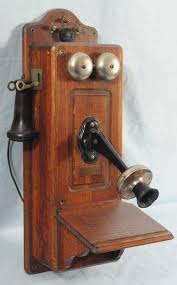
phone1Alexander Graham Bell was one of those curious inventive sort of kids, the kind that love to experiment and blow up the garage with their chemistry set when they’re eight. Although he was normally quiet (except for the explosions), he loved mimicry and ventriloquism, throwing his voice here and there to baffle guests and leave his family carrying on conversations with the dog and the cat and plants.

     Troubled by his mother’s near deafness, he developed a technique of speaking directly into her forehead instead of her ears which for some reason enabled her to hear him. That evidently awakened a dream within him: If he could speak to his mother’s forehead and she could hear, he must be able to speak to a forehead in China or some other faraway place and be heard.

     This of course led to his study of acoustics, and his greatest invention. By 1876, he had developed a theory of forehead to forehead long distance transmission, and just days after receiving a patent, Bell succeeded in getting his invention to work.  He held the device to his forehead and spoke the now famous sentence: “Mr Watson – Come here – I want to see you.” In an adjoining room, Watson, listening at the receiving end (he held it to his ear but probably never told Bell), heard the words clearly.  He shouted to Bell the equally famous words: “Not now.  I’m on the phone.”

Oddly enough, Bell considered his most famous invention an annoyance and refused to have a telephone in his study.

     Bell died on August 2, 1922 before he could invent many improvements to his telephone, leaving it for others to come up with such refinements as the busy signal, call waiting, “Do you have Prince Albert in a can?”, cell phones and smart phones, obnoxious ringtones during concerts, and robocalls from Wayne LaPierre.   As another famous inventor put it: “What hath God wrought?”


March 10, 1876: It’s a Telephone, My Dear Watson

Who would have thought back on March 10, 1876, that in a hundred or so years practically every other human on the face of the earth would have a phone pressed against the side of his or her head at any given moment. Certainly not Alexander Graham Bell, as he was in the process of making the very first phone call. It wasn’t much of a call, certainly not long distance. Bell called his assistant Thomas A. Watson who was in the next room. The phones they used weren’t much to behold; they looked more like tin cans connected by a long string than today’s sleek models. But nevertheless they made history.

The moment of truth in Bell’s own words: “I then shouted . . . the following sentence: Mr. Watson come here — I want to see you. To my delight he came and declared that he had heard and understood what I said.”

Enter the quibblers. Why didn’t Watson answer Bell using that brand new telephone, they ask. And if Bell shouted his words and Watson were in the very next room, he’d very likely hear them without the phone, they suggest.

Watson’s diary says Bell’s words were actually “Mr. Watson, come here, I want you. ” a minor difference but just chock full of innuendo, they say, eyebrows raised. And some even suggest that the incident is all fabrication, that Bell actually stole the idea for the telephone from another inventor, Elisha Gray.

History does not record Bell’s disappointment when he tried to duplicate the experiment and was put on hold.

The Milkman Cometh

New Mexico State University’s first ever graduation was to have taken place on this date in milkman1893 but was abruptly canceled when Sam Steel, the lone graduating senior, was shot and killed while delivering milk the day before graduation.

Said the local paper: “The hearts of the whole community were stricken with sadness when it was learned that Samuel Steel, the most brilliant student of our College, had been foully and wil(l)fully murdered on Thursday evening, March 9th. We do not consider it in place to refer to the details of this ghastly deed, which are known to most of our readers; we only feel assured that it was perpetrated in sheer cold-bloodedness, and, knowing the victim as well as we have done, without the slightest provocation.”

Knowing what we do today about the reputation of milkmen, one might speculate that there could have been a slight provocation.

March 10, 1876: It’s a Telephone, My Dear Watson

Who would have thought back on March 10, 1876, that in a hundred or so years practically every other human on the face of the earth would have a phone pressed against the side of his or her head at any given moment. Certainly not Alexander Graham Bell, as he was in the process of making the very first phone call. It wasn’t much of a call, certainly not long distance. Bell called his assistant Thomas A. Watson who was in the next room. The phones they used weren’t much to behold; they looked more like tin cans connected by a long string than today’s sleek models. But nevertheless they made history.

The moment of truth in Bell’s own words: “I then shouted . . . the following sentence: Mr. Watson come here — I want to see you. To my delight he came and declared that he had heard and understood what I said.”

Enter the quibblers. Why didn’t Watson answer Bell using that brand new telephone, they ask. And if Bell shouted his words and Watson were in the very next room, he’d very likely hear them without the phone, they suggest.

Watson’s diary says Bell’s words were actually “Mr. Watson, come here, I want you. ” a minor difference but just chock full of innuendo, they say, eyebrows raised. And some even suggest that the incident is all fabrication, that Bell actually stole the idea for the telephone from another inventor, Elisha Gray.

History does not record Bell’s disappointment when he tried to duplicate the experiment and was put on hold.

The Milkman Cometh

New Mexico State University’s first ever graduation was to have taken place on this date in milkman1893 but was abruptly canceled when Sam Steel, the lone graduating senior, was shot and killed while delivering milk the day before graduation.

Said the local paper: “The hearts of the whole community were stricken with sadness when it was learned that Samuel Steel, the most brilliant student of our College, had been foully and wil(l)fully murdered on Thursday evening, March 9th. We do not consider it in place to refer to the details of this ghastly deed, which are known to most of our readers; we only feel assured that it was perpetrated in sheer cold-bloodedness, and, knowing the victim as well as we have done, without the slightest provocation.”

Knowing what we do today about the reputation of milkmen, one might speculate that there could have been a slight provocation.

OCTOBER 11, 1983: DON’T YANK THE CRANK

The title refers to a movement that took place in Maine back in 1981. Movement is probably a pretty strong word for laid-back Maine where crankdemonstrators tend not to get worked up into a chanting frenzy over things. And even less so in a sleepy little town like Woodstock whose population squeaked by 1,200 a couple of years ago.

Bryant Pond is Woodstock’s largest settlement and as much of an urban center as you’re likely to find. It captured its fifteen minutes of national fame and media attention during the mid1970s when its family-owned Bryant Pond Telephone Company became the last telephone exchange in the United States to use hand-cranked phones. Then in 1981, the two-position magneto switchboard in the living room of the owners was purchased by the Oxford County Telephone & Telegraph Company, a larger company in the Maine neighborhood. The Bryant Pond Telephone Company was swallowed like so many krill off the shores of Maine.

Two Bryant Pond residents started the “Don’t Yank The Crank” movement to save their crank telephones, financed by the sale of tee shirts – a valiant effort but nonetheless futile. At a meeting in the local school gymnasium warmed by a wood stove, townsfolk spoke out. “We have the oldest pay station in the United States,” said one resident, either complaining or bragging. “You put in a nickel and wind it up.” “You are a person instead of a number.” And did they mention no robocalls?

Alas, to no avail. The last “crank calls” took place on October 11, 1983, and the beloved telephones slipped into history like so much Americana.

Just Put Your Lips Together

Harry “Steve” Morgan and his alcoholic sidekick, Eddie, are a couple of ne’er-do-wells crewing a boat for hire on the island of Martinique. to_have_and_have_not_1944_film_posterLife is okay, but World War II is happening all around them, doing a number on the tourist trade and thus their livelihood. Howard Hawks’ film To Have and Have Not which premiered in New York on October 11, 1944, was notable for bringing together what would become one of Hollywood’s hottest couples, Humphrey Bogart and Lauren Bacall.

The film takes the title from the book by Ernest Hemingway but not much else. Hawks was a Hemingway fan but thought this particular book was a “bunch of junk.” Even so, Hemingway worked with Hawks on the screenplay, in which Bogart once again gives up his professed neutrality in the war to thwart the Nazis. The plot is well thickened by the stormy relationship between Bogart and Bacall who plays Slim, a saucy singer in the club where Morgan drinks away his days.

Another notable member of the cast is Hoagy Charmichael who appears as the club piano player, Cricket. He and Bacall perform several Charmichael songs: “How Little We Know,” “Hong Kong Blues,” and “The Rhumba Jumps.” Bacall does her own singing, even though persistent rumors would have a 14-year-old Andy Williams singing for her.

The most memorable take away from the film is one line of dialogue delivered seductively by Bacall: “You know how to whistle, don’t you, Steve? You just put your lips together and . . . blow . . .”

AUGUST 2, 1922: YOUR CALL IS IMPORTANT TO US

phone1Alexander Graham Bell was one of those curious inventive sort of kids, the kind that love to experiment and blow up the garage with their chemistry set when they’re eight. Although he was normally quiet (except for the explosions), he loved mimicry and ventriloquism, throwing his voice here and there to baffle guests and leave his family carrying on conversations with the dog and the cat and plants.

     Troubled by his mother’s near deafness, he developed a technique of speaking directly into her forehead instead of her ears which for some reason enabled her to hear him. That evidently awakened a dream within him: If he could speak to his mother’s forehead and she could hear, he must be able to speak to a forehead in China or some other faraway place and be heard.

     This of course led to his study of acoustics, and his greatest invention. By 1876, he had developed a theory of forehead to forehead long distance transmission, and just days after receiving a patent, Bell succeeded in getting his invention to work.  He held the device to his forehead and spoke the now famous sentence: “Mr Watson – Come here – I want to see you.” In an adjoining room, Watson, listening at the receiving end (he held it to his ear but probably never told Bell), heard the words clearly.  He shouted to Bell the equally famous words: “Not now.  I’m on the phone.”

Oddly enough, Bell considered his most famous invention an annoyance and refused to have a telephone in his study.

     Bell died on August 2, 1922 before he could invent many improvements to his telephone, leaving it for others to come up with such refinements as the busy signal, call waiting, “Do you have Prince Albert in a can?”, cell phones and smart phones, obnoxious ringtones during concerts, and robocalls from Wayne LaPierre.   As another famous inventor put it: “What hath God wrought?”