
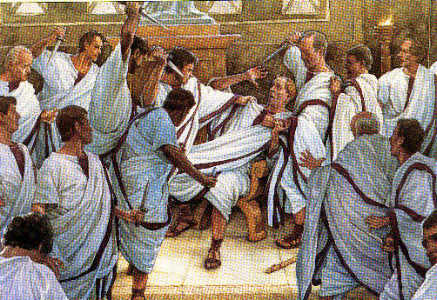
March 15, 44 BC: I Only Have Ides for You

Beware. Today is the ides of March, a day once enthusiastically celebrated among the common people with picnics, drinking, and revelry. In the ancient Roman calendar, each of the 12 months had an ides (from the Latin to divide). In March, May, July and October, the ides fell on the 15th day. In all other months, the ides fell on the 13th.  There is a reason for this, but the logic declined and fell with Rome, and the ides lost their original intent and purpose and eventually came to mean the day that a bunch of guys are going to stick knives into you.

This was thanks to Shakespeare,  Julius Caesar, and Caesar’s pals Brutus et al.  In Act I, Scene 2, of Shakespeare’s history, the old soothsayer utters these words, dripping with foreboding: “Beware the Ides of March.” Pretty straightforward, but does Caesar pay attention? Of course not. And on March 15, 44 BC, aided by his friends, he buys the forum, so to speak, exiting stage left halfway through the play even though it bears his name.

Despite an occasional pretentious allusion to the Ides of March and the popular song, today’s calendar is pretty much ideless (as ideless as a painted ship upon a painted ocean, to slip in a quick pretentious allusion).


February 24, 1942: The Bombs Bursting in Air

It had been less than three months since the Japanese attack on Pearl Harbor brought the United States into World War II, and tensions were running high.  And then on the evening of February 24, 1942, in Los Angeles, it appeared that we were being attacked once again.  The United States Navy responded with an anti-aircraft artillery barrage.  The resulting brouhaha lasted through the night with 1,400 shells fired until the Secretary of the Navy announced the end of the air raid.  He also admitted that the entire incident had been a false alarm, a case of “war nerves.”

The attacking force, it seems, was an errant weather balloon, and “once the firing started, imagination created all kinds of targets in the sky and everyone joined in.”  The incident was later derisively dubbed the “Battle of Los Angeles” or the “Great Los Angeles Air Raid.”

A Midsummer Night’s Prayer Meeting

“The Family Shakespeare — in which nothing is added to the original text,censored-shakespeare but those words and expressions are omitted which cannot with propriety be read aloud in a family. My great objects in this undertaking are to remove from the writings of Shakespeare some defects which diminish their value.”

Thus read an introduction for the 1807 edition of Shakespeare’s works, finally made suitable for general audiences by Thomas Bowdler some 200 years after the Bard was safely buried. Certainly Shakespeare, were he alive, could not have objected to having the defects which diminished their value removed from his works. Shakespeare and family values — together at last.

Bowdler undertook this project, along with his sister Henrietta, thanks to childhood memories in which his father had entertained his family with readings from Shakespeare. Only later as an adult did Bowdler realize that his father had been leaving out some of the naughty parts of the plays, anything he felt unsuitable for the ears of his wife and children. Realizing that not all fathers were clever enough to censor on the spot, Bowdler decided it would be worthwhile to publish an edition which came already sanitized.

Shakespeare no doubt would have thanked Thomas Bowdler who joined him in the hereafter on February 24, 1827.


JANUARY 5: Twelfth Day, Twelfth Night

Here we are — the last day of Christmas, number twelve, the big climax.  And what a thundering climax for True Love.  We already have milking maids, dancing ladies, leaping lords, piping pipers and all those birds.  And now twelve drummers drumming, furiously wielding those drumsticks on snare drums, bass drums, tomtoms, steel drums, bongos even.  For Scrooge, it’s an anticlimax; the twelfth ghost of Christmas made it clear that Scrooge was not off the hook, that he would be seeing more ghosts come Valentines.  Scrooge was nevertheless relieved.  He went to his window and called down to a passing boy “What day is it?” “It’s night, you old fool. Twelfth night.” “What a clever boy.  Does the poulterer still have that great big turkey?” “How should I know?” “Quick, run and see and fetch it for me.” “It’ll cost you.” “What a lad.”  The boy returned a few minutes later.  “The turkey’s gone, so I brought you something else instead.”  “What my boy?” “There’s seven swans a-swimming, six geese a-laying, five . . .”

Night Falls

Twelfth Night is a celebration.  Traditionally, once everyone is pleasantly plastered, they all head out into the fields where they toast oxen and trees and rocks until they get cold and decide to go back inside only to find that they’ve been locked out and will not be admitted until they sing a few songs. Those that don’t sing freeze to death. Everybody else goes back inside where they divide up a cake that someone has baked a bean into. Whoever gets the bean gets to be King or Queen of the Bean and boss everyone around.

Then they watch a little Shakspeare, a play coincidentally called Twelfth Night or Whatever.  In it, Viola and Sebastian, twins, have been shipwrecked, and each thinks the other has drowned. Viola disguises herself as a man, Cesario, and goes to work as a servant for the Duke, Orsino.

Orsino loves Olivia, but she’s mourning her dead brother and has no time for Orsino. He sends Cesario (Viola)  to woo Olivia on his behalf. But Olivia falls in love with Cesario who is really Viola.  Viola (Cesario) meanwhile has fallen in love with Orsino  So at halftime, Viola loves Orsino, Orsino loves Olivia and Olivia loves Cesario who is Viola.

Sebastian (remember him?) returns.  He meets Olivia. She thinks he’s Cesario and asks him to marry her, and he says okay.  So at the homestretch, we have Olivia and Sebastion and Cesario and — well, let’s just say they all live happily ever after.  Especially the revelers who have all passed out.

And the twelve drummers finally stop drumming.

March 15, 44 BC: I Only Have Ides for You

Beware. Today is the ides of March, a day once enthusiastically celebrated among the common people with picnics, drinking, and revelry. In the ancient Roman calendar, each of the 12 months had an ides (from the Latin to divide). In March, May, July and October, the ides fell on the 15th day. In all other months, the ides fell on the 13th.  There is a reason for this, but the logic declined and fell with Rome, and the ides lost their original intent and purpose and eventually came to mean the day that a bunch of guys are going to stick knives into you.

This was thanks to Shakespeare,  Julius Caesar, and Caesar’s pals Brutus et al.  In Act I, Scene 2, of Shakespeare’s history, the old soothsayer utters these words, dripping with foreboding: “Beware the Ides of March.” Pretty straightforward, but does Caesar pay attention? Of course not. And on March 15, 44 BC, aided by his friends, he buys the forum, so to speak, exiting stage left halfway through the play even though it bears his name.

Despite an occasional pretentious allusion to the Ides of March and the popular song, today’s calendar is pretty much ideless (as ideless as a painted ship upon a painted ocean, to slip in a quick pretentious allusion).

 

Wretched Richard’s Little Literary Lessons – No. 2

al·lu·sion

əˈlo͞oZHən/

noun

As a literary device, an allusion is an expression designed to call something to mind without mentioning it explicitly; an indirect or passing reference to another person, event, work etc.

For example:

“That’s a rather abrupt and indifferent exit. Feel guilty?”

“I’m not sure. You don’t approve?”

“Well, I suppose it’s better than ‘I’m running off to hook up with Lolita for a few days. I’ll be back when I’m tuckered out. I hope you don’t mind.”

“Lolita? You’re hardly a nymphet.”

“I beg your pardon,” Huey huffed. “Would you care to elaborate on that point?”

“A nymphet is fourteen or fifteen years old, tops.”

“Maybe I’m only fifteen.”

“You also pointed out that you weren’t trying to seduce me.”

“Maybe I was lying. And maybe I’m no Lolita – as hot as I am – but you most definitely fit the part of Humbert Humbert, you old fart. Just remember you’re here of your own free will. You can’t claim I forced you to come along.”

“I won’t if you won’t,” said Paul.

Not forcing anyone to come along, just inviting: Voodoo Love Song