APRIL 18, 1968: IF YOU BELIEVE THIS, I’VE GOT A BRIDGE . . .

Famous real estate deals abound — the sale of Manhattan for beads, the Louisiana Purchase, Seward’s Folly. One of the more unusual is the April 18, 1968, sale of London Bridge for a mere $1 million (of course, as any schoolchild knows, the thing was falling down). American oil sphinx_magnate Robert McCullough was the buyer and he bought it as a large conversation piece for his Arizona real estate development in an out-of-the-way spot that had previously only been an inspiration for Roadrunner cartoons.  The bridge was disassembled in London, each piece numbered, then hauled to Lake Havasu City, Arizona, where it was reassembled.

McCullough had wanted to buy the Brooklyn Bridge for his project, but it had already been sold. Many times, actually. One George Parker had made his living selling the bridge to oil magnates and other naive visitors to New York, some of whom actually tried to erect toll booths.

The relocation of London Bridge inspired, in addition to a great deal of laughter, a forgettable 1985 made-for-television movie Bridge Across Time (aka Arizona Ripper or Terror at London Bridge) in which several murders are committed in Lake Havasu by the spirit of Jack the Ripper, whose soul is transported to the United States in one of the stones of the bridge (sorry you missed it, aren’t you).

Although the Sphinx may have been more architecturally appropriate to the location, McCullough wasn’t interested. “Something about the nose,” he said.

Legumes in Love

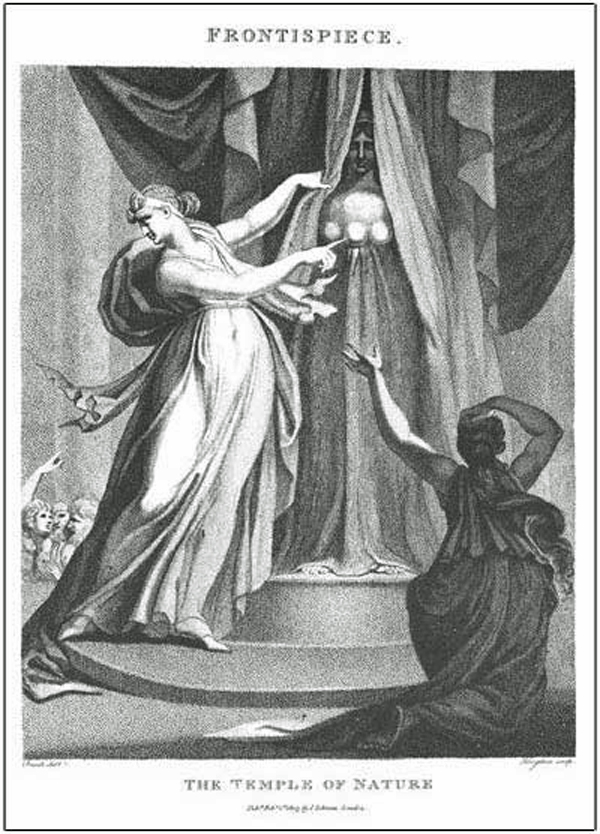
British poet and physician Erasmus Darwin died on April 18, 1802.  As a physician graduated from Cambridge, he didn’t really distinguish himself. When he is remembered at all, it is for his poetry, and one particular poem, The Loves of the Plants, part of a larger work called The Botanic Garden (the other part being The Economy of Vegetation), in which the physiology and classification of the vegetable world is presented in a rather lofty and lyrical manner. Although the subject was mundane and the technical accuracy questionable, the poetic frenzy reached amazing heights. Had Erasmus Darwin’s grandson Charles presented his discoveries in a more poetic fashion, perhaps they would have been more warmly received.


November 24, 1859: Insulting Monkeys

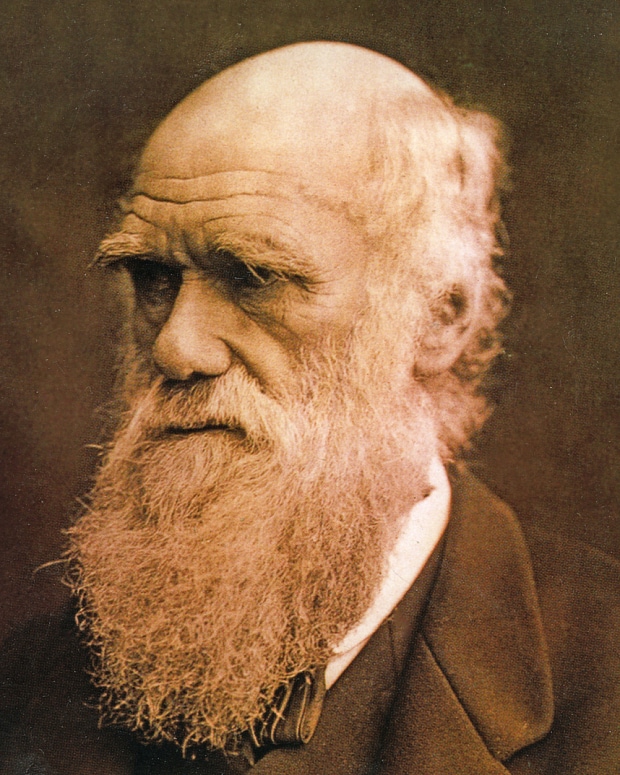
Charles Darwin was not expecting a seismic event when on November 24, 1859, he introduced a little volume with the catchy title On the Origin of Species. Although it didn’t go viral at the time, the printing run of 1,250 copies did sell out.  A few more have sold since then.

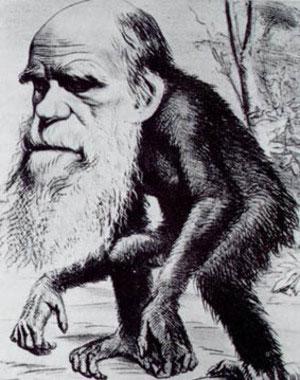
In his book, Darwin suggested that all species of life have descended over time from common ancestors.  That sounds a lot like a plug for family values, but weren’t people upset anyway.  Although Darwin’s only allusion to human evolution was a cryptic “light will be thrown on the origin of man and his history,” the title of his book might just as well have been Men from Monkeys because that’s what detractors brought away from it.  And any attempt on the part of scientists to explain that it’s not about that pretty much put people to sleep.  Even though enlightenment eventually crept into the scientific community, to many others Darwin became forever the symbol of runaway science.  Were he alive today, he’d probably be conspiring with the 99 percent of scientists involved in the vast climate change hoax.

What is Man? Man is a noisome bacillus whom Our Heavenly Father created because he was disappointed in the monkey. ― Mark Twain

New Rule: Stop asking Miss USA contestants if they believe in evolution. It’s not their field. It’s like asking Stephen Hawking if he believes in hair scrunchies. Here’s what they know about: spray tans, fake boobs and baton twirling. Here’s what they don’t know about: everything else. If I cared about the uninformed opinions of some ditsy beauty queen, I’d join the Tea Party. ― Bill Maher

It is even harder for the average ape to believe that he has descended from man. ― H.L. Mencken

Organic life, we are told, has developed gradually from the protozoan to the philosopher, and this development, we are assured, is indubitably an advance. Unfortunately it is the philosopher, not the protozoan, who gives us this assurance. ― Bertrand Russell

OCTOBER 18, 1963: SPACE, THE FELINE FRONTIER

The story of cats in space is a dramatic tale indeed. It begins in an unlikely place with the 1957 Soviet launch of Sputnik 2, carrying of all felicettethings a dog named Laika. Laika was a stray found on the streets of Moscow who could have been the star of a dandy rags-to-riches shaggy dog story, except that things didn’t go all that well and the pooch perished under mysterious circumstances.

This was viewed as an early skirmish in the superpower space race to which NASA responded by sending a chimp into space and successfully returning him.

The French meanwhile had been plotting their own animal space probe. Fifteen cats had been chosen to undergo extensive training involving centrifuges, compression chambers and other medieval torture devices for a space mission in which the French would prove that they belonged at the table with the big guys and a cat would demonstrate to its fanciers everywhere that cats were superior to dogs in yet another way.

A pretty black and white Parisian chatte was eventually selected for the mission, because she was the only one who hadn’t become overweight during training, something to do with croissants most likely. On October 18, 1963, at 8:09 am, Chatte Félicette boarded a Véronique AGI 47 rocket at a base in the Algerian Sahara Desert and was blasted 97 miles into space. Fifteen minutes later, she parachuted safely to earth and pussycat immortality. Voilà!

SEPTEMBER 26, 1849: DROOLING FOR SCIENTIFIC PROGRESS

There’s a certain something that makes the scientific mind differ from the ordinary mind.

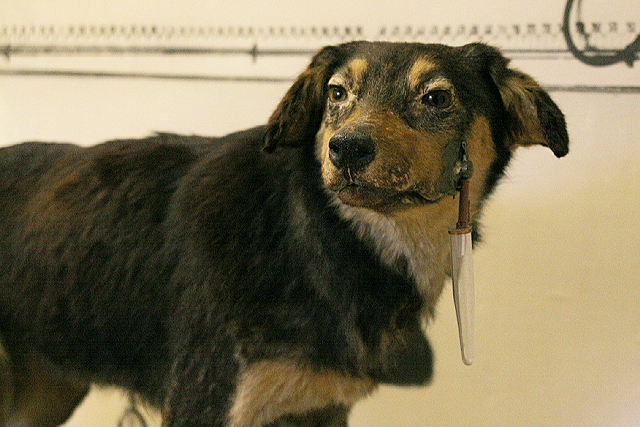
An example: We are in the habit of walking into our dog’s room (it’s a hypothetical room, okay?) at cocktail time and feeding Rover (becausepavlov he looks like a Rover, okay?) (and he’s hypothetical too). This makes Rover quite happy. One day we walk in, drinking our cocktail but forgetting Rover’s food. No, he doesn’t bite us (an angry look, maybe). But he salivates even though there’s no food. What do we do? We beat Rover, clean up his drool, drink our cocktail, and get on with our lives.

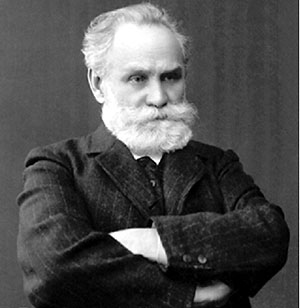
But a scientist? He’d stare at that saliva, ponder it, apply a little scientific method and possibly come up with a bunch of new scientific ideas. Ivan Pavlov, born on September 26, 1849, did just that. He saw his Rover drool, and he developed a major branch of learning called classical (or Pavlovian) conditioning with theories and laws and all sorts of scientific accoutrements. This in turn led to concepts such as comparative psychology, behavior modification and Brave New World.

Ever the scientist, even on his death bed, Pavlov engaged a student to sit with him and take notes as he died. He did not salivate. We don’t know if the student did.

I’ll be with you in apple blossom time

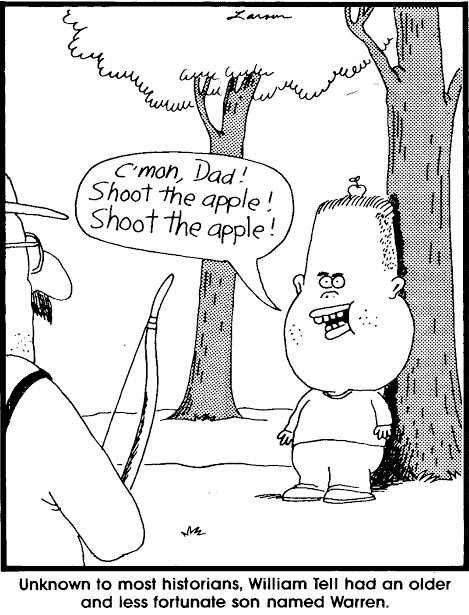
The animated 1948 film Melody Time, from Walt Disney Studios features a 19-minute segment with Dennis Day as an apple farmer who sees others going west, wishing he was not tied down by his johnny-appleseedorchard, until an angel appears, singing a happy apple song, setting him on a mission. When he treats a skunk kindly, all animals everywhere thereafter trust him. The cartoon features lively tunes, and a simplistic message of goodness, and probably helped to cement the image of Johnny Appleseed firmly in American lore.

John Chapman, the flesh and blood Johnny Appleseed, was born in Massachusetts on September 26, 1774.   At the age of 18, he persuaded his 11-year-old half-brother Nathaniel to go west with him to live the lives of carefree nomadic wanderers – rolling stones gathering no moss. Eventually Nathaniel grew up and quit the rambling around to gather moss and help his father farm. Johnny didn’t.

Johnny embarked on a career as an orchardist, apprenticing to a man who had apple orchards. Eventually, he returned to roaming, and the popular accounts have him spreading apple seeds randomly, everywhere he went. He actually planted nurseries, built fences around them, left the nurseries in the care of a neighbor who sold trees on shares, and returned every year or two to tend the nursery.

And Johnny Appleseed was against grafting. Therefore his apples were of a sour variety and used primarily for hard cider and apple jack. “What Johnny Appleseed was doing and the reason he was welcome in every cabin in Ohio and Indiana was he was bringing the gift of alcohol to the frontier. He was our American Dionysus.”

Johnny also spread the Swedenborgian word of God, preaching as he traveled. The Swedenborgian movement was a popular new religion of the time promoting repentance, reformation, and regeneration of one’s life.   Johnny would tell stories to children and lay the gospel on adults, receiving a floor to sleep on and supper in return.  Said one of his converts: “We can hear him read now, just as he did that summer day, when we were busy quilting upstairs, and he lay near the door, his voice rising denunciatory and thrillin’—strong and loud as the roar of wind and waves, then soft and soothing as the balmy airs that quivered the morning-glory leaves about his gray beard.”

And a wee bit of apple jack didn’t hurt either.


September 16, 1732: How Hot Is It?

Some people find their true calling early on in life, some take a good part of their lives to find it and fahrothers never find it.  A young man named Gabriel who lived in Danzig around the turn of the 18th century took some time to find his calling. Starting out as a merchant, Gabriel found himself ill-suited as an entrepreneur; every business he touched failed.

     Stand-up comedy didn’t work so well either. If anyone were foolish enough to rise to the bait of Gabriel’s opening remarks about how hot it had been with the question “How hot is it?” they didn’t even get the mediocre chuckle of “It’s so hot that my chickens are laying hard-boiled eggs” or “It’s so hot that even Mitt Romney seems cool.” Gabriel might answer, “On a scale of 32 to 212, I’d give it a 92.” Yawn.

     But hidden in his failure as a comedian was success of a sort – he had actually constructed the device that measured the temperature of which he joked. Up until that time all measurements of temperature were as vague as “hot as a basted turkey” or “cold as a Republican’s heart.” Many a scientist – including Isaac Newton – had tried to develop a means of measuring the temperature. Gabriel had done it – and had found his calling.

     At first, he made his temperature measuring devices using wine-filled tubes, but he couldn’t achieve any degree of accuracy and someone was always drinking the contents of his thermometer. Switching to mercury solved both problems. He marked the tube at the point where the mercury stood when the tube was placed in freezing water and again at the point it reached in boiling water. The freezing point became 32 degrees (his lucky number, perhaps). He then divided the space between that and the boiling point into 180 parts (something to do with half a circle). It was just mysterious enough that it caught on, and it became oh so trendy to measure the temperature of things.

     His thermometer took his name, and would from then on be known as the Gabriel. Well it might have been, but his agent insisted that his last name, Fahrenheit, was much more scientific sounding. Even after Gabriel Fahrenheit’s death on September 16, 1736, the Fahrenheit Thermometer remained the standard by which temperature was measured, used by everyone except some guy from Stockholm named Celsius.

A Harvard Medical School study has determined that rectal thermometers are still the best way to tell a baby’s temperature. Plus, it really teaches the baby who’s boss. — Tina Fey

Since we Americans are no longer allowed to travel to Europe, the Almanac, as a public service, will bring Europe to you. This will be accomplished through the magic of occasional postcards from Europe and other faraway places with strange sounding names. You’re welcome.

MAY 15, 1482: TOSCANELLI’S COMET

Paolo Toscanelli, born in 1397, was your typical Italian Renaissance Man, dabbling in everything from astronomy to mathematics to philosophy to cartography. He rubbed elbows (and influenced) the likes of Leonardo da Vinci and Christopher Columbus. In fact, that fickle finger of fate could have just as easily pointed at Paolo instead of Columbus.

As we all know, Christopher Columbus as a boy used to sit on the docks in Genoa watching ships slowly disappear over the horizon. While all the other boys sitting on the docks attributed this phenomenon to the ships falling off the edge of the world, Christopher determined that ships were gradually disappearing because the world was actually round. A fairy tale, of course. Columbus knew the world was round because Paolo Toscanelli told him it was round. Toscanelli even gave Columbus a map (a flat map admittedly) that showed Asia to the left on the other side of the Atlantic. Neither of them had reckoned on that other continent lying in-between. Yet Columbus got an October holiday and a city in Ohio while Toscanelli got squat.

Another near miss for Paolo was his observation of a comet in 1456. Although Paolo was the first to identify it, it remained known only as the Comet of 1456 until 300 years later when English astronomer Edmond Halley predicted its 1759 return and got naming rights.

Paolo died on May 15, 1482, ten years before Columbus sailed the ocean blue and some 350 years before “Halley’s” Comet did an encore.

Over the Rainbow
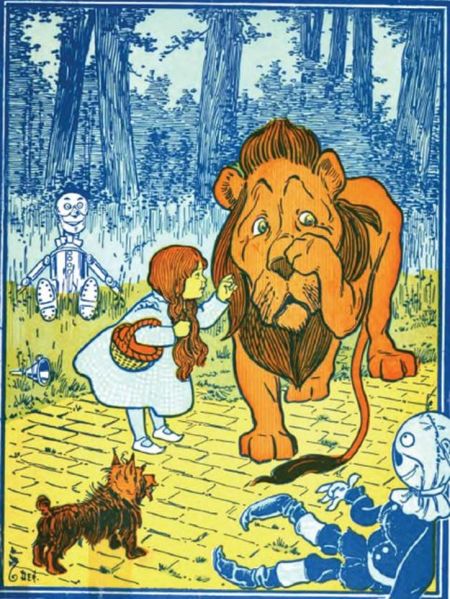
She threw her arms around the Lion’s neck and kissed him, patting his big head tenderly. Then she kissed the Tin Woodman, who was weeping in a way most dangerous to his joints. But she hugged the soft, stuffed body of the Scarecrow in her arms instead of kissing his painted face, and found she was crying herself at this sorrowful parting from her loving comrades.

Glinda the Good stepped down from her ruby throne to give the little girl a good-bye kiss, and Dorothy thanked her for all the kindness she had shown to her friends and herself.

Dorothy now took Toto up solemnly in her arms, and having said one last good-bye she clapped the heels of her shoes together three times saying, “Take me home to Aunt Em!

Lyman Frank Baum, born in Chittenango, New York, on May 15, 1856 (died 1919), was best known for writing The Wonderful Wizard of Oz, although he wrote a total of 55 novels, 83 short stories, over 200 poems, and made many attempts to bring his works to the stage and screen.

In 1897, after several abortive early careers, Baum wrote and published Mother Goose in Prose, a collection of Mother Goose rhymes written as prose stories, and illustrated by Maxfield Parrish. The book was a moderate success, allowing Baum to quit his door-to-door sales job and devote time to his writing. In 1899, Baum partnered with illustrator W. W. Denslow, to publish Father Goose, His Book, a collection of nonsense poetry. The book was a success, becoming the best-selling children’s book of the year. Then in 1900, the duo published The Wonderful Wizard of Oz to critical acclaim and financial success.   The book was the best-selling children’s book for two years after its initial publication.

Oz was a popular destination long before the famous 1939 screen version of the book.  A  musical  based closely upon the book,  the first to use the shortened title “The Wizard of Oz”, opened in Chicago in 1902, then ran on Broadway for 293 performances.   Baum went on to write another 13 Oz novels.

Baum’s intention with the Oz books, and other fairy tales, was to tell American tales in much the same manner as the Brothers Grimm and Hans Christian Andersen , modernizing them and removing the excess violence.  He is often credited with the beginning of the sanitization of children’s stories, although his stories do include eye removals, maimings of all kinds and an occasional decapitation.

Most of the books outside the Oz series were written under pseudonyms. Baum was variously known as Edith Van Dyne, Laura Bancroft, Floyd Akers, Suzanne Metcalf, Schuyler Staunton, John Estes Cooke, and Capt. Hugh Fitzgerald.

Baum wrote two newspaper editorials about Native Americans that have tarnished his legacy because of his assertion that the safety of white settlers depended on the wholesale genocide of American Indians. Some scholars take them at face value, others suggest they were satire. Decide for yourself.

The Pioneer has before declared that our only safety depends upon the total extermination of the Indians. Having wronged them for centuries we had better, in order to protect our civilization, follow it up by one more wrong and wipe these untamed and untamable creatures from the face of the earth. In this lies safety for our settlers and the soldiers who are under incompetent commands. Otherwise, we may expect future years to be as full of trouble with the redskins as those have been in the past.


September 16, 1732: How Hot Is It?

Some people find their true calling early on in life, some take a good part of their lives to find it and fahrothers never find it.  A young man named Gabriel who lived in Danzig around the turn of the 18th century took some time to find his calling. Starting out as a merchant, Gabriel found himself ill-suited as an entrepreneur; every business he touched failed.

     Stand-up comedy didn’t work so well either. If anyone were foolish enough to rise to the bait of Gabriel’s opening remarks about how hot it had been with the question “How hot is it?” they didn’t even get the mediocre chuckle of “It’s so hot that my chickens are laying hard-boiled eggs” or “It’s so hot that even Mitt Romney seems cool.” Gabriel might answer, “On a scale of 32 to 212, I’d give it a 92.” Yawn.

     But hidden in his failure as a comedian was success of a sort – he had actually constructed the device that measured the temperature of which he joked. Up until that time all measurements of temperature were as vague as “hot as a basted turkey” or “cold as a Republican’s heart.” Many a scientist – including Isaac Newton – had tried to develop a means of measuring the temperature. Gabriel had done it – and had found his calling.

     At first, he made his temperature measuring devices using wine-filled tubes, but he couldn’t achieve any degree of accuracy and someone was always drinking the contents of his thermometer. Switching to mercury solved both problems. He marked the tube at the point where the mercury stood when the tube was placed in freezing water and again at the point it reached in boiling water. The freezing point became 32 degrees (his lucky number, perhaps). He then divided the space between that and the boiling point into 180 parts (something to do with half a circle). It was just mysterious enough that it caught on, and it became oh so trendy to measure the temperature of things.

     His thermometer took his name, and would from then on be known as the Gabriel. Well it might have been, but his agent insisted that his last name, Fahrenheit, was much more scientific sounding. Even after Gabriel Fahrenheit’s death on September 16, 1736, the Fahrenheit Thermometer remained the standard by which temperature was measured, used by everyone except some guy from Stockholm named Celsius.

A Harvard Medical School study has determined that rectal thermometers are still the best way to tell a baby’s temperature. Plus, it really teaches the baby who’s boss. — Tina Fey

JULY 24, 1934: SERIOUSLY, ARE YOU MY MOTHER?

Ornithologists at Cornell University in Ithaca, NY, having precious little to do in 1934, hatched – or rather engineered the hatching of, since they didn’t actually sit on the eggs themselves or do much of anything other than whisper words of encouragement to those actually sitting on the eggs – the very first ptarmigans in captivity. Ornithologists and students of game birds throughout the country – and possibly the world – held glasses on high and stood and cheered this bold step in quasi-motherhood. These folks had been increasingly interested in experiments in hand-rearing and introducing game birds to new areas, for reasons that remain unclear.

     Known to their devotees in the bird world as Lagopus leucurus, the hatchlings also went by the name White-tailed Ptarmigan or Eskimo Chicken. They came from two and a half cartons of ptarmigan eggs “collected” by a Doctor (conspiracy theorists take note) Alien, of Cornell’s Department of Ornithology on Canada’s Hudson Bay. They were then smuggled transported to Ithaca where they were put under unsuspecting and very confused bantams.  These foster mothers broke several of the eggs while trying to figure out what they were. Nevertheless several hatched, leaving the mothers wondering if they had truly given birth to these strange little creatures, even though the Mysterious Doctor Alien had read the “Ugly Duckling” to them several times.  One small step for ptarmigans, one giant leap for aviankind.


It may be hard for an egg to turn into a bird: it would be a jolly sight harder for it to learn to fly while remaining an egg. − C. S. Lewis
  • TERRYCOVERjune13If you know someone who is patiently sitting on eggs, you could keep her contented by reading her passages from Terry and the Pirate.  You never know what might hatch.  Check it out at Amazon, Barnes and Noble, Apple.

JUNE 22, 1774: RUN SILENT, RUN DEEP

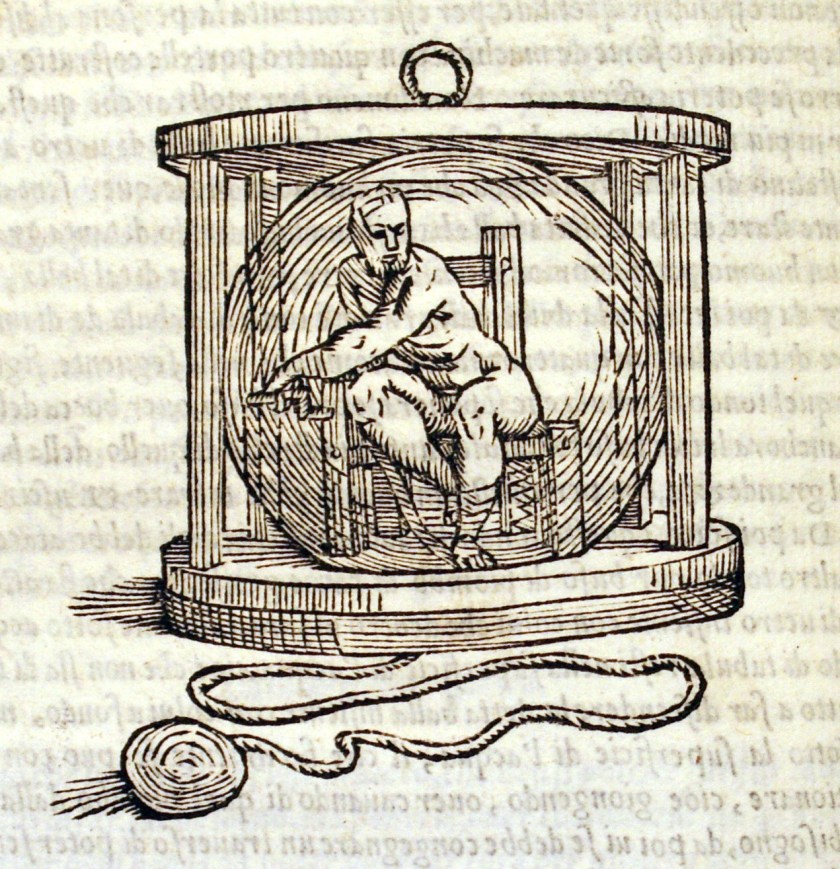
In 1774, John Day, an ignorant but ingenious English millwright, fancied that he had devised a plan by which he could remain completely underwater at any depth for at least 24 hours. The contraption he had devised for this feat would afford him a degree of comfort until, at his leisure, he returned to the surface.  Day could think of no useful purpose for his invention other than making money by wagering on his feat. He therefore contacted a local gambler who agreed to furnish funds for the construction of Day’s diving machine for a lion’s share of all the bets gained by it.

If nothing else, Day’s plan had the virtue of simplicity. His machine was merely a watertight box attached to a weight by means of screws. After entering the box and sealing the entrance, the vessel would be sunk and would remain underwater until, at the designated time, Day would remove the screws and he and the box would rise to the surface.

The machine was finished, bets were taken, and everyone convened at a designated spot on Plymouth Sound where the water was 132 feet deep. Day entered the compartment with a comfortable chair, a watch, some biscuits, a bottle of water and a candle.  Perhaps had he taken a basic science book with him — it may have enlightened him (if he read fast enough) but at that point it wouldn’t have helped.   The box was tightly closed and sunk 132 feet to the bottom from where neither it nor the unfortunate John Day ever arose.