December 11, 1969: The Naked Cold War

Relations between the United States and the Soviet Union were generally confrontational through most of the second half of the last century.  In the United States, Communist plots were everywhere, and the Soviet Union blamed American capitalists for most of the ills of the world. On December 11, 1969, a noted Russian author lashed out against western decadence in one of the more unusual cold war recriminations.

On December 11, 1969, Sergei Mikhailkov, secretary of the Moscow writer’s union, known for his books for children, weighed in against the production of “Oh! Calcutta!” that was currently an off-Broadway hit. Performers in their “birthday suits,” he fumed, were proof of the decadence and “bourgeois” thinking in Western culture.  American nudity was an assault on Soviet innocence.

Oddly enough, those Americans throughout the Midwest who didn’t think the play was about India were convinced it was a Communist plot.

More disturbing, Mikhailkov raged on, was the fact that this American abomination was affecting Russian youth. These vulgar exhibitions were “a general striptease that is one of the slogans of modern bourgeois art.” Soviet teens were more familiar with “the theater of the absurd and the novel without a hero and all kinds of modern bourgeois reactionary tendencies in the literature and art of the West” than with “the past and present of the literature of their fatherland.”

Mikhailkov’s outburst came at the end of a conference of Russian intellectuals, who applauded his remarks without visible enthusiasm before returning to their clandestine copies of Fanny Hill.

OCTOBER 18, 1963: SPACE, THE FELINE FRONTIER

The story of cats in space is a dramatic tale indeed. It begins in an unlikely place with the 1957 Soviet launch of Sputnik 2, carrying of all felicettethings a dog named Laika. Laika was a stray found on the streets of Moscow who could have been the star of a dandy rags-to-riches shaggy dog story, except that things didn’t go all that well and the pooch perished under mysterious circumstances.

This was viewed as an early skirmish in the superpower space race to which NASA responded by sending a chimp into space and successfully returning him.

The French meanwhile had been plotting their own animal space probe. Fifteen cats had been chosen to undergo extensive training involving centrifuges, compression chambers and other medieval torture devices for a space mission in which the French would prove that they belonged at the table with the big guys and a cat would demonstrate to its fanciers everywhere that cats were superior to dogs in yet another way.

A pretty black and white Parisian chatte was eventually selected for the mission, because she was the only one who hadn’t become overweight during training, something to do with croissants most likely. On October 18, 1963, at 8:09 am, Chatte Félicette boarded a Véronique AGI 47 rocket at a base in the Algerian Sahara Desert and was blasted 97 miles into space. Fifteen minutes later, she parachuted safely to earth and pussycat immortality. Voilà!

ANOTHER CAT CAME BACK

In 1813, Londoners were amazed to see, floating down the Thames River toward London Bridge, a large bowl with a passenger on board — a tortoiseshell cat, quite relaxed and seemingly enjoying the journey. As she approached the fall, onlookers were certain she would be overturned and thrown into the water. But she stayed seated and, to loud cheers, deftly shot the center arch with as much dexterity as a white water kayaker.

A young boy in a boat having observed this feat rowed toward her and lifted her into his boat. He discovered a parchment scroll hanging from a collar around her neck. The note stated that if she should reach London safely she should be taken to a Mrs. Clarke in Highstreet who would reward the person delivering the cat. The boy conveyed the cat to Mrs. Clarke who gave him half a crown. Mrs. Clarke was well aware of the circumstances of the cat’s arrival, the voyage having been the result of a wager between two Richmond gentlemen. With precious little to do, it would seem.

APRIL 6, 1722: AND TWO RUBLES FOR A FIVE 0’CLOCK SHADOW

In 1722, Peter the Great of Russia abolished a tax he had introduced some twenty years earlier, it having proved to be a rather hairy source of national income. The tax had been the result of an 18-month European tour to seek the aid of European monarchs, and to observe how other militias and armies were trained. During the tour, he learned that many European customs and styles were far superior to the antiquated ways in Russia. One of the first rulings he made upon his return was that all of his courtiers and officials shave off their long beards, as being clean-shaven was the European style. Anyone who kept their beard was subject to an annual Beard Tax of 100 rubles. Upon payment of the tax, bearded Russians were given a token; on one side of the token was an image of the lower part of a face with a full beard and the inscription “the beard is a superfluous burden.”

The idea of a beard tax had a bit of a history. Nearly 200 years earlier, King Henry VIII of England, who wore a beard himself, had introduced a tax on beards, although he probably didn’t pay the tax himself (it’s good to be the king). The tax was a graduated tax, varying with the wearer’s social position, not the length of his beard. Some years later, his daughter, Elizabeth I, reintroduced the beard tax, taxing every beard of more than two weeks’ growth, although she probably didn’t pay the tax herself (it’s good to be the queen).

March 27, 1958: They Say Goofy Is a Fellow Traveler

     Nikita Khrushchev was elevated to top commie in the Soviet Union on March 27, 1958. His Cold War relationship with President Eisenhower and the United States was a complex one, certainly more so than the Ego War between the current Russian leader and his previous U.S. bro-hug counterpart.

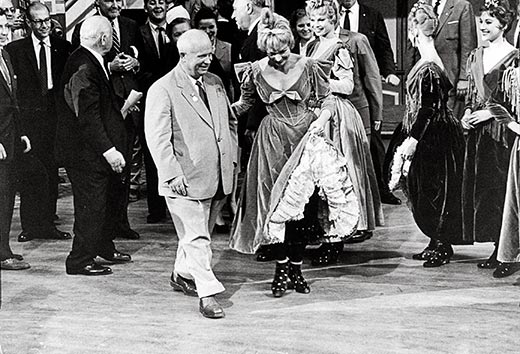
     The following year Khrushchev was in the U.S. for a summit meeting with Eisenhower.   At the Soviet leader’s request, a visit to Hollywood was arranged.  Khrushchev and his wife arrived in Los Angeles, where the day started with a tour of the Twentieth Century Fox Studios in Hollywood and a visit to the sound stage of  Can-Can. Meeting stars Shirley MacLaine and Juliet Prowse pleased the roly-poly dictator even though he had to nyet a chance to dance with MacLaine (probably something to do with the Siberian stare coming from Mrs. K)   A lunch hosted by Frank Sinatra was also a big success even though Sinatra didn’t sing “That Old Bolshevik Magic,” as Nikita requested.

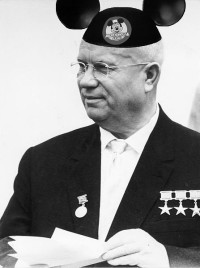
     The day headed downhill when Twentieth Century Fox President Spyros P. Skouras, who wore his anticommunism on his sleeve, got into a bit of a who-will-bury-whom brouhaha with the Russian leader who was known for his temper tantrums.  Shortly afterward, it began to look as though a nuclear exchange were imminent. Meeting Frank Sinatra was nice, but who Nikita really wanted to meet was Mickey Mouse.  His American hosts told him it couldn’t happen.  Security concerns.   Perhaps he’d like to see Cape Canaveral, the White House War Room, the Strategic Air Command. But no Disneyland.  Nicky exploded. “And I say, I would very much like to go and see Disneyland. But then, we cannot guarantee your security, they say. Then what must I do? Commit suicide? What is it? Is there an epidemic of cholera there or something? Or have gangsters taken hold of the place that can destroy me?”

Khrushchev left Los Angeles the next morning, and the Cold War returned to deep freeze.

Put a Cork in It

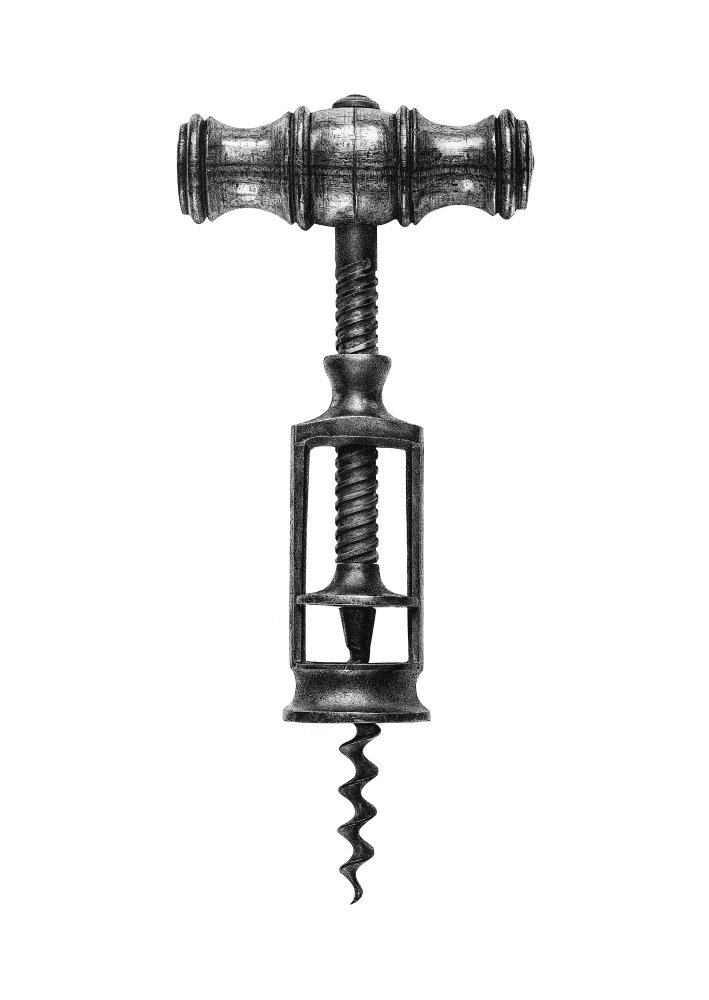
Back through the centuries wine lovers never aged their wines; they consumed it quickly before it went bad.  Then in the 18th century, British glassblowers began to make bottles with narrow necks for wine that made airtight storage possible. Corks were used to seal the bottles. This quickly led to the invention of one of the dandiest little gizmos ever devised — the corkscrew. The design was based on a similar device used to clean muskets. The first corkscrews were T-shaped devices that twisted into the cork and after a certain amount of pulling extracted the cork. Corkscrews were first patented in England and France, then on March 27, 1860, M. L. Byrn of New York City received an American patent.

Since then, hundreds of corkscrews have been designed of every shape, size and mechanics you can imagine — single-lever, double-winged, air pump, electric, mounted. Naturally there are corkscrew books, corkscrew clubs, and corkscrew collectors, helixophiles.

MARCH 18, 1662: The Bus Is Leaving

As ideas go, it seemed like a pretty good one.  And it was thought up by Blaise Pascal, noted French inventor, mathematician, physicist, philosopher, author and all around heavy thinker.  He shopped the idea around to various French nobles who jumped on the band wagon, so to speak.  He even went right up to King Louis XIV who gave him a royal monopoly.  Those who tried to compete could lose their horses, their carriages and possibly even their heads.  The guillotine was a popular diversion at the time.

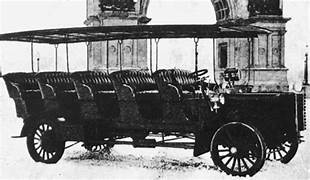
The Carosses à Cinq Sous, or Five-Penny Coaches, debuted on March 18, 1662 — the world’s first bus service.  With a fleet of seven horse-drawn carriages running along three separate routes, each carrying up to eight passengers, it proved a popular but fleeting phenomenon.  It carried only nobles; peasants were pedestrians, relegated to being run down Sadly, the novelty quickly wore off, the nobles not being known for their attention span.  Ennui set in.  By 1675, the carriages no longer cruised the rues.  They were gone, not to reappear until the 19th century when every London, Boston, and New York had them.

C’est la vie.


Don’t Sit Next to Him on the Bus

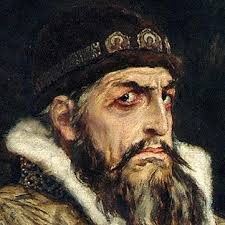
Ivan IV Vasileyevich, known to his friends as Ivan the Terrible, died in 1584 while engaged in a particularly wicked game of chess. He rose to prominence, and some might say infamy, as the Grand Prince of Moscow, a position he held from 1533 to 1547, when he declared himself the first ever Tsar of All the Russias, a title he held until his death. He was succeeded by his son, Feodor the Not So Terrible.

Historians disagree on the exact nature of Ivan’s enigmatic personality. He was described as intelligent and devout, yet paranoid and given to rages, episodic outbreaks of mental instability, and late-night Truth Social rants.


January 31, 1696: Gobsmacked by a Dutch Undertaker

One would not think of undertakers as having particularly fiery dispositions.  Especially Dutch undertakers. They’d probably look at a current corpse  and realize they had it better than that poor bloke.  The most you might expect would be a mild oath such as “Go stick your finger in a dike.”  Thus it comes as a surprise that Dutch undertakers rose up in revolt on January 31, 1696.  On that day, they rioted in the streets 0f Amsterdam.

The cause of their dudgeon was a death tax, a tax on the burial of people, and since the person being buried would not be paying the tax, the undertakers got stiffed.  Not only that, the Amsterdam City Council reduced the number of official undertakers allowed from 300 to 72.  (They also reduced the number of political commentators to 1, but no one seemed to care.) The petulant undertakers stormed right up to the house of the Mayor of Amsterdam.  Someone in the crowd (most likely an undercover government operative) shouted “We’ll huff and we’ll puff and we’ll blow your house down.”  Which they did.  And they carried off the Mayor and tossed him into the Zuider Zee, wooden shoes and all.  Sailors and Dutch Uncles joined the revolt which moved on to the houses of the City Captain, Burgomasters and other city elite who also received their comeuppance.

Then as quickly as it had started, the riot ended.  Some say the undertaker’s hearts grew three sizes that day; others say it was cocktail time.  Nevertheless the Aansprekersoproer (that’s the official title of the event) ended, and shortly afterward the death tax was repealed.


Glasnost on a Sesame Seed Bun

Muscovites lined up on January 31, 1990, to try a most unRussian guilty pleasure. The Soviet Union might be crumbling around them, but that icon of Western decadence was riding high. McDonald’s had come to town.

Those Big Macs, with fries and shakes might cost a day’s wages, but the people of Moscow were eating them up. The notorious golden arches of capitalism were signs that times they were a’changing in the Soviet Union – in fact, within two years the Soviet Union would dissolve. A Soviet journalist saw no great political earthquake but rather an “expression of pragmatism toward food.” Could the Quarter Pounder be the ultimate example of the People’s Food?

Photographer: Andrey Rudakov/Bloomberg via Getty Images

Located in Pushkin Square, this McDonald’s was the world’s largest, boasting 28 cash registers and a seating capacity of 700. Its opening day broke a McDonald’s record with more than 30,000 customers served.

Moscow resident Natalya Kolesknikova told Russian State Television that when out-of-town guests came to visit, she showed them two things, McDonald’s and the McKremlin.

In 2022, there were 850 McDonald’s in Russia. Then Russia invaded Ukraine.  And McDonald’s is pulling out of a market it’s been a part of for 32 years, “de-arching” and selling every one of its restaurants.


APRIL 19, 1949: SEND IN THE CLOWNS

russian

With the threat of nuclear annihilation hanging over the world, cold war adversaries were nonetheless able to find glimmers of humor. At the opening night of the Moscow Circus, noted Russian clown, Konsantin Berman, demonstrated who had the upper hand in the clown cold war, launching barb after barb in the direction of the United States.

Tossing a boomerang, he likened it to the U.S. Marshall Plan that was pumping economic recovery aid into Western Europe. “American aid to Europe,” he said, “Here is the dollar.” as the boomerang returned to his hand, delighting the audience. Producing a radio that bellowed out the sound of barking dogs, he announced: “That’s the Voice of America.”

Meanwhile American clowns were dumping buckets of water on each other and slipping on banana peels.

Speaking of Banana Peels

The Vagabond King a 1925 operetta by Rudolf Frimi was already an American success when it opened in London on April 19, 1927.  It’s success in England was probably assured given its theme of foibles of the French.  Its hero is a braggart, thief and rabble-rouser who attempts to steal an aristocratic lady from the king himself.  Not only that, he openly mocks the king, boasting about what he would do if he were king.  The angry king gives him royal powers for 24 hours — king for a day — during which he must solve all France’s problems or go to the gallows (the guillotine had not yet been invented).  He succeeds, wins the lady’s hand and lives happily ever after in exile — probably in England.  The operetta was the inspiration for a couple of movies and, of course, the popular radio and television program “Queen for a Day.”


APRIL 6, 1722: AND TWO RUBLES FOR A FIVE 0’CLOCK SHADOW

In 1722, Peter the Great of Russia abolished a tax he had introduced some twenty years earlier, it having proved to be a rather hairy source of national income. The tax had been the result of an 18-month European tour to seek the aid of European monarchs, and to observe how other militias and armies were trained. During the tour, he learned that many European customs and styles were far superior to the antiquated ways in Russia. One of the first rulings he made upon his return was that all of his courtiers and officials shave off their long beards, as being clean-shaven was the European style. Anyone who kept their beard was subject to an annual Beard Tax of 100 rubles. Upon payment of the tax, bearded Russians were given a token; on one side of the token was an image of the lower part of a face with a full beard and the inscription “the beard is a superfluous burden.”

The idea of a beard tax had a bit of a history. Nearly 200 years earlier, King Henry VIII of England, who wore a beard himself, had introduced a tax on beards, although he probably didn’t pay the tax himself (it’s good to be the king). The tax was a graduated tax, varying with the wearer’s social position, not the length of his beard. Some years later, his daughter, Elizabeth I, reintroduced the beard tax, taxing every beard of more than two weeks’ growth, although she probably didn’t pay the tax herself (it’s good to be the queen).

MARCH 18, 1902: ITALIAN TENORS ARE A LIRE A DOZEN

Tenor Enrico Caruso recorded ten arias for the Gramophone & Typewriter Company in Milan, Italy. He was paid 100 pounds sterling, and was not required to do any typing. These acoustic recordings, recorded in a hotel room on March 18, 1902, created a win-win situation for both Caruso and the Gramophone Company. The gramophone, and its flat circular discs, quickly became victorious in the recording competition, besting both Thomas Edison’s phonograph cylinders and eight-track tapes. The gramophone recordings became best-sellers, helping to spread the 29-year-old Caruso’s fame.

Caruso was signed by London’s Royal Opera House for a season of appearances in eight different operas ranging from Verdi’s Aida to Don Giovanni by Mozart. His successful debut at Covent Garden occurred just two months after his recording session. The following year, Caruso traveled to New York City to take up a contract with the Metropolitan Opera.

By 1920, Caruso had made nearly 300 recordings. His 1904 recording of “Vesti la giubba” from Leoncavallo’s opera Pagliacci was the first sound recording to sell a million copies. All of these recordings are available today on CD, as digital downloads, and in garages throughout the world on eight-track tapes.


Ivan Was Probably a Baritone

Ivan IV Vasileyevich, known to his friends as Ivan the Terrible, died in 1584 while engaged in a particularly wicked game of chess. He rose to prominence, and some might say infamy, as the Grand Prince of Moscow a position he held from 1533 to 1547, when he declared himself the first ever Tsar of All the Russias, a title he held until his death. He was succeeded by his son, Feodor the Not So Terrible.

Historians disagree on the exact nature of his enigmatic personality. He was described as intelligent and devout, yet paranoid and given to rages, episodic outbreaks of mental instability, and late-night tweet storms.

He was also know as Ivan the Fearsome but is not to be confused with Ivan the Gorilla.

Wretched Richard’s Little Literary Lessons – No. 3

plot

plät/  noun

~ the sequence of events of a play, novel, movie, or similar work that develops a story.

Use it in a sentence perhaps?

“What do you do when you’re not floating around the West Indies?” asked Albert.

“I write mostly.”

“A writer, says he,” Basil had returned from the bar and sat across the table from Terry. “I was a writer meself once upon. Never made any money at it, though. I was always a poor writer what never had a plot to piss on.”

Here’s where the plot thickens.


December 11, 1969: The Naked Cold War

Relations between the United States and the Soviet Union were generally confrontational through most of the second half of the last century.  In the United States, Communist plots were everywhere, and the Soviet Union blamed American capitalists for most of the ills of the world. On December 11, 1969, a noted Russian author lashed out against western decadence in one of the more unusual cold war recriminations.

On December 11, 1969, Sergei Mikhailkov, secretary of the Moscow writer’s union, known for his books for children, weighed in against the production of “Oh! Calcutta!” that was currently an off-Broadway hit. Performers in their “birthday suits,” he fumed, were proof of the decadence and “bourgeois” thinking in Western culture.  American nudity was an assault on Soviet innocence.

Oddly enough, those Americans throughout the Midwest who didn’t think the play was about India were convinced it was a Communist plot.

More disturbing, Mikhailkov raged on, was the fact that this American abomination was affecting Russian youth. These vulgar exhibitions were “a general striptease that is one of the slogans of modern bourgeois art.” Soviet teens were more familiar with “the theater of the absurd and the novel without a hero and all kinds of modern bourgeois reactionary tendencies in the literature and art of the West” than with “the past and present of the literature of their fatherland.”

Mikhailkov’s outburst came at the end of a conference of Russian intellectuals, who applauded his remarks without visible enthusiasm before returning to their clandestine copies of Fanny Hill.