Just whose fault was it anyway? Was it a cow kicking over a lantern, that strange new sect known as Christians, or the Emperor himself whom rumor would have wailing on a fiddle during the conflagration? It started in the central slums, spread rapidly through the market area and eventually engulfed most of the city. When the flames finally died out more than a week later, nearly two-thirds of Rome had been destroyed.
History likes to blame Emperor Nero, suggesting that he not only started the fire because he did not find the city architecturally pleasing, but staged his one-man concert as the flames surrounded him. History does not recall the name of the tune or tunes he played. History is funny that way. He did use the fire as an opportunity to rebuild Rome in a more orderly Greek style. And he did blame the curious Christian cult for the fire, responding with what became the popular Roman pastime of feeding them to the lions and other pagan parlor games.
Unfortunately for conspiracy theorists, Nero was 35 miles away when the fire started, couldn’t play a lick on the fiddle (which hadn’t been invented anyway), and let his palace be used as a homeless shelter (no Christians need apply, of course).
Actually, Nero wasn’t musically inept. He could play a mean lyre, an ancient Greek stringed instrument sort of like a zither but sort of not. This is probably why conspiracy theorists determined to blame him for the fire, chanted “Lyre, lyre, pants on fire.”
Astute almanackers will recall that we touched upon those lovable Roman twins, Romulus and Uncle Remus, back on January 1. (Many others tried their best to forget on January 2 and were largely successful.) The next few sentences contain a lot of funny names which you do not need to remember. Romulus and Remus were born in Alba Longa to Rhea Silvia, a Vestal Virgin and daughter of King Numitor who had been overthrown by his brother Amulius. Rhea conceived them when their daddy, Mars (yes, the god), came to her in a sacred grove. He got her in the garden, folks.
King Amulius thought the twins might prove a threat to his throne, so naturally he ordered them killed. They were left to die on the banks of the Tiber (not a particularly effective homicide technique) but were saved by Tiberinus, another god, suckled by a she-wolf (hear that, Mowgli?) and adopted by a shepherd, Faustulus. They grew up among the sheep, unaware of their royal demigod identities (and evidently not knowing that wolves eat sheep).
This all took place in the locale that would become known as Rome. As the years passed quickly backwards, the boys grew up, killed Amulius, and reinstated Numitor as king. They got to thinking that Europe could use another major metropolis, something of the Alexandria or Carthage sort. Unfortunately, they couldn’t agree on which of the seven hills to build their city. They quibbled, they argued, they battled and Romulus slew Remus. (This is something we can’t be absolutely sure of, given the fact they were twins. “I’m Romulus and I just killed my twin brother Remus.” “No I’m Romulus and my brother just killed me.”
In any event, Romulus is credited with being the true founder of Rome. Had it been his brother, it would now be called Reme.
Hustle and Bustle
Among the many advances of the 19th century, the idea that Alexander Douglas patented on this day in 1857 hardly stands out. At first glance the bustle seems to have no useful function beyond making a woman’s butt seem larger. But on closer inspection this item of apparel has some noteworthy attributes. The bustle replaced the infamous crinoline, a contraption that was like a large metal bird cage strapped to the unfortunate female wearer. Not only was it difficult to navigate in, it was also impossible to exit in a hurry should the flammable fabric covering it catch fire which it frequently did (killing some 3,000 women in England during the 1860s.
The bustle also had a utilitarian function, keeping milady’s dress from dragging through the mud. And there was plenty of mud around during the 19th century. The bustle pretty much disappeared during the latter part of the century, allowing women to occasionally sit down.
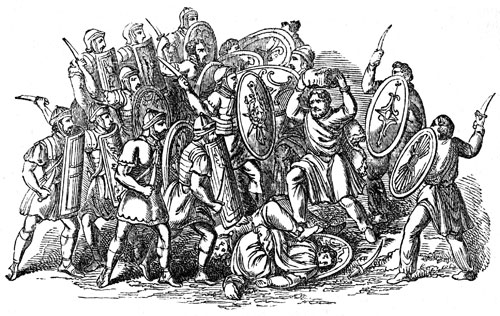
Romans got two emperors for the price of one, when in 238, Gordian I and II became father-and-son tag-team Caesars after an insurrection against Maximinus Thrax, a rather unpopular emperor who had come to the position by the popular tradition of assassinating his predecessor. Gordian I was a bit long in the tooth so the younger Gordian was attached to the imperial throne and acclaimed Augustus too – sort of like if Poppa Bush and W had been presidents together, mano e mano so to speak.
Some supporters of Maximinus Thrax who were not happy with this turn of events staged a rebellion in Africa. Gordian II fought against them in the Battle of Carthage but lost and was killed for good measure. Hearing the bad news, Gordian I took his own life. All of this happened within a month. Fortunately, there was no dearth of Gordians in Rome, and Gordian II’s 13-year-old nephew Gordian III soon became emperor. During his six-year reign, the teenage ruler endured pimples, the fickleness of teenage girls, and Persians until he was done in by the latter in yet another battle. He was succeeded by Philip the Arab (son of Ahab) sometimes referred to as the Gordian Not.
Slow and steady wins the race
Back in 1767, Lord Robert Clive of the East India Company was given a gift of four Aldabra tortoises from the Seychelle Islands. Three soon died, but the fourth, a gent named Addwaita “the one and only,” prospered. He was transferred to a Calcutta zoo in 1875.
Addwaita was a bit of a loner, content to pass the decades in his zoo cubicle, munching on carrots, lettuce, chick peas, bran, bread and grass, growing to a stately 550 pounds and living to the ripe old age of 250, give or take a year or two.
Alas, Addwaita bought the reptilian ranch on March 22, 2006. Foul play was not suspected.
How did St. Valentine’s Day become a day associated with hearts and flowers and all things romantic? One account puts a definitely sinister spin on the origin of this holiday. It begins back in the third century with a fellow named Claudius the Cruel. As you might guess, Claudius is not going to be the hero of this tale.
Claudius (II, if you’re counting) was the Emperor of Rome, a barbarian who proved that any young boy can grow up to be emperor if he believes. Valentinus, or Valentine, was not a saint at the time, but he was a holy priest.
Claudius, in addition to his barbarianism and cruelty, was a bit of a warmonger. Continually involved in bloody campaigns to destroy upstart nations throughout the region, Claudius needed to maintain a strong army. But it was a constant battle to keep his military at full strength what with Christianity gaining a toehold and everyone into family values. The men for their part were unwilling to be all they could be in the army because of their annoying attachment to wives and families.
Claudius had a fairly simple solution; he banned all marriages and engagements in Rome. Valentine, part of whose livelihood was the performing of marriages, thought this decree unjust and defied the emperor by continuing to marry young lovers on the sly. Claudius, as emperors will, got wind of Valentine’s doings and, true to his name, ordered that Valentine be put to death. Valentine was arrested and condemned to be beaten about the head, and then have said head cut off. The sentence was carried out on February 14, 278.
Legend has it that while in jail, Valentine left a farewell note for the jailer’s daughter, with whom he had had a brief relationship (that will not be explored here), and signed it “From Your Valentine.” There may have been other cute little Valentine poems as well, but they have been lost to history.
For this, Valentine was named a saint and had a holiday created after him, though not a legal one with school closings and such. Conspiracy theorists will naturally jump up and down, saying there were several St. Valentines and the holiday could have been named after any one of them. Or it could have come from the pagan festival Lupercalia, a day of wanton carrying on. They should mind their own business.
It’s a new year, a new beginning, a fresh start and all those cliches. It’s a cold slap in the face after last night when you celebrated and then made that resolution while licking the wassail bowl dry. You don’t remember? Your resolution went something like this: I hereby resolve to read Wretched Richard’s Almanac every day so that I might be well informed, sophisticated and attractive. And I will recommend it to all my friends so they too might be well informed, sophisticated and attractive.
Here Come Januarius
As we previously pointed out, today is January 1, New Year’s Day, the start of a brand new year. It wasn’t always thus. There wasn’t always a January. According to legend, the first calendar was created by Romulus who along with his twin brother Uncle Remus founded Rome. This calendar had only ten months (these were leaner times), the ten being Martius, Aprilis, Maius, Innius, Quintilis, Sextilis, Aquarius, Donner, Blitzen, and the ever-popular Decembris.
The year consisted of only 298 regularly scheduled calendar days. The authorities would add bonus days here and there as they saw fit to bring the total number to the magic 365. (Martius 3, a Tuesday, will be postponed so we can bring you a special wear-a-toga-to-work day. Martius 3 will return on Thursday.)
A fellow by the name of Numa Pompilius (no need to memorize his name) succeeded Romulus who had murdered Uncle Remus in a typically Roman display of sibling rivalry. In an effort to Make Rome Great Again, Pompilius added two months to the Roman calendar. The first of these was Januarius, dedicated to the two-faced god Janus, the deity who presided over doors, looking back through the doorway to the past and ahead to the future. Clever, what?
More Wolf-monat, Van Helsing?
Wolf contemplating a Saxon snack
The Saxons (the Almanac is a big tent, they’re welcome too) didn’t hold much with naming things after Roman gods. They had a different and more colorful name for the month of January — Wolf-monat or Wolf-month, because Saxon folks were more likely to be devoured by wolves during Wolf-monat than at any other time of the year. But we digress.
Et Tu, Sosigenes
Even though Januarius was added some 600 years earlier, New Year’s Day was celebrated on Januarius 1 for the first time in 45 B.C. On that day the Julian calendar went into effect — created by Julius Caesar himself — with the aid of his trusty sidekick Sosigenes, an Alexandrian astronomer.
Sosigenes advised Caesar to dump the whole Roman calendar and start from scratch. New Year’s no longer came in March. A one-time bonus of 67 days was thrown in, with the promise of an extra day every four years in February.
But Caesar couldn’t stop there. In 44 B.C. (that’s a year later than 45), he changed the month of Quintilis to Julius (July, to friends). He would no doubt have done more damage had not a group of noble Romans assassinated him that same year. But didn’t Augustus come along and keep fiddling with the calendar. (There’s something about Caesars and fiddling.). Sextilis became (what else?) Augustus. But it only had 30 days, compared to Julius’ 31. What’s a Roman emperor to do? Steal a day from Februarius, of course.
. . .And on the Eighth Day
For those folks who just can’t get enough ’tis the season, today is also the eighth of a dozen days of Christmas. This is infamously celebrated by the carol in which on this day, the first day of Christmas, someone’s True Love bestows upon him or her a gift of a partridge in a pear tree. While we might point out that a crock pot or a circular saw would be a bit more practical, we won’t quibble with the sentiment. A flock followed: turtle doves, French hens, colly birds, geese, swans, all calling, clucking, cooing and squawking around that pear tree.
But now on the eighth day, True Love, having at last run out of feathered friends, has created an entirely new category of giving — the gift of people. The first contribution to this premise consists of eight maids a-milking, a lovely gift with nary a cackle or a caw. Of course this requires the addition of cows — one can’t very well expect the recipient to go out and find his or her own cows (True Love could have added a disclaimer of cows not included, but that would be a cheap trick.) We suppose there might be just one cow with all the maids milking it, but that would be one very sore cow.
Charles Dickens, it would seem, missed the Christmas boat by failing to take advantage of this twelve day gimmick. Imagine if you will the twelve ghosts of Christmas.
Romans got two emperors for the price of one, when in 238, Gordian I and II became father-and-son tag-team Caesars after an insurrection against Maximinus Thrax, a rather unpopular emperor who had come to the position by the popular tradition of assassinating his predecessor. Gordian I was a bit long in the tooth so the younger Gordian was attached to the imperial throne and acclaimed Augustus too – sort of like if Poppa Bush and W had been presidents together, mano e mano so to speak.
Some supporters of Maximinus Thrax who were not happy with this turn of events staged a rebellion in Africa. Gordian II fought against them in the Battle of Carthage but lost and was killed for good measure. Hearing the bad news, Gordian I took his own life. All of this happened within a month. Fortunately, there was no dearth of Gordians in Rome, and Gordian II’s 13-year-old nephew Gordian III soon became emperor. During his six-year reign, the teenage ruler endured pimples, the fickleness of teenage girls, and Persians until he was done in by the latter in yet another battle. He was succeeded by Philip the Arab (son of Ahab) sometimes referred to as the Gordian Not.
Slow and steady wins the race
Back in 1767, Lord Robert Clive of the East India Company was given a gift of four Aldabra tortoises from the Seychelle Islands. Three soon died, but the fourth, a gent named Addwaita “the one and only,” prospered. He was transferred to a Calcutta zoo in 1875.
Addwaita was a bit of a loner, content to pass the decades in his zoo cubicle, munching on carrots, lettuce, chick peas, bran, bread and grass, growing to a stately 550 pounds and living to the ripe old age of 250, give or take a year or two.
Alas, Addwaita bought the reptilian ranch on March 22, 2006. Foul play was not suspected.
Some 2,000 years give or take before our current leader (?) kicked up his first tweetstorm another statesman/orator/philosopher launched the Roman equivalent of a tweetstorm. On September 2, 44 BC, Marcus Tullius Cicero delivered the first of a series of speeches known as the Philippics (or Philippicae in Latin) hectoring his favorite enemy Mark Antony.
As every schoolchild knows, a group of unhappy Roman senators had removed Julius Caesar from office a year earlier. Cicero had not taken part in the affair, but he heartily approved of it. In a letter written afterward, he said: “How I wish that you had invited me to that most glorious banquet on the Ides of March!”
Cicero was not a fan of Caesar’s protege, Mark Antony, either. He was convinced that Antony was planning revenge upon the Ides gang. Cicero’s attacks on Antony rallied the Senate in his favor and established him as the leading politician of his age.
Antony did not take these insults lightly (Cicero had called him a sheep and said he had small hands). He and his supporters prepared to march on Rome and “lock him up, lock him up,” forcing Cicero to hit the road. But to no avail; Cicero was intercepted and executed.
“O tempora! O mores!” (Oh what times. Oh what standards.)
O Tempora, O Swine
Another Cicero might be more familiar to a lot of us. That would be Cicero Pig, a diminutive version of his famous Uncle Porky. He first appeared in the cartoon “Porky’s Naughty Nephew” as a bit of a brat. He was called Pinky at the time, then Algernon, and finally Cicero. He never went by the name Marcus Tullius, and no one ever called Marcus Tullius Pinky — although Mark Antony probably would have had he thought of it.
Never try to teach a pig to sing; it wastes your time and it annoys the pig. — Robert Heinlein
Carry a Big Shtick
Vice President Theodore Roosevelt was somewhat of an orator himself. He delivered a speech at the Minnesota State Fair On September 2, 1901 in which he publicly used the phrase with which he would always be associated: Speak softly and carry a big stick; you will go far. Four days later, President William McKinley was shot by an assassin and following his death eight days later, Roosevelt became President.
My father always wanted to be the center of attention. When he went to a wedding, he wanted to be the bridegroom. When he went to a funeral, he wanted to be the corpse. — Alice Roosevelt Longworth
Just whose fault was it anyway? Was it a cow kicking over a lantern, that strange new sect known as Christians, or the Emperor himself whom rumor would have wailing on a fiddle during the conflagration? It started in the central slums, spread rapidly through the market area and eventually engulfed most of the city. When the flames finally died out more than a week later, nearly two-thirds of Rome had been destroyed.
History likes to blame Emperor Nero, suggesting that he not only started the fire because he did not find the city architecturally pleasing, but staged his one-man concert as the flames surrounded him. History does not recall the name of the tune or tunes he played. History is funny that way. He did use the fire as an opportunity to rebuild Rome in a more orderly Greek style. And he did blame the curious Christian cult for the fire, responding with what became the popular Roman pastime of feeding them to the lions and other pagan parlor games.
Unfortunately for conspiracy theorists, Nero was 35 miles away when the fire started, couldn’t play a lick on the fiddle (which hadn’t been invented anyway), and let his palace be used as a homeless shelter (no Christians need apply, of course).
Actually, Nero wasn’t musically inept. He could play a mean lyre, an ancient Greek stringed instrument sort of like a zither but sort of not. This is probably why conspiracy theorists determined to blame him for the fire, chanted “Lyre, lyre, pants on fire.”


 eventually engulfed most of the city. When the flames finally died out more than a week later, nearly two-thirds of Rome had been destroyed.





 Wretched Richard's Almanac