The world premier of Giacomo Puccini’s last opera “Turandot” was held at Milan’s La Scala on April 25, 1926, two years after his death. Arturo Toscanini conducted. Toward the end of the third act, Toscanini laid down his baton, turned to the audience and announced: “Here the Maestro died.” Puccini had died before finishing the opera. Subsequent performances at La Scala and elsewhere included the last few minutes of music composed by Franco Alfano using Puccini’s notes. A highlight of the opera is “Nessun Dorma,” probably the most famous aria in all of opera.
Down at the End of Lonely Street
Elvis Presley scored his first number one hit on the Billboard Pop 100 on this date in 1956. Recorded and released as a single in January, “Heartbreak Hotel” marked Presley’s debut on the RCA Victor record label . It spent seven weeks at number one, became his first million-seller, and was the best-selling single of 1956. The song was based on a newspaper article about a lonely man who committed suicide by jumping from a hotel window.
A music staple of the 40s and 50s, Your Hit Parade, made its radio debut on April 20, 1935. It lasted for nearly 25 years before being done in by rock and roll music – and perhaps Snooky Lanson. It began as a 60-minute program with 15 songs played in a random format, and eventually moved to television where the seven top-rated songs of the week were presented each week in elaborate production numbers requiring constant set and costume changes. The list of top songs was compiled through a closely guarded top secret algorithm that involved record sales, quarters plunked into jukeboxes, shoplifted sheet music and the divination of an unidentified mystic in Memphis, Tennessee.
Dorothy Collins , Russell Arms, Snooky Lanson and Gisèle MacKenzie were top-billed during the show’s peak years. And Lucky Strike cigarettes starred throughout its run.
As the rock and roll era took over, the program’s chief fascination became seeing a singer like Snooky Lanson struggle with songs like Splish Splash and Hound Dog.
Would Snooky Make a Good Macbeth
Although Shakespeare’s Macbeth was written in 1606, the first record of a performance was at the Globe Theater on April 20, 1611, although chances are there were a few out-of-town tryouts earlier. Shakespeare’s tragedy is one of the most performed and one of the shortest. It has in its 413-year history made a lot of contributions to the English culture and picked up some interesting baggage. One of the most noted of the latter is the Macbeth curse: speaking the name of the play in the theater is inviting a grim reckoning. It is always referred to as “the Scottish play.” No one knows exactly why there is a curse, but it has been suggested that the witches’ spells used in the play were real. They were taken from a book on demonology written by King James I, either to suck up to the king or to poke fun at his belief in witchcraft. Were some unfortunate to slip up and utter the word Macbeth, he or she must immediately leave the room, turn around three times, spit, say Donald Trump, then beg to be re-admitted.
“Double, double, toil and trouble, fire burn and cauldron bubble.” No, Snooky would make a better witch.
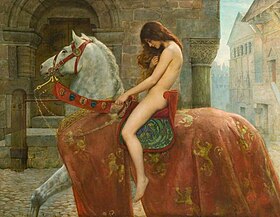
A lady rode through the streets of London on horseback, naked (the lady not the horse), and didn’t get pinched (in the law and order sense, that is). But more of that later.
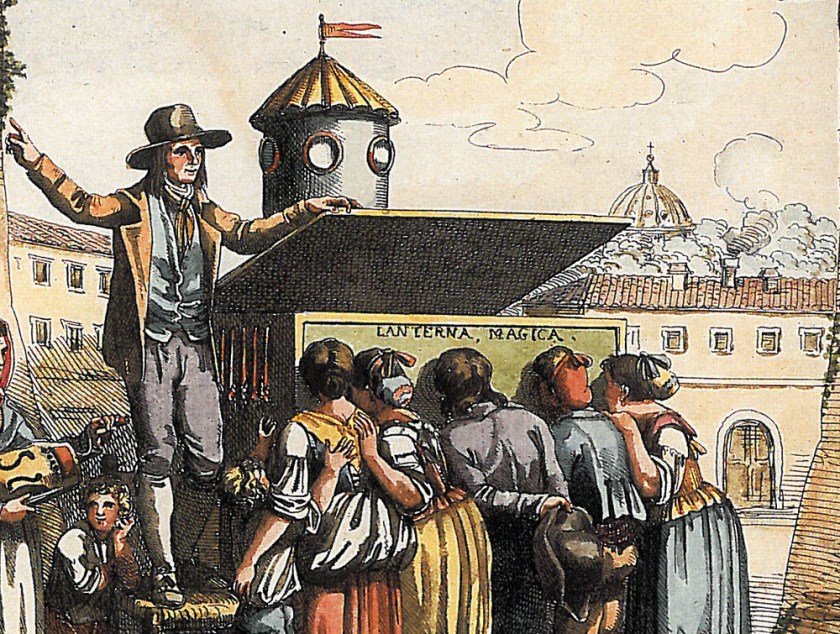
In 1861, Samuel B. Goodale who hailed from Cincinnati received a patent for a clever hand-operated stereoscope device on which still pictures were attached like spokes to an axis which revolved, causing the pictures to come to life in motion — a mechanical peep show that folks viewed through a small hole for a penny a pop. The usual subjects for peep shows were animals, landscapes, and theatrical scenes, high-minded, proper subjects. Nothing naughty or titillating. How long could that last, you ask. Not long of course. The peep show quickly came to stand for pictures and performances involving sex.
The term peep show itself comes from Peeping Tom, a sneaky British tailor who made a hole in the shutters of his shop so he might surreptitiously spy on Lady Godiva who felt the need to ride naked naked through the streets of the city. He was struck blind for his effort.
Collier, John; Godiva; Herbert Art Gallery & Museum
What about this Lady Godiva? Was she for real? Yes kids, she was. And the performance she is famous for took place back in the 11th century. According to her press agent, Lady Godiva was not just your ordinary exhibitionist giving the folks of Coventry, particularly the Toms, Dicks and Harrys of Coventry, their daily eyeful. She was a noblewoman, married to the “Grim” Earl of Mercia, a nasty fellow who burdened the folks under his sway with high taxes and poor service. Lady Godiva pleaded frequently with her husband to give the poor some relief, to no avail. He eventually agreed to lower the taxes if she would ride through town completely naked. The Lady called his bluff. To keep her ride from becoming something of the magnitude of a Taylor Swift concert, the townspeople were told to shutter themselves indoors with no peeping. Which they did, except for you know who. In a later interview, Blind Tom said it was worth it.
That Ain’t No Cat in the Hat
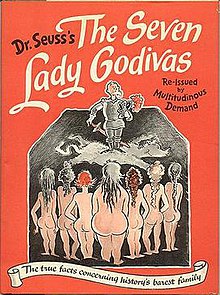
“It was all full of naked women, and I can’t draw convincing naked women. I put their knees in the wrong places.” What’s better than a Lady Godiva? Two Lady Godivas. Or how about seven? The story of the seven Godiva sisters was penned by none other than Dr. Seuss, his fourth book and one written for adults or “obsolete children” as he called them. The seven sisters never wear clothing, not even when they leave the seven Peeping brothers, and head off in the world to warn of the dangers of horses.
The 1939 book had a 10,000 print run with most of them remaining unsold, what Seuss called his greatest failure. It is one of only two Dr. Seuss books allowed to go out of print.
But Please Lose That Sports Jacket
It has been endlessly debated when and with whom rock and roll actually began, but most enthusiasts have pretty much settled on a guy who cut an unlikely figure for a rock artist but who brought rock and roll into the public eye with a bang in 1955. The man was Bill Haley, along with his Comets, and the song was “Rock Around the Clock” introduced in the film Blackboard Jungle. During the next few years a string of hits including “Shake, Rattle and Roll” and “See Ya Later, Alligator” followed.
Time passes quickly and when you’re at the pinnacle of musical stardom, you’re on a slippery slope. Along comes a guy named Elvis and you’re yesterday’s sha-na-na. Who’s going to scream and carry on for a thin-haired, paunchy 30-year-old musician with a silly curl in the middle of his forehead and a garish plaid sports jacket?
The Brits, that’s who.
By 1957, Bill Haley and the Comets had already enjoyed their golden days of American super-stardom. But the battle of Britain lay ahead. When they stepped off the Queen Elizabeth in Southampton on February 5, they began the first ever tour by an American rock and roll act and launched what rock historians called the American Invasion.
When Haley and the band reached London later that same day, they were greeted by thousands in a melee the press called “the Second Battle of Waterloo.” These were the British war babies just becoming teenagers, and they were ready for American rock and roll.
The world premier of Giacomo Puccini’s last opera “Turandot” was held at Milan’s La Scala on April 25, 1926, two years after his death. Arturo Toscanini conducted. Toward the end of the third act, Toscanini laid down his baton, turned to the audience and announced: “Here the Maestro died.” Puccini had died before finishing the opera. Subsequent performances at La Scala and elsewhere included the last few minutes of music composed by Franco Alfano using Puccini’s notes. A highlight of the opera is “Nessun Dorma,” probably the most famous aria in all of opera.
Down at the End of Lonely Street
Elvis Presley scored his first number one hit on the Billboard Pop 100 on this date in 1956. Recorded and released as a single in January, “Heartbreak Hotel” marked Presley’s debut on the RCA Victor record label . It spent seven weeks at number one, became his first million-seller, and was the best-selling single of 1956. The song was based on a newspaper article about a lonely man who committed suicide by jumping from a hotel window.
A music staple of the 40s and 50s, Your Hit Parade, made its radio debut on April 20, 1935. It lasted for nearly 25 years before being done in by rock and roll music – and perhaps Snooky Lanson. It began as a 60-minute program with 15 songs played in a random format, and eventually moved to television where the seven top-rated songs of the week were presented each week in elaborate production numbers requiring constant set and costume changes. The list of top songs was compiled through a closely guarded top secret algorithm that involved record sales, quarters plunked into jukeboxes, shoplifted sheet music and the divination of an unidentified mystic in Memphis, Tennessee.
Dorothy Collins , Russell Arms, Snooky Lanson and Gisèle MacKenzie were top-billed during the show’s peak years. And Lucky Strike cigarettes starred throughout its run.
As the rock and roll era took over, the program’s chief fascination became seeing a singer like Snooky Lanson struggle with songs like Splish Splash and Hound Dog.


 Toscanini conducted. Toward the end of the third act, Toscanini laid down his baton, turned to the audience and announced: “Here the Maestro died.” Puccini had died before finishing the opera. Subsequent performances at La Scala and elsewhere included the last few minutes of music composed by Franco Alfano using Puccini’s notes. A highlight of the opera is “Nessun Dorma,” probably the most famous aria in all of opera.
 on this date in 1956. Recorded and released as a single in January, “Heartbreak Hotel” marked Presley’s debut on the RCA Victor record label . It spent seven weeks at number one, became his first million-seller, and was the best-selling single of 1956. The song was based on a newspaper article about a lonely man who committed suicide by jumping from a hotel window.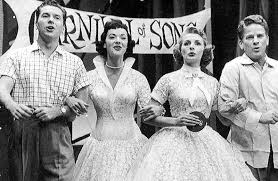


 Wretched Richard's Almanac