
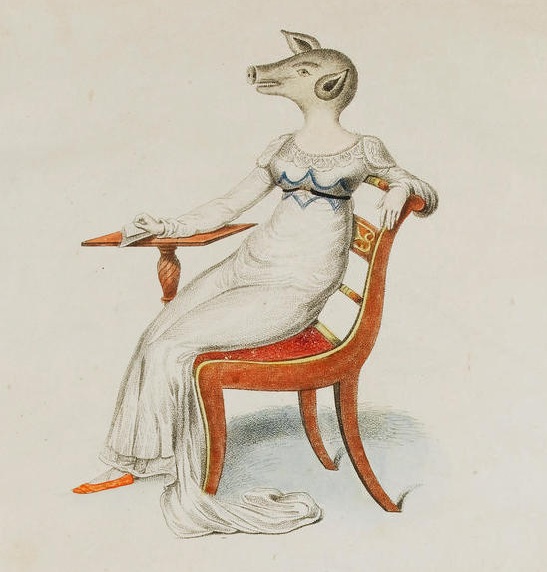
AUGUST 23, 1618: THIS LITTLE PIG HAD ROAST BEEF

There is no dearth of stories in the realm of pig-faced lady literature; a 17th century Dutch account typifies the genre. This particular pig-faced lady was born at Wirkham on the Rhine in 1618. Her name was Tanakin Skinker. Miss Skinker was a near perfectly formed little girl – one might say beautifully constructed – except that her face (some say her entire head) was that of a swine. She was a dead ringer for a pig.

     The child grew to be a woman and a source of great discomfort to her parents, for although her disposition and carriage were in general unoffending, her table manners fell a bit short of those desirous in a lady. Her voracious and indelicate appetite was appeased by placing large amounts of food in a silver trough to which she would vigorously apply her entire face, accompanied by grunts, snorts and squeals. The maid who served her had to be paid handsomely for enduring this and risking her limbs to the wildly snapping jaws.

     A fortune awaited the man who would consent to marry Miss Skinker, and many suitors came calling, gallants from Italy, France, Scotland, and England – fortune hunters all, naturally – but ultimately they all refused to marry her. Were there no pig-faced men in the world?  Or even a dog-faced boy?  Apparently not, at least not one who saw himself as such.

     In this particular account, our pig-faced lady was sadly left to die an old maid (or sow, if you prefer). Other accounts have happier, if less likely, conclusions. The woman’s pig-like appearance was the result of witchcraft.  A husband was found, and he was granted the choice of having her appear beautiful to him but pig-like to others, or pig-like to him and beautiful to others. When the husband told her that the choice was hers, the enchantment was broken and her pig-like appearance vanished. And in some modern accounts, the pig-faced lady is abducted by aliens.


January 18, 970: The Mice That Roared

On an island in the Rhine River near the German village of Bingen am Rhein, there’s a structure known as Mäuseturm, the Mouse Tower.  The tower was first erected by the Romans, and in 968 it was restored by Hatto II, the Archbishop of Mainz.  It has, if you choose to believe it, a curious history which features the untimely death of the Archbishop on January 18, 970.

Hatto was not one of Germany’s nicer guys. Aided by archers and crossbowmen, he used his tower to extract “tolls” from passing ships, all in all a lucrative sideline to his religious duties. He also filled his barns with grain in anticipation of a future rainy day which soon came in the form of a famine. The nearby peasants ran out of food and you know who was ready to sell it to them at prices they could not afford. Naturally, the peasants were not a happy lot, and Hatto got wind of a possible rebellion. Hatto assembled the peasants at his castle and promised to feed them.  He sent the hungry but now happy peasants to an empty barn to wait for the food he would bring.  But when Hatto and his servants arrived at the barn, they were not armed with food. Hatto ordered the barn doors locked, and immediately set the barn on fire. Hearing the screams from inside, Hatto was said to have remarked: “Hear the mice squeak!”

Hatto’s amusement was short-lived. When he returned to his castle, he was set upon by thousands of mice. With the mice in pursuit, Hatto fled the castle and crossed the river to his tower, in hopes that the mice would drown if they followed. They didn’t. They swarmed the island, gnawed their way through the tower door, and — well, as a poet described it:

They have whetted their teeth against the stones,
And now they pick the bishop’s bones;
They gnawed the flesh from every limb,
For they were sent to punish him!

The Kid’s Got Talent?

As the program began, the spinning of a wheel would determine the contestants’ order of appearance. As the wheel spun, Ted Mack would chant the magic words: “Round and round she goes, and where she stops nobody knows.” It was January 18, 1948, and The Original Amateur Hour, episode number one, was on the air. And each week, we would be informed how many episodes had aired. The final broadcast in 1970 was number 1,651.

Ted Mack brought the Amateur Hour to television from radio where it amateurhourhad been a fixture for over a decade under the command of Major Edward Bowes. Mack’s television version was one of only six shows to appear on all four major TV networks – ABC, CBS, NBC, and DuMont. (the others were The Arthur Murray Party; Down You Go; The Ernie Kovacs Show; Pantomime Quiz; and Tom Corbett, Space Cadet).

Contestants were often singers and other musicians, although acts included jugglers, tap dancers, baton twirlers, and such. The television audience voted for their favorites by postcard or by calling JUdson 6-7000. Winners returned for another appearance, and three-time winners became eligible for the annual championship and the chance to win a $2000 scholarship.

During 22 years on television, you might guess that the program would discover a throng of celebrities, but you’d be wrong. Gladys Knight, Ann-Margret, Irene Cara, and Tanya Tucker were a few of the handful of future stars. Pat Boone was a winner, but his appearances caused a bit of a tempest in a TV pot. After his winning appearances, it was discovered that he had appeared on the rival program Arthur Godfrey’s Talent Scouts, and was therefore not an “amateur” singer. Boone was booted from the program, but his fame was already a given, and within a few years he was hosting his own variety show The Pat Boone Chevy Showroom (Ted Mack was never a guest).

Elvis Presley, on the other hand, was turned down for the show.

AUGUST 23, 1618: THIS LITTLE PIG HAD ROAST BEEF

There is no dearth of stories in the realm of pig-faced lady literature; a 17th century Dutch account typifies the genre. This particular pig-faced lady was born at Wirkham on the Rhine in 1618. Her name was Tanakin Skinker. Miss Skinker was a near perfectly formed little girl – one might say beautifully constructed – except that her face (some say her entire head) was that of a swine. She was a dead ringer for a pig.

     The child grew to be a woman and a source of great discomfort to her parents, for although her disposition and carriage were in general unoffending, her table manners fell a bit short of those desirous in a lady. Her voracious and indelicate appetite was appeased by placing large amounts of food in a silver trough to which she would vigorously apply her entire face, accompanied by grunts, snorts and squeals. The maid who served her had to be paid handsomely for enduring this and risking her limbs to the wildly snapping jaws.

     A fortune awaited the man who would consent to marry Miss Skinker, and many suitors came calling, gallants from Italy, France, Scotland, and England – fortune hunters all, naturally – but ultimately they all refused to marry her. Were there no pig-faced men in the world?  Or even a dog-faced boy?  Apparently not, at least not one who saw himself as such.

     In this particular account, our pig-faced lady was sadly left to die an old maid (or sow, if you prefer). Other accounts have happier, if less likely, conclusions. The woman’s pig-like appearance was the result of witchcraft.  A husband was found, and he was granted the choice of having her appear beautiful to him but pig-like to others, or pig-like to him and beautiful to others. When the husband told her that the choice was hers, the enchantment was broken and her pig-like appearance vanished. And in some modern accounts, the pig-faced lady is abducted by aliens.