December 12, 1937: Is That a Snake in Your Fig Leaf?

Mae West was certainly not a stranger to controversy. But on December 12, 1937, she brought her outrageous humor to radio and in less than a half hour managed to get herself banned from the air waves for good – or at least, as it turned out, for a dozen years until finally invited to perform on Perry Como’s Chesterfield Supper Club in 1950.

The vehicle of Mae’s descent into disgrace was ventriloquist Edgar Bergen’s radio show The Chase and Sanborn Hour. She went on the show to promote her latest movie, Every Day’s a maewHoliday, and playing herself, appeared in two sketches with Charlie McCarthy. As usual she was all wit and double entendre, referring to Charlie in the first sketch as “all wood and a yard long” and commenting that his kisses gave her splinters.

But it was the second sketch that started the phones ringing. Mae played Eve and Don Ameche was Adam in the Garden of Eden.  Charlie McCarthy entered as the snake and the dialog got dicey.

Eve: Listen, what are you — my friend in the grass or a snake in the grass?

Snake: But, forbidden fruit.

Eve: Are you a snake or are you a mouse?

Snake: I’ll — I’ll do it [hissing laugh].

Eve: Now you’re talking. Here — right in between those pickets.

Snake: I’m, I’m stuck.

Eve: Oh — shake your hips. There, there now, you’re through.

Snake: I shouldn’t be doing this.

Eve: Yeah, but you’re doing all right now. Get me a big one. I feel like doin’ a big apple.

For days after the broadcast, the studio received calls and letters labeling the show immoral and obscene. Women’s clubs and Catholic groups went after the show’s sponsor for “prostituting” their services and being far from good to the last drop. The Federal Communications Commission weighed in, finding the broadcast “vulgar and indecent.”

Standing a little less than tall, NBC personally blamed West for the incident and banned her (and the mention of her name) from their stations. It was not the content of the skit (which the network had provided), but the way she delivered it. Charlie McCarthy and Don Ameche escaped punishment.  Just like in the Bible, it was all Eve’s fault.


OCTOBER 30, 1938: JUST ME AND MY RADIO

It’s easy from the comfort of our 21st century recliners to dismiss the mass hysteria of an earlier generation as so many Chicken Littles or Turkey Lurkeys, afraid of their own shadows. We’ve seen it all, any horror one can imagine, right there on the screen in front of us, and should it become too squirmy, well we can always just hit a button. The remote is there to protect us.

But what if you were at home, alone perhaps, on that October night back in 1938. It’s dark out; Halloween and all its spookiness is just a day away. But there’s the radio to keep you company. Like millions of other Americans, you’ll tune in to Edgar Bergen and Charlie McCarthy. That should lighten up a dark night. They finish their comedy routine at ten after eight. A singer you’ve never heard of follows so, like millions of Americans, you surf the radio stations (Wasn’t there supposed to be a dramatic program on?) pausing to hear an unenthusiastic announcer: “. . . the Meridian Room in the Hotel Park Plaza in downtown New York, where you will be entertained by the music of Ramon Raquello and his orchestra.” You listen for a minute; it’s not that great. You’re all set to surf again when the announcer interrupts, reporting that a Professor Farrell of the Mount Jenning Observatory has detected explosions on the planet Mars. The music returns, but only for a minute. The announcer is back with the news that a large meteor has crashed into a farmer’s field in Grovers Mills, New Jersey.

Now your ears are glued to the radio, as announcement after announcement confirms the impossible – a Martian invasion. “Good heavens, something’s wriggling out of the shadow like a gray snake. Now here’s another and another one and another one. They look like tentacles to me … I can see the thing’s body now. It’s large, large as a bear. It glistens like wet leather. But that face, it… it … ladies and gentlemen, it’s indescribable. I can hardly force myself to keep looking at it, it’s so awful. The eyes are black and gleam like a serpent. The mouth is kind of V-shaped with saliva dripping from its rimless lips that seem to quiver and pulsate.”

Now’s the time to surf the radio. If you do, you’ll quickly realize that everything is normal on other radio stations, that you’ve been listening to a realistic but fictional radio drama. But if you don’t, chances are you’ll join the thousands of people jamming highways, trying to flee the alien invasion.

Orson Welles was just 23 years old when his Mercury Theater company broadcast its update of H.G. Wells’ War of the Worlds with no idea of the uproar it would cause. He employed sophisticated sound effects and top notch acting to make the story believable.

And believed it was. In Indianapolis, a woman ran into a church where evening services were being held, yelling: “New York has been destroyed! It’s the end of the world! Go home and prepare to die!”

When the actors got wind of the panic, Welles went on the air as himself to remind listeners that it was just fiction. Afterward, he feared that the incident would ruin his career, but three years later he was in Hollywood working on Citizen Kane.

JULY 26, 1921: EXCELSIOR, YOU FATHEADS

To many of those who have even heard of Jean Shepherd, he is the voice of the grown-up Ralphie Parker whose childhood struggle to score an Official Red Ryder 200-Shot Range Model Air Rifle for Christmas is the subject of the holiday classic A Christmas Story. The film is based on Shepherd’s stories about growing up in Indiana.

Born July 26, 1921, Shepherd was an American raconteur, radio and TV personality, writer and actor. After several radio gigs, he settled in at WOR radio New York City in 1956 with an overnight slot on which he delighted fans by telling stories, reading poetry, and organizing listener stunts. The most famous of his stunts was the creation of a book, I, Libertine, by an 18th century author. Shepherd suggested that his listeners visit bookstores and ask for a copy of it, which led to booksellers attempting to purchase the book from their distributors.  Fans of the show also planted references to the book and author so widely that demand for the book led to its being listed on The New York Times Best Seller list even though it hadn’t been written.  Shepherd’s radio stories found their way into magazines and were later collected in the books In God We Trust, All Others Pay Cash; Wanda Hickey’s Night of Golden Memories and Other Disasters; The Ferrari in the Bedroom; and A Fistful of Fig Newtons.


“What the hell time is it?” muttered the old man. He was always an aggressive sleeper. Sleep was one of the things he did best, and he loved it. Some look upon sleep as an unfortunate necessary interruption of life; but there are others who hold that sleep is life, or at least one of the more fulfilling aspects of it, like eating or sex. Any time my old man’s sleep was interrupted, he became truly dangerous.”Wanda Hickey’s Night of Golden Memories: And Other Disasters


From A Christmas Story:

I had woven a tapestry of obscenity that as far as I know is still hanging in space over Lake Michigan.

Only I didn’t say “Fudge.” I said THE word, the big one, the queen-mother of dirty words, the “F-dash-dash-dash” word!

Now, I had heard that word at least ten times a day from my old man. He worked in profanity the way other artists might work in oils or clay. It was his true medium; a master.

And of course:  You’ll shoot your eye out, kid.

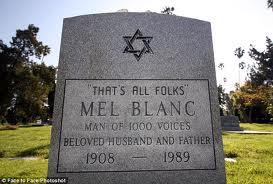
MAY 30, 1908: THAT’S ALL FOLKS

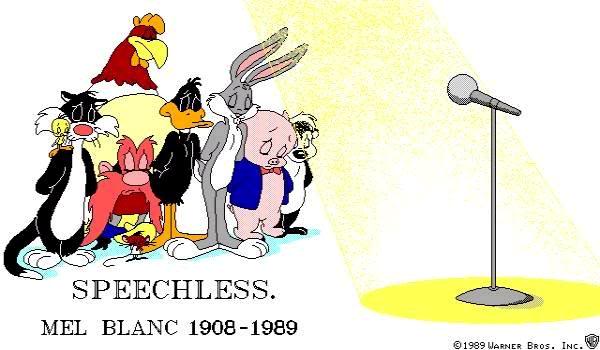
Although Mel Blanc, “the Man of a Thousand Voices,” is most often remembered as the voice of Bugs Bunny, Porky Pig, Daffy Duck, Woody Woodpecker, Tweety Bird, Sylvester, Yosemite Sam, Speedy Gonzales, Foghorn Leghorn, Pepé Le Pew, the Tasmanian Devil and many of the other characters from theatrical cartoons and Hanna-Barbera’s television cartoons, he had a long career as a comedian and character actor in radio and television. He was born on May 30, 1908, and died in 1989.

Blanc was a regular on The Jack Benny Program in various roles, and appeared on many other shows (Fibber McGee and Molly, Great Gildersleeve, Abbott and Costello, Burns and Allen), including his own which ran from September 1946 to June 1947. In the Jack Benny radio show he was Carmichael, the irascible polar bear who guarded the comedian’s underground vault; his outspoken parrot; his violin teacher, Monsieur Le Blanc; his Mexican gardener, Sy; and even his Maxwell automobile.

Blanc was easily the most prolific voice actor in the history of the industry and the first to be identified in the ending credits. In his 60-year career, he helped develop nearly 400 characters and provided voices for some 3,000 animated cartoons. During the cartoon heydays of the 1940’s and 50’s, he voiced 90 percent of the Warner Brothers cartoon empire. As movie critic Leonard Maltin said, “It is astounding to realize that Tweety Bird and Yosemite Sam are the same man!”

A gem from The Jack Benny Program:

MAY 2, 1843: THE LITTLE TOWN THAT CRIED WOLF

     Chances are you’ve never heard of Champoeg — unless maybe you’re from Oregon which is where it is, or was. Champoeg had the historical significance of being the first American government on the West Coast, having been established by representatives of Willamette Valley settlers on May 2, 1843, by a vote of 52-50. These representatives had held a series of meetings starting back in February to entertain measures to deal with the threat of wolves. During these so-called “Wolf Meetings,” the conferees established a series of civil codes (although its doubtful the wolves paid much attention to them).

     When the Oregon Territory was created in 1848, Champoeg was cold-shouldered as upstart Oregon City became its capital. This despite the fact that Champoeg had become rather a bustling little metropolis with a steamboat landing, a ferry across the Willamette River, a stagecoach office, a granary and a warehouse. Ten streets ran north to south, crossed by six east-west thoroughfares.

     Champoeg chugged along through the years as Oregon grew and gained statehood. Then in 1861, the Willamette River reared its ugly head, rising 55 feet above its normal stage, flooding the town and destroying every structure in it with the exception of two saloons (there’s a lesson here somewhere). Champoeg was never rebuilt after the flood; all that remains is a small monument describing its place in history and a stake marking a street corner (probably the one where a saloon stood).

“Well!”

     Although he was first heard on radio as a guest of Ed Sullivan, Jack Benny debuted his own radio show for NBC on May 2, 1932. After six months he moved to CBS and then in 1933 back to NBC. Although he continued to jump back and forth on networks, his radio program lasted until 1955, some five years after his television program appeared.

     Benny was a fixture on radio and TV for three decades, and is still considered one of the best. He was a master of comic timing, creating laughter with pregnant pauses or a single expression, such as his signature “Well!

     Appearing with him over the years were Eddie “Rochester” Anderson, Don Wilson, Dennis Day, Mary Livingston, Phil Harris, Mel Blanc and Sheldon Leonard. Leonard helped Benny produce what was said to be the longest laugh in radio history. Leonard as a holdup man approached Benny and demanded “your money or your life.” Benny remained silent. Finally, Leonard said “Well!?” and Benny answered “I’m thinking it over!”

February 16, 1923: Beware of the Hippo

This could be the mother of all conspiracy theories. On February 16, 1923, mummy_2in Thebes, Egypt, English archaeologist Howard Carter entered the burial chamber of the Egyptian ruler King Tutankhamen — Tut to his friends and hangers on. As every schoolgirl knows, Tut died and was mummified back in 1324 B.C., give or take a year, while still a teen idol. As every schoolboy knows, anyone foolish enough to enter Tut’s burial chamber would become subject to a pretty nasty curse — involving but not limited to crocodiles, snakes and scorpions.

Tut was the first mummy found in tact and with all his wealth untouched by tomb raiders. And his discovery left scientists scratching their heads. No one knew what had caused the young king’s death. Theories have popped up during the years — genetic disorders, disease, foul play.

An Egyptologist at California State University, Dr. Benson Harer, has come up with a dandy new idea: Tut was done in by an angry hippopotamus. Well, we all know what nasty tempers hippos have. They kill more people each year than lions, gorillas, you-name-it. And ancient Egypt was lousy with hippos — capsizing boats, stomping crops, stampeding through villages, chomping people in half with a single bite.

King Tut loved to hunt hippos, and every schoolgirl knows what dummies hippo hunters can be. We can imagine Tut happening upon a baby hippo: “Isn’t he cute? Let’s get closer. I wonder if his mother’s around somewhere.” Dr. Harer has a lot of scientific stuff that goes along with his theory, but what’s most interesting is the good doctor’s speculation that a coverup took place, with authorities stonewalling and concealing the pharaoh’s death by hippo for political reasons, fearing that the common folk might see Tut as less Trumplike, more Bidenlike — or that the gods always liked hippos best. There you have it, slippery slopers — Hippogate!

When it comes to mummies, they don’t make them like this anymore:

Radio for Dummies

edgarbergenandcharliemccarthyBorn February 16, 1903, Edgar Bergen, along with his cohorts, Charlie McCarthy and Mortimer Snerd, got his start in vaudeville and one-reel movie shorts, but his real success came on radio of all places. The popularity of a ventriloquist on radio, when no one could see the dummies or even whether Bergen’s mouth moved, is a puzzler. But popular they were. Seen at a New York party by Noel Coward, who recommended them for an engagement at the famous Rainbow Room, they were discovered by two producers who booked them for a guest appearance on Rudy Vallee’s radio program. That quickly led to their own show which, under various sponsors, was on the air from 1937 to 1956.  Bergen died in 1978.  Charlie lives on at the Smithsonian.  One might be tempted to think Charlie related to Congressional Republicans because — well, for obvious reasons — but he’s not.

February 3, 1882: You’re a Big One, Aren’t Ya

A rather large sales transaction took place on February 3, 1882: Flamboyant showman and circus entrepreneur P.T. Barnum purchased his largest performer, a single-named star who stood ten feet at the shoulders, Jumbo. Jumbo of course was an elephant, a very big elephant. He was born in the Sudan and took a rather circuitous journey north to Germany, France and finally England and the London Zoo, where he resided for 17 years, becoming famous for giving rides to zoo visitors.

Londoners were not happy about the sale. The Zoological Society was up in arms. 100,000 schoolchildren petitioned Queen Victoria to halt the sale. A lawsuit was filed against the zoo. The zoo attempted to renege on the sale, but the court sided with Barnum.

The deal was a bonanza for Barnum. He exhibited Jumbo to huge crowds at Madison Square Garden, recovering the entire cost of his investment in three weeks. With Jumbo as its main attraction, the circus earned $1.75 million for the season.

Jumbo’s circus career would be short-lived, however. In 1885, he was struck by a train and died within minutes.

What’s in a Name

While jumbo as an adjective is used today to describe everything from CDs to shrimp, the word did not have that meaning when the London zookeeper association gave it to the big fellow. Its derivation could be Indian from jambu (pronouced jumboo) a tree that grows on a mythical island whose fruits were said to be as big as elephants or Swahili from jambo (hello) or jumbe (chief). It is safe to say it has no relation to jambalaya or gumbo.

Never Forget Elephants

Although Jumbo is arguably the most famous elephant, there are many, many others who might be in the running — circus elephants, movie elephants, rescue elephants, war elephants, zoo elephants, pet elephants (Charlemagne, Pope Leo X and Henry III all had one), gift elephants (Ronald Reagan and Jimmy Carter both received one),  and very naughty elephants.  Here’s a portrait gallery from which you may choose your own favorites.

From the top: Tusko (world’s meanest elephant), Babar, Thomas Nast’s GOP, Horton, Dumbo.

He-e-e-y Abbott

Radio’s Kate Smith Hour was a mainstay during the 30s and 40s. On February 3, 1938, the comedy duo of Bud Abbott and Lou Costello made their first radio outing on the program and became regular performers. They first performed their classic “Who’s on First?” the following month.

abbott-costelloThe former vaudevillians quickly became major stars in radio, followed by movies and television. They left the Kate Smith show after two years to star in their own radio program, as well as a Broadway revue, The Streets of Paris, and their first film, One Night in the Tropics, in which, although cast in supporting roles, they stole the show with several classic comedy routines and cemented their film careers.

Universal Pictures signed them to a long-term contract. Their second film, Buck Privates, made them box-office stars and in the process saved Universal from bankruptcy. In most of their films, the plot was not much more than a framework that allowed them to reintroduce comedy routines they had first performed on stage. Universal also added glitzy production numbers to capitalize on the popularity of musical films, featuring such performers as the Andrews Sisters, Ella Fitzgerald, Martha Raye, Dick Powell and Ted Lewis and his Orchestra. The Andrews Sisters hits “Boogie Woogie Bugle Boy” and “I’ll Be With You In Apple Blossom Time” were both introduced in Buck Privates.

During the following years, Abbott and Costello “met” many other movie legends – Frankenstein, Dracula, the Wolf Man, the Invisible Man, Captain Kidd, Dr. Jekyll and Mr. Hyde, the Mummy, the Killer (Boris Karloff).  And they traveled throughout the world (and beyond): in a Harem, in the Foreign Legion, Lost in Alaska, Mexican Hayride, Mars, and Africa Screams, which featured both Clyde Beatty and Frank Buck as themselves. They made a total of 36 films.

On television, they frequently hosted the Colgate Comedy Hour and had their own syndicated television program.


They dissolved their partnership in 1957, with Lou making sporadic appearances until his death in 1959.  Bud died in 1974.

January 30, 1798: Was That a Yea or a Nay?

The US House of Representatives, known for its deliberative diligence, lyonduelgood comradeship, and decorous behavior, was not always thus. Take for instance the morning of January 30, 1798. Members had just concluded a vote on the impeachment of a Tennessee senator, and the House had recessed to tally ho the ballots. Members stood about chatting informally, waiting for the results. One member, Representative Matthew Lyon of Vermont was waxing passionate about another bill before the House. During his rant he took to task Connecticut politicians, whom he accused – rather loudly – of hypocrisy and corruption. He also mentioned greed and a few other deadly sins.

Not surprisingly, given the volume of his oratory, he was heard by one of the very men he disparaged, one Representative Roger Griswold of Connecticut. Griswold fumed, then shouted back, dredging up Lyon’s temporary dishonorable discharge from the Continental Army. Lyon either did not hear Griswold’s comment or chose to ignore it. Griswold naturally felt duty-bound to repeat the comment at closer range; he approached Lyon, grabbed his arm, and repeated once more. Lyon, insulted and embarrassed before his peers, responded as any gentleman would – he spit in Griswold’s face. Without a word, Griswold wiped away the spit and exited the chambers. The Committee of Privileges immediately drew up a formal resolution calling for the expulsion of Matthew Lyon for “a violent attack and gross indecency.”

The two men nursed their respective angers until they were bound to boil over again, which they did on the morning of February 15.  Pandemonium, it is fair to say, broke out when, without a word of warning, Representative Griswold stormed across the chambers to where Lyon sat preoccupied with correspondence of some sort. Cursing him as a “scoundrel,” Griswold pounded the Vermont Republican’s head and shoulders with a thick, hickory walking stick. A witness described the attack:

“I was . . . interrupted by the sound of a violent blow. I raised my head, and directly before me stood Mr. Griswold laying on blows with all his might upon Mr. Lyon, who seemed to be in the act of rising out of his seat. Lyon made an attempt to catch his cane, but failed — he pressed towards Griswold and endeavored to close with him, but Griswold fell back and continued his blows on the head, shoulder, and arms of Lyon who, protecting his head and face as well as he could, then turned and made for the fireplace and took up the fire tongs. Griswold dropped his stick and seized the tongs with one hand, and the collar of Lyon by the other, in which position they struggled for an instant when Griswold tripped Lyon and threw him on the floor and gave him one or two blows in the face.”

The combatants were separated, and Lyon retreated to the House water table; but Griswold approached him again, and Lyon lunged forward with the fire tongs and initiated a second brawl. As Representative Jonathan Mason commented, the central legislative body of the United States of America had been reduced to “an assembly of Gladiators.” A lesson, perhaps, for today’s legislators, although the House of Representatives has become a place of cooperation and reasoned debate where no harsh words, let alone blows, are ever exchanged. Although it’s rumored that Marjorie Taylor Greene beats up fellow legislators and takes their lunch money.

With a Hearty Hi Yo Silver

That iconic Robin Hood of the Old West, the Lone Ranger, made his radio debut in 1933  He and his faithful companion Tonto pursued and vanquished black hats for more than 20 years and 3,000 episodes until 1956.  From 1949 to 1957, they hi yo silvered on TV as well.  Who was that masked man whose selfless heroism and defense of the innocent and helpless tamed the West? Well it certainly wasn’t Marjorie Taylor Greene.


MAY 2, 1843: THE TOWN THAT CRIED WOLF

     Chances are you’ve never heard of Champoeg — unless maybe you’re from Oregon which is where it is, or was. Champoeg had the historical significance of being the first American government on the West Coast, having been established by representatives of Willamette Valley settlers on May 2, 1843, by a vote of 52-50. These representatives had held a series of meetings starting back in February to entertain measures to deal with the threat of wolves. During these so-called “Wolf Meetings,” the conferees established a series of civil codes (although its doubtful the wolves paid much attention to them).

     When the Oregon Territory was created in 1848, Champoeg was cold-shouldered as upstart Oregon City became its capital. This despite the fact that Champoeg had become rather a bustling little metropolis with a steamboat landing, a ferry across the Willamette River, a stagecoach office, a granary and a warehouse. Ten streets ran north to south, crossed by six east-west thoroughfares.

     Champoeg chugged along through the years as Oregon grew and gained statehood. Then in 1861, the Willamette River reared its ugly head, rising 55 feet above its normal stage, flooding the town and destroying every structure in it with the exception of two saloons (there’s a lesson here somewhere). Champoeg was never rebuilt after the flood; all that remains is a small monument describing its place in history and a stake marking a street corner (probably the one where a saloon stood).

“Well!”

     Although he was first heard on radio as a guest of Ed Sullivan, Jack Benny debuted his own radio show for NBC on May 2, 1932. After six months he moved to CBS and then in 1933 back to NBC. Although he continued to jump back and forth on networks, his radio program lasted until 1955, some five years after his television program appeared.

     Benny was a fixture on radio and TV for three decades, and is still considered one of the best. He was a master of comic timing, creating laughter with pregnant pauses or a single expression, such as his signature “Well!

     Appearing with him over the years were Eddie “Rochester” Anderson, Don Wilson, Dennis Day, Mary Livingston, Phil Harris, Mel Blanc and Sheldon Leonard. Leonard helped Benny produce what was said to be the longest laugh in radio history. Leonard as a holdup man approached Benny and demanded “your money or your life.” Benny remained silent. Finally, Leonard said “Well!?” and Benny answered “I’m thinking it over!”

MARCH 24, 1990: Bob & Ray & Bud & Lou

After a lifelong career on radio with partner Bob Elliott, beginning in 1946 at WHDH in Boston and ending in 1987 on National Pubic Radio, Ray Goulding died on March 24, 1990.

Bob and Ray created and gave voice to such offbeat characters as domestic advisor Mary Margaret McGoon; adenoidal reporter Wally Ballou, Matt Neffer, boy spot-welder; and cowboy singer Tex Blaisdell who did radio rope tricks. The duo also parodied radio and television with spoofs that often outlasted the programs they were based on —  Mr. Trace, Keener Than Most Persons; Jack Headstrong, The All-American American; and the soap operas One Fella’s Family and Mary Backstage, Noble Wife.  They  successfully adapted their comedy to other media, including stage and television.

One enduring routine features Goulding as a rather dense reporter interviewing Elliott as an expert on the Komodo dragon.

The comedy duo of Bud Abbott and Lou Costello made their first radio outing on the the Kate Smith Hour in February 1938 and became regular performers for two years. They first performed their classic “Who’s on First?” the following month on March 24.

abbott-costelloThe former vaudevillians quickly became major stars in radio, followed by movies and television. They left the Kate Smith show to star in their own radio program, as well as a Broadway revue, The Streets of Paris, and their first film, One Night in the Tropics, in which, although cast in supporting roles, they stole the show with several classic comedy routines and cemented their film careers.

buck-privatesUniversal Pictures signed them to a long-term contract. Their second film, Buck Privates, made them box-office stars and in the process saved Universal from bankruptcy. In most of their films, the plot was not much more than a framework that allowed them to reintroduce comedy routines they had first performed on stage. Universal also added glitzy production numbers to capitalize on the popularity of musical films, featuring such performers as the Andrews Sisters, Ella Fitzgerald, Martha Raye, Dick Powell and Ted Lewis and his Orchestra. The Andrews Sisters hits “Boogie Woogie Bugle Boy” and “I’ll Be With You In Apple Blossom Time” were both introduced in Buck Privates.

During the following years, Abbott and Costello “met” many other movie legends – Frankenstein, Dracula, the Wolf Man, the Invisible Man, Captain Kidd, Dr. Jekyll and Mr. Hyde, the Mummy, the Killer (Boris Karloff).  And they traveled throughout the world (and beyond): in a Harem, in the Foreign Legion, Lost in Alaska, Mexican Hayride, Mars, and Africa Screams, which featured both Clyde Beatty and Frank Buck as themselves. They made a total of 36 films.

On television, they frequently hosted the Colgate Comedy Hour and had their own syndicated television program.

In the 1950s Abbott and Costello’s popularity waned, their place atop the comedy heap taken by Dean Martin and Jerry Lewis. Another reason for the decline was overexposure. They were reluctant to introduce new material, and their familiar routines were glutting the movie and television markets, with two films a year, re-releases of most of their older films; their filmed television series and live TV appearances.

They dissolved their partnership in 1957, with Lou making sporadic appearances until his death in 1959.  Bud died in 1974.