JULY 10, 1984: IN THE AFTERNOON HE HUGGED A TREE

To burnish his environmental creds, President Reagan visited the salt marshes and crabbing grounds of the Chesapeake Bay. There he claimed credit for cleanup efforts in the area, provoking a hue and cry among critics who found his environmental policies wanting.

In a bit of derring-do, the President climbed to the top of a 50-foot observation tower at the Blackwater National Wildlife Refuge and made eye contact with two wild bald eagles.

Lunching with a group of Republican Chesapeake Bay fishermen at a Tilghman Island fishing village, Reagan asserted that his efforts to protect the environment were ”one of the best-kept secrets” of his Administration, which indeed they were, since no one had been able to find them. The grateful fishermen donated two bushels of crabs to his re-election campaign.

When a reporter asked the President where former EPA head Anne Burford who had resigned amid charges of mismanagement fit into his secret record, press secretary Larry Speakes ordered the lights turned off. Reagan, who was used to being in the dark was unfazed. “My guardian says I can’t talk,” he quipped. Thus, his environmental record remained a closely guarded secret.
 

JUNE 17, 1972: CREEPS THAT GO BUMP IN THE NIGHT

It was the middle of the night in June 1972, and while much of the nation slept, something was afoot at a large apartment complex in the Foggy Bottom area of Washington DC. A security guard noticed pieces of tape covering the latch on the locks on several doors, leaving the doors unlocked. He removed the tape, naively thinking nothing of it – the wind maybe?  (He evidently had never read a suspense novel.)  An hour later, he discovered that the locks had been retaped and realized that this was something more than just the wind. He called the police who discovered not just one but five intruders in the offices belonging to the Democratic National Committee.

     The five men were charged with attempted burglary and attempted interception of telephone and other communications. In September, a grand jury indicted them and two other men (E. Howard Hunt, Jr. and G. Gordon Liddy) for conspiracy, burglary, and violation of federal wiretapping laws.

     The men who broke into the office were tried and convicted in early 1973.  An investigation, tied all five men to CREEP. CREEP is the loving acronym applied to the 1972 Committee to Re-elect the President, the President being Richard Milhouse Nixon. Trial judge, John J. Sirica, (who evidently did read suspense novels) suspected a conspiracy involving people at the pinnacles of government.

     In March 1973, James McCord, one of the original gang of five claimed that he was told to plead guilty. He implicated Attorney General John Mitchell and other top Nixon aides, who began to topple like so many Republican dominoes, and the June 17 Watergate robbery quickly escalated into one of the juiciest political scandals of the century — wherein the aforementioned President Nixon resigned to avoid — dare we use the word?


MAY 22, 1856: SENATORS WILL BE SENATORS

It all started in the Senate chamber in 1856 when Senator Charles Sumner, a Massachusetts Republican, addressed the Senate on the explosive issue of whether Kansas should be admitted to the Union as a slave state or a free state. Three days later on May 22 the “world’s greatest deliberative body” became a donnybrook fair.

In his speech entitled “Crime Against Kansas,” Sumner identified two Democratic senators as the principal culprits in this crime—Stephen Douglas of Illinois and Andrew Butler of South Carolina. In a little bit of overkill, Sumner called Douglas to his face a “noise-some, squat, and nameless animal . . . not a proper model for an American senator.”  Andrew Butler, who was not present at the time, received an even more elaborate characterization.  Mocking the South Carolina senator’s image as a chivalrous Southerner, the Massachusetts senator charged him with taking “a mistress . . . who, though ugly to others, is always lovely to him; though polluted in the sight of the world, is chaste in his sight—I mean,” added Sumner, “the harlot, Slavery.”

Representative Preston Brooks was a fellow South Carolinian to Butler. He read a certain amount of ridicule into the remarks, and he took great umbrage on Butler’s behalf.  In one of the Senate’s most dramatic moments ever, Brooks stormed into the chamber shortly after the Senate had adjourned for the day, where he found Sumner busily attaching his postal frank to copies of his “Crime Against Kansas” speech.

Brooks claimed that if he had believed Sumner to be a gentleman, he might have challenged him to a duel.  Instead, he chose a light cane of the type used to discipline unruly dogs. Moving quickly, Brooks slammed his metal-topped cane onto the unsuspecting Sumner’s head.   As Brooks struck again and again, Sumner rose and staggered helplessly about the chamber, futilely attempting to protect himself.  After a very long minute, it ended with Sumner lying unconscious. As Sumner was carried away, Brooks walked calmly out of the chamber without being detained by the stunned onlookers.  Overnight, both men became heroes in their home states.

Surviving a House censure resolution, Brooks resigned, was immediately reelected, and promptly died at age 37.  Sumner recovered slowly and returned to the Senate, where he remained for another 18 years. But the incident symbolized the breakdown of civility and reason in the capital and serves as a reminder to current legislators to always play nice with one another.

APRIL 14, 2019: Right Out Loud

It’s okay to laugh out loud today. You don’t even need a reason because today is International Moment of Laughter Day and that ought to be reason enough. The day is the brainchild of Izzy Gesell, a self-described humorologist.

“Laughter comes right after breathing as just about the healthiest thing you can do,” he says. “It relieves stress, instills optimism, raises self-confidence, defuses resistance to change, and enhances all your relationships.”

To help you celebrate the day, here is a list of ways you can laugh. You can titter, giggle, chuckle or chortle. You can cackle or crow. You can snicker, snigger or snort. Ha-ha, hee-haw, ho-ho, tee-hee, yuk-yuk. You can guffaw, belly laugh or horselaugh. You can roar or shake with laughter. Split your sides, bust a gut, roll in the aisles and perhaps die laughing. And of course there’s the ever-popular laughing until you pee your pants.

THE FUTURE WILL BE BETTER TOMORROW

Fireworks, rock music and, yes, laughter punctuated the April 14, 1999, announcement by former Vice President Dan Quayle that he was tossing his hat into the Republican ring for the 2000 presidential race. He offered himself as the antidote for “the dishonest decade of Bill Clinton and Al Gore.” He promised to restore integrity, responsibility and more malaprops to the White House.  He exited the race a few months later, after finishing eighth in the first Republican straw poll, cheating the world out of future Quayle gems such as these:

If we don’t succeed we run the risk of failure.

Republicans understand the importance of bondage between a mother and child.

A low voter turnout is an indication of fewer people going to the polls.

It isn’t pollution that’s harming the environment. It’s the impurities in our air and water that are doing it.

When I have been asked during these last weeks who caused the riots and the killing in L.A., my answer has been direct and simple: Who is to blame for the riots? The rioters are to blame. Who is to blame for the killings? The killers are to blame.

Bank failures are caused by depositors who don’t deposit enough money to cover losses due to mismanagement.

I deserve respect for the things I did not do.

I love California, I practically grew up in Phoenix.

The global importance of the Middle East is that it keeps the Far East and the Near East from encroaching on each other.

I believe we are on an irreversible trend toward more freedom and democracy – but that could change.

APRIL 10, 1953: COMIN’ AT YA

The poobahs at Hollywood’s major film studios watched with amazement and envy as the independently produced 3-D movie Bwana Devil wowed audiences in late 1952.  Columbia Pictures quickly threw together a black- and-white thriller that for an hour hurled practically every prop on the set at the beleaguered audience. It was just as quickly forgotten.  Then on April 10, 1953, Warner Brothers released its entry — in color and stereophonic sound — House of Wax, a horror film starring Vincent Price as a sculptor who kills folks, covers them with wax, dresses them up as famous historical figures, and displays them in his wax museum. Audiences loved it, making it one of the biggest hits of the year. Even critics gave it a go. And although it took a while, the Library of Congress selected it in 2014 for inclusion in the National Film Registry, deeming it “culturally, historically, or aesthetically significant.”

The film revived Vincent Price’s career, positioning him as the go-to guy when you needed a mad scientist or fiendish psychopath.  Although House of Wax had a couple of classic 3-D effects (the pitchman with a paddleball and a character who seemingly stands up in the audience and runs into the screen), it was not loaded down with them. This might have been because the director was blind in one eye and couldn’t understand what all the fuss was about.

And What Do We Suppose Jumbo the Elephant Really Was

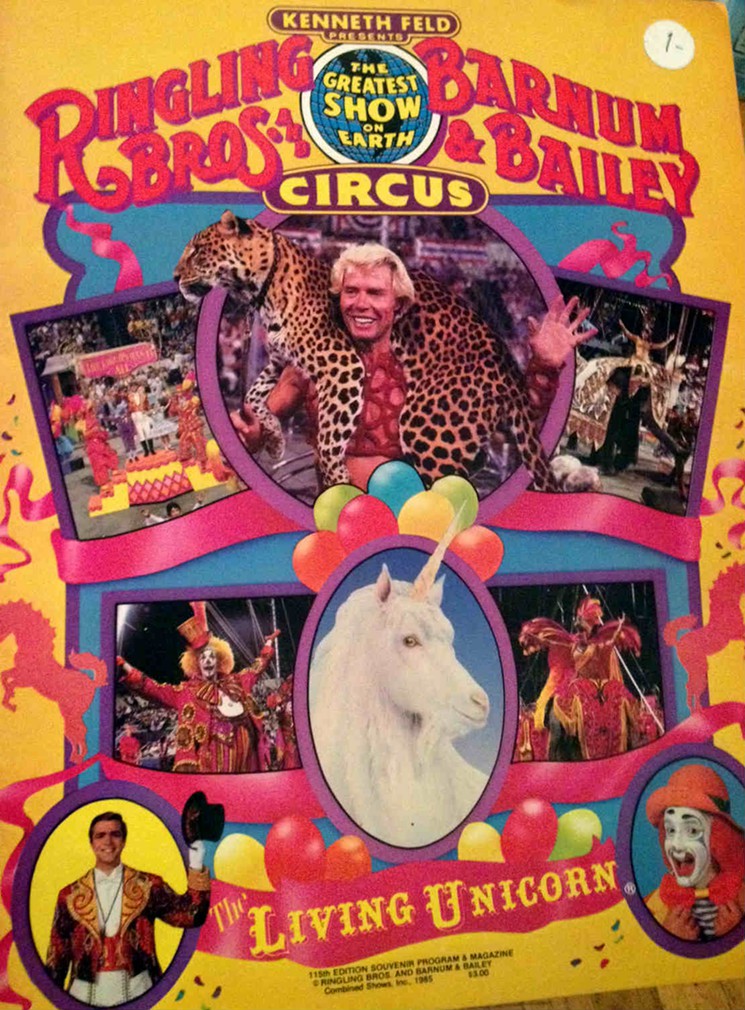
On this day in 1985, Lancelot the Unicorn who had been touring with the Ringling Brothers and Barnum and Bailey Circus — famous for outlandish attractions — was exposed as a fraud.  Audiences were appalled to learn that Lancelot wasn’t a real unicorn at all, just a goat with a horn surgically attached to its forehead.

IF IT HAD ONLY BEEN A NACHO

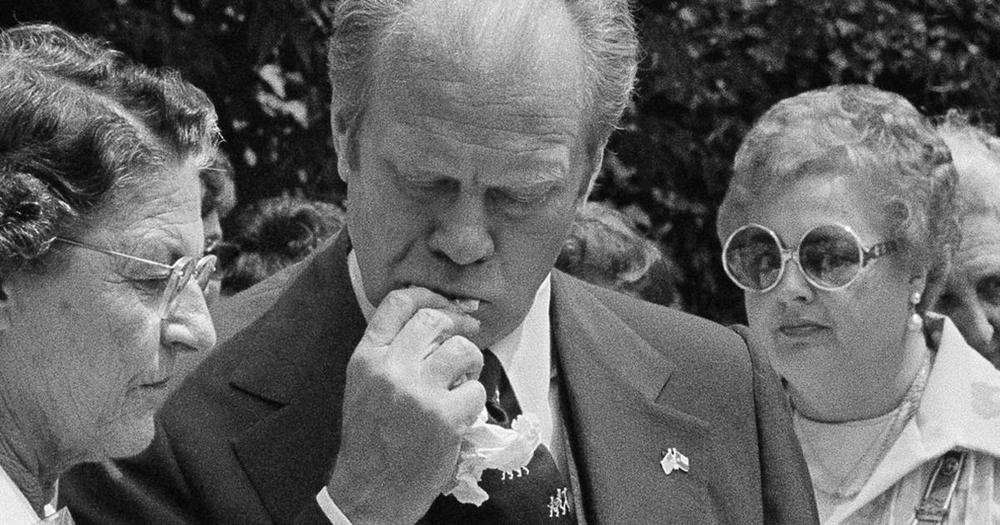
It would seem that in modern politics every president has been forced to deal with a scandal, big or small –vicuna coat, Watergate, Iran Contra, Stormy Daniels. Gerald Ford’s scandal would probably be trivial in comparison to most. But it may have cost him re-election. It was April 10, 1976, in San Antonio, Texas, at the Alamo, where a tiny faux pas morphed into the Great Tamale Incident as the President attempted to eat a tamale without removing the corn husk, playing into his reputation as a bit of a bumbler.

March 27, 1958: They Say Goofy Is a Fellow Traveler

     Nikita Khrushchev was elevated to top commie in the Soviet Union on March 27, 1958. His Cold War relationship with President Eisenhower and the United States was a complex one, certainly more so than the Ego War between the current Russian leader and his previous U.S. bro-hug counterpart.

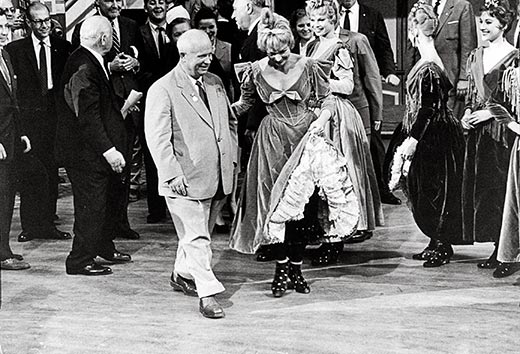
     The following year Khrushchev was in the U.S. for a summit meeting with Eisenhower.   At the Soviet leader’s request, a visit to Hollywood was arranged.  Khrushchev and his wife arrived in Los Angeles, where the day started with a tour of the Twentieth Century Fox Studios in Hollywood and a visit to the sound stage of  Can-Can. Meeting stars Shirley MacLaine and Juliet Prowse pleased the roly-poly dictator even though he had to nyet a chance to dance with MacLaine (probably something to do with the Siberian stare coming from Mrs. K)   A lunch hosted by Frank Sinatra was also a big success even though Sinatra didn’t sing “That Old Bolshevik Magic,” as Nikita requested.

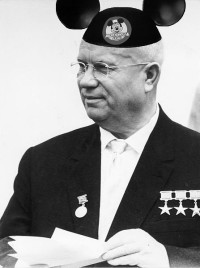
     The day headed downhill when Twentieth Century Fox President Spyros P. Skouras, who wore his anticommunism on his sleeve, got into a bit of a who-will-bury-whom brouhaha with the Russian leader who was known for his temper tantrums.  Shortly afterward, it began to look as though a nuclear exchange were imminent. Meeting Frank Sinatra was nice, but who Nikita really wanted to meet was Mickey Mouse.  His American hosts told him it couldn’t happen.  Security concerns.   Perhaps he’d like to see Cape Canaveral, the White House War Room, the Strategic Air Command. But no Disneyland.  Nicky exploded. “And I say, I would very much like to go and see Disneyland. But then, we cannot guarantee your security, they say. Then what must I do? Commit suicide? What is it? Is there an epidemic of cholera there or something? Or have gangsters taken hold of the place that can destroy me?”

Khrushchev left Los Angeles the next morning, and the Cold War returned to deep freeze.

Put a Cork in It

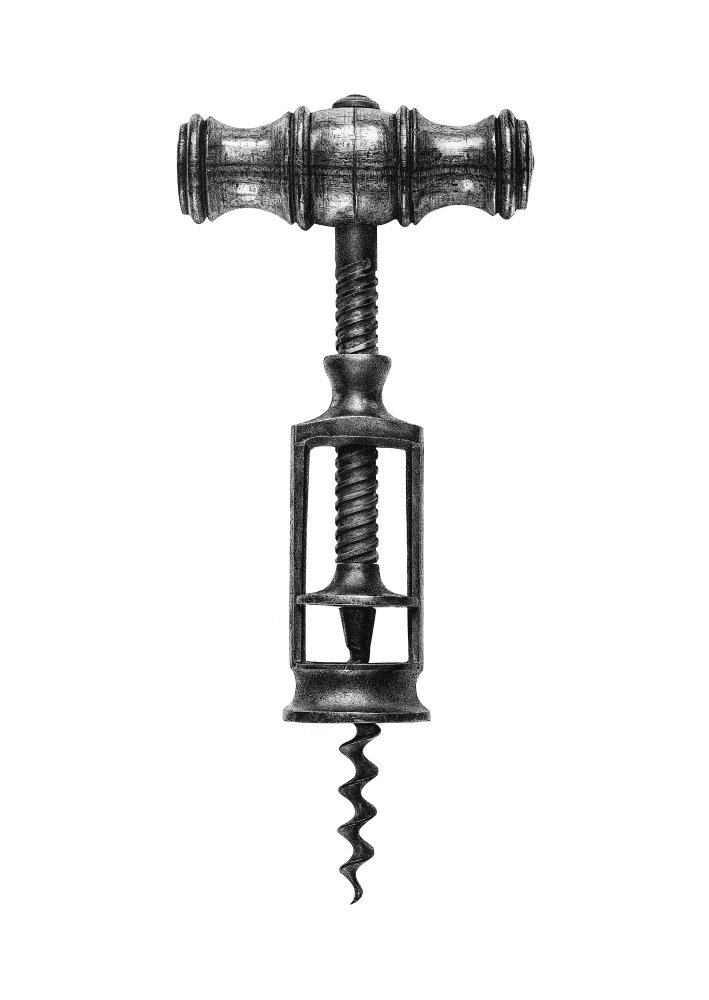
Back through the centuries wine lovers never aged their wines; they consumed it quickly before it went bad.  Then in the 18th century, British glassblowers began to make bottles with narrow necks for wine that made airtight storage possible. Corks were used to seal the bottles. This quickly led to the invention of one of the dandiest little gizmos ever devised — the corkscrew. The design was based on a similar device used to clean muskets. The first corkscrews were T-shaped devices that twisted into the cork and after a certain amount of pulling extracted the cork. Corkscrews were first patented in England and France, then on March 27, 1860, M. L. Byrn of New York City received an American patent.

Since then, hundreds of corkscrews have been designed of every shape, size and mechanics you can imagine — single-lever, double-winged, air pump, electric, mounted. Naturally there are corkscrew books, corkscrew clubs, and corkscrew collectors, helixophiles.

MARCH 20, 689: SOME FOLKS JUST WON’T STAY BURIED

Back in the 7th century on an island in northern Britain, the very holy St. Cuthbert gave up the ghost. The exact date of his departure was March 20, 689. Not only was Cuthbert very holy, he was, you might say, holier than thou, or at least holier than all his peers. He devoted his entire life to converting the half-savage heathens (and there were quite a few half-savage heathens at the time) and praying — lots of praying. Such was his devotion that those about him often wondered if he were not a man but an angel.

Cuthbert was duly shrouded and buried, remaining at rest for some 11 years until some curious monks dug him up to have a peek. They found Cuthbert in perfect condition, which they accepted as miraculous proof of his saintly character. They placed him in a new coffin, leaving him above ground so he might perform miraculous cures.

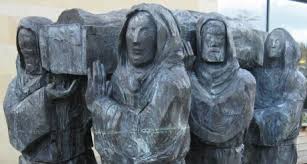
Another 174 years passed and, with Britain facing an invasion by the Danes, the monks (different monks) carried Cuthbert’s still perfect body away and wandered with it from place to place for many years.

Finally in the 11th century, Cuthbert’s body found a permanent home where it was enshrined and enriched with offerings of gold and jewelry from the faithful (there were a lot more of them by the 11th century). In 1104, the body was inspected again and found still fresh. Another 400 years and another inspection.

Three hundred years. It’s 1827 and Cuthbert is past due for inspection. This time, however, the inspectors were much more rigorous, and it was discovered that Cuthbert was an ordinary skeleton swaddled up to look whole, including plaster balls to plump out the eye holes. It would appear that some monks along the way had been quite naughty. St. Cuthbert himself serves as a fine example of a person who was far more interesting dead than alive.

Deciders Unite

The Whigs didn’t last long as as political party. Formed in the 1830s out of annoyance with Andrew Jackson, they gave us four presidents — William Henry Harrison, John Tyler, Zachary republicanTaylor and Millard Fillmore, commonly known by their shared nickname, Who? (not to be confused with the rock group of the same name). As is the case with many political parties, they had disagreements over tents, finding themselves unable to deal with the concept of big ones, and eventually tore themselves asunder with internal disagreements.

The semi-official date of the party’s actual death was March 20, 1854. On that date, a number of don’t wanna-be Whigs met in Ripon, Wisconsin, and the result of that meeting was the birth of the Republican party, which lasted until 2016.


February 28, 1844: Love Story with Cannons

Cruising down the Potomac on a pleasant day in late winter could serve as the backdrop for romance, despite the fact that your vessel is not a gondola or a sailboat but a U.S. Navy steam frigate, and despite the fact that practically every dignitary in Washington is along for the ride.

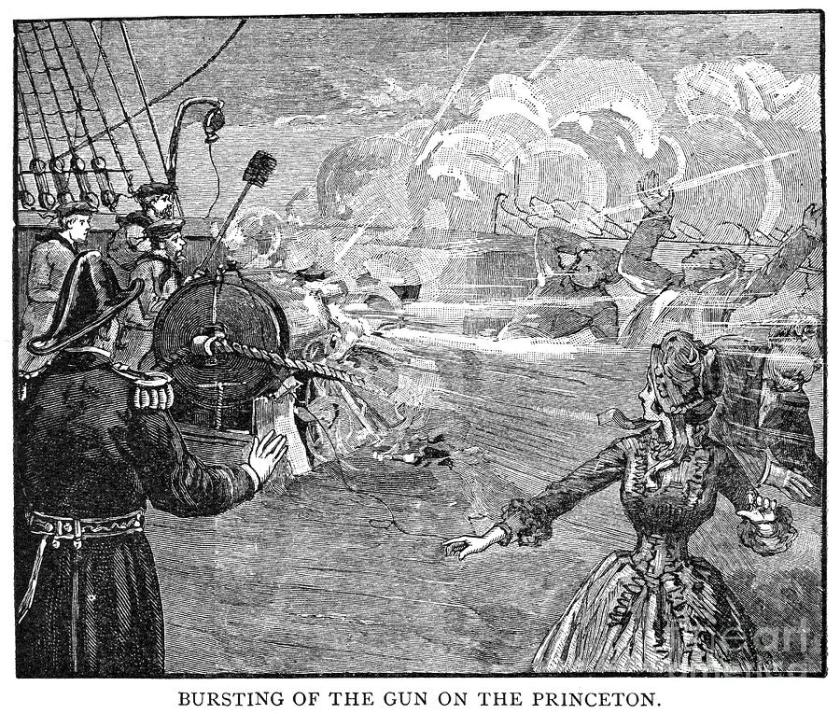
Okay, not so romantic, but if you’re the President of the United States, recently widowed, and you’ve just proposed marriage to an enchanting 20-year-old, it may be the best you can do. And so it was, that President John Tyler (Tyler Too of Tippecanoe-And fame), was on board the USS Princeton on February 28, 1844, for a demonstration of a fancy new 27,000-pound cannon lovingly called the Peacemaker. Julia Gardiner, whose yes vote the President was seeking, was there with her sister and father David, a wealthy New Yorker. The co-designer of the cannon, John Ericsson, was on board; so was the Secretary of War, other cabinet members, congressmen, political and business dignitaries, reporters and other various hangers on. An intimate little gathering. One can imagine 400 breaths being held in anticipation of Julia’s answer.

But first we must fire that cannon. Designer Ericsson tried to persuade, pleaded with, the ship’s captain not to actually fire the weapon before such a crowd, fearing it had not been adequately tested. The captain, however, was having none of it; he had a big audience and a big gun, and he was going to have a big bang. The Peacemaker was fired, and it made a jolly big noise, much to the delight of the audience who cheered and applauded and yelled for more (perhaps this is how wars are started). Once more, the cannon was fired and once more the giddy observers whooped, then they all headed below for toasts and libations.

The Secretary of War (being the Secretary of War) was too enthused to settle for just two shots (of either kind). He insisted that the cannon be fired once more in the direction of Mount Vernon, as a tribute to George Washington.  The cannon was fired, and the third time was not a charm. Mount Vernon was left standing, but the cannon itself exploded into the worst peacetime disaster in the nation’s short history, killing several on board including a couple of cabinet members and the father of the would-be bride. While others counted the dead left by the explosion, oddsmakers recalculated the President’s chances of getting the desired answer out of Julia.

The ship docked, and in a brilliant display of presidential heroics, Tyler carried Julia off to safety. Her answer was delayed a bit, but it was an affirmative, and later that year, Julia became Mrs. Tippecanoe and Tyler Too.

chan9


January 30, 1798: Was That a Yea or a Nay?

The US House of Representatives, known for its deliberative diligence, lyonduelgood comradeship, and decorous behavior, was not always thus. Take for instance the morning of January 30, 1798. Members had just concluded a vote on the impeachment of a Tennessee senator, and the House had recessed to tally ho the ballots. Members stood about chatting informally, waiting for the results. One member, Representative Matthew Lyon of Vermont was waxing passionate about another bill before the House. During his rant he took to task Connecticut politicians, whom he accused – rather loudly – of hypocrisy and corruption. He also mentioned greed and a few other deadly sins.

Not surprisingly, given the volume of his oratory, he was heard by one of the very men he disparaged, one Representative Roger Griswold of Connecticut. Griswold fumed, then shouted back, dredging up Lyon’s temporary dishonorable discharge from the Continental Army. Lyon either did not hear Griswold’s comment or chose to ignore it. Griswold naturally felt duty-bound to repeat the comment at closer range; he approached Lyon, grabbed his arm, and repeated once more. Lyon, insulted and embarrassed before his peers, responded as any gentleman would – he spit in Griswold’s face. Without a word, Griswold wiped away the spit and exited the chambers. The Committee of Privileges immediately drew up a formal resolution calling for the expulsion of Matthew Lyon for “a violent attack and gross indecency.”

The two men nursed their respective angers until they were bound to boil over again, which they did on the morning of February 15.  Pandemonium, it is fair to say, broke out when, without a word of warning, Representative Griswold stormed across the chambers to where Lyon sat preoccupied with correspondence of some sort. Cursing him as a “scoundrel,” Griswold pounded the Vermont Republican’s head and shoulders with a thick, hickory walking stick. A witness described the attack:

“I was . . . interrupted by the sound of a violent blow. I raised my head, and directly before me stood Mr. Griswold laying on blows with all his might upon Mr. Lyon, who seemed to be in the act of rising out of his seat. Lyon made an attempt to catch his cane, but failed — he pressed towards Griswold and endeavored to close with him, but Griswold fell back and continued his blows on the head, shoulder, and arms of Lyon who, protecting his head and face as well as he could, then turned and made for the fireplace and took up the fire tongs. Griswold dropped his stick and seized the tongs with one hand, and the collar of Lyon by the other, in which position they struggled for an instant when Griswold tripped Lyon and threw him on the floor and gave him one or two blows in the face.”

The combatants were separated, and Lyon retreated to the House water table; but Griswold approached him again, and Lyon lunged forward with the fire tongs and initiated a second brawl. As Representative Jonathan Mason commented, the central legislative body of the United States of America had been reduced to “an assembly of Gladiators.” A lesson, perhaps, for today’s legislators, although the House of Representatives has become a place of cooperation and reasoned debate where no harsh words, let alone blows, are ever exchanged. Although it’s rumored that Marjorie Taylor Greene beats up fellow legislators and takes their lunch money.

With a Hearty Hi Yo Silver

That iconic Robin Hood of the Old West, the Lone Ranger, made his radio debut in 1933  He and his faithful companion Tonto pursued and vanquished black hats for more than 20 years and 3,000 episodes until 1956.  From 1949 to 1957, they hi yo silvered on TV as well.  Who was that masked man whose selfless heroism and defense of the innocent and helpless tamed the West? Well it certainly wasn’t Marjorie Taylor Greene.


His Majesty, the Queen

“I’m sorry you don’t exist,” said Alice, hoping to comfort the Dodo who looked like he might cry at any moment. “But what is a tweetstorm?”

“A tweetstorm is like a shotgun filled with mean words. The Queen uses it to show his great displeasure.”

His displeasure? I don’t understand.”

“Of course you don’t understand,” said the Dodo. “You’re a girl.”

“I resent that.”

“I imagine so. But some people have to be girls.”

“I mean I resent your suggesting that girls are somehow inferior.”

“It wasn’t my idea,” said the Dodo. “The Queen has decreed it so.”

“Why would she . . . ?

“He.”

“Are you saying the Queen is a he?”

“I’m only saying what is so.”

“Why is he a Queen and not a King?”

“Queens are more statuesque, better looking, smarter and more powerful. That’s what he says. And queenliness is next to godliness, after all.”

“And he, the Queen, doesn’t like girls?”

“Well, he does like to grab them,” said the Dodo.

“That’s awful,” said Alice angrily.

“He does have big hands and a big . . .”

“Heart,” interjected the Auk, speaking for the first time. “We try not to notice. It’s easier that way.”

“He says they like it,” said the Dodo. “And who wouldn’t want to be grabbed by someone as important as the Queen?”

“Me, that’s who,” Alice growled.

This conversation was interrupted by the Emu who held up a smart phone and announced: “Incoming tweet.”

They all gathered around and read: “White Knight and his gang of 13 wicked democreeps are DESTROYING our GRATE country. Dumb White Rabbit recused himself. No loyalty. SAD!!”

And another:  Knight is no white knight.  He’s a black night, black black, black. Black Rabbit too. Lyin’ Dodo, Little Auk, Crooked Emoo, Leakin’ Ostrich, Sleepy Devil. All lowlifes who I don’t know! Off with there HEADS!!”

The animals began to sob and lament the unfairness of their situation, giving Alice the perfect opportunity to slip away and continue her exploration.

Stay tuned.

Previously: 

Going Down,  

Caucus Race