Frank Capra said that it was his favorite of the many movies he made throughout a phenomenal career. He screened it for his family every Christmas season. Yet it’s initial 1946 release at the Globe Theater in New York did not bring about yuletide euphoria and visions of sugar plums. It’s a Wonderful Life premiered to mixed and sometimes dismissive reviews, but it went on to become one of the most critically acclaimed films ever made, garnering a permanent spot in every list of the top films of the last century.
From its very beginning, it did not inspire great expectations. It was based on an original story “The Greatest Gift”written by Philip Van Doren Stern in 1939. After being unsuccessful in getting the story published, Stern made it into a Christmas card, and mailed 200 copies to family and friends in 1943. In 1944, RKO Pictures ran across the story and bought the rights to it for $10,000, hoping to turn the story into a vehicle for Cary Grant. Grant made another Christmas movie, The Bishop’s Wife, instead, and the story languished on a shelf until RKO, anxious to unload the project, sold the rights to Capra in 1945.
Capra, along with several other writers, including Dorothy Parker, created the screenplay that Capra would rename It’s a Wonderful Life.
The town of Seneca Falls, New York claims that Capra modeled Bedford Falls after it. The town has an annual “It’s a Wonderful Life” Festival in December, a Hotel Clarence, and the “It’s a Wonderful Life” Museum. The town of Bedford Falls itself, however, was built in Culver City, California, on a 4-acre set originally designed for the western Cimarron. Capra added a working bank and a tree-lined center parkway, planted with 20 full grown oak trees. Pigeons, cats, and dogs roamed at will.
The dance scene where George and Mary end up in the swimming pool was filmed at the Beverly Hills High School. The pool still exists.
Back in the 6th century BC, Greek theatrical performances were generally dithyrambs, choral offerings featuring stories from mythology sung by a chorus of anywhere from a dozen to fifty singers They usually wore masks and might even dance a little. Whatever they did, they did in lockstep.
Then on November 23, 534 BC, a member of one of these choruses known as Thespis of Icaria stepped out of the anonymity of the chorus and spoke several lines not as himself, but portraying the character of the Greek God Dionysus. Well, this had never been done before. No one had ever assumed the character of another person for storytelling Thespis thus became the world’s first actor.
This new idea quickly caught on, and individual actors began to portray different characters in their stories which they now called tragedies. Pretty soon scores of Greeks were saying to each other “Gee, we could put on a play in Farmer Brown’s barn.” And taking their tragedies on the road.
Thespis was the most popular actor of the day, winning the first wooden horse for best actor in a tragedy. And he took his shows on the road, carrying with him costumes, masks and props from town to town. This made him not only the father of theater but also the father of theatrical touring. And actors throughout history have called themselves Thespians in his honor.
Let’s Get a Recording of That Greek Chorus
The scene is the Palais Royale Saloon in San Francisco, November 23, 1889. Entrepreneur Louis Glass has installed a machine destined to become an overnight sensation, and find a permanent spot in the psyche of the nation, even the world. He called his device the “nickel-in-the-slot player” a name that would certainly need a bit of massaging in the future.
What it played was music. Inside a handsome oak cabinet was an electric phonograph. Four stethoscope-like tubes were attached to it, each operating individually after being activated by the insertion of a coin. Four different listeners could be plugged into the same song at the same time! In a nod to sanitation, towels were supplied to patrons so they could wipe off the end of the tube after each listening.
The success of the “nickel-in-the-slot player” eventually spelled the demise of the player piano, then the most common way of providing popular music to saloon patrons, notorious for their love of music.
Most machines were capable of holding only one musical selection, the automation coming from the ability to play that one selection at will. Obviously, after each patron had listened to that one song several times, the novelty wore off and the player went idle. In 1918, another entrepreneur solved that problem with an apparatus that automatically changed records. Ten years later, enter Justus P. Seeburg, who combined an electrostatic loudspeaker with a coin-operated record player that gave the listener a choice of eight records.
This machine was pretty cumbersome: it had eight separate turntables mounted on a rotating Ferris wheel-like device, allowing patrons to select from eight different records. Later versions included Seeburg’s Selectophone, with 10 turntables mounted vertically on a spindle. By maneuvering the tone arm up and down, the customer could select from 10 different records.
There was still no decent name for these devices. That came in the 1940s, when person or persons unknown dubbed it a jukebox, a reference to juke house, slang for a bawdy house, a favorite location for the devices. All that remained necessary in the evolution of the jukebox was the addition of a healthy helping of rock and roll.
On the screen, a man steps from behind a curtain to tell us we are about to see “one of the strangest tales ever told. It deals with the two great mysteries of creation; life and death. I think it will thrill you. It may shock you. It might even horrify you. So, if any of you feel that you do not care to subject your nerves to such a strain, now’s your chance to uh, well,––we warned you!!”
It’s November 21, 1931, and the warning is all about Frankenstein, the gothic horror film based on the novel by Mary Shelley. There have been countless films over the years featuring the famed monster but this one is the daddy of them all. Audiences and critics all loved it, and it, along with Dracula released earlier in the year, saved Universal Pictures.
The story is well known. Young Henry Frankenstein has this notion. He wants to create a living being from dead spare parts, mostly stolen. Perhaps he played Mr. Potatohead too often as a child. Things move along swimmingly until the time comes to give the creation a brain. Frankenstein’s assistant, Fritz the Hunchback, botches the brain acquisition, dropping the good brain and substituting a bad brain for it. The assembled creature is brought to life amid an amazing display of electrical pyrotechnics and shouts of “It’s alive!”
Karloff (without the Boris) is both frightening and sympathetic as the monster. He kills a lot of people. It’s not that he’s really bad, he’s just misunderstood. Nevertheless, the villagers form a mob and hunt him down, trapping him in a windmill and setting it ablaze.
One of the most famous and controversial scenes was cut from the original and not restored until the 1980s:
Humor He Wrote
American humorist Robert Benchley died on November 21, 1945, (born 1889) after a writing career that took him from the Harvard Lampoon to Vanity Fair and The New Yorker. Although he described himself as not quite a writer and not quite an actor, he enjoyed success as both. His topical and absurdist essays, particularly at The New Yorker gained him both recognition and influence. He was also one of the members of the group that made up the fabled Algonquin Round Table. As a character actor, he appeared in such films as You’ll Never Get Rich, Bedtime Story, the Crosby/Hope Road to Utopia, and Alfred Hitchcock’s Foreign Correspondent.
It took me fifteen years to discover that I had no talent for writing, but I couldn’t give it up because by that time I was too famous.
Anyone can do any amount of work provided it isn’t the work he is supposed to be doing at the moment.
A dog teaches a boy fidelity, perseverance, and to turn around three times before lying down.
I have tried to know absolutely nothing about a great many things, and I have succeeded fairly well.
New York – The city where the people from Oshkosh look at the people from Dubuque in the next theater seats and say “These New Yorkers don’t dress any better than we do.”
The name Frances Allison probably doesn’t ring a bell with most people. In the days of live programming and test patterns, the radio comedienne and singer became well known to those who huddled around the TV set early evenings to watch the misadventures of the Kuklapolitan Players. She was better known simply as Fran, and she was one-third of the trio Kukla, Fran and Ollie.
Created by puppeteer Burr Tillstrom, the show got its start as Junior Jamboree locally in Chicago, on October 13, 1947. Renamed Kukla, Fran and Ollie, it began airing nationally on NBC in early 1949. Although the show, all puppets except for Fran, was originally targeted to children, it was soon watched by more adults than children. It was entirely ad-libbed.
Fran assumed the role of big sister and cheery voice of reason as the puppets engaged each other in life’s little ups and downs. It was a Punch and Judy kind of show but with less slapstick and more character development. Kukla was the nerdy leader of the amateur acting troupe, plucky and earnest, and Ollie (short for Oliver J. Dragon) was his complete opposite, a devilish one-toothed dragon who would roll on his back when sucking up or slam his chin on the stage when annoyed. Joining them were Madame Oglepuss, a retired opera diva; Beulah, a liberated witch; Fletcher Rabbit, a fussy mailman, and several others.
KFOs fan base included Orson Welles, John Steinbeck, Tallulah Bankhead, and Adlai Stevenson among many others. James Thurber wrote that Tillstrom and the program were “helping to save the sanity of the nation and to improve, if not even to invent, the quality of television.”
Kukla, Fran and Ollie ran for ten years until 1957. Mister, we could use a Kukla, Fran and Ollie today.
To Swazzle or Not To Swazzle
Kukla and Ollie didn’t come on the scene until the mid-20th century; but puppets has already been around for some 4,000 years. And they come in many different flavors: marionettes, finger puppets, rod puppets. The Tillstrom characters are glove puppets, controlled by a hand inside the puppet.
Punch and Judy are the most famous of this type of puppet. Their first recorded appearance in England was during the Restoration when King Charles II replaced wet blanket Oliver Cromwell and the arts began to thrive. Punch and Judy shows generally feature the fine art of slapstick with characters hitting each other as frequently as possible.
Punch speaks with a distinctive squawk, created by means of a swazzle, an instrument held in the mouth while speaking. Punch’s cackle is deemed so important in Punch and Judy circles (yes, there are Punch and Judy circles) that a non-swazzled Punch is considered no Punch at all.
“I knew Punch. Punch was a friend of mine. Senator, you’re no Punch.”
Sometimes great ideas just come falling from out of nowhere, like that apple that beaned Isaac Newton while he sat under a tree daydreaming. Such was the case with Frank Epperson, born on August 11, 1894. Frank wasn’t a scientist or an inventor or any such thing. In fact, he was only 11 years old when he had his Eureka! moment.
Little Frank, who lived in Oakland, California, loved a soda concoction made by dissolving a flavored powder in water. One day as he was mixing his drink, he was distracted by something or other and left the drink with his stirring stick on the porch, completely forgetting about it.
Well, didn’t the Oakland temperatures plummet that night to a record low. The next morning Frank discovered his drink, completely frozen, the stirring stick standing straight up. You guessed it — the very first Popsicle. Only Frank called them Epsicles when, a few years later, he began to sell them to the public at Neptune Beach and later when he applied for a patent for his “frozen confectionary.”
Somewhere along the way, he changed the name to Popsicle, and in 1925 he sold the rights to the Joe Lowe Company of New York. The Popsicle eventually acquired some cousins — Fudgsicle, Creamsicle and Dreamsicle — and in 1989 it was swallowed up by Good Humor, a subsidiary of corporate giant Unilever.
Along Came Popsicle Pete
In 1939, Popsicle Pete became the official spokesman for Popsicle products. He was introduced on the Buck Rogers radio program, urging listeners to send in wrappers and win neat prizes. Popsicle Pete was . . . well, make your own characterization:
And Interstellar Dan
On this day in 1989 , Vice President Dan Quayle uttered these memorable words: “Mars is essentially in the same orbit. Mars is somewhat the same distance from the sun, which is very important. We have seen pictures where there are canals, we believe, and water. If there is water, that means there is oxygen, that means we can breathe.”
A team of linguists continues to study the meaning of the quote.
In 1927, thrill-seekers plunked down their quarters to take a ride on the Cyclone, a new attraction at Brooklyn’s Coney Island. Noting the success of the Thunderbolt in 1925 and the Tornado in 1926, Jack and Irving Rosenthal jumped into the roller coaster business to the tune of about $175,000, and the Cyclone was built. It would take only 700,000 riders to recoup their investment. The Cyclone was built on the site of America’s first roller coaster, known as Switchback Railway, which had opened in 1884.
The Cyclone remained extremely popular through the years and has accumulated its share of legends. One is from 1948, when a coal miner with aphonia, the loss of speaking ability, took a ride. He had not spoken in years, but screamed as the Cyclone plummeted down the first drop, and said “I feel sick” as his train returned to the station, whereupon he fainted.
Statistics were never kept to tell us how many other people got sick on the Cyclone or how many threw up. And of course there were more serious incidents. Two men were killed in separate incidents during the 1980s, both Darwin Award contenders who felt the need to stand up during the ride. One fell out and the other was whacked by a crossbeam.
The Cyclone began to deteriorate during the 1960s and was shut down in 1969. Two years later, the city of New York bought it for one million dollars. It was condemned a short time later and, in 1972, it was nearly destroyed to make way for an expansion of the New York Aquarium. A “Save the Cyclone” campaign did just that, and it was refurbished and reopened in 1975. The Cyclone was declared a city landmark in 1988 and a National Historic Landmark in 1991.
The world premier of Giacomo Puccini’s last opera “Turandot” was held at Milan’s La Scala on April 25, 1926, two years after his death. Arturo Toscanini conducted. Toward the end of the third act, Toscanini laid down his baton, turned to the audience and announced: “Here the Maestro died.” Puccini had died before finishing the opera. Subsequent performances at La Scala and elsewhere included the last few minutes of music composed by Franco Alfano using Puccini’s notes. A highlight of the opera is “Nessun Dorma,” probably the most famous aria in all of opera.
Down at the End of Lonely Street
Elvis Presley scored his first number one hit on the Billboard Pop 100 on this date in 1956. Recorded and released as a single in January, “Heartbreak Hotel” marked Presley’s debut on the RCA Victor record label . It spent seven weeks at number one, became his first million-seller, and was the best-selling single of 1956. The song was based on a newspaper article about a lonely man who committed suicide by jumping from a hotel window.
Samuel Fahnestock was given a patent for the first soda fountain in 1819. Carbonated mineral water was all the rage at the time. Joseph Priestley had created the first man-made carbonated water back in 1767, and Jacob Schweppes had developed a method of mass producing it, quickly leading to the production of different brands of soda and different flavors. Fahnestock’s soda fountain allowed these drinks to be sold by the glass. Oddly enough, it took more than fifty years for someone to create the first ice cream soda, even though ice cream had been around since at least the 10th century.
At the peak of their popularity in the 1940s and 1950s, soda fountains were everywhere – in pharmacies, ice cream parlors, candy stores, department stores, and five-and-dimes. They were public meeting places (or hangouts, when occupied by teenagers).
Soda fountains required the services of a soda jerk. The name referred not to the personality of the person serving sodas but to the jerking action used to swing the soda fountain handle back and forth when dispensing soda. The position of jerk was actually quite sought after and usually came only after an extended period of service in less desirable positions. The soda jerk was the star of the soda fountain show.
The decline of the soda fountain began in the early 1950s when the Walgreens chain introduced full self-service drug stores. Hello Dairy Queen and McDonalds and supersizing; goodbye chocolate soda with two straws and two cents plain.
Wouldn’t Bet on This Horse to Show
Back in 1184 BC, there were no soda fountains. There were jerks, however, the most infamous of them being the Trojan guy who on April 24 said: “Look at that cool wooden horse. Let’s bring it in and have a party.” The Trojan Horse figures mightily in the war between the Trojans and the Greeks. The Greeks who had been trying for the longest time to sack Troy pretended to sail away, leaving the large wooden beast as a going away gift. But weren’t there a gaggle of Greeks hiding inside. Laocoon, a Trojan priest warned the others that he feared the Greeks bearing gifts. Perhaps if he had been more precise, counseling the Trojans to beware a gift bearing Greeks or not to look a gift horse in the mouth or you might see a Greek looking back at you, the outcome may have been different. But it wasn’t.
The Trojan Horse became a symbol of Greek might and was revered through the ages, resting at its home in the Trojan Horse National Park. Inexplicably, the Greeks tired of it and it was eventually converted to a condo. The horse which had once been filled with ancient Greek warriors came to house only five Greeks, the Thermopolis brothers — Dmitri, Ergo, Aristotle, Zorba and Smitty.
Call it destiny. Two men stranded in Kansas City when a storm closed the airport met in a hotel lobby, engaged in conversation, and – go figure – discovered they each had profound worries about the future of the barbershop quartet. This was not just empty lamenting on the part of Owen C. Cash and Rupert I. Hall; these founding fathers acted, and the Society for the Preservation and Encouragement of Barber Shop Quartet Singing in America (SPEBSQSA, as it’s more familiarly known) was born. They wrote a letter that became a mission statement:
“In this age of dictators and government control of everything, about the only privilege guaranteed by the Bill of Rights not in some way supervised or directed is the art of barbershop quartet singing. Without a doubt, we still have the right of peaceable assembly which, we are advised by competent legal authority, includes quartet singing.
“The writers have, for a long time, thought that something should be done to encourage the enjoyment of this last remaining vestige of human liberty. Therefore, we have decided to hold a songfest on the roof garden of the Tulsa Club on Monday, April 11, 1938, at 6:30 pm.”
Twenty-six men attended that first rooftop meeting. Attendance at subsequent meetings multiplied rapidly, and at the third meeting, 150 harmonizers stopped traffic on the street below. A reporter for the Tulsa Daily World put the story on the national news wires and the rest is history. The Society for the Preservation and Encouragement of Barber Shop Quartet Singing in America was born. That acronym SPEBSQSA was the founders’ way of demonstrating that one could be a barbershop quartet enthusiast and still have a sense of humor; it was a parody of the New Deal’s “alphabet soup” of acronyms, and the society has said “attempts to pronounce it are discouraged.”
Ninety years passed (as years will) and the SPEBSQSA evolved (or devolved, perhaps) into the Barbershop Harmony Society. It boasts more than 20,000 enthusiastic members, although unfortunately they are not always singing off the same sheet. Not quite the Hatfields and McCoys, but the Kibbers and the Libbers as they’re known might value harmony but philosophically they practice little of it. We’ll explore this rift, but first we must digress.
The musical style of barbershop dates back to 17th century England. Barbers of course all sing, and the barbers of merry olde were no exception. They generally kept a lute or a flute among the razors to serenade customers waiting for a shave and a haircut, two pence. Patrons, having just come from a nearby alehouse, would join in and the resulting cacophany became known as barber’s music. Centuries passed (as centuries will) and barber’s music grew more refined and subject to rules.
Somewhere it is written that barbershop quartets must have four singers. But, and here’s where it gets a little weird, according to Spin.com, which knows such things: “four striped-shirt, straw-hatted, bow-tied bodies — but five voices. The second tenor sets the stage with a lead melody line, which the first tenor lays a high harmony on. The baritone singer handles mid-range, while the bass, the deepest voice of the four, lays a solid foundation. But when the overtones of these four pitch-perfect voices unite and merge, an invisible fifth voice emerges from the ether, an everywhere-but-nowhere aural apparition not unlike the effect of Buddhist monks chanting in a massive ancient temple. This unified fifth-voice phenomenon is known as harmonic coincidence” not to be confused with harmonic concurrence or harmonic convergence.*
As the genre matured, attempts were made to modernize. Younger members joined the old guard, bringing with them their doo-wop and pop and what-have you, much to the chagrin of the purists — the Kibbers (Keep It Barbershop) as opposed to the Libbers, liberal approach to barbershop.
*Peace Will Guide the Planet
Two days in August of 1987 that marked a grand celestial alignment of the Sun, the Moon, Mars, Mercury, Venus, Jupiter, Saturn, Neptune, and Uranus. Convergence enthusiasts believed that this conjunction would usher in a new age of universal peace — with good karma, good manners and good posture, sort of like the Age of Aquarius** as celebrated in song by a group of five voices, all of which were actual people, therefore not a quartet, barbershop or otherwise.
** Not to be confused with the Age of Aquariums, the period during the 1960s and ’70s, during which it was de rigueur to have a tank of tropical beasties such as neon tetras, seahorses and angel fish.***
*** Not to be confused with Angel Eyes, a song popularized by Frank Sinatra with the haunting conclusion “Excuse me while I disapp . . .”
When the swallows come back to Capistrano/ That’s the day I pray that you’ll come back to me.
And the day is today, St. Josephs Day, although St. Joseph has nothing to do with swallows. But more of that later.
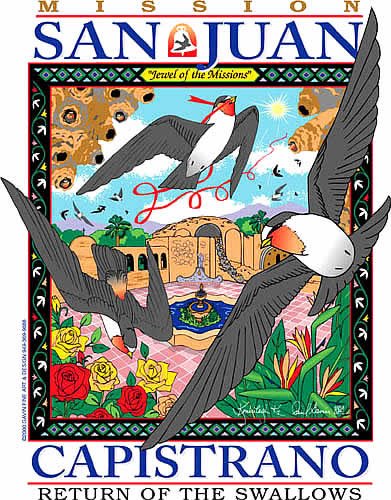
Like feathered clockwork, cliff swallows year after year migrated from Goya, Argentina, to the Mission San Juan Capistrano in southern California. Every year the good townsfolk of San Juan Capistrano welcomed them back with an annual Swallows’ Day Parade with balloons and food trucks, politicians kissing babies and other festive events. And flocks of tourists would come and everybody was happy.
Was happy. For in 2009, the fabled swallows were no shows. A swallowless decade followed, during which folks at the mission tried unsuccessfully to lure their fickle feathered friends back.
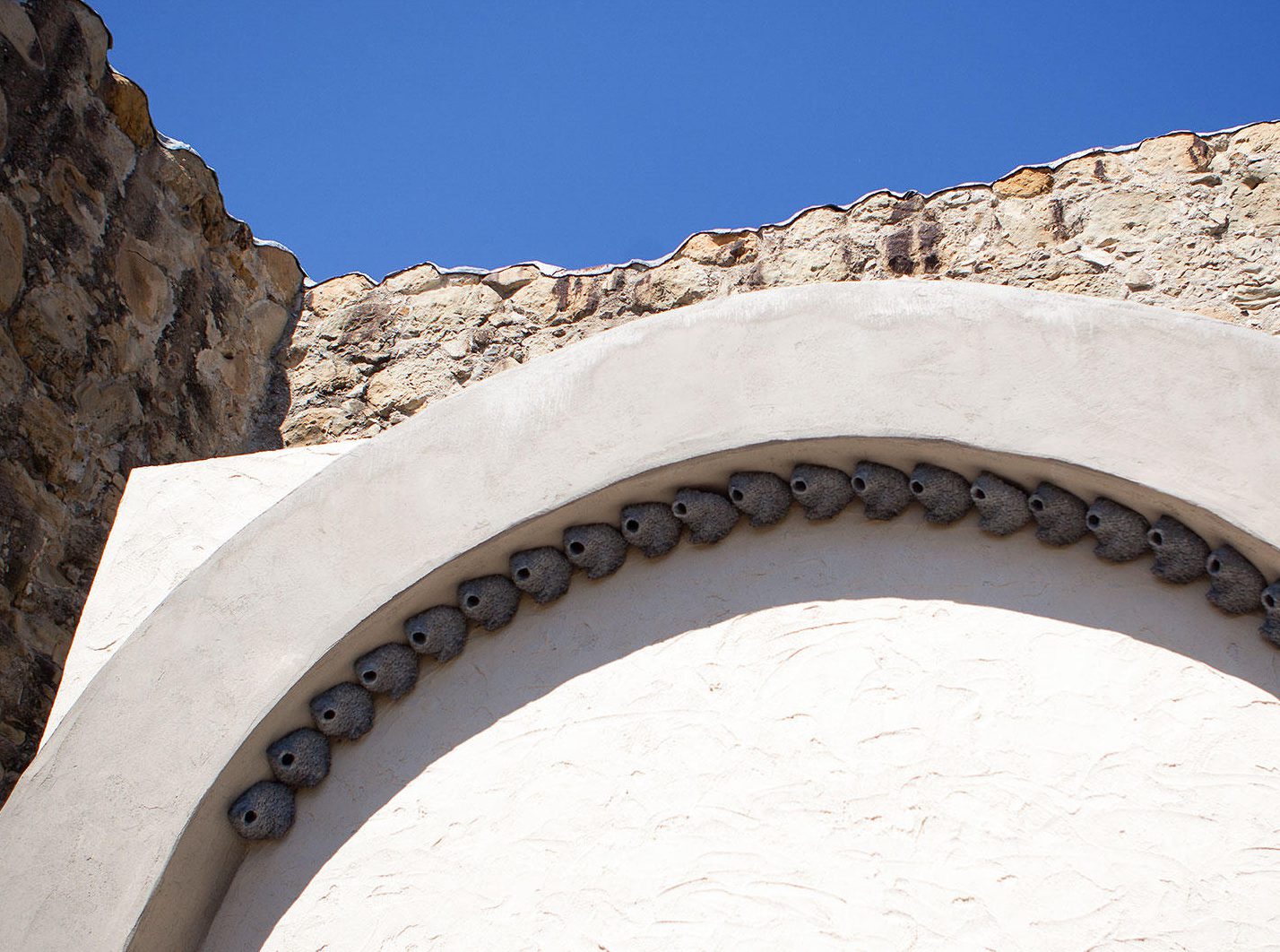
In 2016, swallow experts created faux nests attached to a large temporary wall in hopes that the birds would move in and eventually spill over and start using the actual mission structures. A couple of years ago, two real nests were discovered at the mission and several swallows were spotted in flight. Swallow lovers hopes were riding high.
Hold your breath no longer. They’re back! And the villagers are happy once again, dancing round and round and singing “When the swallows come back to Capistrano . . .”
About That St. Josephs Day
Joseph was mostly known for being the father of Jesus Not the actual father of course, but kind of a placeholder for someone else. And the real father that Joseph was standing in for was, we are told, the big guy himself. Or as some would say the one and only god. So Joseph, a carpenter and all around nice guy schmuck married the pregnant Mary to save her rep when the big guy asked him to. Of course refusing an ask by the big guy might just be inviting a smiting.
When the Pigeons Come Back to China
Pigeons are generally considered the Lower Slobbovia of the bird world. Losers, Nobodies, Butts of avian insults everywhere, Unlike swallows, they wouldn’t be welcomed back year after year. Because they never go away. But hold on you swallows, orioles and cardinals turning up your beaks. There are pigeons and there are pigeons. And in the pigeon pantheon, racing pigeons are the teen idols.
Racing pigeons — win, place, show, poop on the judge’s car.
Known for their remarkable speed and sense of direction,. They can fly up to 70 miles per hour and never have to stop and ask for directions.
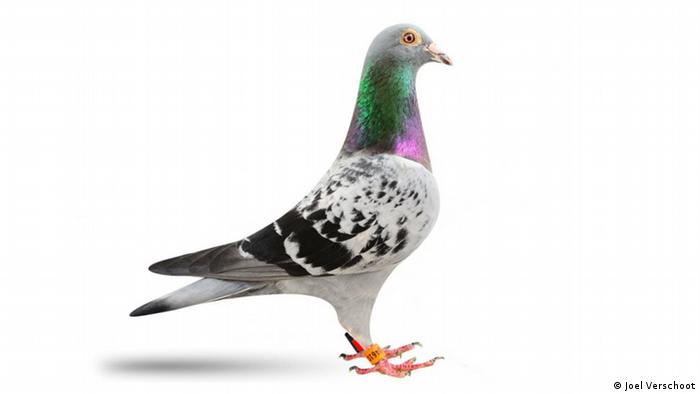
Enter Armando. Yes, a pigeon with a first name. And a reputation. Armando is the fastest pigeon in the world. And people would welcome him back in a heartbeat. As a matter of fact — take note you eagles and ospreys — an anonymous gentleman in China wanted him enough to pony up $1.4 million in an auction. No more racing for Armando. He’s going to be busy fathering hundreds of Armando Jrs. And pooping wherever he wants.
The Swallows’ Retort
“When the Swallows Come Back to Capistrano” was written by Leon René and first recorded by The Ink Spots in 1940, reaching #4 on the charts. It has been recorded by Glenn Miller, Xavier Cugat, Gene Krupa, Fred Waring, Guy Lombardo, Billy May, the Five Satins, Elvis Presley, and Pat Boone to name just a few. How many people have recorded


 Enter Armando. Yes, a pigeon with a first name. And a reputation. Armando is the fastest pigeon in the world. And people would welcome him back in a heartbeat. As a matter of fact — take note you eagles and ospreys — an anonymous gentleman in China wanted him enough to pony up $1.4 million in an auction. No more racing for Armando. He’s going to be busy fathering hundreds of Armando Jrs. And pooping wherever he wants.
 Wretched Richard's Almanac