JUNE 19, 1885: BEWARE THE FRENCH BEARING GIFTS

In 1885, the French ship Isere sailed into New York Harbor carrying 214 crates filled with 350 libertypieces of a 305-foot high jigsaw puzzle that had been crafted in France and would, over the next four months, be re-assembled on an awaiting pedestal on Bedloe Island (now called Liberty Island) – there to stand for the next 139 years (so far).

Once constructed, this would, of course, be the Statue of Liberty or “Liberty Enlightening the World,” to those not on a first-name basis. It was a gift from France to the United States back during the two countries’ honeymoon days.   Actually it was something of a joint enterprise, the French providing the statue and the U.S. the pedestal on which it would stand.

French sculptor Frederic Auguste Bartholdi began designing the statue in 1876, working with Alexandre Gustave Eiffel, the designer of the Eiffel Tower. Richard Morris Hunt, designer of New York City’s first apartment building, designed the pedestal. Given his background, one might have expected his pedestal to house several luxury apartments, a missed funding opportunity: “Give me your tired, your poor, your huddled masses yearning to rent 3BR LUX APT, LWR FLR, UNF, HRBR VIEW.”

As it was, funding of the statue was a bit of an issue. Both countries faced challenges in getting money for the project. The French charged public fees, held fundraising events, and used money from a lottery to finance the statue. One notable fundraising method in the U.S. was a traveling arm. The statue’s torch-bearing arm was displayed at the Centennial Exposition in 1876.  After the exhibition closed, it was transported to New York, where it remained on display in Madison Square Park for several years before being returned to France to be reunited with its torso. The French, in a bit of Gallic oneupsmanship, exhibited the head at the 1878 Paris World’s Fair.

The plan to display Lady Liberty’s breasts in Boston was banned before it got off the drawing board, and a nationwide tour of her feet failed to muster sufficient enthusiasm.

The Statue of Liberty is no longer saying, ‘Give me your poor, your tired, your huddled masses.’ She’s got a baseball bat and yelling, ‘You want a piece of me?’ Robin Williams

When Mexico sends its people, they’re not sending the best. They’re sending people that have lots of problems and they’re bringing those problems. They’re bringing drugs, they’re bringing crime. They’re rapists and some, I assume, are good people. –Donald Trump
MAY 20, 1899: LEADFOOTED IN THE BIG APPLE

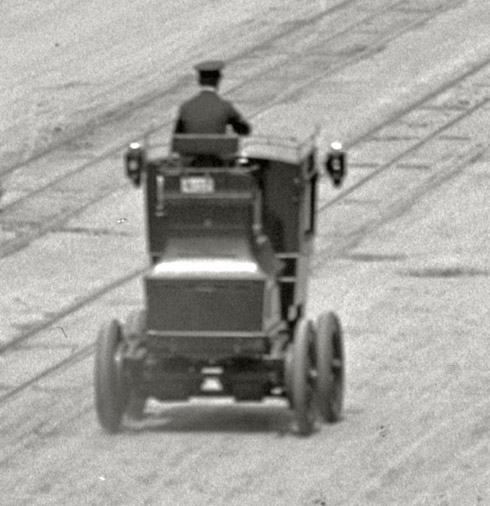
     Jacob German, a New York City taxi driver, earned the dubious distinction of being the first person to be cited for speeding in the United States when he was pulled over for barreling down Lexington Avenue in Manhattan. The scofflaw was “clocked” at a speed of 12 miles per hour by a police officer who, with persistent pedaling of his bicycle, managed to overtake him. German was imprisoned in the East 22nd Street station house. He did not have to surrender his registration and license because there were no such things in 19th century New York.

     The speed limit was claimed to be (although it was not posted) 8 mph on straights and 4 mph through turns. German was driving an electric vehicle. Records don’t indicate whether or not he was on duty or carrying a fare.

     A fair number of drivers have been issued speeding tickets since. The US Census Bureau tells us that 100,000 people per day are cited for speeding in the United States. At an average fine of $150 per ticket, that’s $15 million daily, a nice source of income for various municipalities – particularly in Ohio where the most tickets are issued (followed by Pennsylvania and New York). And certainly an award must go to tiny Summersville, WV. The town, with a population of 3,200, gives out 18,000 to 19,000 speeding tickets annually.

Texas claims the ticket for the fastest speed – 242 mph in a 75 mph zone. That driver was not pulled over by a police officer on a bicycle.

MAY 20, 1899: LEADFOOTED IN THE BIG APPLE

     Jacob German, a New York City taxi driver, earned the dubious distinction of being the first person to be cited for speeding in the United States when he was pulled over for barreling down Lexington Avenue in Manhattan. The scofflaw was “clocked” at a speed of 12 miles per hour by a police officer who, with persistent pedaling of his bicycle, managed to overtake him. German was imprisoned in the East 22nd Street station house. He did not have to surrender his registration and license because there were no such things in 19th century New York.

     The speed limit was claimed to be (although it was not posted) 8 mph on straights and 4 mph through turns. German was driving an electric vehicle. Records don’t indicate whether or not he was on duty or carrying a fare.

     A fair number of drivers have been issued speeding tickets since. The US Census Bureau tells us that 100,000 people per day are cited for speeding in the United States. At an average fine of $150 per ticket, that’s $15 million daily, a nice source of income for various municipalities – particularly in Ohio where the most tickets are issued (followed by Pennsylvania and New York). And certainly an award must go to tiny Summersville, WV. The town, with a population of 3,200, gave out 18,000 to 19,000 speeding tickets annually.

Texas claims the ticket for the fastest speed – 242 mph in a 75 mph zone. That driver was not pulled over by a police officer on a bicycle.

JUNE 19, 1885: BEWARE THE FRENCH BEARING GIFTS

In 1885, the French ship Isere sailed into New York Harbor carrying 214 crates filled with 350 libertypieces of a 305-foot high jigsaw that had been crafted in France and would, over the next four months, be re-assembled on an awaiting pedestal on Bedloe Island (now called Liberty Island) – there to stand for the next 134 years (so far).

Once constructed, this would, of course, be the Statue of Liberty or “Liberty Enlightening the World,” to those not on a first-name basis. It was a gift from France to the United States back during the two countries’ honeymoon days.   Actually it was something of a joint enterprise, the French providing the statue and the U.S. the pedestal on which it would stand.

French sculptor Frederic Auguste Bartholdi began designing the statue in 1876, working with Alexandre Gustave Eiffel, the designer of the Eiffel Tower. Richard Morris Hunt, designer of New York City’s first apartment building, designed the pedestal. Given his background, one might have expected his pedestal to house several luxury apartments, a missed funding opportunity: “Give me your tired, your poor, your huddled masses yearning to rent 3BR LUX APT, LWR FLR, UNF, HRBR VIEW.”

As it was, funding of the statue was a bit of an issue. Both countries faced challenges in getting money for the project. The French charged public fees, held fundraising events, and used money from a lottery to finance the statue. One notable fundraising method in the U.S. was a traveling arm. The statue’s torch-bearing arm was displayed at the Centennial Exposition in 1876.  After the exhibition closed, it was transported to New York, where it remained on display in Madison Square Park for several years before being returned to France to be reunited with its torso. The French, in a bit of Gallic oneupsmanship, exhibited the head at the 1878 Paris World’s Fair.

The plan to display Lady Liberty’s breasts in Boston was banned before it got off the drawing board, and a nationwide tour of her feet failed to muster sufficient enthusiasm.

The Statue of Liberty is no longer saying, ‘Give me your poor, your tired, your huddled masses.’ She’s got a baseball bat and yelling, ‘You want a piece of me?’ Robin Williams

When Mexico sends its people, they’re not sending the best. They’re sending people that have lots of problems and they’re bringing those problems. They’re bringing drugs, they’re bringing crime. They’re rapists and some, I assume, are good people. –Donald Trump