SEPTEMBER 6, 1899: Is Your Cow Really Happy?

Elbridge Amos Stuart was a man who knew his cows. He learned cows on his father’s farm in North Carolina and carried that knowledge into his own adult enterprises. Eventually he went west, young man, finding his way to the state of Washington where on September 6, 1899, he founded a company that was all about cows and a new process that evaporated the milk from those cows and canning it, thus creating a sanitary milk product that required no refrigeration.

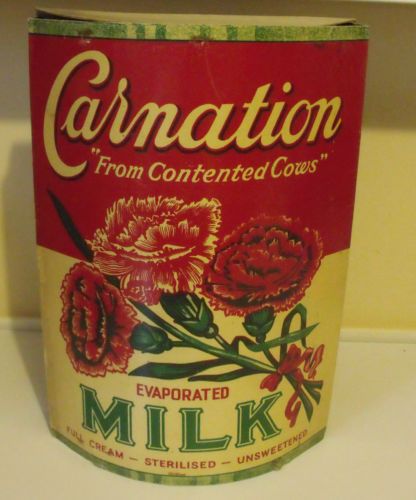
The business grew, and he gave it a new identity, the Carnation Evaporated Milk Company (the name taken from a box of cigars he had seen in a tobacco shop window).  Then in 1907 he introduced the promotional slogan that would from then on be the company’s mantra: “Carnation, the milk from contented cows.”

And were those cows contented. Stuart’s conviction that the best milk came from cows that were healthy, wealthy and wise was the company’s guiding principle. And Stuart didn’t just fall off the turnip truck. Those happy cows were also the most productive. Carnation cows led world milk production for over 30 years. One really contented cow, Segis Pietertje Prospect (Possum Sweetheart to friends), delivered a record 37,381 pints during one year. A statue in Tolt, Washington (now Carnation, Washington) commemorated this achievement.

That’s Some Cow

Possum Sweetheart, a Holstein, achieved her record output in 1920. She was born in 1913 at the Carnation Milk Farms, sired by a bull known as Old Buckshot. The first time her milker (contented cows evidently have personal milkers) milked her, she produced twice as much milk as any of the other less contented cows. And she did it again and again, producing her own weight in milk every three weeks.

Her fame spread. Officials from agricultural colleges throughout the world came to see her. Reporters and photographers reported and photographed. Celebrities and politicians dropped by.

Possum Sweetheart died at the age of 12, five years after her record output. Her offspring were sold to breeders throughout the world, and many of her heifers’ offspring became productive Carnation cows themselves.

Then There’s Elsie

What Contented Cows Listen To

Known throughout his career as the Texas Troubadour, Ernest Tubb was a pioneer of country music who helped to popularize the honky tonk style with his major 1941 hit “Walking the Floor Over You.” His career went on to span another four decades. He died on September 6, 1984.


AUGUST 31, 1928: LOOK OUT FOR LOTTE LENYA

With music by Kurt Weill and words by Bertolt Brecht, Die Dreigoschenoper premiered in Berlin in 1928. By 1933, when Brecht and Weill were forced to leave Germany, the musical comedy which offers a socialist view of a capitalist world had been translated into 18 languages and performed more than 10,000 times. We of course are more familiar with the English title, The Threepenny Opera.  And we’re mostly familiar with the opening song which has been sung by practically everyone, most notably, Frank Sinatra, Louis Armstrong, Ella Fitzgerald in a grammy-winning performance, and Bobby Darin who made it the top song of 1959 – “Die Moritat von Mackie Messer” (“The Ballad of Mack the Knife”). The song was added just before the premiere, when the actor playing Macheath threatened to quit if his character did not receive an introduction.


At the beginning of the play, we meet Jonathan Jeremiah Peachum, a London entrepreneur who runs the city’s begging operation, training the beggars and taking a nice chunk of their earnings. He is the perfect capitalist, a man who today would work for Goldman Sachs.

But Peachum has problems: his grown daughter Polly did not return home the previous night, and Peachum fears she has been misbehaving, and worse still, misbehaving with the ne’er-do-well Macheath.  Peachum does what any worried father would do – he determines to thwart this budding relationship by taking away her cell phone and having her paramour hanged.

Fade to Macheath who is preparing to marry Polly once his gang has stolen her trousseau. After the gang has stolen some food and a table, they all enjoy a wedding banquet. Polly entertains with a charming little song about a maid who becomes a pirate queen and executes her former bosses and customers. The Chief of Police, Tiger Brown, joins the party. It seems he had served with Macheath during the wars and had, over the years, exerted his influence to keep Macheath out of jail. He and Macheath sing. Polly returns home and lays the fact that she has married Macheath on her parents who are not amused. She sings a charming little song advising them to go fuck themselves, bringing the first act to a conclusion.

In Act Two, Polly warns Macheath that her father is gunning for British bear and that he must leave London. He agrees and leaves his gang in Polly’s hands. On his way out of town, Macheath stops at his favorite brothel, where he sees his ex-lover, Jenny. They sing a charming little song (“Pimp’s Ballad”) about their days together, but (the plot having thickened) Jenny has been bribed by Mrs Peachum to turn him in. Despite Brown’s apologies, he’s powerless and must drag Macheath away to jail. Macheath sings a charming little song about his life being over.   Another girlfriend, Lucy (Brown’s daughter) and Polly arrive at the same time from stage right and stage left, respectively.  A nasty argument ensues and together they sing a charming little duet about scratching each other’s eyes out. After Polly leaves, Lucy engineers Macheath’s escape, bringing the act to a tidy conclusion.

In Act Three, Jenny selfishly demands her money for the betrayal of Macheath, which Mrs Peachum refuses to pay.  Jenny nevertheless reveals that Macheath is at Suky Tawdry’s house, and he is once again arrested. Back in jail and scheduled to be executed, Macheath desperately tries to raise the bribe money to get out again, even as the gallows are being erected.  But no one comes to his aid, and Macheath prepares to die.  He laments his fate in a charming little song.  But what’s this? A deus ex machina enters stage left. Peachum announces that in this opera mercy will prevail over justice, and in a parody of a happy ending, a messenger from the Queen arrives to pardon Macheath and grant him a title, a castle and a pension. The play then ends with a plea that wrongdoing not be punished too harshly as life is harsh enough.

AUGUST 26, 1851: DOO-DA, DOO-DA

Picture a young man sitting on an elaborate veranda on a warm afternoon. Off to his right a beautiful river languidly flows on its journey from the swamps of Georgia to the Gulf Mexico; on the left, fields of cotton stretch into the distance. He is sipping a mint julep perhaps, and listening to the lilting voices of the slaves as they sing a happy song while picking cotton for their beloved “massa.” Life is good, everyone thinks, and hopes it will stay just like this forever.

The young man is inspired to pen a song: “Way down upon de Swanee Ribber, Far, far away. Dere’s wha my heart is turning ebber, Dere’s wha de old folks stay.”

The young man is, of course, Stephen C. Foster, one of America’s best-loved musical storytellers, who wrote “Old Folks at Home” (or Swanee River) in 1851, one of about 200 songs he authored during his prolific career.

While working as a bookkeeper in Cincinnati, Foster wrote his first successful songs — among them “Oh! Susanna,” and “Nelly Was a Lady”, made famous by the blackface Christy Minstrels. During the following years, Foster wrote most of his best-known songs for the Christy Minstrels: “Camptown Races,” “Nelly Bly,” “Old Folks at Home”, “My Old Kentucky Home,” and “Jeanie With the Light Brown Hair.”

Many of Foster’s songs were not original; he was a “Songcatcher,” writing down songs that had been passed down for generations. And about him sitting on that southern veranda – erase that. Foster chose the Suwannee River that flows through Florida because it fit the meter of the song; he never set foot in the state. Nor the south. He visited only once, on a riverboat voyage down the Mississippi – after he had written the songs.

Swanee River became the Florida state song in 1935. In an episode of Jackie Gleason’s “Honeymooners” called The $99,000 Answer, Ed Norton warms up on the piano by playing the opening to “Swanee River.” Later, on the game show of the title, the first question asked is, “Who is the composer of “Swanee River?” Ralph nervously responds with “Ed Norton,” and loses the game.

Chances are, those slaves picking cotton were not all that happy either.

Slaves are generally expected to sing as well as to work. ― Frederick Douglass

AUGUST 7, 1966: CINCO DE CUGAT

Francesc d’Asís Xavier Cugat Mingall de Bru i Deulofeu was born in Spain and emigrated to Cuba when he was five. He was trained as a classical violinist and played with the Orchestra of the cugatTeatro Nacional in Havana before coming to the United States in 1915, where he rode the tango craze to stardom in movies and night clubs. Eventually Cugat and his orchestra became the resident musicians at New York’s Waldorf Astoria.

     On August 7, 1966, Cugat took his fifth stab at marriage with Charo, a Spanish guitarist and comic actress. One can only wonder why the 60-year-old Cugat would marry a 20-year-old who could barely speak English. It must have been her flamenco ability. Cugat’s previous wife, the sultry Abbe Lane, couldn’t play a lick.

     As a recording artist, Cugat followed dance trends carefully; his tango years were succeeded by  takes on the conga, the mambo, the cha-cha-cha, and the twist when each was in fashion. He had major hits with his recordings of “Pefidia” and “Brazil.”

     Cugat is the only bandleader in the Conductors-Who-Hold-Chihuahuas-While-Performing Hall of Fame.


I would rather play Chiquita Banana and have my swimming pool than play Bach and starve. ―Xavier Cugat

JULY 29, 1887: NAUGHTY NOMADS AND SINGING SOTS

Born in 1887, Sigmund Romberg moved to the United States in 1909 and, after a short resume builder in a pencil factory (as a sharpener?), found work as a pianist.  An instrument here, an instrument there, and pretty soon he had his own orchestra. He published a few songs that caught the attention of the Shubert brothers, who in 1914 hired him to write music for their Broadway shows. Next day on his dressing room, they hung a star.


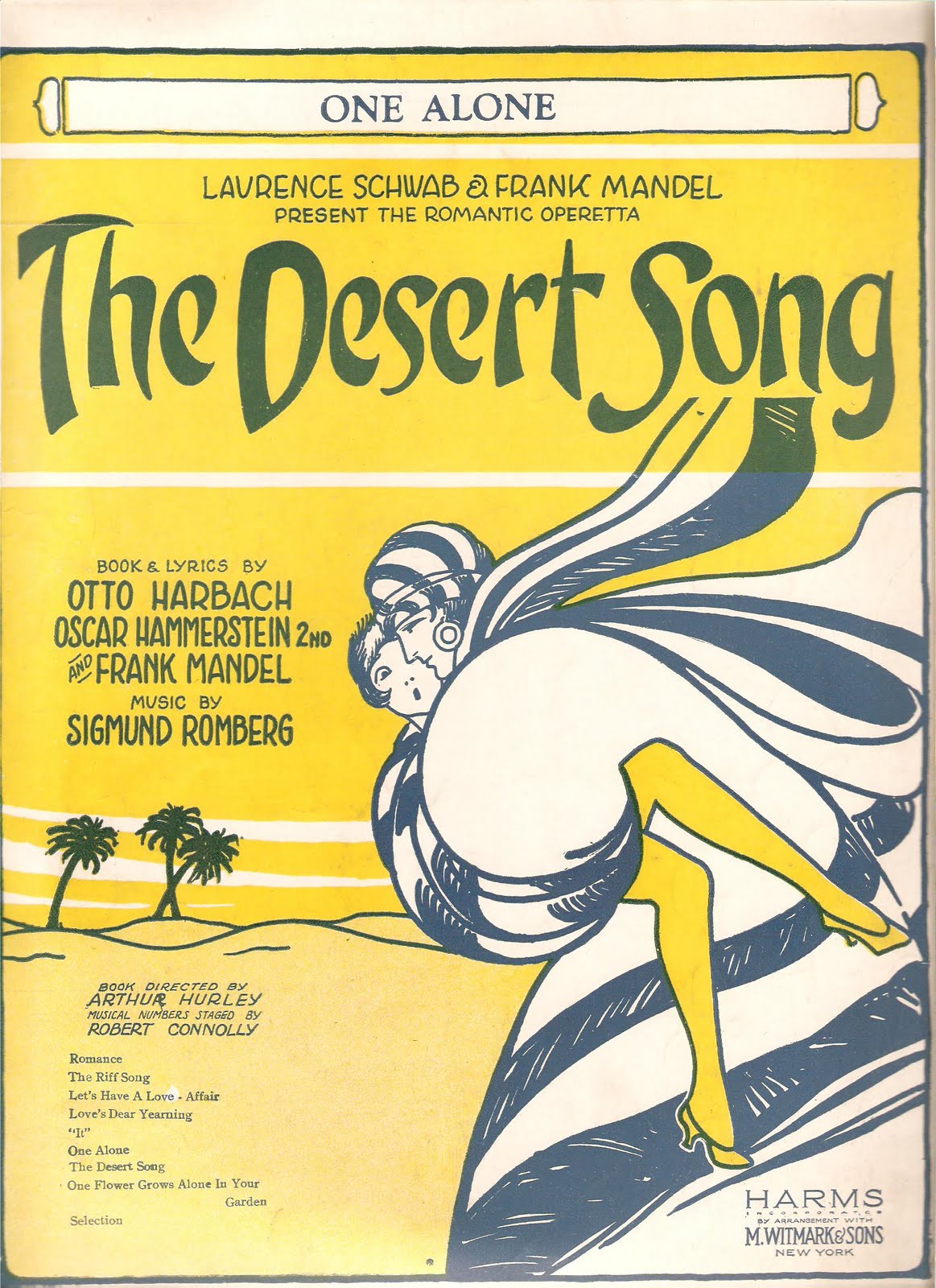
Career off and running, he wrote his best-known operettas, The Student Prince in 1924, The Desert Song in 1926, and The New Moon in 1928.


The Student Prince was the most successful of Romberg’s works, the longest-running Broadway show of the 1920s at 608 performances, even longer than the classic Show Boat.  The “Drinking Song,” with its rousing chorus, was especially popular in 1924, with Prohibition is full swing:

Drink! Drink!
  Let the toast start!
  May young hearts never part!
  Drink! Drink! Drink!
  Let every true lover salute his sweetheart!
  Let's drink!

The Mario Lanza version from the 1954 movie remains popular with imbibers everywhere.

The Desert Song (with lyrics by Oscar Hammerstein) is your typical superhero-adopts-mild-mannered disguise-to-keep-his true-identity-secret saga much like Zorro and Superman but with better music and no phone booths. The Red Shadow loves a beautiful and spirited girl, who loves his hero persona but not his wimpy side.  Will true love win out over hero worship? After much sophisticated music, lust in the dust and naughty humor, we learn the answer, especially in a lavish 1929 film production of the operetta – but only until the 1940s when it became illegal to view or exhibit the 1929 film in the United States because the folks in charge feared the naughty bits would morally harm us.

A second feature version was made in 1943, which had our hero fighting the Nazis, and a third version with Kathryn Grayson and Gordon MacRae in 1953 was about as squeaky clean as you can get.  Thank god for censors.

I drink to make other people more interesting. ― Ernest Hemingway

JULY 17, 1717: CHAMBERMAIDS GONE WILD

The King was on the poop deck counting out his money; the Queen was in the fo’c’sle eating bread and honey.

     A bevy of aristocrats, including King George I himself, boarded the royal barge at Whitehall Palace for a nautical jaunt up the Thames toward Chelsea.  Anne V was there, as was the Duchess Sailing to Musicof Bolton, the Duchess of Newcastle, the Countess of Darlington, the Countess of Godolphin, Madam Kilmarnock, and the Earl of Orkney, to drop just a few names. The rising tide propelled the barge upstream without any necessity of rowing. The evening’s dinner consisted of four and twenty naughty boys, baked in a pie.*

     Another barge provided by the City of London contained His Majesty’s secret service, the press corps, and fifty musicians who performed music written for the occasion by composer and conductor George Frideric Handel. The music opened with a melodic French overture and skittered through minuets and bourrées, with enthusiastic hornpipers hornpiping throughout.

     Many freeloaders also took to the river to hear the free concert. According to a London newspaper, the whole River was covered with rubbernecking boats and barges.  On arriving at Chelsea, the king left his barge, then returned to it at about 11 p.m. for the return trip. No one knows exactly what he did during his bit of shore leave, but rumor has it a chambermaid was involved. (The Queen was in the fo’c’sle eating bread and honey; the King was in the Chambermaid and she was in the money, goes the unauthorized verse.) The king was so pleased with the evening’s music that he yelled “more, more” every time the orchestra attempted to take a break, forcing them to play until well after midnight.  The moonlight, the lapping of the water against the barge, and the chambermaid are all lost to history, but Handel’s Water Music lives on.

* Sing a Song of Sixpence,
   A bag full of Rye,
   Four and twenty Naughty Boys,
   Baked in a Pye.


JULY 14, 1789, 1973: BREAKING UP IS HARD TO DO

Every écolier and écolière knows that the breakup of France – Révolution française – began in 1789, its defining moment the storming of the Bastille on the morning of July 14. 1789. This medieval fortress in the center of Paris represented royal authority. That the Bastille housed only seven inmates – all with good reason to be there – was unimportant. It was a symbol of the abuses of the absolute monarchy, and the French had had it with monarchs, aristocrats, and pretty much anyone in power. Bring on liberté, égalité, fraternité.   King Louis XVI, exit stage right


Bye Bye Don

Another momentous breakup took place on the evening of the same day, nearly 200 years later, in 1973, at Knott’s Berry Farm in California (Knott’s Berry Farm was America’s first theme park and probably the only one devoted to grapes and strawberries and such things). Every schoolgirl and schoolboy knows that the Everly Brothers were one of America’s most successful pop duos, lending their sibling harmony to such hits as “Bye Bye Love”, “All I Have To Do is Dream” and “Wake Up Little Susie”, a franchise that would seemingly go on forever. Well, forever is a long time, and brothers Don and Phil had, by the end of the 1960s pretty much had it with liberté, égalité, fraternité and most definitely with each other.

The defining moment of their breakup came in the middle of their set when the stage manager told the audience that the rest of the show had been canceled because brother Don was “too emotional” to play.  In reality, Brother Don was too drunk to play. His skipped guitar notes and bungled lyrics sent brother Phil into a real snit. Phil smashed his guitar and stormed off stage into a solo career, promising he would “never get on stage with that man again.”


Phil and Don reached a sort of detente a decade later.  Louis XVI, on the other hand, was beheaded.

(Phil Everly died in January 2014).

I have no intention of sharing my authority. — King Louis XVI

Death Visits Aunt Agatha, Part 2: A Bargain Is Struck

Monty hated the thought of paying Bridget Berman seventy-five dollars a day to do practically nothing and eat his food in the bargain. What if Aunt Agatha held on for three or four days? No matter how bad she looked, she was a tough old bird. She could rack up a couple hundred dollars while he was in the city.

By the time Monty bit the bullet and finally contacted Bridget Berman, he had already devised a scheme to avoid paying the old hag more than what he considered appropriate remuneration for her services. Emphasizing how sick the old lady was, how she probably wouldn’t make it through the next 24 hours, Monty proposed a flat fee for Bridget’s sitting services. “Ninety dollars,” said Monty, “It’ll be like getting paid time and a half most likely.”

Bridget didn’t trust Monty at all; she assumed right off that he was trying to procure her services on the cheap. But if the old woman were really dying . . . Bridget also hated to pass up something extra for next to nothing. She expressed doubt about the arrangement. “But I will consider it. Mind you, just consider it. First I must see your aunt for myself.” Bridget had watched a good many people check out of this world and felt confident that she could reasonably judge the amount of time a person had left.

Later, as they stood at Aunt Agatha’s bedside, Bridget, after carefully studying the dying woman for several minutes, concluded that here lay one very sick woman and that she had better get an agreement quickly, before Aunt Agatha expired. “I don’t know,” said Bridget, “She doesn’t look all that bad to me. But I understand your situation, and I want to be as agreeable as I possibly can. One hundred and fifty dollars.”

Monty stood silently thinking. Aunt Agatha groaned.

“One twenty-five,” said Bridget.

“You’ll stay until she dies,” said Monty.

“Or until you return,” said Bridget.

“Agreed.”

Ten hours passed. Monty was in the city, Bridget sat bedside, and Aunt Agatha lay there still looking as though the next minute would be her last. Bridget sighed and dozed off. She awoke Saturday morning to find Aunt Agatha just as ill and just as alive as she had been the night before. For eight hours, Bridget stared at the bedridden woman just lying there, continuing to breathe without consideration for others, taking money from Bridget as though she were a common pickpocket.

continued

JULY 1, 1935 ET AL: THEY’RE WRITING SONGS OF LOVE, BUT NOT FOR ME

Delving into the musical history of July 1 during the 20th century can be instructional for trendspotters if not for music lovers. On this day in 1935, Benny Goodman and his band recorded the “King ElvisHoundDog_jpgPorter Stomp.” Elvis Presley appeared on “The Steve Allen Show” on July 1, 1956, wearing tails and singing “Hound Dog” to a basset hound. And in 1963, the Beatles recorded “She Loves You.” So far so good.

Fast forward to the ’80s and a few melodies you no doubt whistled while on a pleasant walk through the park — all making their appearance on July 1.  In 1987, the English grindcore band Napalm Death released its first recording “Scum.”  Side A of the album was recorded at the Rich Bitch studio; it was planned as part of a split release with the English crossover thrash band Atavistic on Manic Ear. It was released as a single album through Earache. The song “You Suffer” was listed in the Guinness Book of Records as the world’s shortest song at 1.316 seconds (at last, a redeeming quality).

There’s more: The first pressing of the CD included the From Enslavement To Obliteration album and four bonus tracks (hooray!). The album cover was designed by a member of the band Carcass.

Butchered at Birth by American death metal band Cannibal Corpse was released in 1991 through Metal Blade Records. It included the lyrical “Rancid Amputation.” We can be sure that if Benny Goodman were still performing (instead of turning over in his grave), he’d jump right on a cover version of that one.


JUNE 18, 1913: THEY CALL IT SAM’S SONG

Violinist, meat-packer, usher, tinsmith, elevator operator, and lyricist, Sammy Cahn (no relation to Kublai or Genghis) penned his first lyrics at the age of 16 – “Like Niagara Falls, I’m cahnFalling for You,” not one of his most notable successes. But he kept writing them, giving up those other professions, until he got it right, and got it right again, and again.

     Over the course of his career, Cahn was nominated for 23 Academy Awards, five Golden Globe Awards, an Emmy and a Grammy. In 1988, the Sammy Awards, for movie songs and scores, were created in his honor.

With Jimmy Van Heusen, Cahn wrote so many songs for Frank Sinatra that the two were almost considered to be his personal songwriters. Oscar winners “Three Coins in the Fountain,” “All the Way,” and “High Hopes” were all introduced in films by Sinatra.  Add “Love and Marriage,”  “The Tender Trap,” “My Kind of Town,” “Come Fly with Me” and a host of others.

     The pair also won an Oscar for “Call Me Irresponsible” and received nominations for “Pocketful of Miracles,” “The Second Time Around,” and “Thoroughly Modern Millie.” Cahn and Jule Styne added nominations for “I’ll Walk Alone,” “I’ve Heard That Song Before,” and “It’s Magic.”

Cahn was born on June 18, 1913, and died in 1993.

JUNE 6, 1971: THE SHEW MUST GO ON

Ed Sullivan was to the golden age of television what Google is to searching.  He ruled Sunday night TV for 23 years – from 1948 to his very last broadcast on this day in 1971. Sullivan presented acts from the era’s biggest stars to acrobats, dancing bears, puppets, contortionists, you name it.  Ten thousand in all – if they were entertainers, an appearance on the Sullivan show was their holy grail.

Musical performances from rock to opera were a staple of the program. Even its first broadcast, when it was known as Toast of the Town, made music history as Broadway composers Richard Rodgers and Oscar Hammerstein II previewed the score of their upcoming musical, South Pacific. And after that, West Side Story, Cabaret, Man of La Mancha – if it was on Broadway, it was on Sullivan. One of those Broadway musicals, Bye Bye Birdie, was all about making it on the Sullivan show.

Sullivan also chronicled the history of rock and roll from Elvis Presley’s appearance in 1956 through the Supremes, the Beatles, the Rolling Stones, the Doors, the Mamas and the Papas, and on June 6, 1971, the last program, Gladys Knight and the Pips.

When CBS canceled the show, the network let it end with a whimper.  But in the 33 years since cancellation, numerous tribute shows and DVDs have kept Sullivan in the public eye.

Soldiers, Sailors and Airmen of the Allied Expeditionary Force! You are about to embark upon a great crusade, toward which we have striven these many months. The eyes of the world are upon you. The hopes and prayers of liberty loving people everywhere march with you. In company with our brave Allies and brothers in arms on other fronts, you will bring about the destruction of the German war machine, the elimination of Nazi tyranny over the oppressed peoples of Europe, and security for ourselves in a free world. — General Dwight D. Eisenhower, June 6, 1944