December 26, 1921: Hi Ho, Stevarino

But first, hi ho second day of Christmas, because that is today to those who prolong the season through Christmastide.  For True Love, it is the opportunity to give two birds, turtle doves to be precise.  And just as practical as that partridge.

Meanwhile Scrooge is visited by the second ghost of Christmas who conducts a review of the many less than loving names his mother called soon-to-be-born Ebeneezer while in labor.

Hi Ho, Stevarino

Although Steve Allen, born December 26, 1921, was a musician, composer, actor, comedian, and writer, he is best known for his career in television. He first gained national attention as a guest host on Arthur Godfrey’s Talent Scouts and then became the first host of The Tonight Show, initiating the format that television talk shows would follow from then on.

Moving from late night to prime time television, he hosted numerous game and variety shows, most notably The Steve Allen Show, going head to head with Ed Sullivan and Maverick on Sunday evenings. It was there he developed the man on the street interviews which featured Don Knotts, Tom Poston and Louis Nye among others.

Allen was a comedy writer and author of more than 50 books, both fiction and nonfiction, including Dumbth, a commentary on the American educational system, and Steve Allen on the Bible, Religion, and Morality.

Allen was also a pianist and a prolific composer, writing over 14,000 songs, some of which were recorded by Perry Como, Margaret Whiting, Steve Lawrence, Eydie Gorme, Les Brown, and Oscar Peterson. He won a Grammy in 1963 for best jazz composition, with his song The Gravy Waltz. He also wrote lyrics for the standards “Picnic” and “South Rampart Street Parade.” He once won a bet with Frankie Laine that he could write 50 songs a day for a week. His output of songs has never been equaled.

He died in 2000.

December 25: Tis the Season

Today is of course Christmas Day in much of the world.  To some folks who pack a lot into their ’tis the season, it is the beginning of Christmastide or Twelvetide, the first of a dozen days of Christmas.  This is infamously celebrated by the carol in which on this day, the first day of Christmas, someone’s True Love bestows upon him or her a gift of a partridge in a pear tree.  While we might point out that a crock pot or a circular saw would be a bit more practical, we won’t quibble with the sentiment.

It would also seem that Charles Dickens missed the boat.  Imagine the twelve ghosts of Christmas:  The first ghost of Christmas shows Ebenezer Scrooge how happy his parents were before he was born.  Stay tuned, Ebenezer; there’s more to come.

Over There

Just after midnight on December 25, 1914, British, French and Russian troops at European battle fronts were stunned as German joyeauxtroops ceased firing and began to sing Christmas carols — in some cases, even backed up by oompah bands.

World War I had begun five months earlier and would continue for another devastating four years. This spontaneous Christmas truce continued through the night and into daylight when many of the German soldiers emerged from their trenches and called out “Merry Christmas” in their enemies’ native tongues. Finally, Allied soldiers, seeing that the Germans were unarmed, climbed out of their trenches as well. Men from both sides ventured through the so-called No Man’s Land to shake hands with the enemy. The men exchanged small presents and sang carols and songs. In one case, soldiers played an international soccer game.

It was, of course, short-lived as both sides went back to their business of killing each other.  (This true story is told in the 2005 French film Joyeux Noel.)

On Christmas Day in 1941 Bing Crosby introduced a new Christmas song on his weekly NBC radio program. The song, written by composer and lyricist Irving Berlin, went on to become the gold standard of Christmas music — the top-selling Christmas single ever and the top-selling single of any kind for another 55 years.

The success of “White Christmas” came as no surprise to Berlin, who was already a musical legend. He modestly called it “the best song I ever wrote . . . the best song anybody ever wrote.” And written by a man who did not celebrate Christmas.

November 29, 1924: Don’t Shoot the Soprano

Giacomo Puccini, who died on November 29, 1924, was a giant in Italian opera, unrivaled in orchestration and a sense of theater. Passion, sensuality, tenderness, pathos and despair infused such operas as Manon Lescaut, La Bohème, Madama Butterfly, and Turandot.

Tosca was one of Puccini’s greatest operas, but it seems to have taken on a bit of a curse, like that Scottish play whose title shall not be uttered in the theater. More things have evidently gone awry in Tosca than in any other opera.  A few vivid examples:

Exit Stage Left . . . Exit Damnit: In Act II of a performance of Tosca featuring Maria Callas in the title role, Tosca stabs her tormentor Scarpia, and then leaves the stage. After doing the deed, Callas who suffered from myopia but couldn’t wear contact lenses wandered the stage, unable to find her way out. Baritone Tito Gobbi, our Scarpia, while lying dead, tried to discreetly point out the exit, but started laughing so much that both his laughing and his pointing were obvious to the audience. The next morning, newspapers raved about his memorable portrayal of Scarpia’s death.

They Shoot Divas, Don’t They?: In another performance, a firing squad is called upon to execute Tosca’s lover Mario in the final act. The players were instructed to enter and shoot the person they found onstage, and then to exit with the principals. But when the players got onstage, they discovered two people and didn’t know which one to shoot. They aimed at one then the other as both principals said not to shoot them. They finally chose Tosca, but when they shot her, Mario keeled over dead. They stood there, further bewildered; they had been told to exit with the principals but neither of the principals were exiting. Mario remained lifeless while Tosca tried to shoo them away. Finally, when Tosca jumped to her death from the castle parapet, they seized the opportunity to exit with at least one principal, and they jumped after her, adding immeasurably to the tragedy.

Follow the Bouncing Diva: Tosca’s leap to her death  from the parapet of the Castel Sant’Angelo is the dramatic conclusion to the opera. Various methods have been employed to keep the jumping soprano safe; usually a mattress does the trick. In a Lyric Opera of Chicago performance,  stage hands replaced the usual mattress with a trampoline to provide added safety for a British soprano. They also added some unintended encores as Tosca bounced back into view several times.


November 27, 1703: What Do We Do with a Drunken Sailor?

The Eddystone Lighthouse sits atop the treacherous Eddystone Rocks off the coast of the United Kingdom. The current lighthouse is actually the fourth to hold sway there.

eddystoneThe original Eddystone Lighthouse was an octagonal wooden structure whose light first shone in November of 1698. It was destroyed just five years later on November 27 during the Great Storm of 1703. The unfortunate builder Henry Winstanley was on the lighthouse, completing additions to the structure at the time. No trace was found of him, or of the other five men in the lighthouse.

The fame of the lighthouse spread well beyond those using it for guidance in the English Channel. It became the subject of a sea shanty sung by drunken sailors around the world. Shanties are those songs sung on board ship to relieve the boredom of shipboard tasks, but during the 20th century and particularly during the mid-century folk craze, sea shanties were adopted by landlubbers everywhere. The Eddystone Light became a particular favorite of many a drunken sailor, armed with a guitar or banjo and a good supply of beer, no matter how far away the nearest navigable waters.

Oh, me father was the keeper of the eddystone light
And he slept with a mermaid one fine night
From this union there came three
A porpoise and a porgy and the other was me

Yo ho ho
The wind blows free
Oh for the life on the rolling sea

One day as I was a-trimmin’ the glim
Humming a tune from the evening hymn
A voice from the starboard shouted, “Ahoy”
And there was me mother a-sittin’ on the buoy

Yo ho ho
The wind blows free
Oh for the life on the rolling sea

Oh what has become of me children three?
Me mother then she asked of me
One was exhibited as a talking fish
The other was served in a chafing dish

Yo ho ho
The wind blows free
Oh for the life on the rolling sea

Then the phosphorus flashed in her seaweed hair
I looked again, but me mother wasn’t there
But I heard her voice echoing back through the night
The devil take the keeper of the eddystone light

Yo ho ho
The wind blows free
Oh for the life on the rolling sea

November 23, 534 BC: Another Opening, Another Show

Back in the 6th century BC, Greek theatrical performances were generally dithyrambs, choral offerings featuring stories from mythology sung by a chorus of anywhere from a dozen to fifty singers. They usually wore masks and might even dance a little. Whatever they did, they did in lockstep.

Then on November 23, 534 BC, a member of one of these choruses, Thespis of Icaria, stepped out of the anonymity of the chorus and spoke several lines not as himself, but portraying the character of the Greek God Dionysus. Well, this had never been done before. No one had ever assumed the character of another person for storytelling. Thespis thus became the world’s first actor.

This new idea quickly caught on, and individual actors began to portray different characters in their stories which they now called tragedies. Pretty soon scores of Greeks were saying to each other “Gee, we could put on a play in Farmer Brown’s barn.” And taking their tragedies on the road.

Thespis was the most popular actor of the day, winning the first wooden horse for best actor in a tragedy. And he took his shows on the road, carrying with him costumes, masks and props from town to town. This made him not only the father of theater but also the father of theatrical touring. And actors throughout history have called themselves Thespians in his honor.

Let’s Get a Recording of That Greek Chorus

The scene is the Palais Royale Saloon in San Francisco, November 23, 1889. Entrepreneur Louis Glass has installed a machine destined to become an overnight sensation, and find a permanent spot in the psyche of the nation, even the world. He called his device the “nickel-in-the-slot player” a name that would certainly need a bit of massaging in the future.

What it played was music. Inside a handsome oak cabinet was an electric phonograph.  Four stethoscope-like tubes were attached to it, each operating individually after being activated by the insertion of a coin. Four different listeners could be plugged into the same song at the same time! In a nod to sanitation, towels were supplied to patrons so they could wipe off the end of the tube after each listening.

The success of the “nickel-in-the-slot player” eventually spelled the demise of the player piano, then the most common way of providing popular music to saloon patrons, notorious for their love of music.

Most machines were capable of holding only one musical selection, the automation coming from the ability to play that one selection at will. Obviously, after each patron had listened to that one song several times, the novelty wore off and the player went idle. In 1918, another entrepreneur solved that problem with an apparatus that automatically changed records. Ten years later, enter Justus P. Seeburg, who combined an electrostatic loudspeaker with a coin-operated record player that gave the listener a choice of eight records.

This machine was pretty cumbersome: it had eight separate turntables mounted on a rotating Ferris wheel-like device, allowing patrons to select from eight different records. Later versions included Seeburg’s Selectophone, with 10 turntables mounted vertically on a spindle. By maneuvering the tone arm up and down, the customer could select from 10 different records.

There was still no decent name for these devices. That came in the 1940s, when person or persons unknown dubbed it a jukebox, a reference to juke house, slang for a bawdy house, a favorite location for the devices. All that remained necessary in the evolution of the jukebox was the addition of a healthy helping of rock and roll.

November 22, 1928: Au Fou, Au Fou

Russian dancer and actress Ida Rubenstein convinced her friend Maurice Ravel to write her a Spanish flavored ballet in 1928. The composer had long considered the idea of structuring an entire composition around a single theme. The theme came to him on a vacation a few month’s later. He sat at a piano playing a melody with one finger. As he played, he said to a friend: ‘Don’t you think that has an insistent quality? I’m going to try to repeat it a number of times without any development, gradually increasing the orchestra as best I can.”

Bolero was born. It was performed on November 22, 1928, at the Paris Opera. The 15-minute work was received with thunderous acclaim — cheering, shouting, foot stomping. One woman was heard screaming “Au fou, au fou!” (the madman, the madman). Ravel’s reaction, when told of it: “That lady, she understood.”

Rarely staged as a ballet in later years, Bolero became Ravel’s most popular work, although he considered it one of his least important. “Once the idea of using only one theme was discovered,” he said, “any conservatory student could have done as well.”

Time Flies Like an Arrow

Robin Hood has been celebrated through story, song and film as that charming rogue who, along with his merry men, robbed from the 1 percent and gave to the 99 percent, a nobleman cheated out of his birthright by the nasty Sheriff of Nottingham, a patriot in service to Richardrobin hood the Lionhearted, fighting the villainy of that usurper Prince John.

To the consternation of the authorities, Robin Hood and his merry gang carried out their trade for a number of years.  But as Robin Hood ushered in his 87th year, his arrows began to get a little wobbly and off-target. He increasingly felt the infirmities of his age, and was eventually convinced to seek medical attention at the local nunnery. The prioress evidently took an instant dislike to the merry old man, which she vented by opening up an artery and allowing him to bleed to death. The date of his demise is reckoned to be November 22, 1247.

But before he turned his toes completely up, Robin realized that he was the victim of treachery (flowing blood will do that), and he blew a blast on his bugle (kept handily at his bedside for just such a situation). This summoned his compatriot Little John who forced his way into the chamber in time to hear his chief’s last request. “Give me my bent bow in my hand,” he said. “And an arrow I’ll let free, and where that arrow is taken up, there let my grave digged be.” Rhyming right to the end. Which came just after he shot the arrow through an open window, selecting the spot where he should be buried. Which he was.

November 18, 1307: Fun with Apples

It is the dawn of the 14th century and the hundredth anniversary of Austrian rule over Switzerland. Every little Heidi up in Heidiville and william tellevery one of her goats are under the cruel dominion of the Habsburgs. It is November 18, 1307, and a legend is about to be born.

It’s a day of grand celebration for the Austrians (the Swiss, not so much). Soldiers sing of the glories of the Emperor and his appointed local despot Gesler. The evil Gesler has had his hat placed on top of a pole, forcing the Swiss to bow and scrape and generally pay homage to the hat – one of those silly felt things with a feather in it. Gesler also commands that there should be dancing and singing to mark the century during which the Austrian empire has dominated the 98-pound weaklings of Switzerland. Gioachino Rossini and his Italian Racals are on hand to provide appropriate music.

Among the Swiss that day is one William Tell, known among his compatriots as a strong man, a mountain climber, and a whiz with the crossbow. Well, doesn’t Tell pass right by that hat, refusing to bow to it. And doesn’t his son (like father. . .) do just the same. Gesler is really put out and has the pair arrested.  Aware of Tell’s amazing marksmanship, Gesler devises an ingenious punishment: Tell must shoot an apple off the head of his son. If he refuses, they both will be immediately executed. At this point, you can cut the tension with a Swiss Army knife. Rossini strikes up the band.  As every schoolboy knows (if you don’t know, go find a schoolboy), Tell splits the apple with a single bolt (that’s an arrow) from his crossbow. Rossini’s Rascals break into a rollicking version of the William Tell Overture. (In the Lone Ranger, this same music was used to introduce the scene where Tonto shoots an apple from kemo sabe’s head.)

Ah, but sharp-eyed Gesler notices that Tell has taken not one but two crossbow bolts from his quiver. Gesler quizzes Tell, who answers that if he had killed his son, he would have used the second bolt on Gesler himself. Well, Gesler is now pretty pissed and has Tell carted off to prison.

Crossing Lake Lucerne, prison-bound, the soldiers, afraid their boat will founder, release strongman Tell to steer. Tell escapes, tracks down Gesler, places an apple on his head, and misses it by just that much. He shouts out, “Hi yo Switzerland,” Heidis and goats frolic on hillsides, Swiss watches begin keeping perfect time, and the Swiss Confederation is born.

October 25, 1938: It Don’t Mean a Thing If It Ain’t Got That Swing

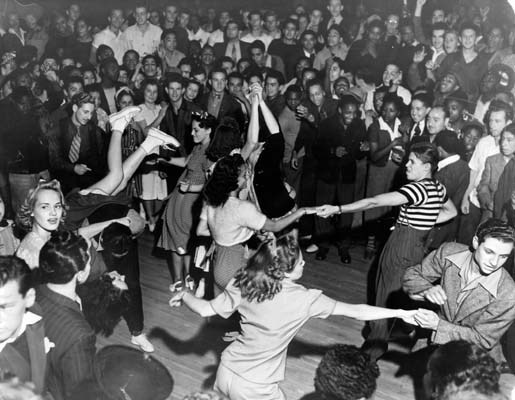
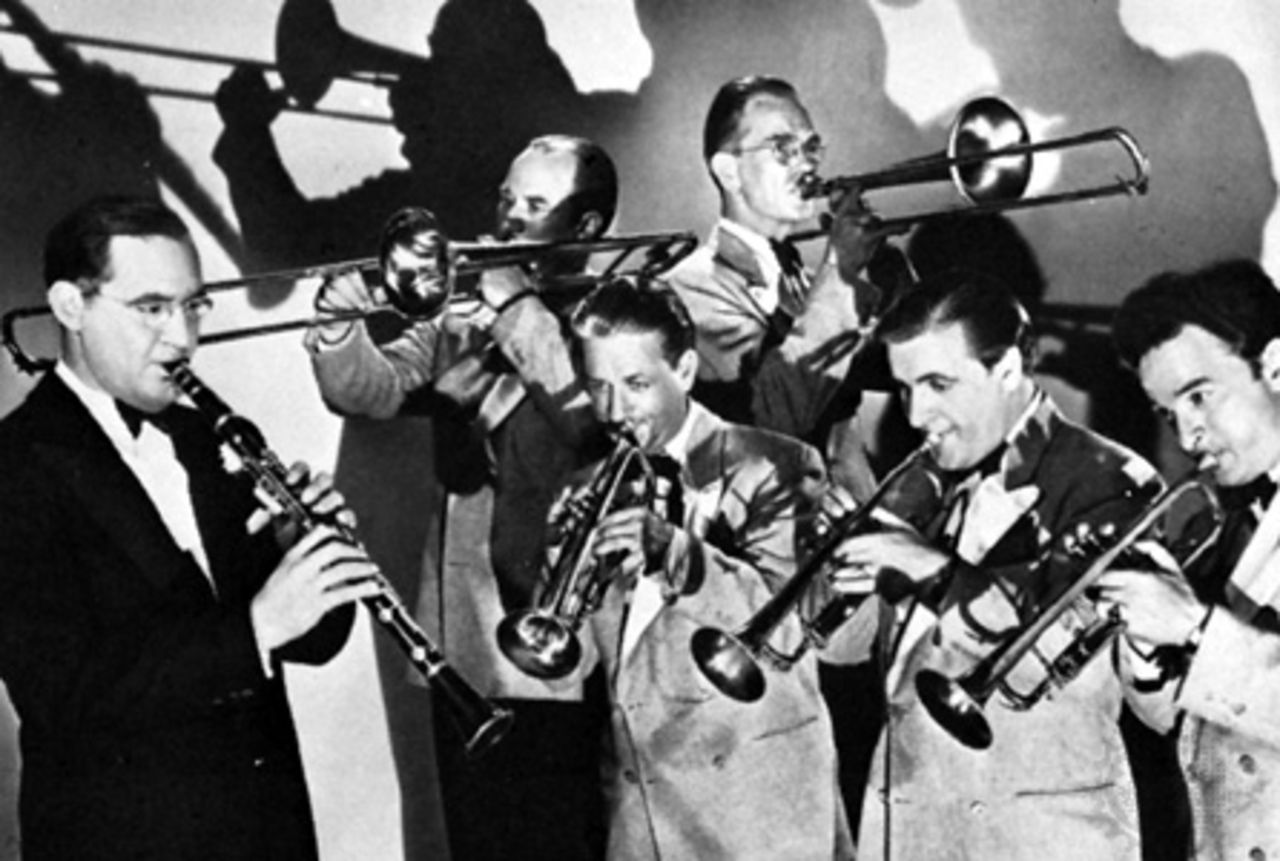
The swing era in American music had its roots in 1920s jazz as small improvisational groups gave way to larger ensembles using written arrangements.  A typical swing song features a strong rhythm section supporting loosely-tied wind and brass sections and in later years string and vocal sections.  It has a lively danceable beat and, well, it swings.

Although it might have seemed so, not everyone in 1930s America wanted to sing and sway and snap fingers to the music of the proliferating number of big bands.

igoodma001p1

Francis Beckman was ordained to the Catholic Ministry in 1902, and moved steadily up the theological ladder until finally becoming Archbishop of Dubuque in 1930, guiding his flock through both the Depression and World War II.  He undertook several crusades during his tenure, the least of which was most likely his campaign against swing music beginning in 1938.  His holy war came to national attention when on October 25, 1938, in a speech before  the National Council of Catholic Women, he denounced swing music in no uncertain terms.  It was, he said, “a degenerated musical system… turned loose to gnaw away the moral fiber of young people” which would lead one down the “primrose path to Hell.”  Perhaps, it’s just as well the Archbishop was  whistling heavenly tunes when rock and roll came around (having died in 1948).

The success of his campaign can no doubt be measured by how infrequently the name Francis Beckman rings a bell compared to Louis Armstrong, Cab Calloway, Benny Goodman, Duke Ellington, Glenn Miller, or Count Basie.


Politics as Unusual

Ross Perot suddenly dropped out of the 1992 presidential race in perotJuly amid swirling controversies after having suddenly dropped into it a few months earlier with an off-the-cuff announcement on Larry King’s television show.  Campaign managers were becoming increasingly disillusioned by his unwillingness to follow their advice to be more specific on issues, and his need to run the show on his own.  They bridled at such practices as forcing volunteers to sign loyalty oaths  and his nine-to-five style  of campaigning.  When he jumped back into the race in October, the campaign professionals were gone, replaced by amateurs of unquestioned loyalty.

In another bizarre turn, Perot went on 60 Minutes on October 25, claiming his July withdrawal from the race was the result of his hearing that President Bush’s campaign was planning to smear his daughter with a computer-altered photograph and to disrupt her wedding.   Perot offered no evidence, only quoting an unidentified “top Republican.” “I can’t prove any of it today,” he said.  “But it was a risk I did not have to take,” he added, “and a risk I would not take where my daughter is concerned.”
A spokesman for the President dismissed Mr. Perot’s assertions as “all loony.”

Maybe not so unusual these days.

SEPTEMBER 8, 1892: PLEDGE, SALUTE, SING OUT THE CHORUS

Daniel Sharp Ford was a bit of a flag-waver. He thought the country needed a little more patriotism, and so launched a crusade to get flags into every school in the country. As the owner of the magazine Youth’s Companion he had a ready-made platform for the promotion of his ideas. As part of his patriotism package, he asked a socialist minister, Francis Bellamy, to create a pledge to the flag of one’s country, a pledge that could be used throughout the world.

Bellamy came up with a pledge that was simplicity itself, and Ford published it in the September 8, 1892, issue of his magazine. The Pledge of Allegiance, as it was called, read:

“I pledge allegiance to my Flag and the Republic for which it stands, one nation, indivisible, with liberty and justice for all.”

The pledge was incredibly popular, repeated in schools, public gatherings, government meetings, in Congress. However, Ford and Bellamy found it awkward that folks just stood there while pledging, so they came up with a nifty salute. Pledgers would face the flag, extend their right arm forward and slightly upward — the Bellamy Salute.

Years passed and folks were happily pledging, but then the tinkering began. In 1923, the words, “the Flag of the United States” were added, thanks to the efforts of the American Legion and the Daughters of the American Revolution who fretted that immigrant children might be confused about just which flag they were pledging allegiance to. A year later, the worriers added “of America.”

Then the Bellamy Salute came under fire; it looked a little too much like the German Nazi salute.

Come 1954, Congress got into the act, adding the words “under God” as a way of thumbing their noses at those godless communists, and giving the pledge its current form.

SING OUT THE CHORUS

BelafontecalypsoHarry Belafonte is an American singer, songwriter, actor, activist, and of course the King of Calypso. His third album, Calypso, hit the top of the charts on September 8, 1956, and had everyone singing out the chorus “Day-o.” It became the first album by a single artist to sell a million copies. In addition to “Day-o (Banana Boat Song),” the album included such calypso standards as “Jamaica Farewell,” “Man Smart,” and “Will His Love Be Like His Rum?” Discerning readers will note that some of those calypso standards serve as titles for short stories included in Calypso: Stories of the Caribbean.

SEPTEMBER 12, 1970: TURN ON, TUNE IN, DROP OUT

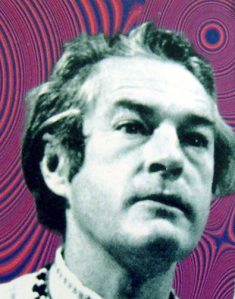
Richard Nixon called him the most dangerous man in America, an honor usually reserved by Republicans for figures such as Charles Darwin and Barack Obama. Timothy Leary wasn’t always so “dangerous.” He had a distinguished military service and academic psychology career timothy-leary-until he started thinking way outside the box, promoting the therapeutic use of psychedelic substances. It was your basic slippery slope, as he quickly evolved during the wild and woolly 60’s to a self-described performing philosopher and hippie guru. He used LSD himself and developed a philosophy of mind expansion and personal truth through LSD with such heady concepts as space migration and intelligence increase. Eventually, it was all about turning on, tuning in, and dropping out.
As a result, Leary also came to spend more time in jail than out of it, becoming intimate with 36 prisons throughout the world. In January 1970, he received a 20-year prison sentence for a pair of earlier transgressions. Upon his reporting for prison duty, Leary was given a series of psychological tests meant to help determine what work duties he was suited to. Having himself designed such tests, he found it quite easy to manipulate the results so that they would show him to be a model citizen with an interest in forestry and gardening, pursuits that would conveniently keep him out of doors.

Leary was assigned to work as a gardener in a minimum security prison. On September 12, 1970, leaving a farewell note, he climbed over the prison wall along a telephone wire to a waiting pickup truck supplied by the Weather Underground. For $25,000 (paid by the Brotherhood of Eternal Love), the weathermen smuggled Leary and his wife out of the United States and into Algeria. From there, they traveled to Switzerland, Vienna and Beirut. In 1972, they headed for Afghanistan which had no extradition policy with the U.S. Unfortunately, they traveled aboard an American airline, and were arrested before they could deplane.

Leary was returned to prison where he remained until his release in 1976. He died in 1996.

Come Together

“Come Together,” written by John Lennon, became a big hit for the Beatles and an anti-war anthem. It was originally written as a campaign song for Timothy Leary’s aborted run for governor against Ronald Reagan.

Said Lennon: “The thing was created in the studio. It’s gobbledygook; “Come Together” was an expression that Leary had come up with for his attempt at being president or whatever he wanted to be, and he asked me to write a campaign song. I tried and tried, but I couldn’t come up with one. But I came up with this, “Come Together,” which would’ve been no good to him—you couldn’t have a campaign song like that, right?”

Murray Middlebury Has an Affair, Part 1: Healthy, Wealthy and Wise

Murray Middlebury downed the last of his daily bran flakes as his wife Lenora looked on approvingly. “Good fiber,” she would frequently intone, giving blessing to their morning ritual of oat bread, bran flakes, and decaffeinated coffee. “To our health,” Murray would often quip in reply as they clinked together their glasses of V-8.

Bacon never found itself on the Middlebury table, for the Middleburys, a classic 21st century health-conscious couple, had forsaken all things animal in their quest for immortality or whatever it is that is the holy grail of 21st century health consciousness. Beef was banished, pork proscribed; even chicken was cast off.

Murray sometimes jokingly referred to Lenora as the bean queen for the innovative ways she could feature the lowly legume. To their credit, their diet and program of daily exercise did leave them fit and trim. Murray’s position as an actuary and Lenora’s as a CPA gave them a good household income. And the Middleburys exercised their minds as well as their bodies, reading the right books and associating with the likes of Bach, Brahms, and Mahler.

In short, the Middleburys were healthy, wealthy, and wise – sure candidates for living happily ever after. But Murray had a dirty little secret. He was about to have an affair.

“You’re remembering, dear,” said the imperfect half of the perfect pair, “that my men’s discussion group is having its first meeting tonight.”

“And you won’t be home for dinner,” said Lenora, showing obvious concern for his well-being.

“No, but I’ll take a couple of extra apples with me,” said Murray. “We’re discussing Pilgrim’s Progress.”

“How lucky for you that you read it just last year.”

“Yes,” Murray agreed, with a smile.

continued


This story originally appeared in Hemispheres, the United Airlines magazine. It is included in Naughty Marietta and Other Stories.