April 20, 1935: Splish Splash, Snooky Was Taking a Bath

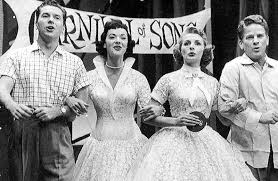
A music staple of the 40s and 50s, Your Hit Parade, made its radio debut on April 20, 1935. It lasted for nearly 25 years before being done in by rock and roll music – and perhaps Snooky Lanson. It began as a 60-minute program with 15 songs played in a random format, and eventually moved to television where the seven top-rated songs of the week were presented each week in elaborate production numbers requiring constant set and costume changes.  The list of top songs was compiled through a closely guarded top secret algorithm that involved record sales, quarters plunked into jukeboxes, shoplifted sheet music and the divination of an unidentified mystic in Memphis, Tennessee.

Dorothy Collins , Russell Arms, Snooky Lanson and Gisèle MacKenzie were top-billed during the show’s peak years. And Lucky Strike cigarettes starred throughout its run.

As the rock and roll era took over, the program’s chief fascination became seeing a singer like Snooky Lanson struggle with songs like Splish Splash and Hound Dog.

APRIL 11, 1938: GIVE ME AN ALTO OR GIVE ME DEATH

Call it destiny. Two men stranded in Kansas City when a storm closed the airport met in a hotel lobby, engaged in conversation, and – go figure – discovered they each had profound worries about the future of the barbershop quartet. This was not just empty lamenting on the part of Owen C. Cash and Rupert I. Hall; these founding fathers acted, and the Society for the Preservation and Encouragement of Barber Shop Quartet Singing in America was born. They wrote a letter that became a mission statement:

“In this age of dictators and government control of everything, about the only privilege guaranteed by the Bill of Rights not in some way supervised or directed is the art of barbershop quartet singing. Without a doubt, we still have the right of peaceable assembly which, we are advised by competent legal authority, includes quartet singing.

“The writers have, for a long time, thought that something should be done to encourage the enjoyment of this last remaining vestige of human liberty. Therefore, we have decided to hold a songfest on the roof garden of the Tulsa Club on Monday, April 11, 1938, at 6:30 pm.”

Twenty-six men attended that first rooftop meeting. Attendance at subsequent meetings multiplied rapidly, and at the third meeting, 150 harmonizers stopped traffic on the street below. A reporter for the Tulsa Daily World put the story on the national news wires and the rest is history.

Today the Society for the Preservation and Encouragement of Barber Shop Quartet Singing in America (SPEBSQSA, as it’s more familiarly known) has 25,000 members,. That acronym SPEBSQSA was the founders’ way of demonstrating that one could  be a barbershop quartet enthusiast and still have a sense of humor; it was a parody of the New Deal’s “alphabet soup” of acronyms, and the society has said “attempts to pronounce it are discouraged.”

Wretched Richard’s Little Literary Lessons — No. 7

Imagery

img·ery ˈi-mij-rē, -mi-jə-

A literary device in which the author uses words and phrases to create “mental images” that help the reader better imagine the world the author has created.

With Huey at the wheel, South Miami, Key Largo and Marathon had been blurs in a landscape littered with condominiums and palm trees and then longer and longer stretches looking out to sea. Squadrons of pelicans flying in Blue Angel formation patrolled the waters offshore. Occasionally one would break ranks and swoop down to make an arrest. The perp quickly disappeared into the pelican’s private holding tank, demanding perhaps a phone call to his lawyer. But he was quickly swallowed without benefit of counsel like so much seafood. A large billboard urged them to “go all the way” to Key West, and Huey announced that they would make it in time for the sunset.


Put yourself in the picture: Voodoo Love Song


APRIL 1, 1903: THE TENOR NOSE

Fabrio Abruzzi was born in a village near Milan in 1883. The Abruzzi family was quite poor with Fabrio’s father cobbling together their existence as a shoemaker. Almost from the time Fabrio could walk, he was put to work pounding leather for his father. He was a nice boy (the villagers lovingly called him bambino brutto) and he was hard-working although his mind would wander and he frequently distracted himself by singing popular Italian folk songs.

As a child, he always had a pleasant singing voice and when, as a teenager, his voice changed, it became a magnificent tenor voice. Fate smiled on Fabrio. A LaScala impresario happened through the village and heard the young man sing as he pounded leather. He took Fabrio under his wings, coached him extensively and on April 1, 1903, scheduled his debut as the principal tenor in Puccini’s Euripedes et Copernica.

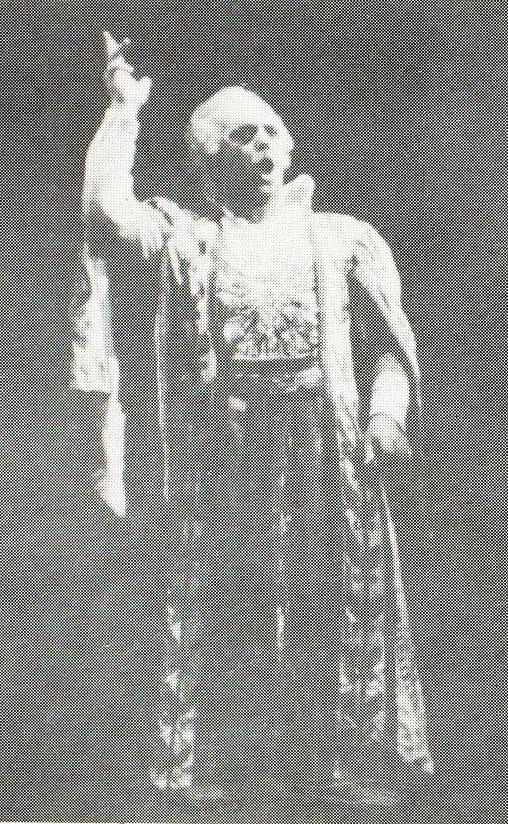
On the day of his performance, he prepared himself (as many leading singers of the day did) by forcing lumps of pancetta up each nostril of his nose to lubricate the nasal passages (he had a magnificent Roman nose). Unfortunately, the pancetta became wedged there and he was forced to go on stage with it still in place. Things looked bad. Fabrio did not sound like a magnificent tenor; his voice was stuffy and nasal. The audience was growing restless with the need to toss tomatoes (which Italians always brought with them to the opera). Fortunately, the famous aria ti amo mortadella comes early in the first act. It’s a robust piece and Fabrio gave it his all, thereby dislodging the pancetta and hurtling meaty projectiles through the air. One put a crack in the second violinist’s Stradavarius; the other slammed into the conductor’s forehead, causing him to lead the orchestra off into an unrestrained allegro punctuated by several tomatoes to the back of his head.

But Fabrio was a success. He went on to have a short but illustrious career and was known throughout Italy as voce bellissima brutte facce.

Pancetta Projectiles in 3-D Perhaps

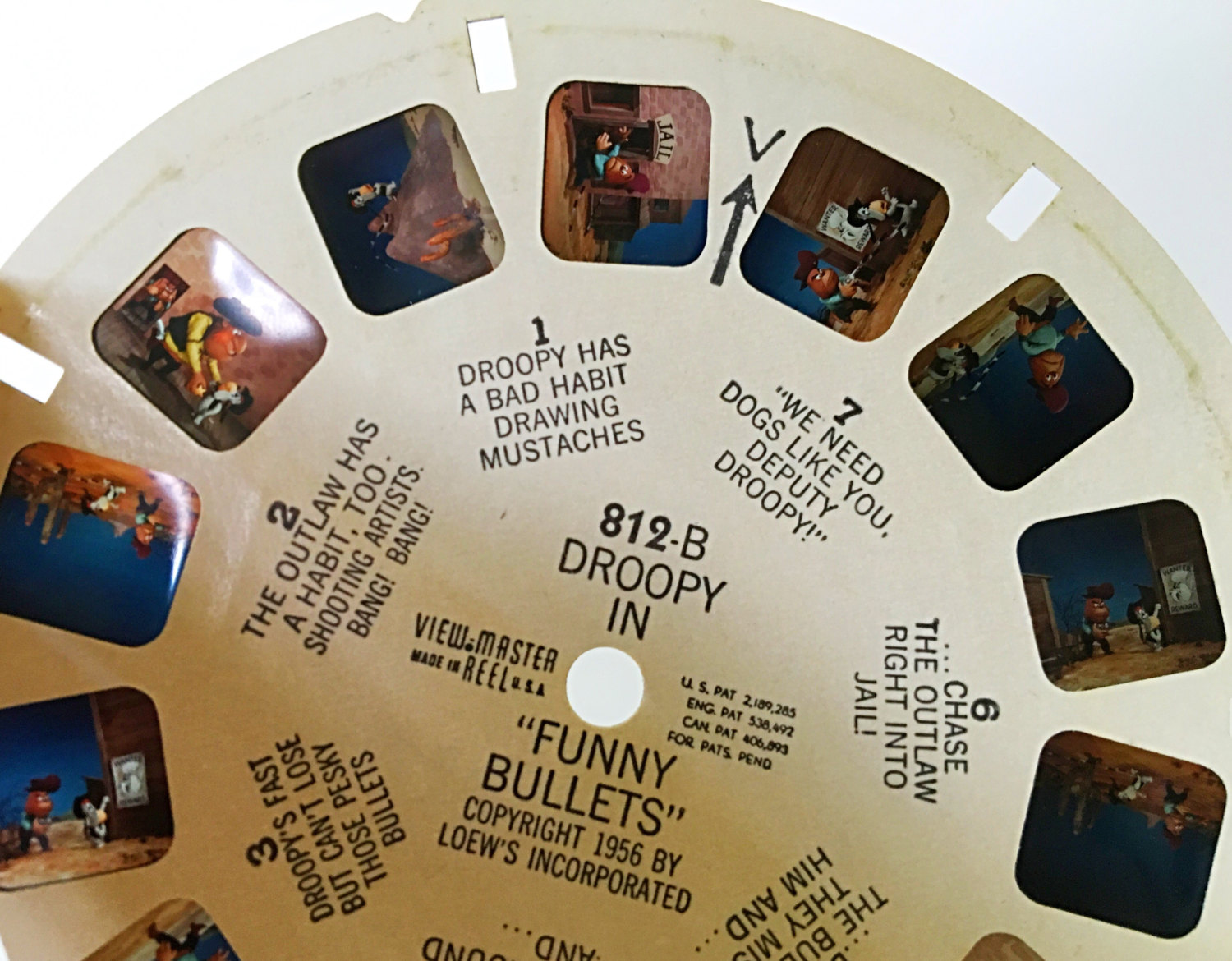
In a letter dated April 1, 1954, Edwin Eugene Mayer explained how he progressed from his early career as a pharmacist in Portland, Oregon, to head of the nation’s largest producer of photographic postcards. Somewhere along the way, Mayer had a eureka moment: updating the old-fashioned 3-D stereoscope. The result, introduced at the 1939 World’s Fair, was the View-Master (although Mayer disliked the name; he thought it sounded like some kind of kitchen appliance).

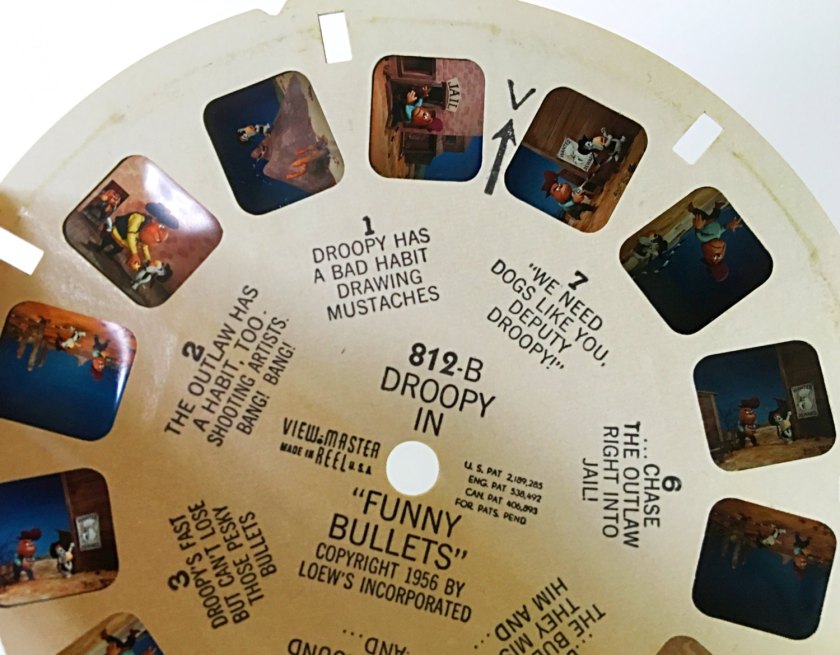
It must have been cumbersome at first, loading all those tiny people and objects into the viewer, sending the viewer back to the factory to be reloaded with new little people and objects once you got tired of the first bunch. But clever Mayer came up with a fix. Instead of loading actual little people and objects into the viewer, he developed a reel with pictures using the fancy new Kodachrome 16 mm film that had become available. The reel had seven pairs of transparencies, fooling the person looking into the viewer that he or she is seeing 3-D. The original reels were mainly scenic, but through the years, content expanded into adaptations of cartoons, movies and television. Since View-Masters introduction, there have been 25 different viewer models. The reels and the internal mechanisms have remain unchanged so that any of the more than a billion reels that have been produced will work in any viewer.

View-Master has been inducted into the National Toy Hall of Fame.

Still More 3-D

Somewhere between the stereoscope and the View-Master, another inventor was beguiled by the wonders of 3-D.  Mervin Ipod spent several years in an attempt to develop a working 3-D radio.  Unfortunately those years were spent in vain, although Mervin Ipod did go on to a bit more success with the invention that bears his name — the Mervinator.

MARCH 30, 1858: PENCIL ME IN

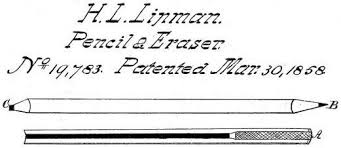
Our story begins in Philadelphia where Hymen J. Lipman in the mid-19th century became one of the city’s leading stationers and founded the first ever envelope company in the United States. Lipman didn’t just content himself with envelopes. His vision took him to pencils as well. And on March 30, 1858, the forward-looking Lipman earned himself a patent for a pencil with an eraser built right into one end of it. This was a giant step for the pencil industry.

Enter Joseph Reckendorfer. Reckendorfer looked at Lipman’s pencil and saw dollar signs. He also saw himself as a titan of the pencil industry. He would be to pencils what Rockefeller was to oil, what Vanderbilt was to railroads. He bought the pencil patent from Lipman for $100,000 (the equivalent of a couple million today).

But alas it wasn’t to be. Pencil manufacturer A. W. Faber began producing eraser-tipped pencils without paying a penny in royalties to Reckendorfer. Reckendorfer sued Faber.  In 1875, the lawsuit made its way to the Supreme Court which declared the patent invalid, reasoning that Lipman’s design combined a known technology, the pencil, with another known technology, the eraser, not creating a new use which was bad news for Reckendorfer.


On the corner of Sodom and Gomorrah

The town of Zion, Illinois, banned all jazz performances on this musicless day, labeling them sinful, right up there with tobacco and alcohol and sexting as things its citizens could well do jazzwithout. The very name was thought (correctly) to have a sexual connotation. The decadent rhythms and wild dancing it elicited were feared (correctly) to be leading young people down the road to sexual abandon, degeneracy, and bad manners. “Oh, you got trouble right here in Zion city.”

Zion is far removed from New Orleans and its bordellos, a place synonymous with jazz and sin. The city was founded in 1901 by John Alexander Dowie as a place where people of faith could come together and live in a moral environment. The population was 24,413 as of the 2010 census. Zion is one of only a few cities in the world to have been completely planned out before building. And Dowie thought of just about everything. The north-south roads in the original plan are all named from the Bible –Ezekiel Place; Gabriel, Galilee, and Gideon Avenues; Matthew, Mark, and Luke, but no John. And no Duke Ellington Circle or Thelonious Monk Boulevard.

MARCH 21, 1867: ON A SHOW BOAT TO BROADWAY

“Curtain! Fast music! Light! Ready for the last finale! Great! The show looks good, the show looks good!”

American Broadway impresario, Florenz “Flo” Ziegfeld, Jr. was born March 21, 1867 (died July 22, ZigfeldFollies19121932). The theater bug came to Ziegfeld early; while still in his teens, he was already running variety shows. In 1893, his father, who was the founder of the Chicago Music College, sent him to Europe to find classical musicians and orchestras. Flo returned with the Von Bulow Military Band — and Eugene Sandow, “the world’s strongest man.”

Ziegfeld was particularly noted for his series of theatrical revues, the Ziegfeld Follies, inspired by the Folies Bergère of Paris – spectacular extravaganzas, full of beautiful women, talented performers, and the best popular songs of the time – and was known as the “glorifier of the American girl”.

“Let us grant that a girl qualifies for one of my productions. It is interesting to note what follows. First, it is clearly outlined to her what she is expected to do. She may be impressed at the outset that the impossible is required, but honest application and heroic perseverance on her part plus skillful and encouraging direction by experts very seldom fail to achieve the desired results. But it is only through constant, faithful endeavor by the girl herself that the goal eventually is reached.”

He also produced musicals in his own newly built Ziegfeld Theatre – Rio Rita, which ran for nearly 500 performances, Rosalie, The Three Musketeers, Whoopee! and Show Boat. Several of his musicals hit the movie screens, including three different versions of Show Boat. William Powell played Flo in the 1932 biopic, The Great Ziegfeld, and a 1946 film recreated the flamboyant Ziegfeld Follies.

Wretched Richard’s Little Literary Lessons, No. 4

pro·tag·o·nist
prōˈtaɡənəst,prəˈtaɡənəst
noun
A protagonist is the main character in any story, such as a literary work or drama:
Say let us put man and woman together,
Find out which one is smarter (and which is the protagonist)

Paul wasn’t sure, but the five-foot duck waddling through the throngs of laughing, crying, shouting, whining children appeared to be waddling toward him – a duck with a destination and, perhaps, a mission. Chances are it had spotted him scowling in a land where grinning is the norm, and it, by God, meant to do something about it.

“Enjoying the Magic Kingdom?” asked the duck upon reaching him. Despite its carefully sculpted plastic smile, this duck wasn’t going to cheer anyone up; its voice dripped sarcasm.

“Of course, I am,” Paul answered, adopting his very own duck attitude. “Isn’t that why you’re here? By the way, didn’t I somewhere get the idea that you’re all supposed to be pleasant and cheerful?”

“I’m not even supposed to talk. Just wave.” The duck waved and, in silence, could have passed for pleasant and cheerful, albeit of a fabricated sort.

“Then why did you talk to me?” Paul asked.

“Because you look bored – like you positively hate the place.”

“Ah, you’re not just an ordinary duck, you’re a member of the happiness squad, here to lift my spirits.”

“No,” answered the duck. “I thought you might have a cigarette.”

Who’s our protagonist?  Paul?  Huey (the duck)? Or two protagonists for the price of one?  Find out here.


MARCH 19, 2009: pigeon

Brussels — A star racing pigeon named Armando has fetched a record 1.25 million euros (about $1.4 million) in an online auction, Belgian media reported Sunday. The prized bird — Belgian’s best long-distance racer of all time according to those in the know — was snapped up by a Chinese buyer for the princely sum that caused a flutter of excitement among fanciers.

Armando had been expected to break the previous record of 376,000 euros ($425,000) paid for a pigeon called Nadine — but not by such a wide margin.

“Earlier this week it became clear that Armando would be the most expensive pigeon ever sold in an online auction,” wrote the specialist website Pigeon Paradise (Pipa.be).

“However, no one expected that the magical cap of a million euros would be pulverised,” it added. The final amount was 1,252,000 euros.

Pigeon Paradise did not say who had bought the pigeon, but according to the Belgian news agency Belga it was a Chinese buyer who will no doubt use his new acquisition to breed other champions.


BYE, BYE, BIRDIE

When the swallows come back to Capistrano/ That’s the day I pray that you’ll come back  to me.

And the day is today, St. Josephs Day, although St. Joseph has nothing to do with swallows. Like feathered clockwork, cliff swallows year after year migrated from Goya, Argentina, to the Mission San Juan Capistrano in southern California. Every year the good townsfolk of San Juan Capistrano welcomed them back with an annual Swallows’ Day Parade with balloons and food trucks, politicians kissing babiesand other festive events. And flocks of tourists would come and everybody was happy.

Was happy. For in 2009, the fabled swallows were no shows. A swallowless decade followed, during which folks at the mission tried unsucessfully to lure their fickle feathered friends  back.

In 2016, swallow experts created faux nests attached to a large temporary wall in hopes that the birds would move in and eventually spill over and start using the actual mission structures. A couple of years ago, two real nests were discovered at the mission and several swallows were spotted in flight.  Swallow lovers hopes were riding high.

Hold your breath no longer.  They’re back!  And the villagers were happy once again, dancing round and round and singing “When the swallows come back to Capistrano

And we can sing once more.  “When the Swallows Come Back to Capistrano” was written by Leon René and first recorded by The Ink Spots in 1940, reaching #4 on the charts.  It has been recorded by Glenn Miller, Xavier Cugat, Gene Krupa, Fred Waring, Guy Lombardo, Billy May, the Five Satins, Elvis Presley, and Pat Boone.

Joseph was mostly known for being the father of Jesus  Not the actual father of course but kind of a placeholder for someone else.  And the real father that Joseph was standing in for was we are told the big guy himself.  Or as some would say the one and only god.So Joseph a carpenterandallaround nice guy schmuck who married the pregnantary tosaveherrep when the big guy asked him to.  Of couse refusing an ask by the big guy might just be inviting a smiting.

oseph, a carpenter by profession, was a descendant of the house of King David. He married Mary and found that she was already pregnant. Being a righteous man and unwilling to expose her to public disgrace, he decided to divorce her quietly. However, an angel convinced him that she was conceived by the holy spirit and that the child in her womb was the Son of God. This is where the story of St. Joseph starts. Joseph’s exit from the story of the Gospels is an unexplainable mystery in the scripture. But various traditions say that Joseph died around Jesus’ 20th birthday.

MARCH 18, 1902: ITALIAN TENORS ARE A LIRE A DOZEN

Tenor Enrico Caruso recorded ten arias for the Gramophone & Typewriter Company in Milan, Italy. He was paid 100 pounds sterling, and was not required to do any typing. These acoustic recordings, recorded in a hotel room on March 18, 1902, created a win-win situation for both Caruso and the Gramophone Company. The gramophone, and its flat circular discs, quickly became victorious in the recording competition, besting both Thomas Edison’s phonograph cylinders and eight-track tapes. The gramophone recordings became best-sellers, helping to spread the 29-year-old Caruso’s fame.

Caruso was signed by London’s Royal Opera House for a season of appearances in eight different operas ranging from Verdi’s Aida to Don Giovanni by Mozart. His successful debut at Covent Garden occurred just two months after his recording session. The following year, Caruso traveled to New York City to take up a contract with the Metropolitan Opera.

By 1920, Caruso had made nearly 300 recordings. His 1904 recording of “Vesti la giubba” from Leoncavallo’s opera Pagliacci was the first sound recording to sell a million copies. All of these recordings are available today on CD, as digital downloads, and in garages throughout the world on eight-track tapes.


Ivan Was Probably a Baritone

Ivan IV Vasileyevich, known to his friends as Ivan the Terrible, died in 1584 while engaged in a particularly wicked game of chess. He rose to prominence, and some might say infamy, as the Grand Prince of Moscow a position he held from 1533 to 1547, when he declared himself the first ever Tsar of All the Russias, a title he held until his death. He was succeeded by his son, Feodor the Not So Terrible.

Historians disagree on the exact nature of his enigmatic personality. He was described as intelligent and devout, yet paranoid and given to rages, episodic outbreaks of mental instability, and late-night tweet storms.

He was also know as Ivan the Fearsome but is not to be confused with Ivan the Gorilla.

Wretched Richard’s Little Literary Lessons – No. 3

plot

plät/  noun

~ the sequence of events of a play, novel, movie, or similar work that develops a story.

Use it in a sentence perhaps?

“What do you do when you’re not floating around the West Indies?” asked Albert.

“I write mostly.”

“A writer, says he,” Basil had returned from the bar and sat across the table from Terry. “I was a writer meself once upon. Never made any money at it, though. I was always a poor writer what never had a plot to piss on.”

Here’s where the plot thickens.


MARCH 16, 1963: PUFF YOUR OWN MAGIC DRAGON

Peter, Paul and Mary released the single, “Puff The Magic Dragon” in 1963. It became a big hit for the folk trio, peaking at number two on the pop charts in spite of its being banned by several radio stations whose management  figured that the song was about the illicit joys of smoking marijuana. The group denied this, saying: “It’s about a magic dragon named Puff.” “Puff” was followed by “Blowin’ in the Wind,” a song about trying to smoke pot on a stormy day, and “Leaving on a Jet Plane,” which is obviously a poorly disguised reference to getting high on the substance of your choice.

Davy, Davy Crockett

On this day eight years earlier, in 1955, “The Ballad of Davy Crockett,” by Bill Hayes, reached the number one spot on the pop music charts and stayed there for five weeks. The smash hit sold more than seven million records by several different artists. Coonskin caps were everywhere, and the words “born on a mountain top in Tennessee” on everyone’s lips – even though the next line “puffed a magic dragon when he was only three” was always bleeped.

Speaking of Substance Abuse:

Giving Up Smoking with Madame Zorene

I stood watching them — laughing young lovers, sitting on the bench, knees touching, talking conspiratorially.  Around them, lilacs and apple blossoms had burst into color, thanks to the fledgling warmth of spring.  As they puffed at long, sleek cigarettes, the exhaled smoke billowed lazily toward the blue sky.  There, sitting in the park, they created a richly satisfying tableau vivant, and I stood mesmerized as I contemplated descending upon them, ripping the cigarettes from their quivering lips and wildly puffing until my heart and lungs cried out in a tobacco-induced orgasm.  Instead, I popped a tiny square of nicotine gum into my mouth — it makes you burp and hallucinate yellow-toothed Doublemint twins — and stormed off.

People were meant to smoke, of course.  Why else tobacco?  A cigarette is tangible; a smoke-free environment hypothetical at best.  And cold turkey is just a dead bird defrosting for Thanksgiving.  Thus I reasoned, when I reached the store and demanded a pack of cigarettes, any brand, with or without filters, from the cowering clerk.  Back to the park, where I hastily lit a cigarette and let its mellowness caress my lungs.  I then smoked the entire pack, one cigarette after another.  It took me less than an hour.

Remorse naturally followed.  I cried out in anguish, bemoaned my weakness, condemned my cowardice — and I began to realize the hopelessness of my situation.  If I were ever to succeed in this quest –and doubts enveloped me — I needed a hired gun.

That evening, I let my fingers do the hobbling through the hypnosis section of the yellow pages.  The trusty phone book paraded before my anxious eyes a plethora of Ph.D.’s, licensed psychologists and certified hypnotherapists, any one of which, I found when phoning the following morning, would be happy to see me two weeks from now, three weeks from now, a month from now.  I had been decisive coming this far, and decisiveness is a fragile, short-lived thing.  I didn’t have that kind of time.

Then I found her.  She was neither psychologist nor hypnotherapist, but Madame Zorene would see me that evening.  I had my moments of doubt when she asked if I wanted her to put a curse on someone, but when I explained that I wanted to quit smoking through hypnosis, she seemed pleased.  “That’s good, too,” she said.

I chain-smoked on the way to my appointment with Madame Zorene, wondering if each cigarette might perhaps be my last.  Her office was tucked away in the back corner of a modern office complex.  I had feared that I would find her in an old shack in the middle of a bayou, although I was pretty certain there wasn’t a bayou within a thousand miles of here.  Upon opening the door, I faced her receptionist, and my fears returned.  A gaunt, colorless woman with stringy hair and sunken eyes, she had a vocabulary of three words:  “You pay first.”

But Madame Zorene herself was a pleasant surprise; a cheerful, chubby woman in her sixties, she smiled reassuringly and greeted me with a hearty handshake.  “Madame Zorene welcomes you,” she said as she opened a door and led me into her office.  “You are a brave man to attempt the smoking cessation.  Smoking is not good for your teeth or your lungs.  You will be happy when you quit.”  It sounded vaguely like a threat.

“Have a seat and relax yourself,” Madame Zorene continued.  “You must be relaxed.”

I settled into a comfortable chair facing her and tried my best to relax, but it wasn’t easy.  Staring at me over Madame Zorene’s left shoulder from the shelves at the other side of the small room was a human skull.  Several smaller skulls stood in a row next to it, each one staring.  On another shelf there were various jars in which dead toads and lizards were suspended in murky water.  There were no medical books, stethoscopes or sphygmomanometers, although there were masks, feathers and various powders.

“Are you a doctor or anything like that?” I asked.

“No, no.  Of course not.”

“What is your background?”

She saw that I was staring past her at her shelves.  “Ah, my little things, they upset you.  No need for you to worry.  I am a much experienced bokor.”

“A bokor?”

“Yes.  A bokor is a sorcerer in the voudun religion.”

“Voudun?”  I asked, growing steadily more anxious.  “Is that voodoo?”

Her eyes lit up and she grinned.  “Yes, yes.”

“And you do curses and things as well as smoking cessation?”

“Of course,” said Madame Zorene.  “But curses are not why we are here, are they?  Why don’t we start?  First I am going to give to you the great sleep.  Then I will lift from your body your ti bon ange.  That is one of your spirits.  I will talk to your ti bon ange, tell it that you no longer want to smoke.  Then when it returns to your body, it will guide you, so that you will no longer smoke.  Now you must relax.”

Madame Zorene stared at me, looked commandingly into my eyes, and began to speak softly in a language I didn’t recognize.  I wanted to turn away from her gaze, which was intimidating, not relaxing, to close my eyes, to stand, to run.  But I couldn’t move and I found myself growing drowsy,  the nagging worry that I would wake up a zombie growing steadily more distant.  I felt as though I were floating through a void.  I could hear Madame Zorene as she continued to talk, and someone answered her.  Was it me, my ti bon ange?

Then I was awake, and Madame Zorene was smiling at me, that same reassuring smile she had first greeted me with.  “Would you like a cigarette?” she asked, and in her smile I now saw the self-satisfaction.

“No, I don’t think so,” I answered truthfully.  I didn’t want one, and I don’t want one now.   I feel good, have no problems.  Well, I do have one problem — it’s odd, really.  The cat stares at me all the time, an evil, possessed stare.  I think it wants a cigarette.


March 14, 1885: Nanki-Poo and the Nattering Nabob

Gilbert and Sullivan’s most famous work The Mikado premiered in London in 1885. It almost didn’t happen. A year earlier, Arthur Sullivan, whining about his precarious health and a Mikadodesire to devote himself to more serious music, told W.S. Gilbert that he couldn’t bring himself to do another piece of the kind the two had previously written. Gilbert was surprised to hear of Sullivan’s qualms, having started work on a new opera in which people fell in love against their wills after taking a magic lozenge. Gilbert wrote Sullivan asking him to reconsider, but the composer replied that he was through with such operas. Gilbert, after much whining of his own, persuaded Sullivan by promising a plot in which no supernatural element occurs “. . . a consistent plot, free from anachronisms, constructed in perfect good faith and to the best of my ability.”

The Mikado was born. With a setting in Japan, an exotic locale far away from Britain, Gilbert was able to poke fun at British politics and institutions by disguising them as Japanese and, with Sullivan’s music, create one of the greatest comic operas, featuring such characters as Nanki-Poo, the wandering minstrel; Yum-Yum, Nanki-Poo’s love; Ko-Ko, the Lord High Executioner; and Pooh-Bah, the Lord High Everything Else.  This is the origin of the word poo-bah — a pretty important person, a high muckety-muck, nabob, honcho, Donald Trump.


December 27, 1895: It’s the Third Day of Christmas, But Don’t You Touch My Stetson

The night was clear and the moon was yellow
And the leaves came tumbling down,

but back to that in a moment.  First we’ll have a quick celebration of the third day of Christmas.  True Love celebrated with three more birds – trois poules françaises, three French hens, that is.  Some say they stand for faith, hope and charity; others say they stand for dinner on Sunday, Monday and Tuesday.

The third ghost of Christmas celebrated by remembering for Scrooge his crawling days when he was often mistaken for the family dog Fido and given kibble, while Fido got the yummy pablum.

Precious Little Faith, Hope and Charity Here

Many of us remember the hit recording from 1959 about an unfortunate bit of  barroom business between Billy Lyon and his good friend Stagger Lee. “Stagger Lee” topped the pop charts for Lloyd Price that year. Fewer of us will remember 1928’s “Stack O’ Lee Blues,” a version of the story by Mississippi John Hurt. And fewer still will remember the incident that inspired the song. It took place on December 27, 1895, in St. Louis, Missouri.

Shooting, fighting and general mayhem have found their way into many songs over the years, and often pop songs are based on true incidents – “Tom Dooley,” the “Wreck of the Edmund Fitzgerald,” “Itsy Bitsy Teeny Weeny Yellow Polka Dot Bikini.” The case of “Stag” Lee was duly reported by the St. Louis Daily Globe-Democrat under the headline “Shot in Curtis’s Place.”

I was standing on the corner
When I heard my bulldog bark
He was barkin’ at the two men
Who were gamblin’ in the dark

It was Stagger Lee and Billy
Two men who gambled late
Stagger Lee threw seven
Billy swore that he threw eight

The Globe-Democrat didn’t mention any gambling. According to its account, Stagger Lee and Billy were in “exuberant spirits” thanks to several rounds of John Barleycorn when they got to discussing politics. Well, a couple of “nattering nabobs” and “right-wing Neanderthals” later, the discussion took on heat, and Billy, in a precipitous move, snatched Stagger Lee’s hat from right atop his head. Such a move cannot go unanswered, and it didn’t.

Stagger Lee told Billy
I can’t let you go with that

You have won all my money
And my brand new stetson hat

Stagger Lee went home
And he got his forty-four
Said, I’m goin’ to the barroom
Just to pay that debt I owe

Go Stagger Lee

Stagger Lee drew his revolver and shot Billy in the stomach. When that poor boy fell to the floor Stagger Lee just took his hat from the dead man’s head and coolly strutted away into musical immortality. Go Stagger Lee, Go Stagger Lee.