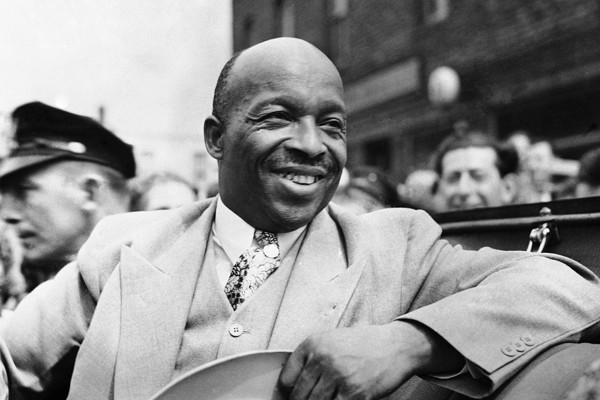
February 12, 1924: Now You Has Jazz

Advertised as an educational event, the “Experiment in Modern Music” drew a capacity crowd to New York City’s Aeolian Hall on the afternoon of February 12, 1924. Noted critics were in attendance as were such luminaries as John Phillip Sousa and Sergei Rachmaninoff.

Organized by the conductor of the Palais Royal Orchestra, Paul Whiteman, the concert was intended to introduce the new form of music called jazz and show audiences that it was a musical form to be reckoned with. True to its billing as educational, most of the concert had consisted of mind-numbing rather than toe-tapping music, two dozen little lessons that began to dissolve into one another as the audience grew antsier and antsier. At last (second to last, actually) a young Broadway composer sat down at the piano to perform a brand new piece written for the occasion.

His composition had been hastily created.  Just over a month earlier, whilegershwin in a Manhattan pool hall, he had read in a newspaper that he was scheduled to perform a jazz concerto at the Whiteman soiree. Painted into the proverbial corner, he set to work. The framework of his concerto came to him on a train journey: “It was on the train, with its steely rhythms, its rattle-ty bang, that is so often so stimulating to a composer – I frequently hear music in the very heart of the noise . . . And there I suddenly heard, and even saw on paper – the complete construction of the Rhapsody, from beginning to end.”

The piece opened with an “outrageous cadenza of the clarinet,” now instantly recognizable, and “Rhapsody in Blue” metamorphosed into a showstopper of American music history. George Gershwin himself would, as a New York Times critic lacking restraint put it, “go far beyond those of his ilk.”

And now you has rock

Forty years later, on February 12, 1964, New York City would again be home to musical history.  This time the venue was Carnegie Hall and the occasion a major skirmish in the British invasion as the Beatles held their first concert in the U.S.  And not everyone thought they would go far beyond those of their ilk:  “Visually they are a nightmare, tight, dandified Edwardian-Beatnik suits and great pudding bowls of hair. Musically they are a near disaster, guitars and drums slamming out a merciless beat that does away with secondary rhythms, harmony and melody.” — Newsweek
 

February 9, 1909: I Make My Money with Bananas

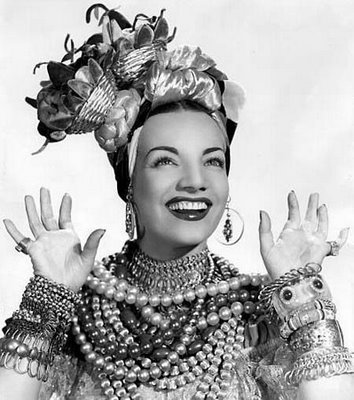
Maria do Carmo Miranda da Cunha was born February 9, 1909, in Marco de Canavazes, Portugal, not in Brazil, as is often assumed.  A year later, though, she did arrive in Rio de Janeiro, where her father opened a lucrative wholesale fruit  business, selling bananas of course.

One wouldn’t think a young girl could soak up much rhythm and culture from the good sisters of the  convent of Santa Teresinha, but by 17 she was singing in the cafes of Rio.  In 1929, using her mother’s surname to keep her career hidden from her disapproving father, Maria do Carmo made her first appearance as Carmen Miranda.  She was tiny in stature, standing only 5’1.”.  Nevertheless, she filled a stage with her Latin energy and machine gun delivery, melodic Brazilian bullets ricocheting everywhere.

She worked her way into singing on Brazilian radio and in movies.  She made her first recording, a romantic choro on one side, but oh on the other side —  a lively samba.

The samba was a lusty part of the social life of the people who lived in the hills beyond the urban refinement of Rio and its European influences.  Its rhythms were African, at once rustic and cosmopolitan, erotic and refined, measured and languorous.  And during the following years, she became the Queen of Samba (or Smiling Dictator of Samba according to one radio announcer).  Her crown an imposing tower of fruit.

She and her samba stormed the United States in 1939 – nightclubs, radio, and throughout the 40s and eary 50s, a string of movies – Down Argentine Way, That Night in Rio, Weekend in Havana, and the over-the-top Busby Berkeley musical The Gang’s All Here in which she sang “The Girl in the Tutti-Frutti Hat.” At age 36, with a salary of over $200,000, she was the highest paid woman in the nation, ninth on the Treasury Department’s salary list, ahead of Betty Grable, Bing Crosby, Bob Hope and Humphrey Bogart.

In 1955, it all ended.  After filming an appearance on the Jimmy Durante television show, at 46 years of age, she died of a heart attack.

Mama Eu Quero

An excerpt from the short story, one of 15 in Calypso, Stories of the Caribbean

The Tropicana was a frenzied, pulsating place, as animated as the tourists and Havana socialites who crowded the casino, bar, dance floor and every table, there to be entertained by a half dozen celebrities, three full orchestras and the Tropicana’s own ballet troupe. It had not been easy for Jorge to secure a table, and when he did, it was some distance from where Carmen Miranda would shortly perform. He liked the table just fine, not wanting to be conspicuous in such a place. Delia wished they were closer but couldn’t say anything, and just being here was the high point in her sixteen years plus four months. She looked as mature as any seventeen-year-old in the place, sipping the wine Jorge had bought her and wearing another bright outfit that Carmen herself might have worn, but without the tutti frutti hat, of course, for that would be presumptuous.
Miranda’s Boys broke into a spirited overture, and suddenly there was Carmen Miranda herself, bouncing to the beat of “South American Way.” Jorge turned to see the look on Delia’s face, but there was no look on Delia’s face because there was no Delia. He scanned the floor, fearing she had fainted in her excitement. Nothing. Then he spotted her, crawling on hands and knees between the tables, toward the stage. He closed his eyes afraid to watch but finally had to look again. He spotted her as she squeezed unnoticed between the chairs occupied by the sleek black-haired man and his sleek black-haired companion, disappearing under the table next to where Carmen Miranda sang and danced.


February 5, 1861: Every Peeping Tom, Dick and Harry

A lady rode through the streets of London on horseback, naked (the lady not the horse), and didn’t get pinched (in the law and order sense, that is).  But more of that later.

In 1861, Samuel B. Goodale who hailed from Cincinnati received a patent for a clever hand-operated stereoscope device on which still pictures were attached like spokes to an axis which revolved, causing the pictures to come to life in motion — a mechanical peep show that folks viewed through a small hole for a penny a pop.  The usual subjects for peep shows were animals, landscapes,  and theatrical scenes, high-minded, proper subjects.  Nothing naughty or titillating.  How long could that last, you ask.  Not long of course. The peep show quickly came to stand for pictures and performances involving sex.

The term peep show itself comes from Peeping Tom, a sneaky British tailor who made a hole in the shutters of his shop so he might surreptitiously spy on Lady Godiva who felt the need to ride naked naked through the streets of the city.  He was struck blind for his effort.

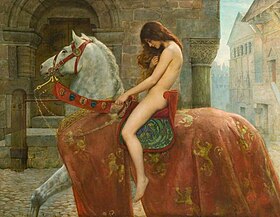
Collier, John; Godiva; Herbert Art Gallery & Museum

What about this Lady Godiva?  Was she for real?  Yes kids, she was.  And the performance she is famous for took place back in the 11th century.  According to her press agent, Lady Godiva was not just your ordinary exhibitionist giving the folks of Coventry, particularly the Toms, Dicks and Harrys of Coventry, their daily eyeful.  She was a noblewoman, married to the “Grim” Earl of Mercia, a nasty fellow who burdened the folks under his sway with high taxes and poor service.  Lady Godiva pleaded frequently with her husband to give the poor some relief, to no avail.  He eventually agreed to lower the taxes if she would ride through town completely naked. The Lady called his bluff.  To keep her ride from becoming something of the magnitude of a Taylor Swift concert,  the townspeople were told to shutter themselves indoors with no peeping.  Which they did, except for you know who.  In a later interview, Blind Tom said it was worth it.

That Ain’t No Cat in the Hat

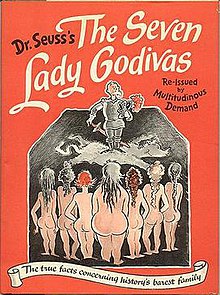
“It was all full of naked women, and I can’t draw convincing naked women.  I put their knees in the wrong places.”  What’s better than a Lady Godiva?  Two Lady Godivas.  Or how about seven?  The story of the seven Godiva sisters was penned by none other than Dr. Seuss, his fourth book and one written for adults or “obsolete children” as he called them.  The seven sisters never wear clothing, not even when they leave the seven Peeping brothers, and head off in the world to warn of the dangers of horses.

The 1939 book had a 10,000 print run with most of them remaining unsold, what Seuss called his greatest failure.  It is one of only two Dr. Seuss books allowed to go out of print.

But Please Lose That Sports Jacket

It has been endlessly debated when and with whom rock and roll actually began, but most enthusiasts have pretty much settled on a guy who cut an unlikely figure for a rock artist but who brought rock and roll into the public eye with a bang in 1955. The man was Bill Haley, along with his Comets, and the song was “Rock Around the Clock” introduced in the film Blackboard Jungle. During the next few years a string of hits including “Shake, Rattle and Roll” and “See Ya Later, Alligator” followed.

Time passes quickly and when you’re at the pinnacle of musical stardom, you’re on a slippery slope. Along comes a guy named Elvis and you’re yesterday’s sha-na-na. Who’s going to scream and carry on for a thin-haired, paunchy 30-year-old musician with a silly curl in the middle of his forehead and a garish plaid sports jacket?

The Brits, that’s who.

By 1957, Bill Haley and the Comets had already enjoyed their golden days of American super-stardom. But the battle of Britain lay ahead. When they stepped off the Queen Elizabeth in Southampton on February 5, they began the first ever tour by an American rock and roll act and launched what rock historians called the American Invasion.

When Haley and the band reached London later that same day, they were greeted by thousands in a melee the press called “the Second Battle of Waterloo.” These were the British war babies just becoming teenagers, and they were ready for American rock and roll.

February 1, 1896: Poor People of Paris

Opera patrons packed the Teatro Regio in Turin, Italy, on the evening of February 1, 1896, for the world premiere of Giacomo Puccini’s latest, La Boheme. Conducting the evening’s performance was a rising young star, Arturo Toscanini. Critics were divided over the opera, but audiences lapped it up, and it remains the world’s most popular opera. It is a timeless story of love among struggling young artists in Paris during the 1830s.

Our Bohemians– a poet, a painter, a musician and a philosopher — share a garret in the Latin Quarter as they try to eke out a living. It’s Christmas Eve; it’s cold. Rodolfo, the poet, and Marcello, the painter, are feeding a small fire with one of Rodolfo’s manuscripts. Their two companions arrive with food and fuel, one having had the good fortune to sell a bit of music. As they eat and drink, the landlord comes looking for their overdue rent. They distract him with wine and, pretending to be offended by his stories, throw him out. The rent money is divided for a night out in the Latin Quarter. Rodolfo stays behind as the other three leave, fortuitously, as a pretty neighbor comes looking for a light for her candle: “They call me merely Mimi.” Merely Mimi faints (she’s not well, folks), she and Rodolfo immediately fall in love, and they head off to the Latin Quarter, singing of their love.

In Act 2, our Bohemians are making merry in the Latin Quarter. Marcello’s one-time sweetheart, Musetta, enters on the arm of the old but wealthy Alcindoro. Trying to get Marcello’s attention, she sings an aria about her own charms (Musetta’s Waltz, recorded as Don’t You Know by Della Reese in 1959). She sends Alcindoro off on a bogus errand and promptly leaps into Marcello’s arms. They all scurry off, stiffing the returning Alcindoro for the check.

Act 3 brings a series of flirtations, jealousies, lovers’ quarrels and, for Mimi, a lot of coughing. At this point, we’re pretty sure she’s not going to make it through Act 4.

Which she doesn’t. After a few attempts at being cheerful, the others leave Mimi and Rodolfo who recall their meeting and happy days together until Mimi is overtaken by violent coughing. The others return, Mimi drifts into unconsciousness and dies.

Enrico Caruso owned the role of Rodolfo during his life, as did Luciano Pavarotti. And Maria Callas was all over Mimi.


Singin’ the Blus

Fast forward to another Italian who took the musical world by storm.  His name was Domenico Mondugno and he wrote a happy little chanson about a man who paints his hands and face blue then flies around above his lover.  It’s probably best left untranslated from the original Italian.  Nel Blu Dipinto Di Blu was released on February 1 and soared to the top of the Billboard 100, finishing out the year as the number one song of 1958. Shortly thereafter, it picked up the Grammy for Record of the Year and Song of the Year.  Every working singer had his or her own recording of it, usually under the title Volare, a word that was added as an afterthought to the chorus.

January 28, 1393: I Don’t Want To Set the World on Fire

A rather unusual celebration took place in France on January 28, 1393 — a masked ball, given by Isabeau of Bavaria, wife of King Charles VI. The ball, which was later given the name Bal Des Ardents or Ball of the Burning Men, celebrated the remarriage of one of the Queen’s ladies-in-waiting. The quaint French custom on such an occasion called for rowdiness and tomfoolery.

At one point during the festivities, six men capered about in costumes portraying wood savages. Their linen outfits were soaked with resin to which flax was attached, making them shaggy from head to toe. They howled like wolves, shouted obscenities, and taunted the audience, inviting them to guess their identities. One of the six men was King Charles himself.

The King’s brother and a drinking buddy arrived late to the party, already drunk. They held torches close to the savages in an attempt to guess their identities — too close, setting the men ablaze. A Duchess, standing near the King, threw her gown over him to protect him. One of the other men jumped into a tub of ale. The other four perished.

Whether or not there was any cause and effect, it was about this time that Charles began to suffer bouts of mental instability, during which he would attack and frequently kill those near him. Modern psychologists, with their advanced knowledge, might refer to the King as mad as a hatter. Charles himself insisted that he was a stable genius and the best king in the history of France.

One of his most celebrated bouts with reality was his belief that he was made of glass and might be easily broken. As a result he allowed no one to touch him and anyone who approached him was required to tread lightly on tiptoe. The windows of the castle remained shut at all times to create an absolutely quiet environment, lest any sudden noise might — well, you know. Modern psychologists refer to this malady as glass delusion or if you break it, you buy it syndrome.

Charles endured his various idiosyncrasies until he was finally shattered in 1422.

Adios Mis Amigos

On January 28, 1948, a DC-3 plane carrying 32 passengers crashed in California’s Diablo Mountain Range, killing everyone aboard. News reports listed only the pilot, first officer and stewardess by name; the others were identified as deportees. The Hispanic victims were buried in a mass grave marked “Mexican Nationals.” At least they were not identified as rapists and murderers and other really bad people.

Woody Guthrie wrote a song about the incident:

January 13, 1930: Day of the Mouse

He’s short with big ears, a big nose and a skinny tail.  He’s nattily attired in red shorts with two big buttons, big yellow shoes and white gloves.  He hails from Florida these days where he has his own kingdom and is a woke Robin Hood to the state’s evil governor.  Back in 1930 when he made his debut he wasn’t quite so colorful, his venue being a black and white comic strip.  Mickey Mouse was already well known when his comic strip first appeared, having been a film star since his first appearance in 1928 in the cartoon Plane Crazy.  Created by Walt Disney and Ub Iwerks, he has grown in stature through the years to become the face of the Walt Disney organization.

The first comic strip sequence was a reprise of the Plane Crazy cartoon in which Mickey dreams of following in the footsteps of his idol Charles Lindbergh, flying into adventure in his own homemade plane, along with his girlfriend Minnie.

The governor of Florida would probably fare better against a less formidable Disney character.  A DeSantis/Donald Duck debate would be priceless.

If Only It Had Wings

On January 13, 1854,  musical inventor Anthony Foss received a patent for his accordion, a strange device shaped like a box with a bellows that is compressed or expanded while pressing buttons or keys which cause pallets to open and air to flow across strips of brass or steel, creating something that vaguely resembles music. It is sometimes called a squeezebox. The person playing it is called an accordionist (or squeezeboxer?)

The harmonium and concertina are cousins. And, yes, there is a World Accordion Day.

If Only She’d Had a Squeezebox

Born in Russia on January 13, 1887, “the Last of the Red Hot Mamas,” Sophie Tucker immigrated to the United States as an infant and began her long career shortly afterward, singing for tips in her parents’ restaurant. Between taking orders and serving customers, Sophie would stand in a narrow space by the door and belt out songs with all the drama she could muster. “At the end of the last chorus,” she remembered, “between me and the onions, there wasn’t a dry eye in the place.”

She gained stardom using a combination of comic risque and “fat girl” songs such as “Nobody Loves a Fat Girl, But Oh How a Fat Girl Can Love.” Her signature song, however, was “Some of These Days.” She became one of the most popular entertainers in America, following her vaudeville and burlesque career with movies through the 30’s and 40’s and television in the 50’s and 60’s.  She influenced many female performers, including such larger than life performers as Mae West and Bette Midler.

Sophie Tucker continued performing until her death in 1966.

JANUARY 10, 49 BC: WADE IN THE WATER

Back in 49 BC, Julius Caesar was a mere governor commissioned by the Roman Senate to oversee a portion of the empire that stretched from Gaul to Illyricum (pretty much most of today’s Europe except Italy). When his term of governorship ended, the Senate ordered Caesar to disband his army and return to Rome. Whatever you do, Julie baby, don’t bring that army across the Rubicon River for that is treason and insurrection and very bad manners. Oh, and the punishment is death.

Caesar may have misunderstood for didn’t he just up and cross the Rubicon into Italy on January 10. His biographer suggests that he was under the control of a supernatural apparition (the Devil made him do it). Willful or not, Caesar is said to have shouted “alia iacta est” as he and his merry men waded across the shallow river (or ‘the die has been cast,” certainly more dramatic in Latin).

Crossing the Rubicon was a declaration of war, but instead of arresting Caesar the Roman Senate fled Rome in fear. Caesar, far from being condemned to death, became dictator for life. Sometimes it’s good to cross the Rubicon. Crossing the Rubicon has endured as a phrase meaning passing a point of no return.

The Hole in My Record Is Bigger Than the Hole in Your Record

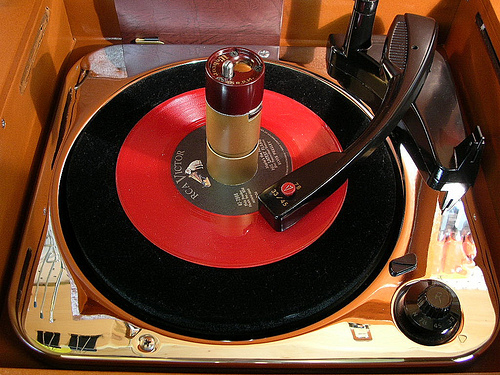
RCA Victor it might be said crossed the Rubicon when on January 10, 1949, it introduced a new kind of record — a vinyl disc, just seven inches in diameter with a great big hole in the middle, the 45 (referring to its revolutions per minute). The 45 replaced the big noisy shellac disc that rotated at a breakneck 78 rpm. The first 45 rpm single was “Peewee the Piccolo.” Remember it?

The Bun Knows

On January 10, 1984, 81-year-old Clara Peller first asked the question for which she would become famous:

MAY 4, 1959: VINYL AND GOLD

     The first Grammy Awards (or Gramophone Awards as they were originally called) honoring achievement in the recording industry were held in 1959. And it was a banner year to start passing out those little gold gramophones.

     In contention for Record of the Year was Perry Como with one of his three Top 10 singles for the previous year, “Catch a Falling Star,” Peggy Lee with her biggest hit of the rock era, “Fever,” Frank Sinatra crooning “Witchcraft,” and the are-you-kidding entry, “The Chipmunk Song” by David Seville. Taking home the statuette (to Italy) was Domenico Mondugno and the only foreign language recording to ever win the top prize, “Nel Blu Dipinto Di Blu.” The recording also won Song of the Year against pretty much the same competition.

     For Album of the Year, Sinatra put both his 1958 releases in the running (possibly canceling each other out) – the upbeat Come Fly With Me, his first with arranger Billy May, and Only The Lonely, arranged by Nelson Riddle. Ella Fitzgerald placed one of her several songbook albums in the ring, this one dedicated to Irving Berlin. And Van Cliburn, having won the April 1958 International Tchaikovsky Competition in Moscow, scored with Tchaikovksy: Concerto No. 1 In B-Flat Minor, Op. 23. Stiff competition but Henry Mancini was up to it, nailing the first of his 20 Grammy Awards with The Music from Peter Gunn.

     Sinatra, Fitzgerald, Como and Cliburn all won in other categories, as did Louis Prima and Keely Smith, Count Basie, Andre Previn, and the Champs (Tequila). The head-scratcher Grammy of the year was in the category Best Country and Western Performance, won by the Kingston Trio for  “Tom Dooley.” Well, it’s not jazz or classical.

APRIL 29, 1946: GOD’LL GET YOU FOR THAT

God was married on this day in 1946. For the second time. He was 70 at the time; she was 21 and, he claimed, a reincarnation of his first wife.

Unlike many other religious leaders who claimed to have God’s ear, Reverend Major Jealous Divine, (1876 – 1965) claimed to be God. Some contemporaries – jealous’ themselves perhaps – claimed he was more charlatan than god. Earlier in his life, before he became God, he was simply the Messenger. He founded what some have called a cult and oversaw its growth into a multiracial and international church.

Father Divine preached extensively in the south where, in 1913, he ran afoul of local ministers and was sentenced to 60 days jail time. While he was serving his sentence, several prison inspectors were injured in an auto accident, which, Father Divine pointed out, was the direct result of their disbelief.

Upon his release, he attracted a following of mostly women in Georgia. In 1914, several of his followers’ husbands and local preachers had Divine arrested for lunacy. This did not have the desired effect; it actually expanded his ministry. Father Divine was found mentally sound in spite of “maniacal” beliefs. When arrested, he had refused to give his name and was tried as John Doe (aka God).

After moving north and attracting a New York following — just as you were saying with a smirk, it could only happen in Georgia — Father Divine was arrested again, this time for disturbing the peace. At his 1932 trial, the jury found him guilty but asked for leniency. Ignoring this request, the judge called him a menace to society and sentenced him to one year in prison and a $500 fine. The 55-year-old judge died of a heart attack a few days later. Father Divine told-you-soed thusly: “I hated to do it. I did not desire Judge Smith to die . . . I did desire that my spirit would touch his heart and change his mind that he might repent and believe and be saved from the grave.”

In 1944, singer/songwriter Johnny Mercer attended one of his sermons – the subject, “You got to accentuate the positive and eliminate the negative.” Mercer was impressed. He returned to Hollywood and, with songwriter Harold Arlen, wrote “Ac-cent-tchu-ate The Positive”, which was recorded by Mercer himself and the Pied Pipers in 1945. It was also recorded by Bing Crosby with the Andrews Sisters.  And probably sung a year later at God’s wedding.


APRIL 25, 1926: HERE THE MAESTRO DIED

The world premier of Giacomo Puccini’s last opera “Turandot” was held at Milan’s La Scala on April 25, 1926, two years after his death. Arturo Toscanini conducted. Toward the end of the third act, Toscanini laid down his baton, turned to the audience and announced: “Here the Maestro died.”  Puccini had died before finishing the opera. Subsequent performances at La Scala and elsewhere included the last few minutes of music composed by Franco Alfano using Puccini’s notes.  A highlight of the opera is “Nessun Dorma,” probably the most famous aria in all of opera.

Down at the End of Lonely Street

Elvis Presley scored his first number one hit on the Billboard Pop 100 on this date in 1956.  Recorded and released as a single in January, “Heartbreak Hotel” marked Presley’s debut on the RCA Victor record label . It spent seven weeks at number one, became his first million-seller, and was the best-selling single of 1956. The song was based on a newspaper article about a lonely man who committed suicide by jumping from a hotel window.