APRIL 29, 1946: Are You Looking for a Smiting?

God was married on this day in 1946. For the second time. He was 70 at the time; she was 21 and, he claimed, a reincarnation of his first wife.

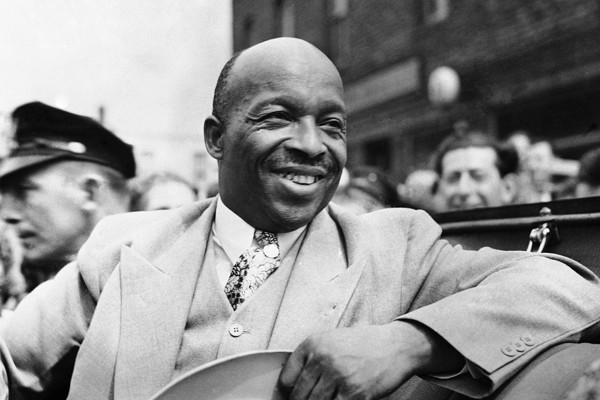
Unlike many other religious leaders who claimed to have God’s ear, Reverend Major Jealous Divine, (1876 – 1965) claimed to be God. Some contemporaries – jealous’ themselves perhaps – claimed he was more charlatan than god. Earlier in his life, before he became God, he was simply the Messenger. He founded what some have called a cult and oversaw its growth into a multiracial and international church.

Father Divine preached extensively in the south where, in 1913, he ran afoul of local ministers and was sentenced to 60 days jail time. While he was serving his sentence, several prison inspectors were injured in an auto accident, which, Father Divine pointed out, was the direct result of their disbelief.

Upon his release, he attracted a following of mostly women in Georgia. In 1914, several of his followers’ husbands and local preachers had Divine arrested for lunacy. This did not have the desired effect; it actually expanded his ministry. Father Divine was found mentally sound in spite of “maniacal” beliefs. When arrested, he had refused to give his name and was tried as John Doe (aka God).

After moving north and attracting a New York following — just as you were saying with a smirk, it could only happen in Georgia — Father Divine was arrested again, this time for disturbing the peace. At his 1932 trial, the jury found him guilty but asked for leniency. Ignoring this request, the judge called him a menace to society and sentenced him to one year in prison and a $500 fine. The 55-year-old judge died of a heart attack a few days later. Father Divine told-you-soed thusly: “I hated to do it. I did not desire Judge Smith to die . . . I did desire that my spirit would touch his heart and change his mind that he might repent and believe and be saved from the grave.”

In 1944, singer/songwriter Johnny Mercer attended one of his sermons – the subject, “You got to accentuate the positive and eliminate the negative.” Mercer was impressed. He returned to Hollywood and, with songwriter Harold Arlen, wrote “Ac-cent-tchu-ate The Positive”, which was recorded by Mercer himself and the Pied Pipers in 1945. It was also recorded by Bing Crosby with the Andrews Sisters.  And probably sung a year later at God’s wedding.


APRIL 25, 1926: HERE THE MAESTRO DIED

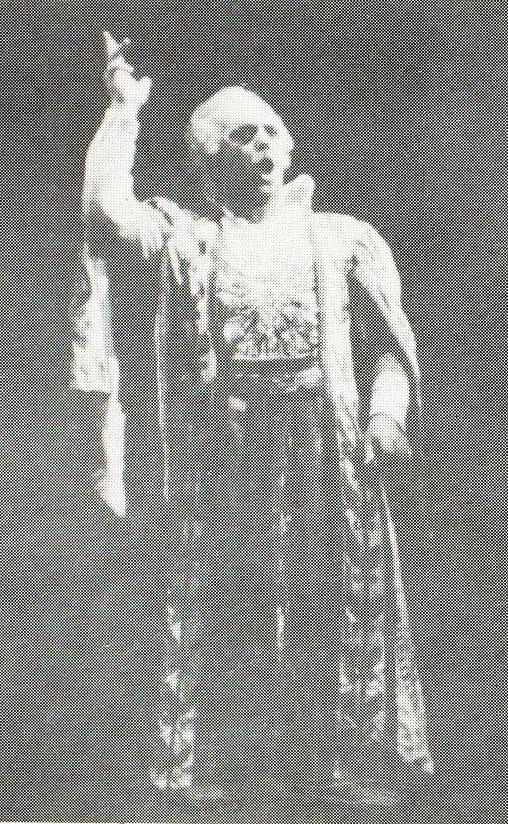
The world premier of Giacomo Puccini’s last opera “Turandot” was held at Milan’s La Scala on April 25, 1926, two years after his death. Arturo Toscanini conducted. Toward the end of the third act, Toscanini laid down his baton, turned to the audience and announced: “Here the Maestro died.”  Puccini had died before finishing the opera. Subsequent performances at La Scala and elsewhere included the last few minutes of music composed by Franco Alfano using Puccini’s notes.  A highlight of the opera is “Nessun Dorma,” probably the most famous aria in all of opera.

Down at the End of Lonely Street

Elvis Presley scored his first number one hit on the Billboard Pop 100 on this date in 1956.  Recorded and released as a single in January, “Heartbreak Hotel” marked Presley’s debut on the RCA Victor record label . It spent seven weeks at number one, became his first million-seller, and was the best-selling single of 1956. The song was based on a newspaper article about a lonely man who committed suicide by jumping from a hotel window.

April 20, 1935: Splish Splash, Snooky Was Taking a Bath

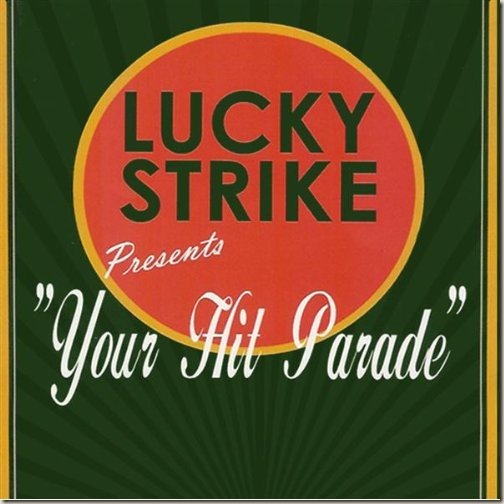
A music staple of the 40s and 50s, Your Hit Parade, made its radio debut on April 20, 1935. It lasted for nearly 25 years before being done in by rock and roll music – and perhaps Snooky Lanson. It began as a 60-minute program with 15 songs played in a random format, and eventually moved to television where the seven top-rated songs of the week were presented each week in elaborate production numbers requiring constant set and costume changes.  The list of top songs was compiled through a closely guarded top secret algorithm that involved record sales, quarters plunked into jukeboxes, shoplifted sheet music and the divination of an unidentified mystic in Memphis, Tennessee.

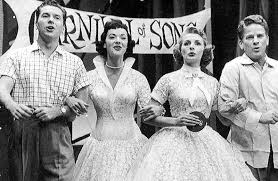
Dorothy Collins , Russell Arms, Snooky Lanson and Gisèle MacKenzie were top-billed during the show’s peak years. And Lucky Strike cigarettes starred throughout its run.

As the rock and roll era took over, the program’s chief fascination became seeing a singer like Snooky Lanson struggle with songs like Splish Splash and Hound Dog.

Would Snooky Make a Good Macbeth

Although Shakespeare’s Macbeth was written in 1606, the first record of a performance was at the Globe Theater on April 20, 1611, although chances are there were  a few out-of-town tryouts earlier.  Shakespeare’s tragedy is one of the most performed and one of the shortest.  It has in its 413-year history made a lot of contributions to the English culture and picked up some interesting baggage.  One of the most noted of the latter is the Macbeth curse: speaking the name of the play in the theater is inviting a grim reckoning.  It is always referred to as “the Scottish play.”  No one knows exactly why there is a curse, but it has been suggested that the witches’ spells used in the play were real. They were taken from a book on demonology written by King James I, either to suck up to the king or to poke fun at his belief in witchcraft. Were some unfortunate to slip up and utter the word Macbeth, he or she must immediately leave the room, turn around three times, spit, say Donald Trump, then beg to be re-admitted.

“Double, double, toil and trouble, fire burn and cauldron bubble.”  No, Snooky would make a better witch.

APRIL 11, 1938: The Tenor Always Sings Twice

Call it destiny. Two men stranded in Kansas City when a storm closed the airport met in a hotel lobby, engaged in conversation, and – go figure – discovered they each had profound worries about the future of the barbershop quartet. This was not just empty lamenting on the part of Owen C. Cash and Rupert I. Hall; these founding fathers acted, and the Society for the Preservation and Encouragement of Barber Shop Quartet Singing in America (SPEBSQSA, as it’s more familiarly known) was born. They wrote a letter that became a mission statement:

“In this age of dictators and government control of everything, about the only privilege guaranteed by the Bill of Rights not in some way supervised or directed is the art of barbershop quartet singing. Without a doubt, we still have the right of peaceable assembly which, we are advised by competent legal authority, includes quartet singing.

“The writers have, for a long time, thought that something should be done to encourage the enjoyment of this last remaining vestige of human liberty. Therefore, we have decided to hold a songfest on the roof garden of the Tulsa Club on Monday, April 11, 1938, at 6:30 pm.”

Twenty-six men attended that first rooftop meeting. Attendance at subsequent meetings multiplied rapidly, and at the third meeting, 150 harmonizers stopped traffic on the street below. A reporter for the Tulsa Daily World put the story on the national news wires and the rest is history. The Society for the Preservation and Encouragement of Barber Shop Quartet Singing in America was born. That acronym SPEBSQSA was the founders’ way of demonstrating that one could  be a barbershop quartet enthusiast and still have a sense of humor; it was a parody of the New Deal’s “alphabet soup” of acronyms, and the society has said “attempts to pronounce it are discouraged.”

Ninety years passed (as years will) and the SPEBSQSA evolved (or devolved, perhaps) into the Barbershop Harmony Society. It boasts more than 20,000 enthusiastic members, although unfortunately they are not always singing off the same sheet.  Not quite the Hatfields and McCoys, but the Kibbers and the Libbers as they’re known might value harmony but philosophically they practice little of it.  We’ll explore this rift, but first we must digress.

The musical style of barbershop dates back to 17th century England.  Barbers of course all sing, and the barbers of merry olde were no exception.  They generally kept a lute or a flute among the razors to serenade customers waiting for a shave and a haircut, two pence.  Patrons, having just come from a nearby alehouse, would join in and the resulting cacophany became known as barber’s music.  Centuries passed (as centuries will) and barber’s music grew more refined and subject to rules.

Somewhere it is written that barbershop quartets must have four singers.  But, and here’s where it gets a little weird, according to Spin.com, which knows such things: “four striped-shirt, straw-hatted, bow-tied bodies — but five voices. The second tenor sets the stage with a lead melody line, which the first tenor lays a high harmony on. The baritone singer handles mid-range, while the bass, the deepest voice of the four, lays a solid foundation. But when the overtones of these four pitch-perfect voices unite and merge, an invisible fifth voice emerges from the ether, an everywhere-but-nowhere aural apparition not unlike the effect of Buddhist monks chanting in a massive ancient temple. This unified fifth-voice phenomenon is known as harmonic coincidence” not to be confused with harmonic concurrence or harmonic convergence.*

As the genre matured, attempts were made to modernize.  Younger members joined the old guard, bringing with them their doo-wop and pop and what-have you, much to the chagrin of the purists — the Kibbers (Keep It Barbershop) as opposed to the Libbers, liberal approach to barbershop.

*Peace Will Guide the Planet

Two days in August of 1987 that marked a grand celestial alignment of the Sun, the Moon, Mars, Mercury, Venus, Jupiter, Saturn, Neptune, and Uranus.  Convergence enthusiasts believed that this conjunction would usher in a new age of universal peace — with good karma, good manners and good posture, sort of like the Age of Aquarius** as celebrated in song by a group of five voices, all of which were actual people, therefore not a quartet, barbershop or otherwise.

** Not to be confused with the Age of Aquariums, the period during the 1960s and ’70s, during which it was de rigueur to have a tank of tropical beasties such as neon tetras, seahorses and angel fish.***

*** Not to be confused with Angel Eyes, a song popularized by Frank Sinatra with the haunting conclusion “Excuse me while I disapp . . .”


APRIL 1, 1903: THE TENOR NOSE

Fabrio Abruzzi was born in a village near Milan in 1883. The Abruzzi family was quite poor with Fabrio’s father cobbling together their existence as a shoemaker. Almost from the time Fabrio could walk, he was put to work pounding leather for his father. He was a nice boy (the villagers lovingly called him bambino brutto) and he was hard-working although his mind would wander and he frequently distracted himself by singing popular Italian folk songs.

As a child, he always had a pleasant singing voice and when, as a teenager, his voice changed, it became a magnificent tenor voice. Fate smiled on Fabrio. A LaScala impresario happened through the village and heard the young man sing as he pounded leather. He took Fabrio under his wings, coached him extensively and on April 1, 1903, scheduled his debut as the principal tenor in Puccini’s Euripedes et Copernica.

On the day of his performance, he prepared himself (as many leading singers of the day did) by forcing lumps of pancetta up each nostril of his nose to lubricate the nasal passages (he had a magnificent Roman nose). Unfortunately, the pancetta became wedged there and he was forced to go on stage with it still in place. Things looked bad. Fabrio did not sound like a magnificent tenor; his voice was stuffy and nasal. The audience was growing restless with the need to toss tomatoes (which Italians always brought with them to the opera). Fortunately, the famous aria ti amo mortadella comes early in the first act. It’s a robust piece and Fabrio gave it his all, thereby dislodging the pancetta and hurtling meaty projectiles through the air. One put a crack in the second violinist’s Stradavarius; another slammed into the conductor’s forehead, causing him to lead the orchestra off into an unrestrained allegro punctuated by several tomatoes to the back of his head.

But Fabrio was a success. He went on to have a short but illustrious career and was known throughout Italy as voce bellissima brutte facce.

Pancetta Projectiles in 3-D Perhaps

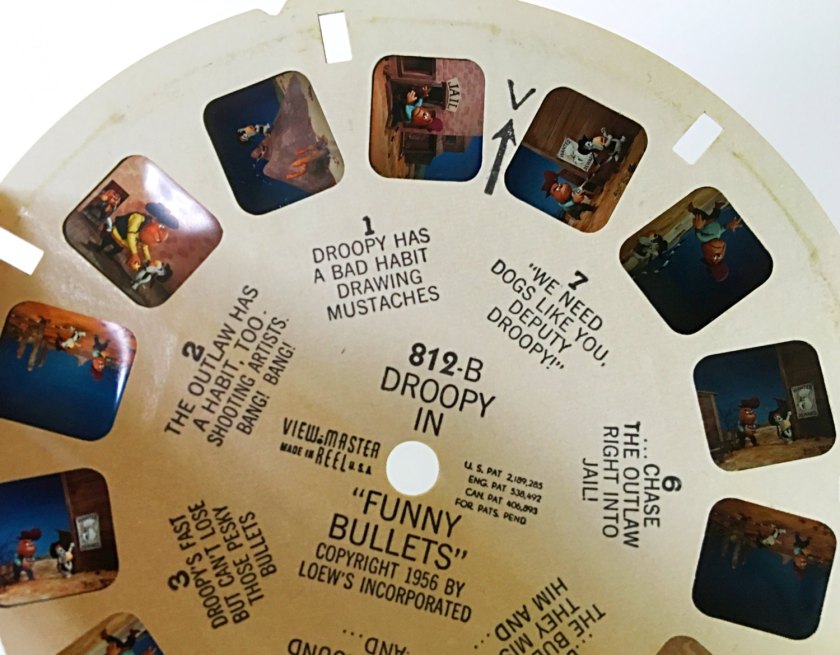
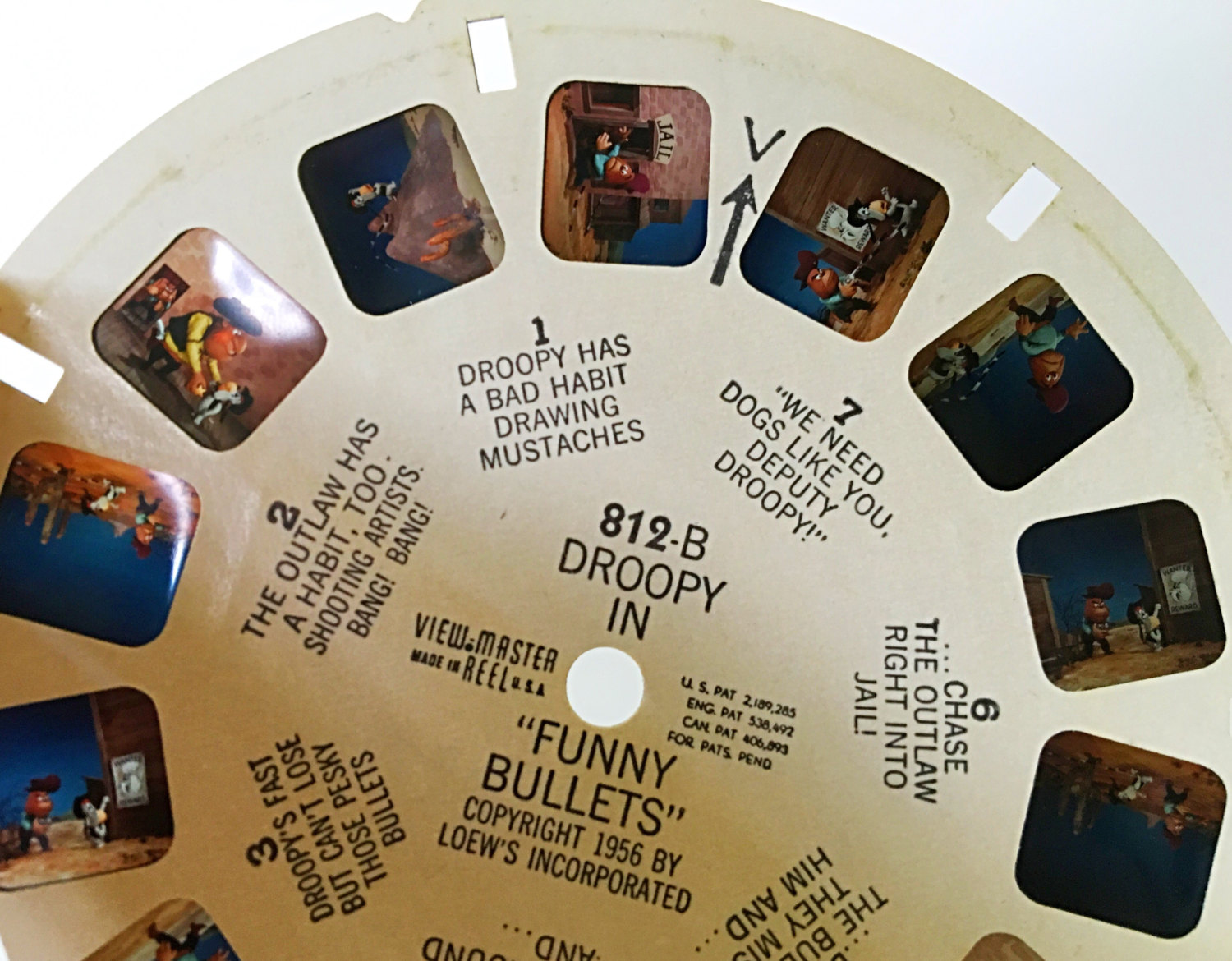
In a letter dated April 1, 1954, Edwin Eugene Mayer explained how he progressed from his early career as a pharmacist in Portland, Oregon, to head of the nation’s largest producer of photographic postcards. Somewhere along the way, Mayer had a eureka moment: updating the old-fashioned 3-D stereoscope. The result, introduced at the 1939 World’s Fair, was the View-Master (although Mayer disliked the name; he thought it sounded like some kind of kitchen appliance).

It must have been cumbersome at first, loading all those tiny people and objects into the viewer, sending the viewer back to the factory to be reloaded with new little people and objects once you got tired of the first bunch. But clever Mayer came up with a fix. Instead of loading actual little people and objects into the viewer, he developed a reel with pictures using the fancy new Kodachrome 16 mm film that had become available. The reel had seven pairs of transparencies, fooling the person looking into the viewer that he or she is seeing 3-D. The original reels were mainly scenic, but through the years, content expanded into adaptations of cartoons, movies and television. Since View-Masters introduction, there have been 25 different viewer models. The reels and the internal mechanisms have remain unchanged so that any of the more than a billion reels that have been produced will work in any viewer.

View-Master has been inducted into the National Toy Hall of Fame.

Still More 3-D

Somewhere between the stereoscope and the View-Master, another inventor was beguiled by the wonders of 3-D.  Mervin Ipod spent several years in an attempt to develop a working 3-D radio.  Unfortunately those years were spent in vain, although Mervin Ipod did go on to a bit more success with the invention that bears his name — the Mervinator.

March 30, 1921: On the Corner of Sodom and Gomorrah

The town of Zion, Illinois, banned all jazz performances on this musicless day, labeling them sinful, right up there with tobacco and alcohol and sexting as things its citizens could well do without. The very word jazz was thought (correctly) to have a sexual connotation. The decadent rhythms and wild dancing it elicited were feared (correctly) to be leading young people down the road to sexual abandon (remember Footloose, barely a degree of Kevin Bacon from Satan himself), degeneracy, and bad manners. “Oh, you got trouble right here in Zion city.”

Zion, Illinois is a bunch of degrees from New Orleans, the birthplace of jazz with its Bourbon Street, bordellos and sin, sin, sin. Zion was founded in 1901 by John Alexander Dowie as a place where people of faith could come together and live in a moral environment, reading the Good Book from  Fri ’til Monday. The population was 24,655 as of the 2020 census. Zion is one of only a few cities in the world to have been completely planned out before building. And Dowie thought of just about everything. The north-south roads in the original plan were all named from the Bible –Ezekiel Place; Gabriel, Galilee, and Gideon Avenues; Matthew, Mark, and Luke, but no John. And no Duke Ellington Circle or Thelonious Monk Boulevard.

During the same year that Zion proscribed jazz, the town nixed evil alcohol,  In what can only be described as a binge, the citizens poured 80,000 pints of beer into Zion sewers.  Did they actually have 80,000 pints on hand?  Or did they have to borrow from nearby towns?  Perhaps Gabriel and Galilee Avenues harbored a lot of closet imbibers.  And maybe even a Louis Armstrong record or two.


Pencil Me In

Hymen J. Lipman one of the Philadelphia’s leading stationers, founded the first ever envelope company in the United States. Lipman didn’t just content himself with envelopes. His vision took him to pencils as well. And on March 30, 1858, the forward-looking Lipman earned himself a patent for a pencil with an eraser built right into one end of it. This was a giant step for the pencil industry.

Joseph Reckendorfer looked at Lipman’s pencil and saw dollar signs. He also saw himself as a titan of the pencil industry. He would be to pencils what Rockefeller was to oil, what Vanderbilt was to railroads. He bought the pencil patent from Lipman for $100,000 (the equivalent of a couple million today).

But alas it wasn’t to be. Pencil manufacturer A. W. Faber began producing eraser-tipped pencils without paying a penny in royalties to Reckendorfer. Reckendorfer sued Faber.  In 1875, the lawsuit made its way to the Supreme Court which declared the patent invalid, reasoning that Lipman’s design combined a known technology, the pencil, with another known technology, the eraser, not creating a new use. Bad news for Reckendorfer.

MARCH 21, 1963: Jailhouse Rock

The Rock, as it’s affectionately known, got started in the incarceration business back in 1934, but this crag poking up out of San Francisco Bay had a much longer history, first as the home of America’s earliest Pacific Coast lighthouse, guiding ships through the bay for over a hundred years, then as the site of a military prison for 75 years. In its thirty years as the nation’s most notorious federal prison, Alcatraz was the iconic slammer, the model for cinematic portrayals.  It’s easy to picture a Pat O’Brien or Roy Best ruling its corridors. 

Although its notable inmates included Al Capone, Machine Gun Kelly and Doc Barker, Alcatraz was not necessarily the home to the most violent.  Rather it was the place to which unruly prisoners were sent from other prisons to learn some manners. Kind of the equivalent of being sent to the principal’s office.  1,576 prisoners made the trip to Alcatraz before it closed on March 21, 1963.


On a Showboat to Broadway

“Curtain! Fast music! Light! Ready for the last finale! Great! The show looks good, the show looks good!”

American Broadway impresario, Florenz “Flo” Ziegfeld, Jr. was born March 21, 1867 (died July 22, ZigfeldFollies19121932). The theater bug came to Ziegfeld early; while still in his teens, he was already running variety shows. In 1893, his father, who was the founder of the Chicago Music College, sent him to Europe to find classical musicians and orchestras. Flo returned with the Von Bulow Military Band — and Eugene Sandow, “the world’s strongest man.”

Ziegfeld was particularly noted for his series of theatrical revues, the Ziegfeld Follies, inspired by the Folies Bergère of Paris – spectacular extravaganzas, full of beautiful women, talented performers, and the best popular songs of the time – and was known as the “glorifier of the American girl”.

MARCH 19, 2009: Bye Bye Birdie

When the swallows come back to Capistrano/ That’s the day I pray that you’ll come back  to me.

And the day is today, St. Josephs Day, although St. Joseph has nothing to do with swallows. But more of that later.

Like feathered clockwork, cliff swallows year after year migrated from Goya, Argentina, to the Mission San Juan Capistrano in southern California. Every year the good townsfolk of San Juan Capistrano welcomed them back with an annual Swallows’ Day Parade with balloons and food trucks, politicians kissing babies and other festive events. And flocks of tourists would come and everybody was happy.

Was happy. For in 2009, the fabled swallows were no shows. A swallowless decade followed, during which folks at the mission tried unsuccessfully to lure their fickle feathered friends  back.

In 2016, swallow experts created faux nests attached to a large temporary wall in hopes that the birds would move in and eventually spill over and start using the actual mission structures. A couple of years ago, two real nests were discovered at the mission and several swallows were spotted in flight.  Swallow lovers hopes were riding high.

Hold your breath no longer.  They’re back!  And the villagers are happy once again, dancing round and round and singing “When the swallows come back to Capistrano . . .”

About That St. Josephs Day

Joseph was mostly known for being the father of Jesus  Not the actual father of course, but kind of a placeholder for someone else.  And the real father that Joseph was standing in for was, we are told, the big guy himself.  Or as some would say the one and only god. So Joseph, a carpenter and all around nice guy schmuck married the pregnant Mary to save her rep when the big guy asked him to.  Of course refusing an ask by the big guy might just be inviting a smiting.

When the Pigeons Come Back to China

Racing pigeons — win, place, show, poop on the judge’s car.
Known for their remarkable speed and  sense of direction,. They can fly up to 70 miles per hour and never have to stop and ask for directions.
Enter Armando.  Yes, a pigeon with a first name.  And a reputation.  Armando is the fastest pigeon in the world.  And people would welcome him back in a heartbeat.  As a matter of fact — take note you eagles and ospreys — an anonymous gentleman in China wanted him enough to pony up $1.4 million in an auction.  No more racing for Armando.  He’s going to be busy fathering hundreds of Armando Jrs.  And pooping wherever he wants.

The Swallows’ Retort

“When the Swallows Come Back to Capistrano” was written by Leon René and first recorded by The Ink Spots in 1940, reaching #4 on the charts.  It has been recorded by Glenn Miller, Xavier Cugat, Gene Krupa, Fred Waring, Guy Lombardo, Billy May, the Five Satins, Elvis Presley, and Pat Boone to name just a few.  How many people have recorded
“When the Pigeons Come Back to China”?

MARCH 16, 1963: PUFF YOUR OWN MAGIC DRAGON

Peter, Paul and Mary released the single, “Puff The Magic Dragon” in 1963. It became a big hit for the folk trio, peaking at number two on the pop charts in spite of its being banned by several radio stations whose management  figured that the song was about the illicit joys of smoking marijuana. The group denied this, saying: “It’s about a magic dragon named Puff.” “Puff” was followed by “Blowin’ in the Wind,” a song about trying to smoke pot on a stormy day, and “Leaving on a Jet Plane,” which is obviously a poorly disguised reference to getting high on the substance of your choice.

Davy, Davy Crockett

On this day eight years earlier, in 1955, “The Ballad of Davy Crockett,” by Bill Hayes, reached the number one spot on the pop music charts and stayed there for five weeks. The smash hit sold more than seven million records by several different artists. Coonskin caps were everywhere, and the words “born on a mountain top in Tennessee” on everyone’s lips – even though the next line “puffed a magic dragon when he was only three” was always bleeped.

Speaking of Substance Abuse:

Giving Up Smoking with Madame Zorene

I stood watching them — laughing young lovers, sitting on the bench, knees touching, talking conspiratorially.  Around them, lilacs and apple blossoms had burst into color, thanks to the fledgling warmth of spring.  As they puffed at long, sleek cigarettes, the exhaled smoke billowed lazily toward the blue sky.  There, sitting in the park, they created a richly satisfying tableau vivant, and I stood mesmerized as I contemplated descending upon them, ripping the cigarettes from their quivering lips and wildly puffing until my heart and lungs cried out in a tobacco-induced orgasm.  Instead, I popped a tiny square of nicotine gum into my mouth — it makes you burp and hallucinate yellow-toothed Doublemint twins — and stormed off.

People were meant to smoke, of course.  Why else tobacco?  A cigarette is tangible; a smoke-free environment hypothetical at best.  And cold turkey is just a dead bird defrosting for Thanksgiving.  Thus I reasoned, when I reached the store and demanded a pack of cigarettes, any brand, with or without filters, from the cowering clerk.  Back to the park, where I hastily lit a cigarette and let its mellowness caress my lungs.  I then smoked the entire pack, one cigarette after another.  It took me less than an hour.

Remorse naturally followed.  I cried out in anguish, bemoaned my weakness, condemned my cowardice — and I began to realize the hopelessness of my situation.  If I were ever to succeed in this quest –and doubts enveloped me — I needed a hired gun.

That evening, I let my fingers do the hobbling through the hypnosis section of the yellow pages.  The trusty phone book paraded before my anxious eyes a plethora of Ph.D.’s, licensed psychologists and certified hypnotherapists, any one of which, I found when phoning the following morning, would be happy to see me two weeks from now, three weeks from now, a month from now.  I had been decisive coming this far, and decisiveness is a fragile, short-lived thing.  I didn’t have that kind of time.

Then I found her.  She was neither psychologist nor hypnotherapist, but Madame Zorene would see me that evening.  I had my moments of doubt when she asked if I wanted her to put a curse on someone, but when I explained that I wanted to quit smoking through hypnosis, she seemed pleased.  “That’s good, too,” she said.

I chain-smoked on the way to my appointment with Madame Zorene, wondering if each cigarette might perhaps be my last.  Her office was tucked away in the back corner of a modern office complex.  I had feared that I would find her in an old shack in the middle of a bayou, although I was pretty certain there wasn’t a bayou within a thousand miles of here.  Upon opening the door, I faced her receptionist, and my fears returned.  A gaunt, colorless woman with stringy hair and sunken eyes, she had a vocabulary of three words:  “You pay first.”

But Madame Zorene herself was a pleasant surprise; a cheerful, chubby woman in her sixties, she smiled reassuringly and greeted me with a hearty handshake.  “Madame Zorene welcomes you,” she said as she opened a door and led me into her office.  “You are a brave man to attempt the smoking cessation.  Smoking is not good for your teeth or your lungs.  You will be happy when you quit.”  It sounded vaguely like a threat.

“Have a seat and relax yourself,” Madame Zorene continued.  “You must be relaxed.”

I settled into a comfortable chair facing her and tried my best to relax, but it wasn’t easy.  Staring at me over Madame Zorene’s left shoulder from the shelves at the other side of the small room was a human skull.  Several smaller skulls stood in a row next to it, each one staring.  On another shelf there were various jars in which dead toads and lizards were suspended in murky water.  There were no medical books, stethoscopes or sphygmomanometers, although there were masks, feathers and various powders.

“Are you a doctor or anything like that?” I asked.

“No, no.  Of course not.”

“What is your background?”

She saw that I was staring past her at her shelves.  “Ah, my little things, they upset you.  No need for you to worry.  I am a much experienced bokor.”

“A bokor?”

“Yes.  A bokor is a sorcerer in the voudun religion.”

“Voudun?”  I asked, growing steadily more anxious.  “Is that voodoo?”

Her eyes lit up and she grinned.  “Yes, yes.”

“And you do curses and things as well as smoking cessation?”

“Of course,” said Madame Zorene.  “But curses are not why we are here, are they?  Why don’t we start?  First I am going to give to you the great sleep.  Then I will lift from your body your ti bon ange.  That is one of your spirits.  I will talk to your ti bon ange, tell it that you no longer want to smoke.  Then when it returns to your body, it will guide you, so that you will no longer smoke.  Now you must relax.”

Madame Zorene stared at me, looked commandingly into my eyes, and began to speak softly in a language I didn’t recognize.  I wanted to turn away from her gaze, which was intimidating, not relaxing, to close my eyes, to stand, to run.  But I couldn’t move and I found myself growing drowsy,  the nagging worry that I would wake up a zombie growing steadily more distant.  I felt as though I were floating through a void.  I could hear Madame Zorene as she continued to talk, and someone answered her.  Was it me, my ti bon ange?

Then I was awake, and Madame Zorene was smiling at me, that same reassuring smile she had first greeted me with.  “Would you like a cigarette?” she asked, and in her smile I now saw the self-satisfaction.

“No, I don’t think so,” I answered truthfully.  I didn’t want one, and I don’t want one now.   I feel good, have no problems.  Well, I do have one problem — it’s odd, really.  The cat stares at me all the time, an evil, possessed stare.  I think it wants a cigarette.


March 14, 1880: Away with Rum, By Gum

“The Salvation Army will attract the Kingdom of the Devil in Harry Hill’s Variety Theater on Sunday, March 14, 1880 at 6:30 pm sharp”  Thus read the announcement of the first public meeting of the Army in the United States.  It was a meeting of the strangest of bedfellows — the Army and the infamous Harry Hill who ran New York’s most well-know concert saloon, a place they said was “nothing more than one of the many gates to hell.”

A small platoon of the Salvation Army under the command of George Scott Railton had arrived in New York City just two days earlier.  The enterprising Harry Hill, having read about their arrival from England, contacted Railton with an offer to pay the group to take the stage on Sunday evening.  Although Railton was warned that respectable people would refuse to attend a meeting in such a vile place, Railton was intrigued by the idea that such a notorious sinner would welcome him before any of the local churches did.

On Sunday evening, Railton and seven Salvation Army lasses took the stage.  Railton knelt and the seven lasses formed a semicircle around him assuming “various and curious positions.”    They sang hymns and invited the audience to repent and be saved.  The audience applauded politely, but other than one habitual drunkard, Ashbarrel Jimmie, no one accepted the invitation to repent.

Undeterred, the Salvation Army soldiered on and, red kettle by red kettle, became a fixture in the United States.

Saving Nanki-Poo

Gilbert and Sullivan’s most famous work The Mikado premiered in London in 1885. It almost didn’t happen. A year earlier, Arthur Sullivan, whining about his precarious health and a desire to devote himself to more serious music, told W.S. Gilbert that he couldn’t bring himself to do another piece of the kind the two had previously written. Gilbert was surprised to hear of Sullivan’s qualms, having started work on a new opera in which people fell in love against their wills after taking a magic lozenge. Gilbert wrote Sullivan asking him to reconsider, but the composer replied that he was through with such operas. Gilbert, after much whining of his own, persuaded Sullivan by promising a plot in which no supernatural element occurs “. . . a consistent plot, free from anachronisms, constructed in perfect good faith and to the best of my ability.”

The Mikado was born. With a setting in Japan, an exotic locale far away from Britain, Gilbert was able to poke fun at British politics and institutions by disguising them as Japanese and, with Sullivan’s music, create one of the greatest comic operas, featuring such characters as Nanki-Poo, the wandering minstrel; Yum-Yum, Nanki-Poo’s love; Ko-Ko, the Lord High Executioner; and Pooh-Bah, the Lord High Everything Else.  This is the origin of the word poo-bah — a pretty important person, a high muckety-muck, nabob, honcho, Donald Trump.