Francesc d’Asís Xavier Cugat Mingall de Bru i Deulofeu was born in Spain and emigrated to Cuba when he was five. He was trained as a classical violinist and played with the Orchestra of the Teatro Nacional in Havana before coming to the United States in 1915, where he rode the tango craze to stardom in movies and night clubs. Eventually Cugat and his orchestra became the resident musicians at New York’s Waldorf Astoria.
On August 7, 1966, Cugat took his fifth stab at marriage with Charo, a Spanish guitarist and comic actress. One can only wonder why the 60-year-old Cugat would marry a 20-year-old who could barely speak English. It must have been her flamenco ability. Cugat’s previous wife, the sultry Abbe Lane, couldn’t play a lick.
As a recording artist, Cugat followed dance trends carefully; his tango years were succeeded by takes on the conga, the mambo, the cha-cha-cha, and the twist when each was in fashion. He had major hits with his recordings of “Pefidia” and “Brazil.”
Cugat is the only bandleader in the Conductors-Who-Hold-Chihuahuas-While-Performing Hall of Fame.
I would rather play Chiquita Banana and have my swimming pool than play Bach and starve. ―Xavier Cugat
Born in 1887, Sigmund Romberg moved to the United States in 1909 and, after a short resume builder in a pencil factory (as a sharpener?), found work as a pianist. An instrument here, an instrument there, and pretty soon he had his own orchestra. He published a few songs that caught the attention of the Shubert brothers, who in 1914 hired him to write music for their Broadway shows. Next day on his dressing room, they hung a star.
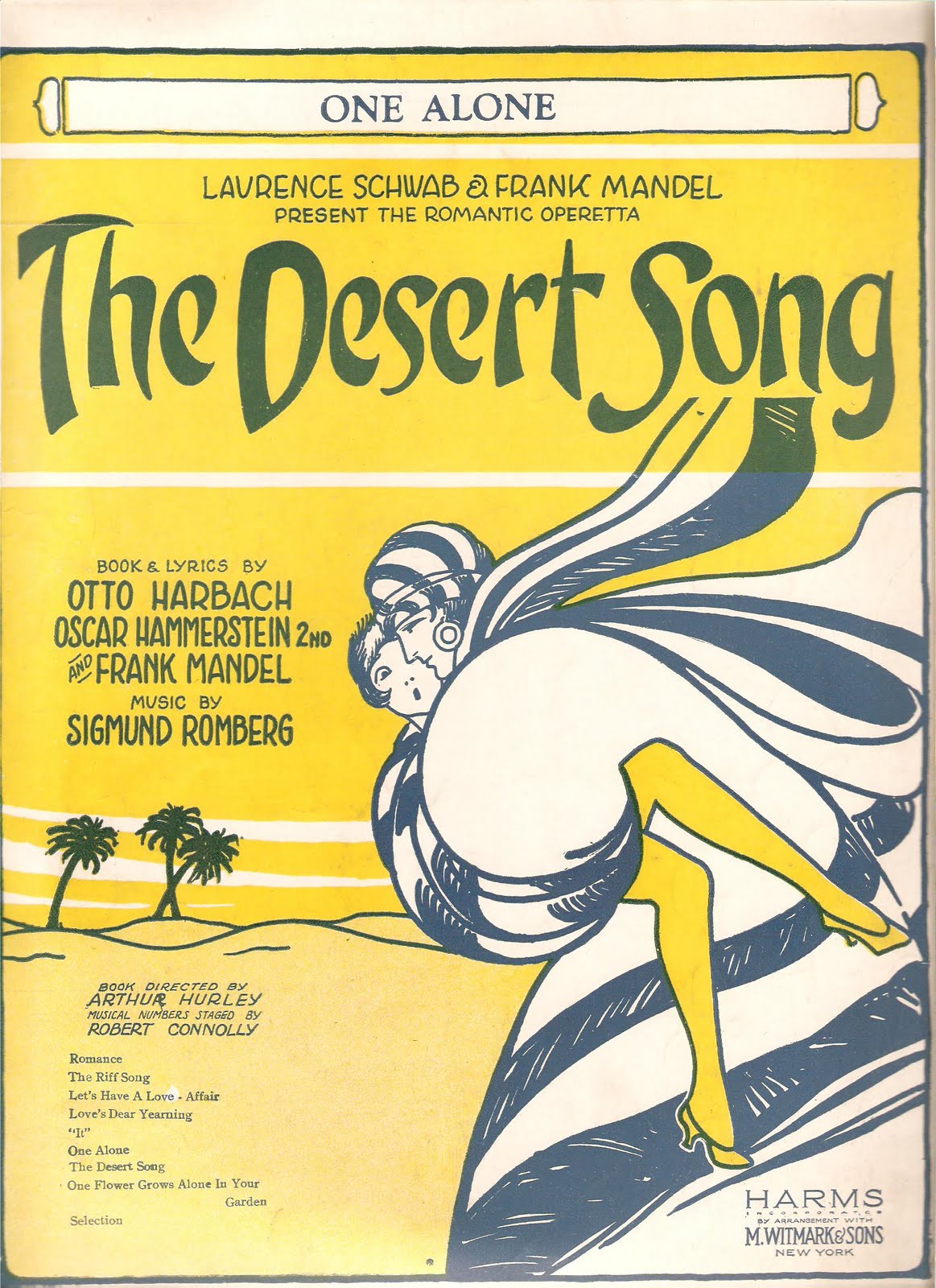
Career off and running, he wrote his best-known operettas, The Student Prince in 1924, The Desert Song in 1926, and The New Moon in 1928.
The Student Prince was the most successful of Romberg’s works, the longest-running Broadway show of the 1920s at 608 performances, even longer than the classic Show Boat. The “Drinking Song,” with its rousing chorus, was especially popular in 1924, with Prohibition is full swing:
Drink! Drink!
  Let the toast start!
  May young hearts never part!
  Drink! Drink! Drink!
  Let every true lover salute his sweetheart!
  Let's drink!

The Mario Lanza version from the 1954 movie remains popular with imbibers everywhere.
The Desert Song (with lyrics by Oscar Hammerstein) is your typical superhero-adopts-mild-mannered disguise-to-keep-his true-identity-secret saga much like Zorro and Superman but with better music and no phone booths. The Red Shadow loves a beautiful and spirited girl, who loves his hero persona but not his wimpy side. Will true love win out over hero worship? After much sophisticated music, lust in the dust and naughty humor, we learn the answer, especially in a lavish 1929 film production of the operetta – but only until the 1940s when it became illegal to view or exhibit the 1929 film in the United States because the folks in charge feared the naughty bits would morally harm us.
A second feature version was made in 1943, which had our hero fighting the Nazis, and a third version with Kathryn Grayson and Gordon MacRae in 1953 was about as squeaky clean as you can get. Thank god for censors.
♦
I drink to make other people more interesting. ― Ernest Hemingway
The King was on the poop deck counting out his money; the Queen was in the fo’c’sle eating bread and honey.
A bevy of aristocrats, including King George I himself, boarded the royal barge at Whitehall Palace for a nautical jaunt up the Thames toward Chelsea. Anne V was there, as was the Duchess of Bolton, the Duchess of Newcastle, the Countess of Darlington, the Countess of Godolphin, Madam Kilmarnock, and the Earl of Orkney, to drop just a few names. The rising tide propelled the barge upstream without any necessity of rowing. The evening’s dinner consisted of four and twenty naughty boys, baked in a pie.*
Another barge provided by the City of London contained His Majesty’s secret service, the press corps, and fifty musicians who performed music written for the occasion by composer and conductor George Frideric Handel. The music opened with a melodic French overture and skittered through minuets and bourrées, with enthusiastic hornpipers hornpiping throughout.
Many freeloaders also took to the river to hear the free concert. According to a London newspaper, the whole River was covered with rubbernecking boats and barges. On arriving at Chelsea, the king left his barge, then returned to it at about 11 p.m. for the return trip. No one knows exactly what he did during his bit of shore leave, but rumor has it a chambermaid was involved. (The Queen was in the fo’c’sle eating bread and honey; the King was in the Chambermaid and she was in the money, goes the unauthorized verse.) The king was so pleased with the evening’s music that he yelled “more, more” every time the orchestra attempted to take a break, forcing them to play until well after midnight. The moonlight, the lapping of the water against the barge, and the chambermaid are all lost to history, but Handel’s Water Music lives on.
Everyécolier and écolière knows that the breakup of France – Révolution française – began in 1789, its defining moment the storming of the Bastille on the morning of July 14. 1789. This medieval fortress in the center of Paris represented royal authority. That the Bastille housed only seven inmates – all with good reason to be there – was unimportant. It was a symbol of the abuses of the absolute monarchy, and the French had had it with monarchs, aristocrats, and pretty much anyone in power. Bring on liberté, égalité, fraternité. King Louis XVI, exit stage right.
Bye Bye Don
Another momentous breakup took place on the evening of the same day, nearly 200 years later, in 1973, at Knott’s Berry Farm in California. (Knott’s Berry Farm was America’s first theme park and probably the only one devoted to grapes and strawberries and such things.) Every schoolgirl and schoolboy knows that the Everly Brothers were one of America’s most successful pop duos, lending their sibling harmony to such hits as “Bye Bye Love”, “All I Have To Do is Dream” and “Wake Up Little Susie”, a franchise that would seemingly go on forever. Well, forever is a long time, and brothers Don and Phil had, by the end of the 1960s, pretty much had it with liberté, égalité, fraternité and most definitely with each other.
The defining moment of their breakup came in the middle of their set when the stage manager told the audience that the rest of the show had been canceled because brother Don was “too emotional” to play. In reality, Brother Don was too drunk to play. His skipped guitar notes and bungled lyrics sent brother Phil into a real snit. Phil smashed his guitar and stormed off stage into a solo career, promising he would “never get on stage with that man again.”
Phil and Don reached a sort of detente a decade later. Louis XVI, on the other hand, was beheaded.
(Phil Everly died in January 2014).
I have no intention of sharing my authority. — King Louis XVI
Delving into the musical history of July 1 during the 20th century can be instructional for trendspotters if not for music lovers. On this day in 1935, Benny Goodman and his band recorded the “King Porter Stomp.” Elvis Presley appeared on “The Steve Allen Show” on July 1, 1956, wearing tails and singing “Hound Dog” to a basset hound. And in 1963, the Beatles recorded “She Loves You.” So far so good.
Fast forward to the ’80s and a few melodies you no doubt whistled while on a pleasant walk through the park — all making their appearance on July 1. In 1987, the English grindcore band Napalm Death released its first recording “Scum.” Side A of the album was recorded at the Rich Bitch studio; it was planned as part of a split release with the English crossover thrash band Atavistic on Manic Ear. It was released as a single album through Earache. The song “You Suffer” was listed in the Guinness Book of Records as the world’s shortest song at 1.316 seconds (at last, a redeeming quality).
There’s more: The first pressing of the CD included the From Enslavement To Obliteration album and four bonus tracks (hooray!). The album cover was designed by a member of the band Carcass.
Butchered at Birth by American death metal band Cannibal Corpse was released in 1991 through Metal Blade Records. It included the lyrical “Rancid Amputation.” We can be sure that if Benny Goodman were still performing (instead of turning over in his grave), he’d jump right on a cover version of that one.
Violinist, meat-packer, usher, tinsmith, elevator operator, and lyricist, Sammy Cahn (no relation to Kublai or Genghis) penned his first lyrics at the age of 16 – “Like Niagara Falls, I’m Falling for You,” not one of his most notable successes. But he kept writing them, giving up those other professions, until he got it right, and got it right again, and again.
Over the course of his career, Cahn was nominated for 23 Academy Awards, five Golden Globe Awards, an Emmy and a Grammy. In 1988, the Sammy Awards, for movie songs and scores, were created in his honor.
With Jimmy Van Heusen, Cahn wrote so many songs for Frank Sinatra that the two were almost considered to be his personal songwriters. Oscar winners “Three Coins in the Fountain,” “All the Way,” and “High Hopes” were all introduced in films by Sinatra. Add “Love and Marriage,” “The Tender Trap,” “My Kind of Town,” “Come Fly with Me” and a host of others.
The pair also won an Oscar for “Call Me Irresponsible” and received nominations for “Pocketful of Miracles,” “The Second Time Around,” and “Thoroughly Modern Millie.” Cahn and Jule Styne added nominations for “I’ll Walk Alone,” “I’ve Heard That Song Before,” and “It’s Magic.”
Ed Sullivan was to the golden age of television what Google is to searching. He ruled Sunday night TV for 23 years – from 1948 to his very last broadcast on this day in 1971. Sullivan presented acts from the era’s biggest stars to acrobats, dancing bears, puppets, contortionists, you name it. Ten thousand in all – if they were entertainers, an appearance on the Sullivan show was their holy grail.
Musical performances from rock to opera were a staple of the program. Even its first broadcast, when it was known as Toast of the Town, made music history as Broadway composers Richard Rodgers and Oscar Hammerstein II previewed the score of their upcoming musical, South Pacific. And after that, West Side Story, Cabaret, Man of La Mancha – if it was on Broadway, it was on Sullivan. One of those Broadway musicals, Bye Bye Birdie, was all about making it on the Sullivan show.
Sullivan also chronicled the history of rock and roll from Elvis Presley’s appearance in 1956 through the Supremes, the Beatles, the Rolling Stones, the Doors, the Mamas and the Papas, and on June 6, 1971, the last program, Gladys Knight and the Pips.
When CBS canceled the show, the network let it end with a whimper. But in the 33 years since cancellation, numerous tribute shows and DVDs have kept Sullivan in the public eye.
A dance party in the beach town of Santa Cruz, California, a quiet oasis 70 miles south of San Francisco, back in 1956 (years before it became a counterculture capital), led to a bit of overreaction by the town’s conservative adult authorities. Two hundred teenagers had taken over the Santa Cruz Civic Auditorium on a Saturday night to dance to the music of a group called Chuck Higgins and his Orchestra, regional favorites with a few hit rock recordings. Shortly after midnight, Santa Cruz police entered the auditorium to check on the event, and didn’t like what they saw: a crowd “engaged in suggestive, stimulating and tantalizing motions induced by the provocative rhythms of an all-negro band.” Although that sounds like a pretty good endorsement for the affair, the police did not view it as a positive. Without so much as a “save the last dance for me,” they shut the place down and sent everyone home to bed.
And they didn’t stop there. On the following day, June 3, city fathers further endeared themselves to city teenagers and captured national attention when they announced a total ban on the playing of rock and roll and other forms of “frenzied music” at public gatherings (the other forms probably meant to pull Wayne Newton into the loop). Such music was, they said, “detrimental to both the health and morals of our youth and community.”
Not everyone saw this as an absurdity, it’s concern with “undesirable elements” not so subtly racial, and an effort that was bound to fail. Within two weeks, similar bans were enacted in Asbury Park, New Jersey, and in San Antonio, Texas. But in spite of such valiant efforts, rock and roll would soon dominate the Billboard Hot 100, and teenagers everywhere would be singing “It’s got to be rock-roll music, if you want to dance with me.”
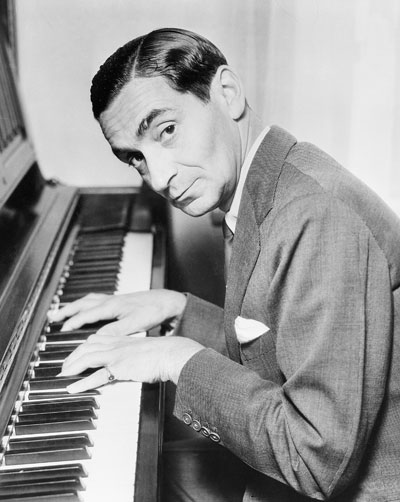
Israel Beilin was born on this day in 1888 in a small village in Belarus. His father, a cantor in a synagogue, with the intimidating name of Moses, uprooted his family in the face of the anti-Jewish pogroms of the late 19th century, emigrating to the United States, where they settled into a cold-water basement flat with no windows in New York City. At the age of fourteen, Izzy, as he was called, realized that he contributed less to the family than his siblings and decided to leave home. With few survival skills and little education, he found no real employment. His only ability was acquired from his father’s vocation: singing. He joined with a few other youngsters, singing in Bowery saloons popular ballads for whatever customers would give them. Beilin began to recognize the kind of songs that appealed to audiences. In his free time he taught himself to play the piano, picking out tunes when the bar had closed for the night.
His first attempt at songwriting was a song called “Marie From Sunny Italy,” written in collaboration with the bar’s pianist. The sheet music to this song is important primarily because of a printer’s error. The name printed on the cover was misspelled as: ‘I. Berlin.’
His meteoric rise as a songwriter came soon after with a song that would become world-famous. “Alexander’s Ragtime Band” firmly established Irving Berlin as an instant celebrity and one of America’s foremost musical wonders. He went on to write an estimated 1,500 songs, many becoming major hits, during his 60-year career, including the scores for 19 Broadway shows and 18 Hollywood films. His songs were nominated eight times for Academy Awards. A list of noted songs might begin with “A Couple of Swells” and end with “You’re Just in Love,” with a whole lot in between. Here’s a more complete list.
George Gershwin called him “the greatest songwriter that has ever lived” and composer Jerome Kern concluded that “Irving Berlin has no place in American music—he is American music.”
Meanwhile in Romania
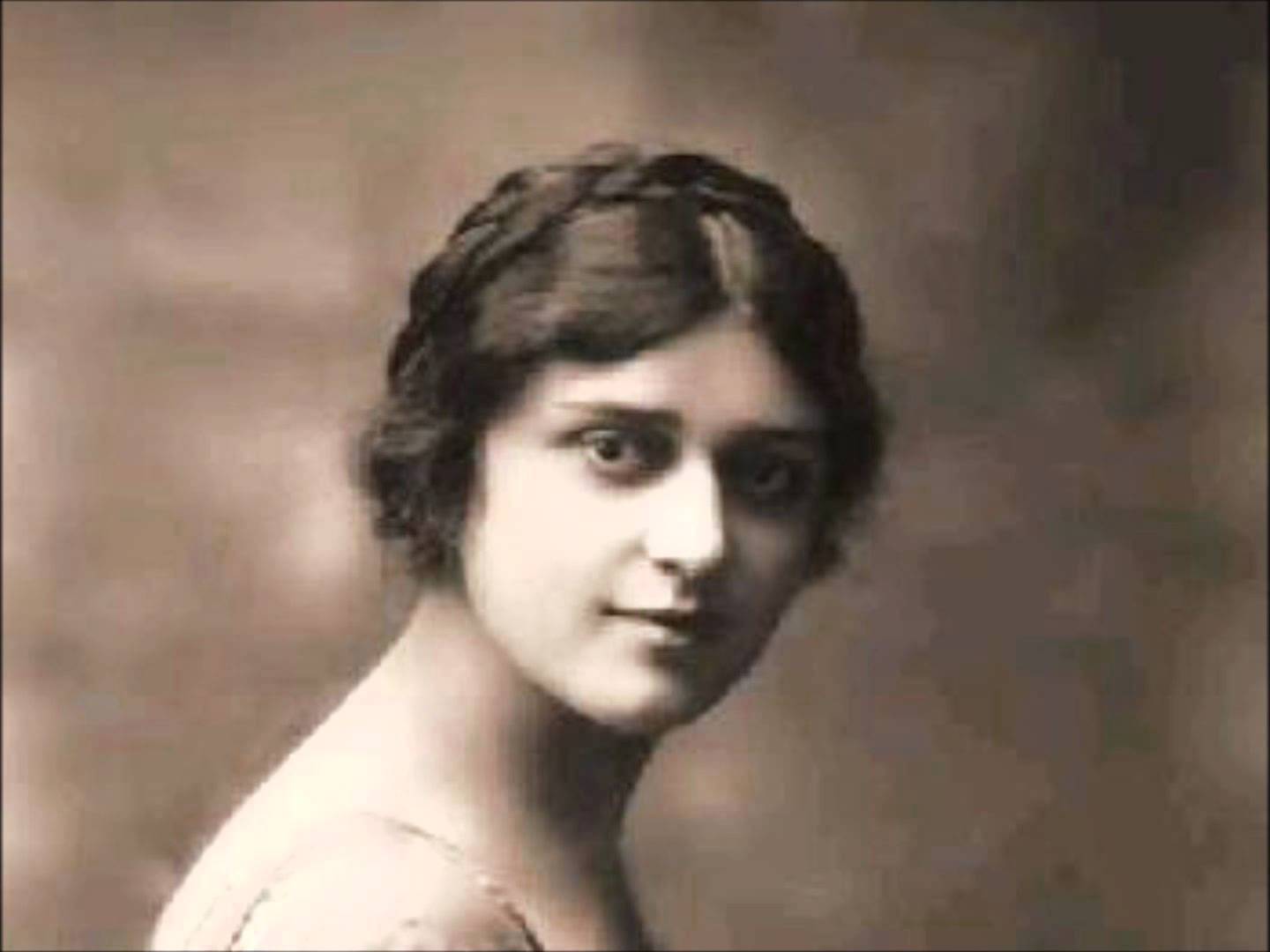
On this same date a few years earlier, in 1884, another musical talent was born in Romania. Like Irving Berlin she emigrated to America at a young age. Alma Gluck did not have his lasting fame, but she became a successful performer at the Metropolitan Opera as well as in concerts throughout the country. She was an early recording pioneer, and her recording of “Carry Me Back to Old Virginny” sold over a million copies, earning her a gold record, only the seventh to be awarded.
Many historic meetings have taken place over the years — when Caesar met Cleopatra, when Stanley met Livingston, when Harry met Sally. Such a meeting took place on May 4, 1904. Henry Royce had operated an electrical and mechanical business in Manchester, England,. since 1884. His real interest, however, was automobiles. He built his first in 1904, the two-cylinder Royce 10. Charles Rolls had a motor car dealership selling imported luxury automobiles. The two were introduced, and before the end of the year they had struck a bargain: Rolls would take all the cars Royce could build. They would be sold exclusively by Rolls and would bear the name Rolls-Royce. The 10-hp automobile had its coming out party at the Paris Salon in December, and quickly became one of the world’s most prestigious brands.
Rolls-Royce Limited was formed in 1906. Throughout the 20th century and into the 21st, it manufactured some of the most luxurious and exclusive automobiles in the world, synonymous with royalty, celebrity and wealth. The iconic Rolls-Royce hood ornament, the Spirit of Ecstasy, was commissioned in 1911 by a Baron Scott-Montagu, its figure looking a lot like his secretary/mistress, her finger pressed to her lips, suggesting the secrecy of their affair. She has endured through the years, evolving with the current fashion. A redesign in 2022 made her more aerodynamic. “Previously she had stood with her feet together, legs straight and tilting at the waist,” said the company. “Now she is a true goddess of speed, braced for the wind, one leg forward, body tucked low, her eyes focused eagerly ahead.” Looking for a gas station.
Now That’s a Hood Ornament
The first Grammy Awards (or Gramophone Awards as they were originally called) honoring achievement in the recording industry were held in 1959. And it was a banner year to start passing out those little gold gramophones.
In contention for Record of the Year was Perry Como with one of his three Top 10 singles for the previous year, “Catch a Falling Star,” Peggy Lee with her biggest hit of the rock era, “Fever,” Frank Sinatra crooning “Witchcraft,” and the are-you-kidding entry, “The Chipmunk Song” by David Seville. Taking home the statuette (to Italy) was Domenico Mondugno and the only foreign language recording to ever win the top prize, “Nel Blu Dipinto Di Blu.” The recording also won Song of the Year.
Other winners included Van Cliburn, Henry Mancini, Louis Prima and Keely Smith, Count Basie, Andre Previn, the Champs and the Kingston Trio.
And Ella Fitzgerald of course. She placed one of her several songbook albums in the ring, this one dedicated to Irving Berlin. This was her first of 13 Grammy Awards. She also has 9 recordings in the Grammy Hall of Fame, the most of any female artist. The first to be inducted was her first hit, A-Tisket, A-Tasket.

 Teatro Nacional in Havana before coming to the United States in 1915, where he rode the tango craze to stardom in movies and night clubs. Eventually Cugat and his orchestra became the resident musicians at New York’s Waldorf Astoria.




 Wretched Richard's Almanac