APRIL 2, 1902: THE TERRIBLE, TERRIBLE BIDDLE BOYS

Admission was ten cents. The movie lasted about an hour. There were no cartoons or newsreels. The first theater to show an actual movie was the Electric Theater in Los Angeles on April 2, 1902. The Capture of the Biddle Brothers was an adventure melodrama based on actual events.

A few months earlier, condemned prisoners Jack and Ed Biddle escaped from a Pennsylvania jail using tools and weapons supplied to them by the warden’s wife, Kate Soffel. “Our picture, which is a perfect reproduction of the capture, is realistic and exciting,” the producer exclaimed — breathlessly one might imagine. Two sheriff-filled sleighs pursue the Biddles and Soffel through the white and drifting snow. The dastardly trio turns to make a stand, shotguns and revolvers blazing. Ed Biddle is shot, falls to the ground in a snow bank. On one elbow, he continues to fire shot after shot until he collapses. The second Biddle continues to fire, and he too is shot. Mrs. Soffel seeing the hopelessness of their situation, if not the error of her ways, attempts to shoot herself. All three are captured. The brothers both die of their wounds. Mrs. Soffel survives, but a reconciliation with her warden husband is probably unlikely.
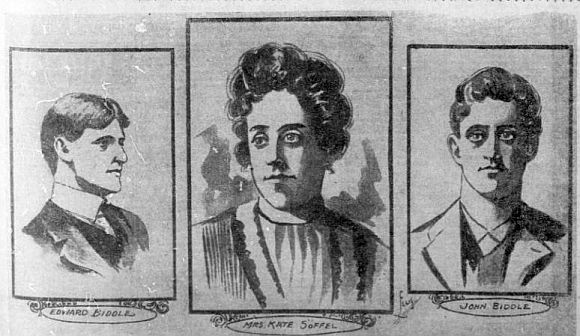
The movie itself did not survive, and the names of the actors are lost to history. Oddly enough a remake — well maybe not exactly a remake — was released in 1984.  Mrs. Soffel starring Diane Keaton and Mel Gibson once again tells the tale of the terrible, terrible Biddle brothers. But not for a dime.

Hear Me Roar

The baseball season was just getting underway as 17-year-old Jackie Mitchell took the mound for the minor-league Chattanooga Lookouts in an exhibition game against the New York Yankees in Chattanooga, Tennessee, and on April 2, 1931, became  one of the first and female pitchers in professional baseball history.

The game had gotten off to a rocky beginning for the Lookouts with their starting pitcher (male) giving up hits to the Yankees’ first two batters. The teenage Mitchell was brought in to face a couple of guys named Babe Ruth and Lou Gehrig. Mitchell’s first pitch to Ruth was a sinker that darted low for ball one. She followed with a sinker on the outside corner, which the Babe swung through and missed. Grinning, the “Sultan of Swat” swung at her next pitch and missed again for strike two. Another sinker on the corner of the plate, and Ruth watched it sail by for a strike three call. “The Babe kicked the dirt and gave his bat a wild heave as he stormed unhappily to the dugout.”

Gehrig came to bat and promptly missed three straight dipping sinkers, swinging early each time. On seven pitches, the Chattanooga teenager had struck out Ruth and Gehrig, two of the game’s greatest hitters. The hometown crowd rewarded her with a standing ovation. The next day, one newspaper cleverly suggested that “maybe her curves were too much for them.”

Unfortunately, Mitchell’s game against the Yankees was also her last.  Just days after her legendary performance, (male) baseball commissioner Kenesaw Mountain Landis voided her contract because the sport of baseball was “too strenuous for women.” Although Jackie went on to tour with other prominent female athletes and play on women’s teams for a short time, Landis had pretty much wrecked her professional career, and she bowed out of sports at age 23.

MARCH 21, 1867: ON A SHOW BOAT TO BROADWAY

“Curtain! Fast music! Light! Ready for the last finale! Great! The show looks good, the show looks good!”

American Broadway impresario, Florenz “Flo” Ziegfeld, Jr. was born March 21, 1867 (died July 22, ZigfeldFollies19121932). The theater bug came to Ziegfeld early; while still in his teens, he was already running variety shows. In 1893, his father, who was the founder of the Chicago Music College, sent him to Europe to find classical musicians and orchestras. Flo returned with the Von Bulow Military Band — and Eugene Sandow, “the world’s strongest man.”

Ziegfeld was particularly noted for his series of theatrical revues, the Ziegfeld Follies, inspired by the Folies Bergère of Paris – spectacular extravaganzas, full of beautiful women, talented performers, and the best popular songs of the time – and was known as the “glorifier of the American girl”.

“Let us grant that a girl qualifies for one of my productions. It is interesting to note what follows. First, it is clearly outlined to her what she is expected to do. She may be impressed at the outset that the impossible is required, but honest application and heroic perseverance on her part plus skillful and encouraging direction by experts very seldom fail to achieve the desired results. But it is only through constant, faithful endeavor by the girl herself that the goal eventually is reached.”

He also produced musicals in his own newly built Ziegfeld Theatre – Rio Rita, which ran for nearly 500 performances, Rosalie, The Three Musketeers, Whoopee! and Show Boat. Several of his musicals hit the movie screens, including three different versions of Show Boat. William Powell played Flo in the 1932 biopic, The Great Ziegfeld, and a 1946 film recreated the flamboyant Ziegfeld Follies.

Wretched Richard’s Little Literary Lessons, No. 4

pro·tag·o·nist
prōˈtaɡənəst,prəˈtaɡənəst
noun
A protagonist is the main character in any story, such as a literary work or drama:
Say let us put man and woman together,
Find out which one is smarter (and which is the protagonist)

Paul wasn’t sure, but the five-foot duck waddling through the throngs of laughing, crying, shouting, whining children appeared to be waddling toward him – a duck with a destination and, perhaps, a mission. Chances are it had spotted him scowling in a land where grinning is the norm, and it, by God, meant to do something about it.

“Enjoying the Magic Kingdom?” asked the duck upon reaching him. Despite its carefully sculpted plastic smile, this duck wasn’t going to cheer anyone up; its voice dripped sarcasm.

“Of course, I am,” Paul answered, adopting his very own duck attitude. “Isn’t that why you’re here? By the way, didn’t I somewhere get the idea that you’re all supposed to be pleasant and cheerful?”

“I’m not even supposed to talk. Just wave.” The duck waved and, in silence, could have passed for pleasant and cheerful, albeit of a fabricated sort.

“Then why did you talk to me?” Paul asked.

“Because you look bored – like you positively hate the place.”

“Ah, you’re not just an ordinary duck, you’re a member of the happiness squad, here to lift my spirits.”

“No,” answered the duck. “I thought you might have a cigarette.”

Who’s our protagonist?  Paul?  Huey (the duck)? Or two protagonists for the price of one?  Find out here.


March 6, 1941: The Bigger They Are

If asked to name an important sculptor, the name John Gutzon de la Mothe Borglum, would not come tripping off most people’s lips, although his most important work certainly would. Borglum died on March 6, 1941, leaving the monument he had worked on since 1927 uncompleted.

Borglum sculpted big: a portrait of Abraham Lincoln carved from a six-ton block of marble, a 76 by 158 foot bas-relief of Confederate heroes, and what would have been his biggest ever, the 60-foot heads of George Washington, Thomas Jefferson, Abraham Lincoln and Theodore Roosevelt carved into the granite face of Mount Rushmore in South Dakota.

Although his work remains admired, his legacy was tarnished by his strong nativist leanings, including membership in the Ku Klux Klan.

Mount Rushmore is home to 2 million visitors and has been extensively depicted throughout popular culture, probably most famously in the climactic chase scene in Alfred Hitchcock’s 1959 thriller North by Northwest with Cary Grant swatting at secret agents from Lincoln ‘s forehead. Hitchcock later admitted: “I wanted Cary Grant to hide in Lincoln’s nostril and then have a fit of sneezing . . . the Department of Interior was rather upset at this thought. I argued until one of their number asked me how I would like it if they had Lincoln play the scene in Cary Grant’s nose. I saw their point at once.”

Speaking of Noses

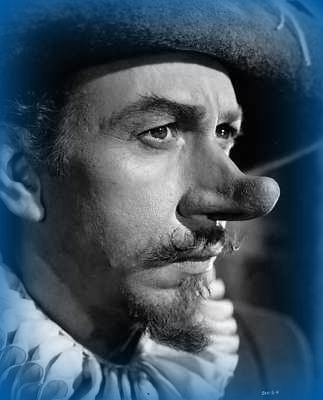
Cyrano de Bergerac, born in 1619, is of course best known in modern times for his nose. According to legend, it was quite large. Depending on which account you accept, Cyrano was either a French aristocrat, author and military hero with a big nose or the descendant of a Sardinian fishmonger who suffered from syphilis with a big nose. He was an early writer of science fiction, and in his most famous work, The Other World, Cyrano travels to the moon using rockets powered by firecrackers where he meets the inhabitants who have four legs, musical voices, and firearms that shoot game and cook it — the TV rights are still available, if you’re interested.  A  lesser known work, Noses from Mars, is self-explanatory.

Then we come to the story of Cyrano himself and how he courted the fair Roxanne on behalf of his friend Christian.  Although these people are real, the story is alas! pure fiction, which is probably just as well, for Roxanne was Cyrano’s cousin and had they ever consummated their relationship, their children would have been half-wits with big noses.

December 31, 1920: Don’t Go Near the Indians

New Year’s Eve, aka the seventh day of Christmas, is the day we shuck off this year with a lot of over the top partying, letting mirth run rampant before we face the sobering of the coming year. Two of the more noble New Year’s Eve traditions are Drinking and the making of Resolutions. The former is often accomplished with Wassail, a bowl of spiced ale around which folks gather and drink to each other’s health until someone gets sick.  The latter is the solemn promise we make to the empty Wassail bowl never to drink again. Mark Twain on resolutions: “Next week you can begin paving hell with them as usual. Yesterday, everybody smoked his last cigar, took his last drink, and swore his last oath. Today, we are a pious and exemplary community. Thirty days from now, we shall have cast our reformation to the winds and gone to cutting our ancient short comings considerably shorter than ever. We shall also reflect pleasantly upon how we did the same old thing last year about this time.” ~Mark Twain

A proper resolution might go something like this: I hereby resolve to read Wretched Richard’s Almanac every day so that I might be well informed, sophisticated and attractive. And I will recommend it to all my friends so they too might be well informed, sophisticated and attractive.

The seventh ghost of Christmas enjoyed his wassail while regaling Scrooge with the painful memory of his Junior Prom when the girl of his dreams broke their date because her grandmother died, she had a hangnail or she was grounded for misbehaving with the captain of the football team — take your pick.  True Love celebrated in his or her predictable fashion with a gifts of the avian persuasion, to be specific seven swans a-swimming.  That’s a bird count of 28 thus far.  No, make the 27; one of the calling birds made the mistake of calling the cat.

About Those Indians

It was 1949 and executives at Republic Pictures had a brainstorm – let’s take that nice clean-cut guy hanging around the studio and make him a cowboy – maybe even a singing cowboy – he’ll be a God-fearing American hero of the Wild West, wearing a white Stetson hat; he’ll love his faithful horse (platonic, of course); and maybe he could have a loyal sidekick who shares his adventures. We’ll call him the Arizona Cowboy (Arizona isn’t already taken, is it?) And so Rex Allen, born December 31, 1920, came to a silver screen near you,  joining such singing cowboys as Roy Rogers and Gene Autry. His horse was Koko, and his comic relief sidekick was Buddy Ebsen (later Slim Pickens). He rode out of the West just as the West was losing interest for moviegoers. He did get a quick 19 movies in the can (and a comic book) before the genre played out. And in 1954, he starred in Hollywood’s last singing western. Then, like other cowboy stars, he rode into the sunset and onto TV in a series called Frontier Doctor. Allen had written and recorded a number of the songs featured in his movies. He continued recording, and in 1961, had a hot country single with a song called “Don’t Go Near The Indians,” featuring the Merry Melody Singers. The song told the story of a young man who disobeys his father’s titular advice and develops a relationship (platonic, of course) with a beautiful Indian maiden named Nova Lee. The father reveals a deep dark secret out of the past: his biological son was killed by an Indian during one of those skirmishes between the white man and a nearby tribe. In retaliation, he kidnapped an Indian baby and raised him as his son who grew up to be you-know-who. And there’s another jaw-dropping secret: Nova Lee is the boy’s biological sister! (But poppa, it’s purely platonic; our kids won’t be imbeciles.) They don’t write them like that anymore. Rex Allen turned in his spurs in 1999 at the age of 79.  

December 21, 1946: Don’t You Know Me, Bert? Ernie?

Frank Capra said that it was his favorite of the many movies he made throughout a phenomenal career. He screened it for his family every Christmas season. Yet it’s initial 1946 release at the Globe Theater in New York did not bring about yuletide euphoria and visions of sugar plums. It’s a Wonderful Life premiered to mixed and sometimes dismissive reviews, but it went on to become one of the most critically acclaimed films ever made, garnering a permanent spot in every list of the top films of the last century.

From its very beginning, it did not inspire great expectations. It was based on an original story “The Greatest Gift”written by Philip Van Doren Stern in 1939. After being unsuccessful in getting the story published, Stern made it into a Christmas card, and mailed 200 copies to family and friends in 1943.  In 1944, RKO Pictures ran across the story and bought the rights to it for $10,000, hoping to turn the story into a vehicle for Cary Grant. Grant made another Christmas movie, The Bishop’s Wife, instead, and the story languished on a shelf until RKO, anxious to unload the project, sold the rights to Capra in 1945.

Capra, along with several other writers, including Dorothy Parker, created the screenplay that Capra would rename It’s a Wonderful Life.

The town of Seneca Falls, New York claims that Capra modeled Bedford Falls after it. The town has an annual “It’s a Wonderful Life” Festival in December, a Hotel Clarence, and the “It’s a Wonderful Life” Museum. The town of Bedford Falls itself, however, was built in Culver City, California, on a 4-acre set originally designed for the western Cimarron. Capra added a working bank and a tree-lined center parkway, planted with 20 full grown oak trees. Pigeons, cats, and dogs roamed at will.

The dance scene where George and Mary end up in the swimming pool was filmed at the Beverly Hills High School. The pool still exists.


itsa-wonderfulll


December 14, 1977: You Are the Dancing King

He was just another juvenile delinquent in a television sit-com, before he became a superstar playing a nobody by day who blossoms at night on the dance floor.  John Travolta strutted his stuff as Tony Manero, a paint-store clerk who dons a dashing white suit to ride the disco craze out of his dead-end existence in Saturday Night Fever. The film premiered on December 14, 1977, already guaranteed success thanks to its soundtrack, released months before the movie.

The disco songs recorded by the Bee Gees (including “Stayin’ Alive”) were all over the pop charts, sparking intense interest in the film before its release, with the film then popularizing the entire soundtrack after its release – the first (and certainly not the last) use of cross-media marketing.

 The movie follows Tony’s foray into the Manhattan world of flashing lights and sweaty bodies. Disco and the culture of the disco era also star in the movie – the symphonic orchestration over a steady beat and disciplined choreography, the high style in clothing, and the sexuality of it all.

“Travolta on the dance floor is like a peacock on amphetamines,” said movie critic Gene Siskel, who bought Travolta’s famous white suit at a charity auction. “He struts like crazy.”

The film had an R-rating when it was originally released in 1978. Several years later it was edited down to PG  to make it more “family-friendly” and suitable for television.

A Practical Gift Idea

Just trying to help. This one’s about sticking pins in little dolls to get what you want.

December 8, 1959: Battle of the Smellies

During the 1950s, movie studios were grasping at any gimmick to lure eyeballs away from television and back into theaters. One gimmick that seemed to be a favorite among movie-makers,  judging by the frequent attempts (usually unsuccessful) to use it was the sense of smell.

Individual theater owners had played around with smells off and on aromafor years, using various makeshift techniques such as spraying perfume in front of an electric fan. But the first use of odor as created by the producers of the film itself didn’t come until the December 8, 1959, premiere of Behind the Great Wall, a travelogue featuring the sights, sounds and, yes, odors of China. The odors were provided by a process called AromaRama. On the heels of this movie, came another film cleverly titled the Scent of Murder, touting the wonders of Smell-O-Vision. (We also had Scentovision and Smell-O-Rama.) Variety called the competition “the battle of the smellies.”

In an interview, the inventor of AromaRama gushed: “More than 100 different aromas will be injected into the theater during the film. Among these are the odors of grass, earth, exploding firecrackers, a river, incense, burning torches, horses, restaurants, the scent of a trapped tiger and many more. We believe, with Rudyard Kipling, that smells are surer than sounds or sights to make the heartstrings crack.”

Well, maybe. There were a few glitches early on. Faulty timing might give you a picture of a steaming bowl of jasmine rice that smelled like that trapped tiger. And the distraction of a hundred or so members of the audience simultaneously and loudly sniffing. Even though most of the bugs were ironed out, the whole idea never caught on, despite occasional attempts to revive it (including one notable high tech process that provided audiences with scratch and sniff cards along with instructions on when to scratch and when to sniff).

Those fun-loving folks at BBC jumped on the bandwagon in 1965, airing an April 1 interview with the inventor of a process that allowed viewers at home to experience aromas produced in the television studio. In a vivid demonstration, he chopped onions and brewed a pot of coffee, then took calls from viewers who had experienced the transmitted smells. (Note the date.)

Even BBC couldn’t slow the demise of AromaRama et al, however. In 2000, a Time magazine survey listed it as one of the “Top 100 Worst Ideas of All Time.”

December 2, 1941: Here’s Looking at You, Kid *

World War II had engulfed most of Europe and refugees everywhere were searching for the exits. The most popular way out was through Lisbon, Portugal, but getting there was a bit of a do. A long, roundabout refugee trail led desperate refugees from Paris to Marseilles, across the Mediterranean to Algeria, then by train or auto or even by foot across northern Africa to Casablanca in French Morocco.

Once in Casablanca, those with enough cash or influence could scare up exit visas and scurry off to Lisbon, then the Americas. Ah, but those unlucky ones, those without means, would wait in Casablanca “and wait and wait and wait.”

casablanca2

Picture yourself in an open-air city market, dripping with intrigue, teeming with black marketeers, smugglers, spies, thieves, double agents, and assorted ne’er-do-wells, all loudly engaged in their business activities. And of course there’s the aforementioned refugees attempting to deal and double-deal their way out. It’s December 2, 1941. The news spreads quickly through the market that two German couriers on their way to Casablanca have been murdered. They were carrying “letters of transit” allowing the bearers to travel freely around German-controlled Europe and to neutral Portugal. You better believe these papers are to kill for.

Now walk into a cafe owned by an American expatriate named Rick. It’s the place in Casablanca where everybody and everything eventually show up. And right on cue, the letters of transit do, in the possession of Ugarte, the town weasel. And so does everyone else who is anyone else: There’s Czech resistance leader, Victor Lazlo, Norwegian Ilsa Lund (Rick’s former lover), nasty German Major Strasser, Vichy syncophant Louis Renault, rival club owner and black marketeer Senor Ferrari, Sam the piano player, and a cast of, if not thousands, dozens. Of course, all of this is taking place not in Casablanca but on the lot of Warner Brothers studio in Hollywood, California.

The story line is well-known by most movie-goers, and the cast is like one large dysfunctional family. If you haven’t seen Casablanca during its first seven decades, chances are you never will. But if you have, you’ll probably see it again and again. And you probably have your favorite scene. Maybe it was this one:

* No.5 on the AFI list of top movie quotes

November 21, 1931: It’s Alive, It’s Alive

On the screen, a man steps from behind a curtain to tell us we are about to see “one of the strangest tales ever told. It deals with the two great mysteries of creation; life and death. I think it will thrill you. It may shock you. It might even horrify you. So, if any of you feel that you do not care to subject your nerves to such a strain, now’s your chance to uh, well,––we warned you!!”

It’s November 21, 1931, and the warning is all about Frankenstein, the gothic horror film based on the novel by Mary Shelley. There have been countless films over the years featuring the famed monster but this one is the daddy of them all. Audiences and critics all loved it, and it, along with Dracula released earlier in the year, saved Universal Pictures.

The story is well known. Young Henry Frankenstein has this notion. He wants to create a living being from dead spare parts, mostly stolen. Perhaps he played Mr. Potatohead too often as a child. Things move along swimmingly until the time comes to give the creation a brain. Frankenstein’s assistant, Fritz the Hunchback, botches the brain acquisition, dropping the good brain and substituting a bad brain for it. The assembled creature is brought to life amid an amazing display of electrical pyrotechnics and shouts of “It’s alive!”

Karloff (without the Boris) is both frightening and sympathetic as the monster.  He kills a lot of people. It’s not that he’s really bad, he’s just misunderstood. Nevertheless, the villagers form a mob and hunt him down, trapping him in a windmill and setting it ablaze.

One of the most famous and controversial scenes was cut from the original and not restored until the 1980s:

Humor He Wrote

American humorist Robert Benchley died on November 21, 1945, (born 1889) after a writing career that took him from the Harvard Lampoon to Vanity Fair and The New Yorker. Although he described himself as not quite a writer and not quite an actor, he enjoyed success as both. His topical and absurdist essays, particularly at The New Yorker gained him both recognition and influence. He was also one of the members of the group that made up the fabled Algonquin Round Table.  As a character actor, he appeared in such films as You’ll Never Get Rich, Bedtime Story, the Crosby/Hope Road to Utopia, and Alfred Hitchcock’s Foreign Correspondent.

benchley

It took me fifteen years to discover that I had no talent for writing, but I couldn’t give it up because by that time I was too famous.

A dog teaches a boy fidelity, perseverance, and to turn around three times before lying down.

I have tried to know absolutely nothing about a great many things, and I have succeeded fairly well.

After an author has been dead for some time, it becomes increasingly difficult for his publishers to get a new book out of him each year.

Dachshunds are ideal dogs for small children, as they are already stretched and pulled to such a length that the child cannot do much harm one way or the other.

October 28, 1993: Moon Over Bogota

National University in Bogota, Colombia, prided itself on its reputation for academic excellence. Like many institutions of higher learning, it also attracted its share of student radicals from across the political spectrum.

On October 28, 1993, University President Antanas Mockus was delivering a speech at the opening of a university art show and enduring frequent interruptions with catcalls from rowdies in the audience. Finally, Mockus stopped mid-sentence, turned around, bent over, dropped his drawers and mooned the audience into a stunned silence. Score one for the prez.

Unfortunately, an enterprising student caught the whole thing on videotape. Naturally, the videotape found its way to the media. The incident was shown over and over on national TV, and stills from the tape made it into print. Radio talk shows were abuzz with calls for his censure, his ouster, his head. He had damaged the image of higher education and of the country itself, according to some.

But there were others such as the columnist who wrote: “That he showed his pale buttocks to some disrespectful, bus-burning anarchists is a thing I understand.”

Mockus made a tearful mea culpa appearance on TV, placing his fate with the Colombian president. And he survived. Two years later he was elected Mayor of Bogota. But maybe mooning was in his blood. In 2018, now age 65 and a Congressman, Mockus mooned his fellow legislators who were interrupting the outgoing president’s farewell speech.

You May Not Kiss the Bride

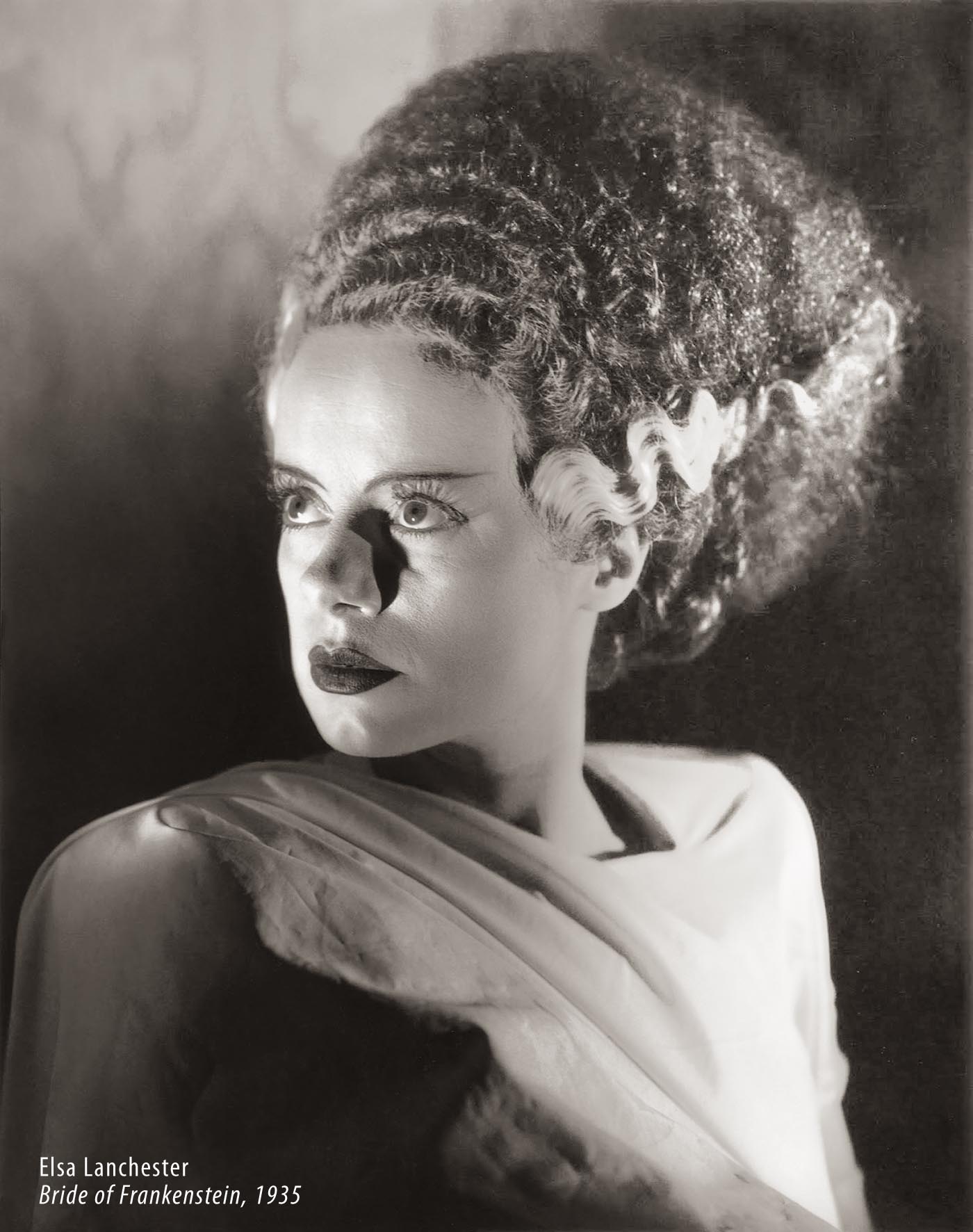
Elsa Lanchester, born in London on October 28, 1902, enjoyed a long show business career first in England then with her husband Charles Laughton in the United States. Her most famous role was probably that of the title character in the 1935 film Bride of Frankenstein ( a good choice for a Halloween movie). She starred with Laughton in a dozen films before his death in 1962. She died in 1986.