JULY 22, 1959: THE MOON IS ALIVE WITH THE SOUND OF MUSIC

Plan 9 From Outer Space is not the worst picture ever made. It’s probably not even the worst film to premier on July 22, 1959. The film has been featured in countless retrospectives, Turner Classic Movies, and documentaries. It’s been adapted for the stage, in comic books and computer games. It’s music has been featured on a CD. It’s been colorized!Plan_9_Alternative_poster

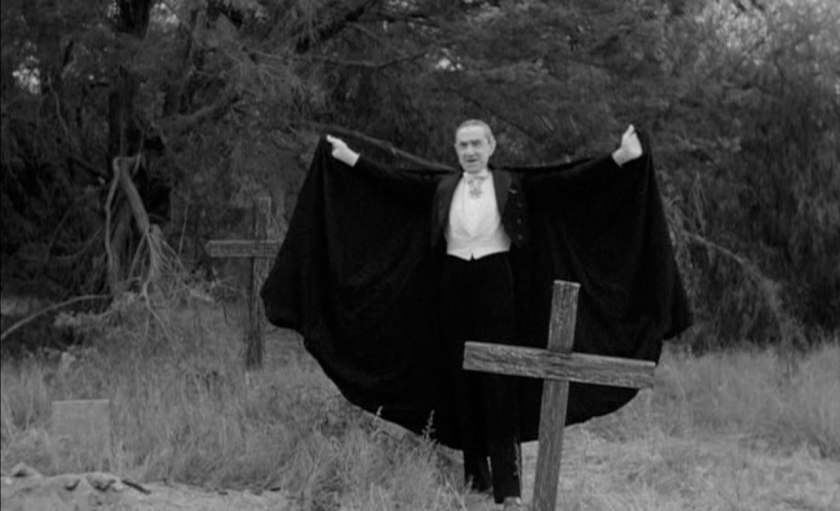
     And, of course, it was obviously the model for NASA’s grand hoax ten years later, the so-called moon landing and moonwalk.  Rumor has it that NASA even gave its charade the code name Plan 10 from Outer Space. Yet  even with all those scientists working on it, they couldn’t get the string holding up the Apollo spacecraft just right.  Nor did they include a single Bela Lugosi walk-on – his emerging dramatically from a crater would have been the perfect touch.

     And there you have the main argument – can any film featuring Bela Lugosi be the worst film ever made.  No way.   Lugosi has several scenes in Plan 9, even though he was dead and buried with a stake through his heart when the film was produced.  And narration by the Amazing Criswell. Had Criswell narrated the moon landing many more people would have believed in it.

     Some naysayers fault the film’s dialogue. “Can your heart stand the shocking facts about grave robbers from outer space?” Is that anywhere near as bad as “Doe, a deer, a female deer?”  Plan 9 from Outer Space is not the worst film ever made. The Sound of Music is.

And the Dish Ran Away with the Spoon

Or the Mound of Susic as the Reverend William Archibald Spooner, born July 22, 1844, might have called it.  The Reverend gave his name to that bit of word play known as a spoonerism. For example:

“Give three cheers for our queer old dean.”

“Is it kisstomary to cuss the bride?”

“The Lord is a shoving leopard.”


JULY 21, 1865: ALL HAT AND NO CATTLE

We all know from movies, pulp fiction and other pop culture that the streets of the Old West were littered with the remnant losers of showdowns that took place practically on the hour. gunslingTwo steel-jawed gunslingers coolly staring at each other, contemplating who would draw first and, more importantly, who would draw fastest. Conspiracy theorists are quick to point out that most gun battles took place between drunks who only managed to hit their adversaries because they were standing a foot away — or if they were at a distance, were most likely hiding behind a handy horse or schoolmarm and aiming at somebody’s back.

True, but there was a sort of Code of the West based on the gentlemanly European tradition of dueling in which opponents behaved with good breeding before attempting to kill one another. The Code of the West required that a person resort to a six-gun on the city streets only in matters of major import such as the defense of one’s honor or life, and only if the opponent was also armed. If the Code were followed, a gunslinger could pretty much kill another gunslinger without fear of punishment.

On July 21, 1865, Springfield, Missouri, saw just such a classic showdown. Wild Bill Hickok had a reputation as a real hotshot with a gun, so it is a bit surprising that a former Union soldier agreed to a showdown after an argument with Wild Bill over a card game or the upcoming Presidential election or something.

Armed with sodas and popcorn, a huge crowd of onlookers watched as the two men approached each other from the far ends of the long street. When the two men were still way beyond field goal territory, the challenger drew and fired wildly in Hickok’s direction. Ever cool, Hickok, drew his own revolver, took careful aim, and put a bullet through his opponent’s chest.

Having been true to the Code, Hickok remained a free man. Unfortunately, several years later, Wild Bill was done in by someone not so fastidious about playing by the rules. A young gunslinger with absolutely no sense of gallantry shot him in the back of the head while he played cards.

When my time comes, just skin me and put me up there on Trigger, just as though nothing had ever changed. — Roy Rogers

JULY 3, 1954: WHOOPS, THERE GOES THE FIRST PROP

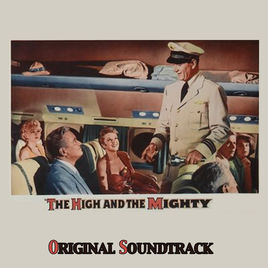
In 1954, a gaggle of Hollywood VIPs boarded a DC-4 airliner headed from Hawaii to California. Their troubled flight made a bit of film history — in Cinemascope, no less. The High and the Mighty premiered on July 3, 1954, with a roster of stars that included Claire Trevor, Robert Stack, Laraine Day, Phil Harris, and shepherding them through the sky, John Wayne.

Introducing the scenario that would be used so successfully by the Airport movies of the 1970s as well as countless other disaster movies, the film details the lives and interactions of the passengers and crew when calamity strikes the flight. Calamity comes in the form of a ‘whoops there goes the first prop’ moment and another, followed by a nasty engine fire. Co-pilot Wayne leaps to the fore and (spoiler alert) guides the plane to its destination. And what happened to the pilot, you ask. The pilot, played by Robert Stack goes all squishy and useless (probably because Wayne produced the film and Stack didn’t).

Stack, incidently, showed up in a 1980 film that brought the air disaster genre to its illogical conclusion. In Airplane he stays on terra firma trying to talk an experienced pilot through a landing: “Striker, listen, and you listen close: flying a plane is no different than riding a bicycle, just a lot harder to put baseball cards in the spokes”.

Composer Dimitri Tiomkin won an Academy Award for his original score of The High and the Mighty.  The title song was nominated for an award but did not win.

MIAMI WIT

Dave Barry, born July 3, 1947, is a Pulitzer Prize-winning columnist and humorist who wrote a nationally syndicated column for The Miami Herald from 1983 to 2005. He has also written numerous books of humor.

• The word user is the word used by the computer professional when they mean idiot.

Dave-Barry-

• If you were to open up a baby’s head – and I am not for a moment suggesting that you should – you would find nothing but an enormous drool gland.

• Although golf was originally restricted to wealthy, overweight Protestants, today it’s open to anybody who owns hideous clothing.

• Gravity is a contributing factor in nearly 73 percent of all accidents involving falling objects.

• Dogs feel very strongly that they should always go with you in the car, in case the need should arise for them to bark violently at nothing right in your ear.

• The simple truth is that balding African-American men look cool when they shave their heads, whereas balding white men look like giant thumbs.

• Thus the metric system did not really catch on in the States, unless you count the increasing popularity of the nine-millimeter bullet.

JUNE 28, 1926: IT’S GOOD TO BE THE KING

“Humor keeps the elderly rolling along, singing a song. When you laugh, its an involuntary explosion of the lungs. The lungs need to replenish themselves with oxygen. So you laugh, you breathe, the blood runs, and everything is circulating. If you don’t laugh, you’ll die.”

     Mel Brooks, born June 28, 1926, has kept the world rolling along since he broke into the entertainment business in early TV. Director, screenwriter, composer, lyricist, comedian, actor 01f/26/arve/g2659/024and producer, he is best known for his comic film farces and parodies.

     He began his career as a stand-up comic and writer for Sid Caesar’s Your Show of Shows then teamed up with fellow writer Carl Reiner, as The 2000 Year Old Man. In the 70s he became one of the most successful film directors, producing such comedy classics as Blazing Saddles, The Producers, Young Frankenstein (numbers 6, 11 and 13 on the American Film Institute’s list of the top 100 comedy films of all-time), The Twelve Chairs, Silent Movie, High Anxiety, History of the World, Part I, Spaceballs and Robin Hood: Men in Tights. The musical adaptation of his first film, The Producers, became a smash hit on Broadway. Brooks is one of the few entertainers with the distinction of having won an Emmy, a Grammy, an Oscar and a Tony award.

A true funny man, no joke was ever beneath him.

mel2

mel3


mel4

TRUE CONFESSIONS: MY DARK DAYS AS A REPUBLICAN

I used to be a Republican.  There, it’s out in the open.  It was a long time ago, and I was too young to see the error of my ways.  At the time, our family was pretty much all Republican – not avid table thumping Republicans, but Republicans all the same.  Truman was a swear word, and we all liked Ike.  Ike was like a grandfather, and my grandmother loved him.

As long as I’m confessing, I might as well admit that I probably would have voted for Nixon over Kennedy.  Fortunately, I was not old enough to vote.  It was a couple of years later  in college that I began to change.  See, the conservatives are right.  Colleges take our respectable fresh-faced Republican youths and teach them unsavory liberal things like literature and philosophy and science.

It happened to me, and I never saw it coming.  For a few days, I was just an independent.  But it’s a slippery slope indeed, and the leftward lurch was inevitable.  And by the time I graduated from the halls of propaganda, my mind had been molded into the liberal quagmire it is today.

Tomorrow: I cozy up to the Second Amendment.


JUNE 18, 1913: THEY CALL IT SAM’S SONG

Violinist, meat-packer, usher, tinsmith, elevator operator, and lyricist, Sammy Cahn (no relation to Kublai or Genghis) penned his first lyrics at the age of 16 – “Like Niagara Falls, I’m cahnFalling for You,” not one of his most notable successes. But he kept writing them, giving up those other professions, until he got it right, and got it right again, and again.

     Over the course of his career, Cahn was nominated for 23 Academy Awards, five Golden Globe Awards, an Emmy and a Grammy. In 1988, the Sammy Awards, for movie songs and scores, were created in his honor.

With Jimmy Van Heusen, Cahn wrote so many songs for Frank Sinatra that the two were almost considered to be his personal songwriters. Oscar winners “Three Coins in the Fountain,” “All the Way,” and “High Hopes” were all introduced in films by Sinatra.  Add “Love and Marriage,”  “The Tender Trap,” “My Kind of Town,” “Come Fly with Me” and a host of others.

     The pair also won an Oscar for “Call Me Irresponsible” and received nominations for “Pocketful of Miracles,” “The Second Time Around,” and “Thoroughly Modern Millie.” Cahn and Jule Styne added nominations for “I’ll Walk Alone,” “I’ve Heard That Song Before,” and “It’s Magic.”

Cahn was born on June 18, 1913, and died in 1993.

JUNE 16, 1917: WHIPPING BOY

Harrison Ford cracked a mean bullwhip as the title character in the Indiana Jones series of films. Ford wasn’t born brandishing a bullwhip; he had to learn it for the films. And he was taught by bullwhip master, Lash LaRue born on June 16, 1917.

Like many actors in the 40s and 50s, LaRue spent most of his career making B-Westerns. Originally hired because he looked enough like Humphrey Bogart that producers thought this would draw in more viewers, he used his real last name as the name for most of his film characters. He was given the name Lash because, although he carried a gun, he was noted for preferring to use an 18-foot-long bullwhip to take on bad guys. Lash not only disarmed bad guys, he performed many stunts such as saving people about to fall to their doom by wrapping his whip around them — often while at full gallop on Black Diamond, his trusty horse — and pulling them to safety. Lash, like a guy named Cash, was also known for always wearing black.

After starting out as a sidekick to singing cowboy Eddie Dean, he earned his own series of Western films and his own sidekick, Fuzzy Q. Jones (Al St. John), inherited from Buster Crabbe. He also got his very own villain — an evil, cigar-smoking twin brother, The Frontier Phantom.

His films ran from 1947 to 1951. The comic book series that was named after his screen character lasted even longer, appearing in 1949 and running for 12 years as one of the most popular western comics published.


JUNE 11, 1939: Mustard, Your Majesty?

‘On behalf of the United States of America, may we offer you this tubular delight of meat, meat byproducts, curing agents and spices?’”

On June 11, 1939, on a royal visit to the United States, King George VI and Queen Elizabeth (II’s mum) joined President Roosevelt and others at his Hyde Park residence for a picnic.  There, the British monarch experienced his first ever hot dog — and his second ever hot dog, along with a beer.  It was a far cry from a typical state dinner.  No reporters, no photgraphers, no politicos.  The guest list included relatives, friends and neighbors of the Roosevelts, as well as employees and their children.

“King Tries Hot Dog and Asks For More” read the headline in The New York Times the following day, including that imagined dinner proclamation.

Werewolf? There Wolf

Actor, comedian, director, screenwriter, author and activist Gene Wilder was born on June 11, 1933.  After his first film role playing a hostage in Bonnie and Clyde, he went on to star in such memorable films as Willy Wonka & the Chocolate Factory, The Producers, Young Frankenstein and Blazing Saddles.

wilderInvention, my dear friends, is 93% perspiration, 6% electricity, 4% evaporation, and 2% butterscotch ripple.” — Willy Wonka in Willy Wonka & the Chocolate Factory

“The clue obviously lies in the word “cheddar.” Let’s see now. Seven letters. Rearranged, they come to, let me see: “Rachedd.” “Dechdar.” “Drechad.” “Chaderd” – hello, chaderd! Unless I’m very much mistaken, chaderd is the Egyptian word meaning “to eat fat.” Now we’re getting somewhere!” Sigerson Holmes in The Adventures of Sherlock Holmes Smarter Brother


“You’ve got to remember that these are just simple farmers. They’re people of the land. The common clay of the New West. You know – morons.”The Waco Kid in Blazing Saddles


wild1

“This is a nice boy. This is a good boy. This is a mother’s angel. And I want the world to know once and for all, and without any shame, that we love him. I’m going to teach you. I’m going to show you how to walk, how to speak, how to move, how to think. Together, you and I are going to make the greatest single contribution to science since the creation of fire.” – Dr. Frankenstein in Young Frankenstein


wilder2

I’m in pain and I’m wet and I’m still hysterical! – Leo Bloom in The Producers

MAY 7, 1885: COMIN’ THROUGH THE SCREEN, SHOOTIN’ UP THE LAND

An essential player in Hollywood westerns was the leadinggabby man’s sidekick, and many sidekicks became just as famous as their starring partners: Andy Devine was Jingles to Wild Bill Hickock, Pat Buttram and Smiley Burnette were both sidekicks to Gene Autry, Jay Silverheels was Tonto to the Lone Ranger, Leo Carillo was Pancho to the Cisco Kid. The top sidekick was, of course, Gabby Hayes, born May 7, 1885. Through the 1930s and 1940s, he was sidekick to Hopalong Cassidy in 18 films and to Roy Rogers in 41.

The third of seven children, George Francis Hayes was born in an upstate New York hotel owned by his father. As a young man, he worked in a circus and played semi-pro baseball while a teenager. He ran away from home at 17, and joined a touring stock company.  He married and with his wife enjoyed a successful vaudeville career. Although he had retired in his 40s, he lost money in the 1929 stock market crash, and he felt the need to work again.  He and his wife moved to California, and he began his movie career, taking various roles until finally settling into a Western career.

Hayes first gained fame as Hopalong Cassidy’s sidekick Windy Halliday in many films between 1936-39. He left the Cassidy films in a salary dispute and was legally prevented from using the name “Windy.”   So “Gabby” Hayes was born.  He rode alongside  stars such as John Wayne, Randolph Scott, and, of course, Roy Rogers.

Offstage Hayes was the complete opposite of his screen persona – an elegant bon vivant, man-about-town and connoisseur.  He died in 1969.  On the subject of his movies: “I hate ’em. Really can’t stand ’em. They always are the same. You have so few plots – the stagecoach holdup, the rustlers, the mortgage gag, the mine setting and the retired gunslinger.”

“You’re a good-looking boy: you’ve big, broad shoulders. But he’s a man. And it takes more than big, broad shoulders to make a man.” — High Noon

“There are only two things that are better than a gun: a Swiss watch and a woman from anywhere. Ever had a good… Swiss watch?” — Red River

“A gun is a tool, Marian; no better or no worse than any other tool: an ax, a shovel or anything. A gun is as good or as bad as the man using it. Remember that.” –Shane

“You don’t look like the noble defender of poor defenseless widows. But then again, I don’t look like a poor defenseless widow.” –Once Upon a Time in the West

APRIL 28, 2004: IT WAS SHEAR PLEASURE

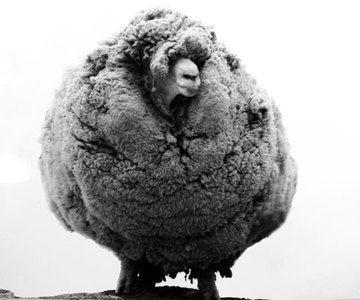
Some folks will go to great lengths to avoid sitting in a barber’s chair. So it seems will some animals. A New Zealand Merino sheep named Shrek — not to be confused with the bald green guy of the same name — really didn’t want to be shorn. So he went on the lam in the late 90’s, living as a fugitive, hiding in caves, always looking back over his shoulder.  He avoided capture for six years but alas someone finally fingered him and he was apprehended in April 2004. And on April 28, the now incredibly woolly Shrek went under the shears. It took a mere 20 minutes to denude him, and the entire indignity was nationally televised. The suddenly svelte Shrek gave up 60 pounds of wool, enough to suit 20 New Zealanders.

Now famous, he took tea with the Prime Minister on his tenth birthday and was allowed to spurn the shears for another 30 months before being shorn on an iceberg off the New Zealand coast (certainly a jumping the shark event). Shrek bought the sheep farm in 2011.

This Was No Toy

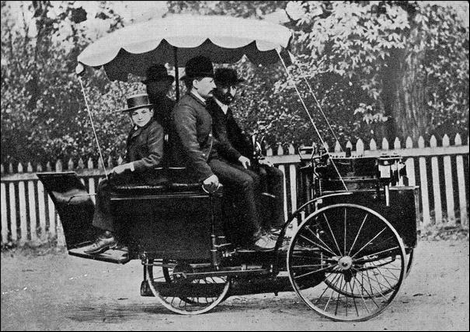
The world’s first car race took place on April 28, 1887.  It was organized by the editor-in-chief of the Parisian magazine Le Vélocipè. The winner of the race was Georges Bouton, an engineer and toymaker driving an 1884 La Marquise, a steam-powered automobile he had constructed with his partner Albert, the Count of Dion.  The race from Paris to Versailles wasn’t particularly exciting; Bouton’s La Marquise was the only car taking part.

Named for the Count’s mother, La Marquise is a four-seater powered by twin steam engines.  A 40-gallon steel tank underneath the passengers gives the car a range of 20 miles with speeds up to 38 mph.  Once it gets going , that is.  Fueled by coal, wood and bits of paper, it takes 40 minutes  to create enough steam to move.  The car was still running when it was sold in 2011 for a record $4.6 million, making it the world’s longest running automobile.

Sardine in Honorable Tin Can

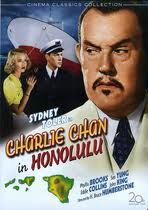
Following the death of Warner Oland, who had successfully brought the character of Charlie Chan to the screen in 16 films, Twentieth Century Fox began the search for a new Chan. Sidney Toler, who was born in Warrensburg, Missouri, on April 28, 1874, was chosen to play the detective, and filming began less then a week later on Charlie Chan in Honolulu. Through four years and eleven films, Toler played Charlie Chan for Twentieth Century Fox. Fox terminated the series in 1942, following the completion of Castle in the Desert. Sidney Toler went on to star in eleven more Charlie Chan films for Monogram Pictures. Very ill during the filming of his last two Chan pictures in 1946, Toler died in 1947.

The character of Charlie Chan was created for the novel The House Without a Key in 1925 by Earl Derr Biggers. Biggers loosely based Chan on a real-life Honolulu detective named Chang Apana. He conceived of the heroic Chan as an alternative to the many stereotypical villains such as Fu Manchu that typified the so-called Yellow Peril, a prevailing vision of the menace of Asia. Sounding like a turn-of-the-century Donald Trump, Horace Greeley, editor of the New York Tribune intoned: “The Chinese are uncivilized, unclean, and filthy beyond all conception without any of the higher domestic or social relations; lustful and sensual in their dispositions; every female is a prostitute of the basest order.”

Over four dozen films featuring Charlie Chan were made, beginning in 1926. Movie-goers took to Chan, but in later years critics found that in spite of his good qualities he too was an Asian stereotype. Many also objected to the fact that he was played by Caucasian actors in  (although Keye Luke who played Chan’s number one son in 7 films was a Chinese-American actor).

In addition to his great detection, Charlie Chan was noted for the aphorisms sprinkled liberally throughout the films. A handful of the very many: Action speak louder than French, Bad alibi like dead fish – cannot stand test of time Detective without curiosity is like glass eye at keyhole, Dead as sardine in honorable tin can.


APRIL 10, 1953: COMIN’ AT YA

The poobahs at Hollywood’s major film studios watched with amazement and envy as the independently produced 3-D movie Bwana Devil wowed audiences in late 1952.  Columbia Pictures quickly threw together a black- and-white thriller that for an hour hurled practically every prop on the set at the beleaguered audience. It was just as quickly forgotten.  Then on April 10, 1953, Warner Brothers released its entry — in color and stereophonic sound — House of Wax, a horror film starring Vincent Price as a sculptor who kills folks, covers them with wax, dresses them up as famous historical figures, and displays them in his wax museum. Audiences loved it, making it one of the biggest hits of the year. Even critics gave it a go. And although it took a while, the Library of Congress selected it in 2014 for inclusion in the National Film Registry, deeming it “culturally, historically, or aesthetically significant.”

The film revived Vincent Price’s career, positioning him as the go-to guy when you needed a mad scientist or fiendish psychopath.  Although House of Wax had a couple of classic 3-D effects (the pitchman with a paddleball and a character who seemingly stands up in the audience and runs into the screen), it was not loaded down with them. This might have been because the director was blind in one eye and couldn’t understand what all the fuss was about.

And What Do We Suppose Jumbo the Elephant Really Was

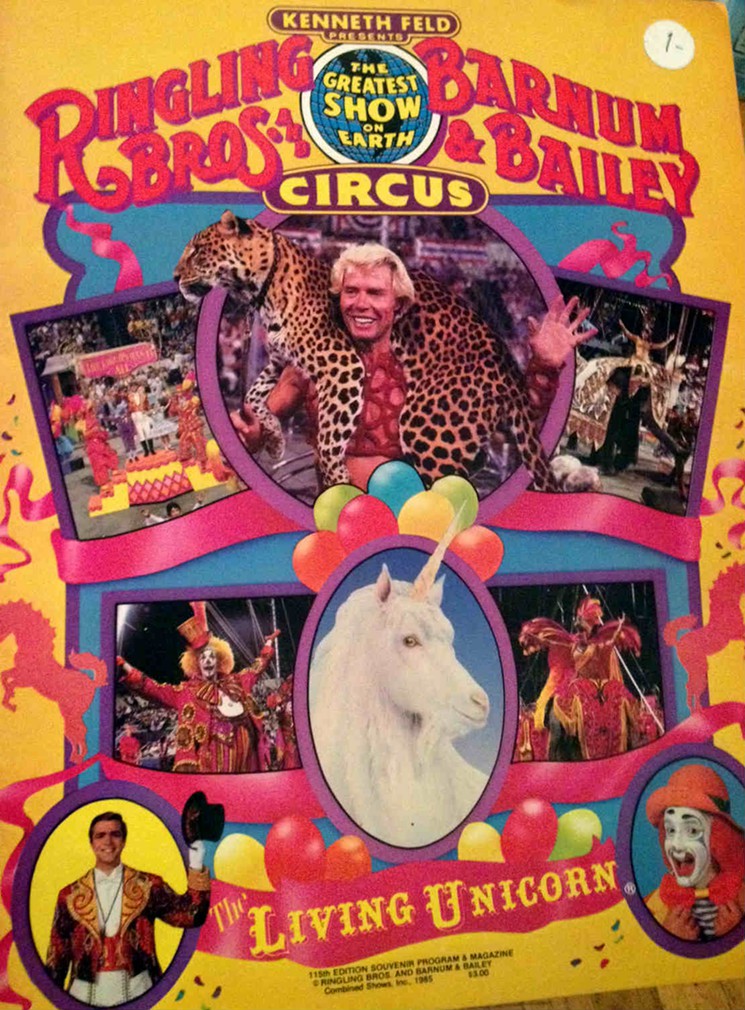
On this day in 1985, Lancelot the Unicorn who had been touring with the Ringling Brothers and Barnum and Bailey Circus — famous for outlandish attractions — was exposed as a fraud.  Audiences were appalled to learn that Lancelot wasn’t a real unicorn at all, just a goat with a horn surgically attached to its forehead.

IF IT HAD ONLY BEEN A NACHO

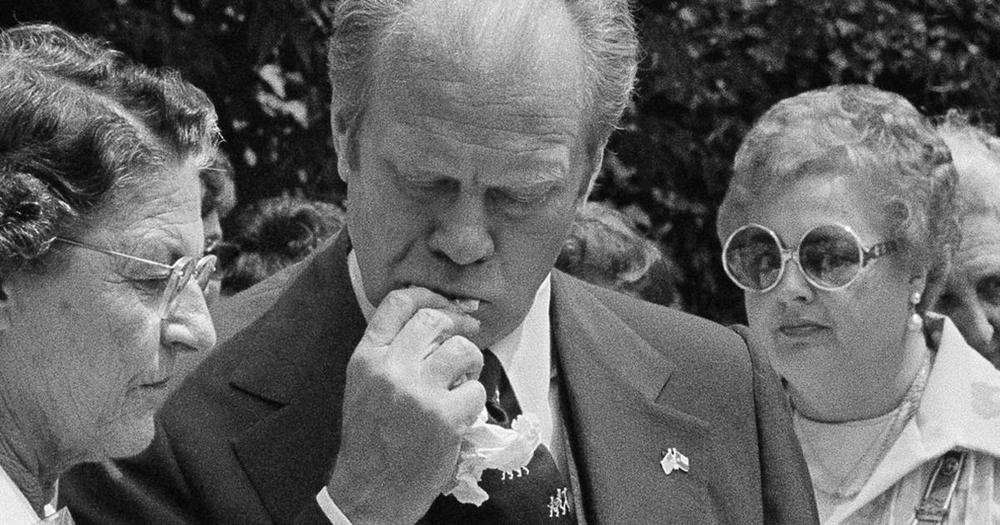
It would seem that in modern politics every president has been forced to deal with a scandal, big or small –vicuna coat, Watergate, Iran Contra, Stormy Daniels. Gerald Ford’s scandal would probably be trivial in comparison to most. But it may have cost him re-election. It was April 10, 1976, in San Antonio, Texas, at the Alamo, where a tiny faux pas morphed into the Great Tamale Incident as the President attempted to eat a tamale without removing the corn husk, playing into his reputation as a bit of a bumbler.