OCTOBER 11, 1944: All the Presidents’ Dogs

Republicans were on the political attack and the President was angry. At a campaign dinner with the Teamsters union, on this day in 1944, President Franklin D. Roosevelt struck back. It was one thing for the Republicans to spread “malicious falsehoods” about him and Eleanor, but they had stepped over the line, making libelous statements about Fala, his small, black Scottish terrier.

After addressing weighty labor and war issues, Roosevelt blasted Republican critics for circulating a claim that he had accidentally left Fala behind while visiting the Aleutian Islands earlier that year and had, at a taxpayer cost of $20 million, sent a Navy destroyer to pick up the dog. Although Fala slept at the foot of President’s bed and received a bone every morning with Roosevelt’s breakfast tray, Roosevelt accused his critics of attempting to tarnish a defenseless dog’s reputation just to distract Americans from more pressing issues facing the country.

Did Richard Nixon, eight years later to the day, take a page out of the Roosevelt playbook to defend his own honor when critics accused him of accepting improper gifts and making funny with campaign funds? The story broke two months after Nixon’s selection as Dwight D. Eisenhower’s running mate, threatening Nixon’s place on the ticket. Nixon interrupted a whistle-stop tour of the West Coast to fly to Los Angeles for a television and radio broadcast to the nation in which he vowed he would not return one gift: a black-and-white dog who had been named Checkers by his children. But unlike Roosevelt, who took Fala to meetings with heads of state such as Winston Churchill, there is no evidence that Nixon even touched Checkers, let alone fed him.

Just Put Your Lips Together

Harry “Steve” Morgan and his alcoholic sidekick, Eddie, are a couple of ne’er-do-wells crewing a boat for hire on the island of Martinique. to_have_and_have_not_1944_film_posterLife is okay, but World War II is happening all around them, doing a number on the tourist trade and thus their livelihood. Howard Hawks’ film To Have and Have Not which premiered in New York on October 11, 1944, was notable for bringing together what would become one of Hollywood’s hottest couples, Humphrey Bogart and Lauren Bacall.

The film takes the title from the book by Ernest Hemingway but not much else. Hawks was a Hemingway fan but thought this particular book was a “bunch of junk.” Even so, Hemingway worked with Hawks on the screenplay, in which Bogart once again gives up his professed neutrality in the war to thwart the Nazis. The plot is well thickened by the stormy relationship between Bogart and Bacall who plays Slim, a saucy singer in the club where Morgan drinks away his days.

Another notable member of the cast is Hoagy Charmichael who appears as the club piano player, Cricket. He and Bacall perform several Charmichael songs: “How Little We Know,” “Hong Kong Blues,” and “The Rhumba Jumps.” Bacall does her own singing, even though persistent rumors would have a 14-year-old Andy Williams singing for her.

The most memorable take away from the film is one line of dialogue delivered seductively by Bacall: “You know how to whistle, don’t you, Steve? You just put your lips together and . . . blow . . .”

OCTOBER 6, 1962: YOU CAN COME OUT FROM UNDER YOUR SEAT

When one thinks of offbeat film-making, directors Tim Burton and David Lynch come to mind. You’d be hard pressed, however, to find a more offbeat body of cinematic work than that of Tod Browning. Who?, most people would be asking. Tod Browning’s strange macabre films were a pulp-fiction parade of crooks, carnies, lowlifes, deadbeats, wretches, wastrels, scoundrels and, of course, vampires and freaks. And they helped to define the horror film genre.

Browning came to this career honestly. Born in Louisville, Kentrucky, he gave up his comfortable home life at 16 to immerse himself in the world of carnivals, sideshows and circuses. His resume included stints as a Ringling Brothers clown, a barker for the Wild Man of Borneo and the “Living Corpse” for which he was buried alive. He also worked as a magician, dancer and actor before finding his niche as a director of dozens of silent films, including a 10-film collaboration with Lon Chaney. When sound came to the movies, he made his mark with two of his most notable films: Dracula starring Bela Lugosi and Freaks, his master work and the film that destroyed his career. Freaks was so grotesque and unnerving that it was banned in the United Kingdom for three decades. In the U.S., MGM took the film away from Browning and chopped it by almost a third. It performed miserably.

His career on the skids, Browning made a handful of films during the 1930s before “retiring” at the end of the decade. He died on October 6, 1962.

Freak Show

The Halloween season (not to mention the political season) offers the perfect opportunity to indulge in Freaks.  It’s a love triangle set in a bizarre carnival world, featuring Hans, a wealthy dwarf, Cleopatra, a gold-digging trapeze artist, and Hercules, a strongman. Cleopatra and Hercules plan to trick Hans into marrying Cleopatra and then poison him. All the performers are real sideshow “freaks” — Koo Koo, the bird girl, Daisy and Violet, the Siamese twins, Johnny Eck, the Half Boy, Schlitzie, the Pinhead, to name a few, but the beauty of the film is Browning’s portraying them as the real human beings they are. The film remains frightening and grotesque, even after MGM’s “editing.” The deleted scenes were trashed, so it’s likely that no one still living today has seen the original version.


How I Stopped Worrying and Learned to Love the Bomb

Cold war and nuclear fears had been ramping up for years, when President John F. Kennedy took to the tube on October 6, 1961, to suggest that American families build bomb shelters to protect them from atomic fallout when those pesky Communists of the Soviet Union attacked the Homeland with their nuclear missiles. Just a year later, the Cuban Missile Crisis raised the stakes even higher.

While folks like Nelson Rockefeller and Edward Teller were outlining grandiose plans for an enormous network of concrete lined underground fallout shelters to shelter millions of people, civil defense authorities were talking up concrete block basement shelters that could be constructed by home handifolk for a couple hundred bucks. Exactly how much protection they might actually provide was an open question.

Most people calmed down during the mid-1960s,  and fallout shelters pretty much went the way of duck and cover.  They were converted into wine cellars, recreation rooms or mushroom gardens. For others, the fallout shelter notion has been kept alive by internet sites devoted to nuclear hysteria. You can survive a nuclear or dirty bomb attack, shouts one such site.  It will not be the end of the world. But, you must be prepared!

Being prepared naturally involves purchasing a fallout shelter from one of the many firms that still market them — Acme Survival Shelters, Hardened Structures Inc., Safecastle.  Taking it over the top is a company called Zombie Gear whose motto is Be prepared for anything.

October 3, 1874: Pathetic Earthlings, You Know Who You Are

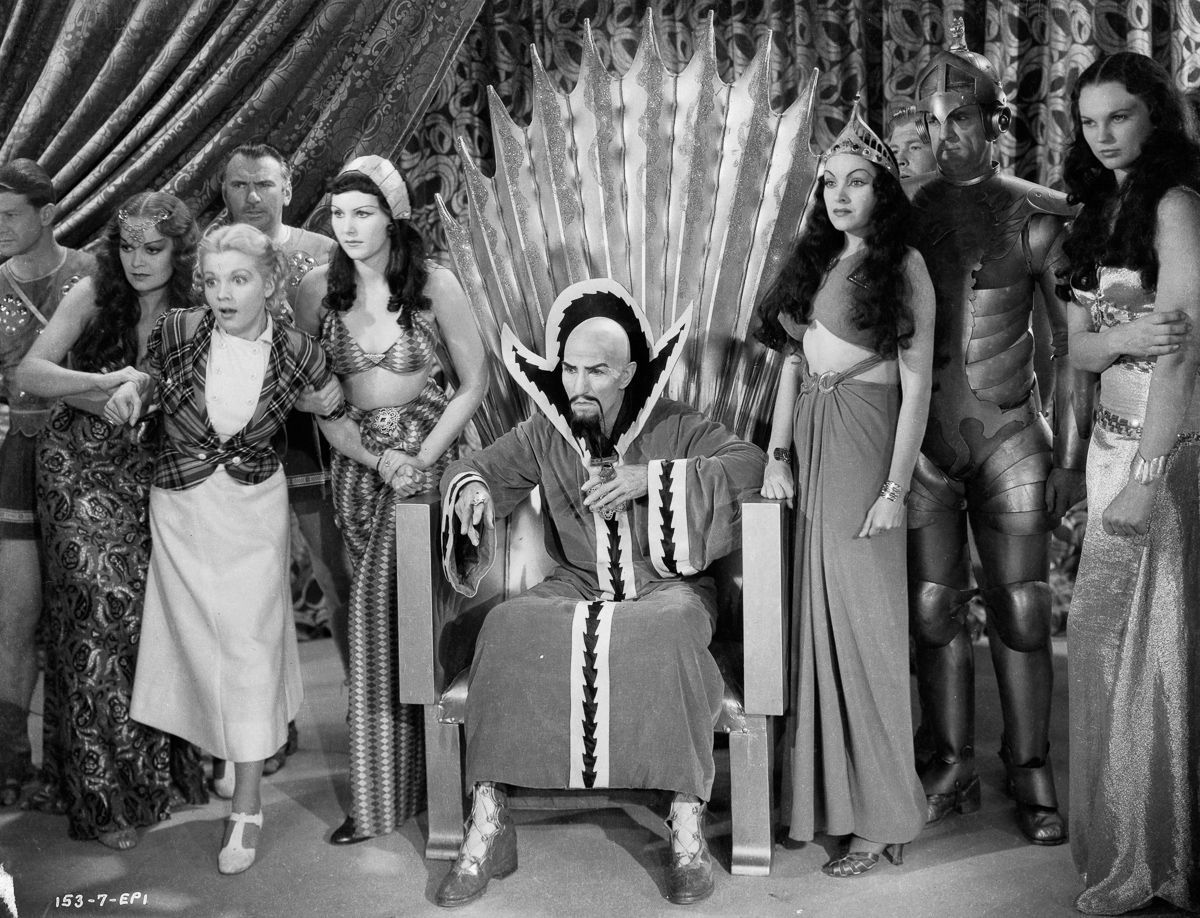
Although the name Charles Middleton (born in Kentucky, October 3, 1874) doesn’t invite instant recognition, his face — or at least one of his faces — certainly does. He worked in vaudeville, on the legitimate stage, and in traveling circuses before striking out as a motion picture actor in 1920. His career took off when sound came to the movies, thanks to a deep, menacing voice that dripped villainy.

To many generations he will always be the villain he played for the first time in 1936, one of film’s most notable nasties — Ming the Merciless. The evil enemy of the entire universe first appeared in the serial Flash Gordon, battling wits with Buster Crabbe’s Flash. He reprised his role in Flash Gordon’s Trip to Mars (1938) and Flash Gordon Conquers the Universe (1940).

Middleton appeared in 200 movies. He died in 1949.

Pathetic earthlings. Hurling your bodies out into the void, without the slightest inkling of who or what is out here. If you had known anything about the true nature of the universe, anything at all, you would’ve hidden from it in terror.

Cheap Halloween Thrills

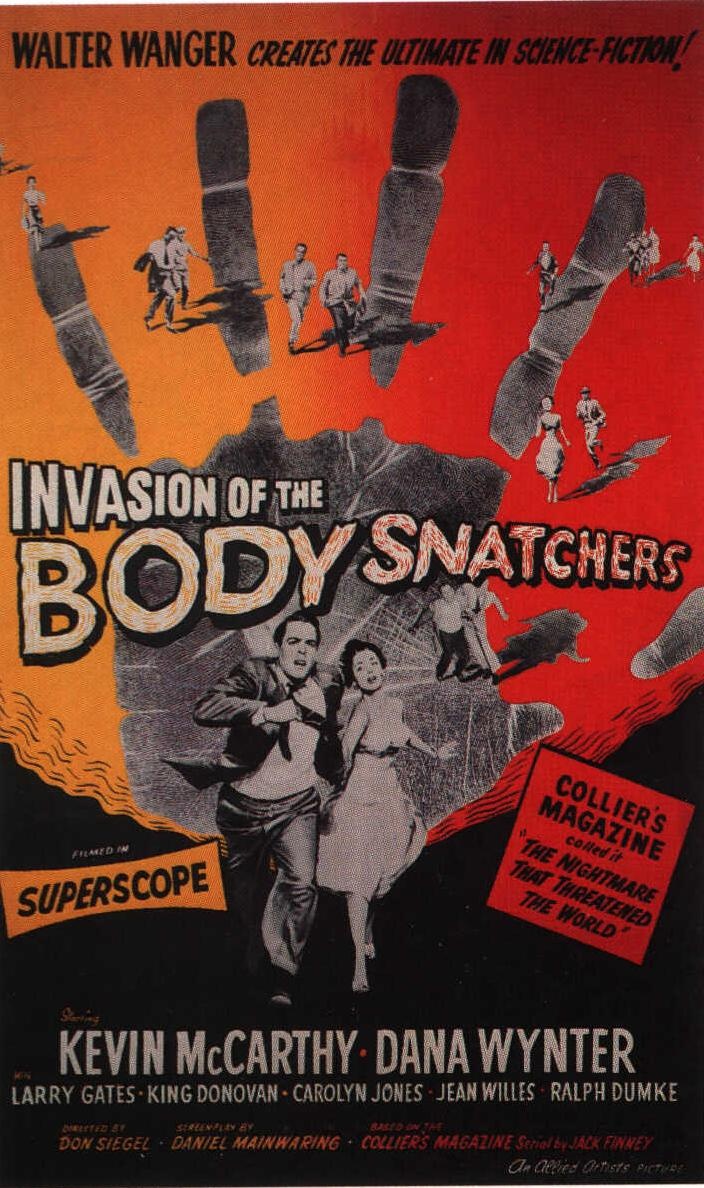
If Ming doesn’t get us pathetic earthlings, these guys might. There’s something terribly strange going on in tiny Santa Mira, California. Friends and loved ones have suddenly become emotionless body doubles, all thanks to those strange pods that have been popping up everywhere. Kevin McCarthy has discovered the truth, an alien invasion of human duplicates. Trouble is, no one believes him. As much a horror film as sci-fi, the 1956 Invasion of the Body Snatchers is also a political allegory with most of the scariness in its theme.


October 2, 1851: That Hit the Snail on the Head

Jacques Toussaint Benoit was a man with a vision, more specifically a Frenchman with a vision, even more specifically a French wizard who had a vision that involved snails. You might call him a snail whisperer. And on October 2, 1851, he set about proving his theory of the telepathic power of these cunning little gastropods.

Benoit believed that when snails mated, they didn’t just fool around, but rather they created an invisible thread that linked them together in a sort of “sympathetic communication,” allowing them to have conversations even at great distances. Instantly. Wirelessly.

Benoit had constructed an apparatus to which he gave the snappy name pasilalinic-sympathetic compass, known more familiarly as a snail telegraph. Long wooden beams supported zinc bowls lined with cloth soaked in copper sulphate — 24 pairs. Snails were glued to the bottom of each bowl. Snails in the first 24 bowls were each assigned a letter of the alphabet; in the second 24 bowls, their significant others had the same letter of the alphabet. To send a message, one would tap it out on the first set of snails and it would be received by the second set of snails. Simplicity itself.

On the day of the great demonstration before Benoit’s one financial backer and a journalist, Benoit ran back and forth between the sender and receiver just to make sure they were touching and reading the snails correctly. A message was sent and received (although it was full of typos). Benoit’s backer suspected a hoax. He demanded a second test.

On the scheduled day of the second test, Benoit was nowhere to be found. He was spotted occasionally wandering the rues of Paris during the next two years before his death. Nobody continued his work.

Maybe If These Guys Had Had Snails

It took a couple of thousand years for us terrestrials to take aviation from a crazy notion to the reality of that flight in Kitty Hawk in 1903. It took less than seven years for these flying contraptions to start bumping into each other. The first mid-air collision took place on October 2, 1910, in Milan, Italy. There you go smirking about those crazy Italians, but one plane had an English pilot, the other French. They didn’t really walk away from the encounter, but both men survived.

How He Got in My Pajamas I’ll Never Know

Groucho (Julius Henry) Marx was born on October 2, 1890. During his seven-decade career, he was known as a master of quick wit and rapid-fire, impromptu patter, frequently filled with innuendo.  He made 26 movies, 13 of them with his brothers Chico and Harpo, and many with Margaret Dumont as a stuffy dowager and the butt of Groucho’s jokes. The films included such comedy classics as The Cocoanuts, Animal Crackers, Monkey Business, Horse Feathers, Duck Soup, A Day at the Races, and A Night at the Opera. He also had a successful solo career, most notably as the host of the radio and television game show You Bet Your Life.

groucho

AUGUST 18, 1930: A DOG WALKS INTO A BAR

The world of Disney (as opposed to Disney World) is “peopled” by a group of cartoon animals who walk on two legs, talk intelligibly and dress stylishly. Mickey came first. Then Minnie. Add Donald plutoDuck, Daisy Duck, and Goofy, and you have five of the characters known as the Sensational Six — the superstars of the Disney universe. The sixth character joined the group on August 18, 1930, with the release of the cartoon short Chain Gang. But he was different from the other five. He walked on all fours, barked and was completely naked. He was an animal animal.

Pluto was nameless in his debut vehicle. It wasn’t until a month later and a second appearance in The Picnic that he acquired the clever name Rover. In the cartoon, Rover belongs to Minnie Mouse who brings him along on a picnic with Mickey. In a Mitt Romney moment, Mickey ties the dog to the back of the car before driving off and dragging him behind. But when the poor pooch spots a couple of frolicking rabbits, he ends up dragging the car and its mouse occupants on a merry chase.

The following year, Rover returned as Mickey’s pet with the new name Pluto the Pup. The origin of that name is the subject of argument. It was back in 1930 that the now ex-planet Pluto was discovered. Was this the source of his name? Or were both planet and dog named after the Roman god of the underworld? And then there’s that other great mystery: If Pluto’s a dog and Goofy’s a dog, why is the latter anthropomorphic and the former not?  Walt remained mum.


AUGUST 15, 1935: WILL POWER

Cowboy, vaudeville performer, humorist, social commentator and motion picture actor, Will Rogers was one of the world’s best-known celebrities in the 1920s and 1930s and adored by the Will-Rogers-StampAmerican people. Known as “Oklahoma’s Favorite Son,” Rogers was born in 1879 to a prominent Cherokee Nation family in Indian Territory (now part of Oklahoma). During his amazing career, he traveled around the world three times, wrote more than 4,000 nationally-syndicated newspaper columns, and starred in 71 movies (a majority of them silent ) and several Broadway productions. He was the top-paid Hollywood movie star at the time, and in 1934, was voted the most popular male actor in Hollywood.

     As a radio broadcaster and political commentator, he was the leading political wit of the Progressive Era.  He called politics “the best show in the world” and described Congress as the “national joke factory.”

     Rogers died on August 15, 1935, with aviator Wiley Post, when their small airplane crashed in Alaska.

Never miss a good chance to shut up.


wr


There are three kinds of men. The one that learns by reading. The few who learn by observation. The rest of them have to pee on the electric fence for themselves.


We can’t all be heroes because somebody has to sit on the curb and clap as they go by.


When I die, I want to die like my grandfather who died peacefully in his sleep. Not screaming like all the passengers in his car.


Will-Rogers-Quotes-1


Ten men in our country could buy the whole world and ten million can’t buy enough to eat.


The best way to make a fire with two sticks is to make sure one of them is a match.

AUGUST 13, 1942: DEAD, A DEER, A FEMALE DEER

At some point, practically everybody on the planet has laughed and cried with Flower the Skunk, Thumper the Rabbit, the Great Prince of the forest and his unnamed mate, and Bambi, the title character in the Walt Disney classic first released on this date in 1942. It has become a favorite of generation after generation of kids and critics alike and ranks third in the American Film Institute’s all-time best animation features, “…the crowning achievement of Walt Disney’s animation studio.”

     It wasn’t a big success out of the gate. The New York Times said: “In the search for perfection, Mr. Disney has come perilously close to tossing away his whole world of cartoon fantasy.” Another critic called it “entirely unpleasant.” Hunters called it “an insult to American sportsmen.” Even Disney’s daughter complained, saying that Bambi’s mother shouldn’t have died. When Walt said he was just following the book, she protested, saying that he had taken other liberties before, and that Walt Disney could do whatever he wanted.

     As it was, we didn’t see Bambi’s mother die on-screen. They decided it was emotional enough without showing it. And there was much more we didn’t see. We didn’t see the six bunnies modeled after the Seven Dwarfs. They became five generic rabbits and Thumper. The squirrel and chipmunk comedy team didn’t make the final cut, nor did the two falling autumn leaves conversing like an old married couple. The civilization that Bambi destroyed by stepping on an ant hill and a family of squabbling grasshoppers didn’t pass the “What’s this got to do with Bambi?” test.  And Walt was talked out of showing a man burned to death by the fire that he inadvertently started.

     Oddly enough, Bambi is also listed in the Top 25 Horror Movies of all Time by Time magazine, because it “has a primal shock that still haunts oldsters who saw it 40, 50, 65 years ago.” Which brings us back to the question, did Bambi’s mother really have to die?


AUGUST 12, 1881: READY WHEN YOU ARE, C.B.

Cecil B. DeMille was a larger-than-life filmmaker throughout the first half of the last century as well as God’s public relations director. Born in 1881 in Ashfield, Massachusetts, he went on to enter the world of theater as an actor, director and playwright.  He helped to establish Paramount Pictures and co-directed his first film, The Squaw Man, the first of over 70 films, in 1914. Through the years, he burnished his reputation with lavish biblical epics such as The King of Kings, Samson and Delilah, and The Ten Commandments.

     DeMille created the first movie to have a budget of more than $1 million, paving the way for his future epics “with a cast of thousands.” Although he was adept at directing thousands of extras, he had a bit of a problem with individual actors, becoming a tad tyrannical on the set.  When making redsea1927′s King of Kings, DeMille demanded that in order to preserve the film’s spiritual integrity, the actors all had to enter into contracts promising that they would not do anything “unbiblical” for five years — that included going to baseball games,  frequenting nightclubs and  driving sexy cars.

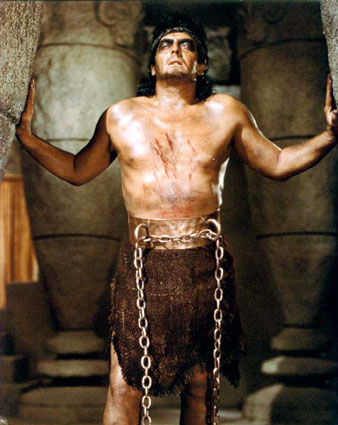
     He saw no reason his actors shouldn’t risk their lives for the good of the film.  Although Victor Mature was a superhero in Samson and Delilah, DeMille said he was “100% yellow” because he refused to wrestle a lion. Paulette Goddard lost future roles with the director by refusing to play with fire in Unconquered.

     And he loved spectacle – the parting of the Red Sea in The Ten Commandments, the toppling of the temple in Samson and Delilah, train wrecks in The Road to Yesterday, Union Pacific and The Greatest Show on Earth, and the destruction of a zeppelin in Madame Satan.

     Gloria Swanson immortalized DeMille in a movie he didn’t direct, Sunset Boulevard, with the frequently repeated line: “All right, Mr. DeMille, I’m ready for my close-up.”

Give me any two pages of the Bible and I’ll give you a picture.  — Cecil B. DeMille

AUGUST 1, 1953: DON’T TAKE YOUR GUNS TO TOWN

In 1953, a new type of western hit the movie screens. Moviegoers were looking for something more complex than the head-em-off-at-the pass, white hat/black hat fare that Hopalong Cassidy and Roy Rogers had been dishing out through the forties. They felt more sophisticated and worldly, and they wanted their cowboys to be more sophisticated and worldly as well (even though most cowboys never strayed beyond Montana).

A gun-toting drifter with only one name rides down out of the rugged Teton Mountains into a fertile valley where a family of homesteaders – a man and wife, and their only son — eke out a living.  Shane as played by Alan Ladd is conflicted, a basically good man who lives by his gun, anxious to give up his wandering and get a normal life. Well, that’s fine, but the local cattle baron and his thug Jack Palance aren’t about to let that happen. At the end of the movie, Shane realizes he can’t escape his past, and in a great cinematic moment, rides off wounded (mortally?) past the gravestones on Cemetery Hill, and out of town, into the sunrise, with the young boy calling after him: “Come back, Shane!”

Gary Cooper gave us another nuanced hero during the early 1950s in the masterful High Noon.

And if you want to talk nuanced, there’s John Wayne:

“Never apologize, mister, it’s a sign of weakness.”

“Life’s hard. It’s even harder when you’re stupid.”

“A man’s got to do what a man’s got to do.”

Or maybe not.


Come back, Huey!

https://richarddaybell.files.wordpress.com/2010/07/vres.jpgThat’s what Paul might have yelled as she waddled (being a duck) off into the crowd of human-sized ducks and dogs and chipmunks at Disney World.  He didn’t, but she came back anyway, and together they set off on a romantic adventure, facing an abundance of perils — neither of them toting a gun.  Feel free to join them.  Voodoo Love Song

JULY 29, 1887: NAUGHTY NOMADS AND SINGING SOTS

Born in 1887, Sigmund Romberg moved to the United States in 1909 and, after a short resume builder in a pencil factory (as a sharpener?), found work as a pianist.  An instrument here, an instrument there, and pretty soon he had his own orchestra. He published a few songs that caught the attention of the Shubert brothers, who in 1914 hired him to write music for their Broadway shows. Next day on his dressing room, they hung a star.

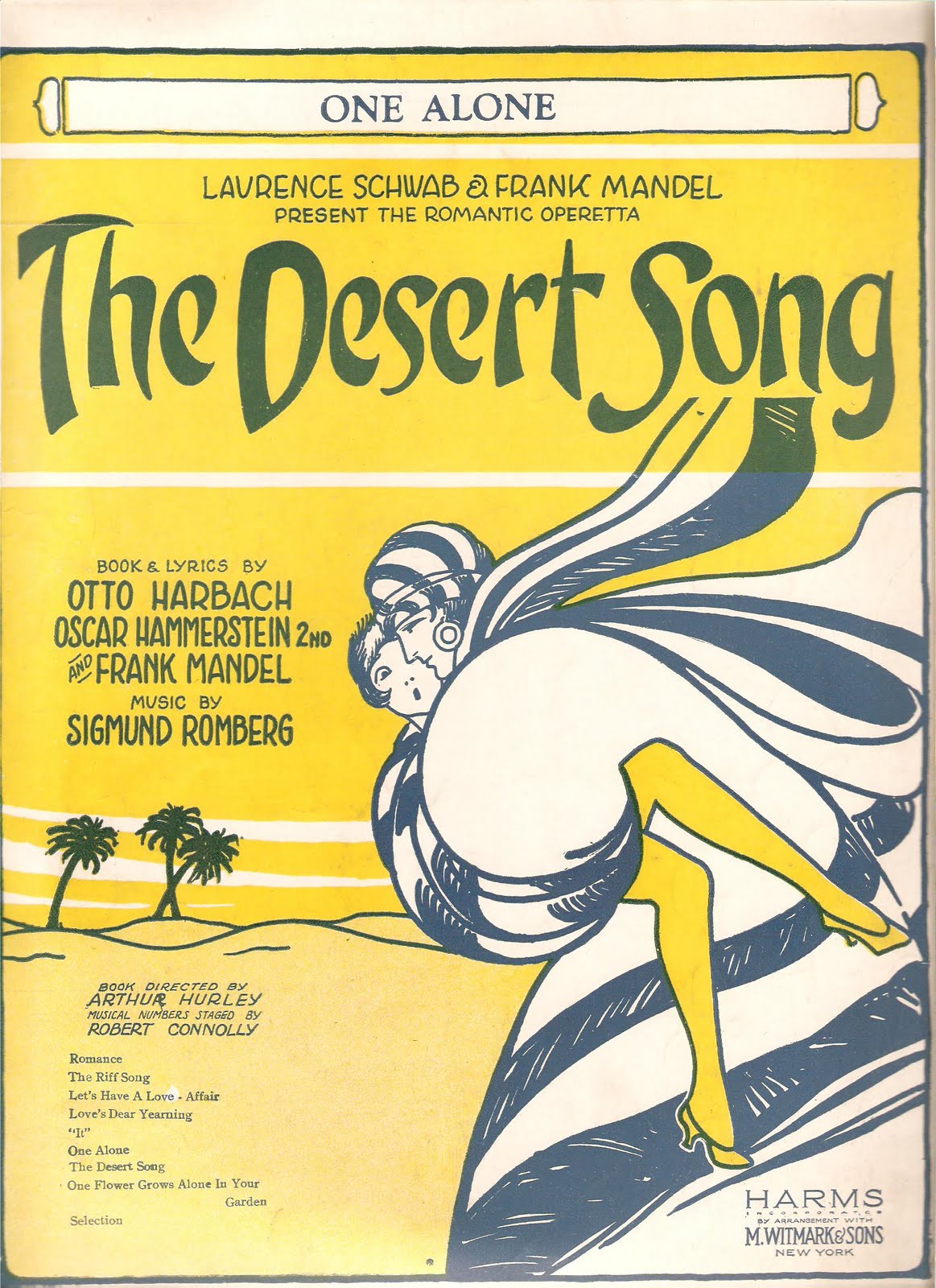
Career off and running, he wrote his best-known operettas, The Student Prince in 1924, The Desert Song in 1926, and The New Moon in 1928.

The Student Prince was the most successful of Romberg’s works, the longest-running Broadway show of the 1920s at 608 performances, even longer than the classic Show Boat.  The “Drinking Song,” with its rousing chorus, was especially popular in 1924, with Prohibition is full swing:

Drink! Drink!
  Let the toast start!
  May young hearts never part!
  Drink! Drink! Drink!
  Let every true lover salute his sweetheart!
  Let's drink!

The Mario Lanza version from the 1954 movie remains popular with imbibers everywhere.

The Desert Song (with lyrics by Oscar Hammerstein) is your typical superhero-adopts-mild-mannered disguise-to-keep-his true-identity-secret saga much like Zorro and Superman but with better music and no phone booths. The Red Shadow loves a beautiful and spirited girl, who loves his hero persona but not his wimpy side.  Will true love win out over hero worship? After much sophisticated music, lust in the dust and naughty humor, we learn the answer, especially in a lavish 1929 film production of the operetta – but only until the 1940s when it became illegal to view or exhibit the 1929 film in the United States because the folks in charge feared the naughty bits would morally harm us.

A second feature version was made in 1943, which had our hero fighting the Nazis, and a third version with Kathryn Grayson and Gordon MacRae in 1953 was about as squeaky clean as you can get.  Thank god for censors.

I drink to make other people more interesting. ― Ernest Hemingway