
OCTOBER 7, 1219: I’M-A GONNA GIVE YOU APPLE AND A PLUM AND AN APRICOT OR TWO

Every history buff is familiar with the great Khwarezmian Empire. No? The Khwarezmian Empire under the stewardship of Shah Ala ad-Din Muhammad reached the height of its glory during the early 13th century. It also reached its nadir during the early 13th century. The story of the Khwarezmian Empire is a cautionary tale about the  genghisimportance of peace, friendship and good manners and as such would be uplifting in its own special way were it not for all the bloodshed and gore.

Khwarezmia was a neighbor to Mongolia whose benevolent commander-in-chief was none other than Genghis Khan, who had a bit of a bad reputation throughout the East. Nevertheless Genghis offered an olive branch to the shah by sending him a rather lavish fruit basket with the Hallmark words of friendship: ‘You are the ruler of the land of the rising sun and I of the setting sun.’

Comes a watershed moment in the history of Khwarezmia and possibly the reason it doesn’t trip off our tongues today. Genghis sent a delegation of several hundred men to deliver the fruit basket, but the shah, in an admittedly bad start to a relationship, had them tossed into a dungeon. He kept the fruit basket.

Genghis was irked, but thought maybe the shah misunderstood his intentions (his being a foreigner and all). So he sent three royal ambassadors — two Mongols and a Muslim interpreter –to make inquiries. The shah, in what we can all agree was a doozie of a tactical blunder, had everyone in the first delegation killed, shaved the heads of the two Mongol ambassadors, and sent them back with the head of the interpreter as his answer to Genghis.

Genghis Khan sent no further pleasantries. Instead, he personally visited Khwarezmia, along with thousands of his best cutthroats. Khwarezmian cities fell like dominoes. The shah’s army was decimated and four million Khwarezmians were killed. Genghis even diverted rivers to erase the shah’s birthplace. The empire ceased to exist.

Violence never settles anything. — Genghis Khan

What It Was Was Football

Back in the days when football was still known as that game with the pointy ball, the son of German immigrants became the coach at the Georgia Institute of Technology (known to its friends as Georgia Tech). John Heisman became the first coach in college football to be paid for his services. They got their money’s worth. He led the school to its first national championship and had a career winning percentage of .779 which remains the best in Tech history.

The most memorable — or perhaps infamous — game in Heisman’s Georgia Tech career was played on October 7, 1916, with Tech playing host to Tennessee’s Cumberland University. Talk about a nail biter! The plucky Cumberland Bulldogs got off to a bad start, losing the coin toss.  Georgia Tech returned the Bulldogs’ first punt for a touchdown. Score 7-0 in less than a minute played. Cumberland fumbled on its first play after the following kickoff. 14-0, with just seconds off the clock.   On their next possession, the Bulldogs fumbled once again on their first play.  21-0. It went pretty much the same until the game mercifully ended with a score of 222-0.  A record, of course, that still stands.

In Cumberland’s defense, it should be pointed out that the college, on the verge of bankruptcy, had eliminated its football program at the beginning of the season. The school was forced to field a team (fraternity brothers of the team’s student manager) to avoid a $3,000 forfeit fee.

Heisman, who went on to be elected to the Football Hall of Fame and give his name to the trophy for the outstanding college football player of the year, up by 18 touchdowns at the half, told his players not to relent. “We’re ahead, but you just can’t tell what those Cumberland players have up their sleeves.”

SEPTEMBER 21, 1219: I’M-A GONNA GIVE YOU APPLE AND A PLUM AND AN APRICOT OR TWO

Every history buff is familiar with the great Khwarezmian Empire. No? The Khwarezmian Empire under the stewardship of Shah Ala ad-Din Muhammad reached the height of its glory during the early 13th century. It also reached its nadir during the early 13th century. The story of the Khwarezmian Empire is a cautionary tale about the  genghisimportance of peace, friendship and good manners and as such would be uplifting in its own special way were it not for all the bloodshed and gore.

Khwarezmia was a neighbor to Mongolia whose benevolent commander-in-chief was none other than Genghis Khan, who had a bit of a bad reputation throughout the East. Nevertheless Genghis offered an olive branch to the shah by sending him a rather lavish fruit basket with the Hallmark words of friendship: ‘You are the ruler of the land of the rising sun and I of the setting sun.’

Comes a watershed moment in the history of Khwarezmia and possibly the reason it doesn’t trip off our tongues today. Genghis sent a delegation of several hundred men to deliver the fruit basket, but the shah, in an admittedly bad start to a relationship, had them tossed into a dungeon. He kept the fruit basket.

Genghis was irked, but thought maybe the shah misunderstood his intentions (his being a foreigner and all). So he sent three royal ambassadors — two Mongols and a Muslim interpreter –to make inquiries. The shah, in what we can all agree was a doozie of a tactical blunder, had everyone in the first delegation killed, shaved the heads of the two Mongol ambassadors, and sent them back with the head of the interpreter as his answer to Genghis.

Genghis Khan sent no further pleasantries. On September 21, 1219, he personally visited Khwarezmia, along with thousands of his best cutthroats. Khwarezmian cities fell like dominoes. The shah’s army was decimated and four million Khwarezmians were killed. Genghis even diverted rivers to erase the shah’s birthplace. The empire ceased to exist.

Violence never settles anything. — Genghis Khan

Since we Americans are no longer allowed to travel to Europe, the Almanac, as a public service, will bring Europe to you. This will be accomplished through the magic of occasional postcards from Europe and other faraway places with strange sounding names. You’re welcome.

Wish You Were Here: Greece

The Trojan Horse dates way back to the war between the Trojans and the Greeks in the thousand or so BC. The Greeks pretended to sail away, leaving the large wooden beast as a going away gift. But weren’t there a gaggle of Greeks hiding inside. Laocoon, a Trojan priest warned the others that he feared the Greeks bearing gifts. Perhaps if he had been more precise, counseling the Trojans to beware a gift bearing Greeks or not to look a gift horse in the mouth or you might see a Greek looking back at you, the outcome may have been different. But it wasn’t.

The Trojan Horse became a symbol of Greek might and was revered through the ages, resting at its home in the Trojan Horse National Park. Inexplicably, the Greeks tired of it and it was eventually converted to a condo. The horse which had once been filled with ancient Greek warriors came to house only five Greeks, the Thermopolis brothers — Dmitri, Ergo, Aristotle, Zorba and Smitty.

JUNE 14, 1287: PROSE AND KHANS

In 1287, Kublai Khan, on a bit of a tear through Asia, defeated the forces led by princes of Mongolia and Manchuria. Kublai was a grandson of Genghis, another Khan known for being rather hard to get along with. Like his grandfather, Kublai was a holy terror right from infancy when he frequently seized power from fellow toddlers. Eventually, Kublai pushed the Mongol Empire to new heights, creating a unified, militarily powerful China and gaining international attention in the process.

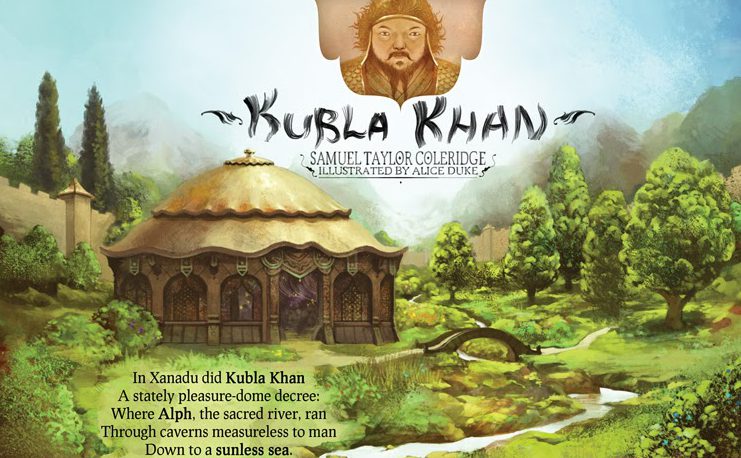
Marco Polo, in the accounts of his travels, made Kublai well-known to western audiences, and Samuel Taylor Coleridge added a romantic aura in the early 19th century with his description of Kublai (Kubla to Coleridge) Khan’s summer cottage at Xanadu:

     In Xanadu did Kubla Khan

     A stately pleasure-dome decree:

     Where Alph, the sacred river, ran

     Through caverns measureless to man

     Down to a sunless sea.

     When the sacred river Alph plunged into that sunless sea it naturally created a great waterfall. In the rush of this waterfall, the voices of Kubla’s ancestors could be heard — that strident, discordant one being Genghis.


Face down in a cranberry bog, part 3: somebody stole my corpse

“A person ought to remain at the scene of the crime,” said the chief of police, taking me to task when he should have been commending my citizenship, as we drove back toward the bog.

“What crime?” I complained. “I’m sure it’s just an accident. And even if I had stayed at the scene of the accident, how could I report it? I don’t have a cell phone. It might be weeks before anyone came by. I’d eventually starve. I couldn’t even eat cranberries because the sign said not to. And I’m too law-abiding to disobey a sign let alone do something criminal to a person, if someone did indeed do something criminal, which I don’t think anyone did, but I have no way of knowing.”

“You’re acting mighty guilty.” I thought I was behaving quite calmly. Upon hearing the word guilty, however, any veneer of calm was violently stripped away. And then I remembered with a jolt of nausea that the recently departed wore only red boxer shorts.

“I always act guilty,” I said, squirming to confirm my words. “Even as a kid. If someone put a baseball through a window, the owner of the house would look at me and figure I did it – just because I looked guilty. People who act guilty are almost always innocent; did you know that?”

“No, I didn’t,” said the chief, looking skeptical. “Here we are.” He stopped the car and we got out. “Now exactly where is this body?”

“Over there. On the other side of that bog.”

We approached and began to circle the bog. We circled it once, and we circled it again. We saw nothing but cranberries. “Are you sure you got the right bog?” the chief asked, giving me that look.

“Yes, I’m sure,” I said. We circled three more bogs, and a deputy who joined us began to circle the rest.

The chief of police leaned back against his car, reached into his pocket and pulled out a pen and a small tablet. “This wouldn’t be a joke, would it? If it was, it wouldn’t be very funny; I can tell you that.”

“Of course not. Do I look like a joker?” I wished I hadn’t said that.

“Had anything to drink today?” He scratched at the tablet as he spoke.

“It’s ten a.m.”

“Had anything to drink this morning?”

“Tomato juice and coffee, that’s it.”

“Do you take medication or any other kinds of drugs?”

“No, I don’t, and I resent that implication.”

“I resent spending my time searching cranberry bogs for bodies that don’t exist.” He looked at me as though he wanted nothing more out of life than to throw me into a jail cell. “You say you’re not joking, you’re not drunk or spaced out. Tell me what you think.”

“It’s obvious,” I said. “Somebody stole the corpse. Otherwise, it would be there.”

“Not that obvious to me. What’s obvious to me is that I’m going to be watching you. Now describe this alleged body to me.”

“It looked dead.”

“Nice start. Would you care to elaborate?”

“Male Caucasian.”

“Now you’re getting it. Go on.”

“Hair gray. Face sort of blue. Mustache.”

“You think this whole thing is some kind of big joke, don’t you?”

“Not at all,” I answered. “I take dead bodies quite seriously. I’m doing my best to help.”

“Okay, mustache. Gray like his hair?”

“Hmmm.” I tried to visualize the mustache but couldn’t. “I don’t know. I think it was dark. But maybe it just looked darker because it was wet. I’m just not sure. In real life, people don’t really remember all the little details. Anyone who knows all the details probably memorizes them. And maybe because that person is guilty – even though he doesn’t look it.”

“Or she.”

“What?”

“Never assume the guilty party is a man. Women kill too. Now can we dispense with the criminology and get on with it?” He continued to write in his little tablet. I wished I could have seen what he was writing; I’ll bet it wasn’t flattering.

“Okay,” I said. “The mustache was three shades darker than the hair. His forehead had six, no seven, wrinkles.”

“Okay, I’ve got enough,” he said, flipping the notebook shut and giving me a nasty look. “If we come up with a body, we’ll get back to you.”

“Don’t call us, we’ll call you?”

“Something like that.”

I watched as he and his trusty deputy returned to their respective police vehicles and pulled away, leaving me alone, angry and confused. Someone had stolen my corpse.

continued