AUGUST 18, 1930: A DOG WALKS INTO A BAR

The world of Disney (as opposed to Disney World) is “peopled” by a group of cartoon animals who walk on two legs, talk intelligibly and dress stylishly. Mickey came first. Then Minnie. Add Donald plutoDuck, Daisy Duck, and Goofy, and you have five of the characters known as the Sensational Six — the superstars of the Disney universe. The sixth character joined the group on August 18, 1930, with the release of the cartoon short Chain Gang. But he was different from the other five. He walked on all fours, barked and was completely naked. He was an animal animal.

Pluto was nameless in his debut vehicle. It wasn’t until a month later and a second appearance in The Picnic that he acquired the clever name Rover. In the cartoon, Rover belongs to Minnie Mouse who brings him along on a picnic with Mickey. In a Mitt Romney moment, Mickey ties the dog to the back of the car before driving off and dragging him behind. But when the poor pooch spots a couple of frolicking rabbits, he ends up dragging the car and its mouse occupants on a merry chase.

The following year, Rover returned as Mickey’s pet with the new name Pluto the Pup. The origin of that name is the subject of argument. It was back in 1930 that the now ex-planet Pluto was discovered. Was this the source of his name? Or were both planet and dog named after the Roman god of the underworld? And then there’s that other great mystery: If Pluto’s a dog and Goofy’s a dog, why is the latter anthropomorphic and the former not?  Walt remained mum.


APRIL 27, 1899: I COULDA BEEN A TENOR

Walter Lantz, who was born in 1899 to Italian immigrant parents,  actually had the surname Lanza until an immigration official anglicized it. Had he not, Walter could have grown up to be an opera singer rather than the creator of Woody Woodpecker and many other cartoon characters.

The first of these characters was Oswald the Lucky Rabbit, star of a 1928 cartoon series for Lantz_OswaldUniversal Studios. The character, who bears more than a passing resemblance to Mickey Mouse, had once belonged to Disney. Lantz won it in a game of poker.

Other less memorable characters followed: a trio of chimps, Meany, Miny and Moe; Baby-Face Mouse; Snuffy Skunk; Doxie (a dachshund); and monkeys Jock and Jill. One character stood out from the crowd – Andy Panda became the comic star for 1939.

A year later, Lantz married actress Grace Stafford. While on their honeymoon, Walter and Grace were pestered by an insistent woodywoodpecker02woodpecker pecking on their roof, and Grace suggested that Walter use the bird as a cartoon character. Woody Woodpecker appeared for the first time in an Andy Panda cartoon and soon became a leading character.

Mel Blanc was originally the voice of Woody Woodpecker, but after only three cartoons, he left to join Warner Brothers. Lantz held anonymous auditions for a new Woody. Lantz’s wife Grace made a secret audition tape and was chosen to be the new voice. She continued in the part until production ceased in 1972.

Woody Woodpecker is the only comic character to have his own hit song. Kay Kyser recorded “The Woody Woodpecker Song,” a top hit and Academy Award nominee in 1948.

Ho-ho-ho ho ho! Ho-ho-ho ho ho! Oh, that’s the Woody Woodpecker song.  They don’t write lyrics like that anymore.

April 12, 1905: Magic Kingdoms Here and There

It was a Big Apple Fantasyland. Finishing touches were still being put in place on New York City’s Hippodrome just hours before its April 12, 1905, opening. Seating 5300 people, it dwarfed the Metropolitan Opera with its 3000 seats. A marvel of theatrical architecture, its stage was 12 times larger than any existing Broadway house. A four-hour extravaganza opened with A Yankee Circus on Mars, which featured acrobats, clowns, horses, elephants, and space ships, of course.  A baboon named Coco joined 60 musicians, several hundred singers, and 150 dancers for a musical spectacle.  A depiction of the Civil War featured gunfire, explosions and cavalry troops on horseback swimming across a huge water tank simulating a lake.  Harry Houdini made a 10,000-pound elephant disappear.

For the next two decades, the Hippodrome was the largest and most successful theater in New York, hosting operas, circuses, vaudeville and silent movies.The musical spectacular Good Times ran for 456 performances from 1920 to 1921 and Better Times ran for 405 performance in 1922–23.  Unfortunately leaner times were ahead.  The Sixth Avenue property that the Hippodrome occupied became too valuable for its use.  Finally, the elephants all left the stage and marched off to the Bronx Zoo and, in 1939, the Hippodrome closed its doors.

Flying Elephants Perhaps (a Clever Segue to 1992)

Could Mickey Souris really cut it among continental consumers? Would the rodent empire have the necessary je ne sais quoi to win those jaded Gallic hearts and minds? No more guessing or advance planning or idle speculation after D-Day (as in Disney) — April 12, 1992, the day Euro Disney opened its gates in Marne-La-Vallee on the outskirts of Paris. Mickey, Donald Duck and, yes, Dumbo scored. The royaume magique became one of Europe’s leading tourist destinations with some 15 million annual visitors. Disney had created another Fantasyland.

Speaking of Disney (a Clever Segue to a Blatant Commercial Message)

Paul wasn’t sure, but the five-foot duck waddling through the throngs of laughing, crying, shouting, whining children appeared to be waddling toward him – a duck with a destination and, perhaps, a mission.  Chances are it had spotted him scowling in a land where grinning is the norm, and it, by God, meant to do something about it.
“Enjoying the Magic Kingdom?” asked the duck upon reaching him. Despite its carefully sculpted plastic smile, this duck wasn’t going to cheer anyone up; its voice dripped sarcasm.
“Of course, I am,” Paul answered, adopting his very own duck attitude.  “Isn’t that why you’re here?  By the way, didn’t I somewhere get the idea that you’re all supposed to be pleasant and cheerful?”
“I’m not even supposed to talk.  Just wave.”  The duck waved and, in silence, could have passed for pleasant and cheerful, albeit of a fabricated sort.
“Then why did you talk to me?” Paul asked.
“Because you look bored – like you positively hate the place.”
“Ah, you’re not just an ordinary duck, you’re a member of the happiness squad, here to lift my spirits.”
“No,” answered the duck.  “I thought you might have a cigarette.”
“That’s an interesting deduction.”
“Well, do you?”
“Yes.”
“May I have one?” the duck asked, sitting next to him on the bench.
“Certainly.  I’ve never seen a duck smoke before.  Rabbits maybe, hedgehogs maybe, but never a duck.  Some people might find that a bit weird.”
“I think most people would agree that what’s really weird is someone talking to a duck.”

Quack here.


March 27, 1958: They Say Goofy Is a Fellow Traveler

     Nikita Khrushchev was elevated to top commie in the Soviet Union on March 27, 1958. His Cold War relationship with President Eisenhower and the United States was a complex one, certainly more so than the Ego War between the current Russian leader and his previous U.S. bro-hug counterpart.

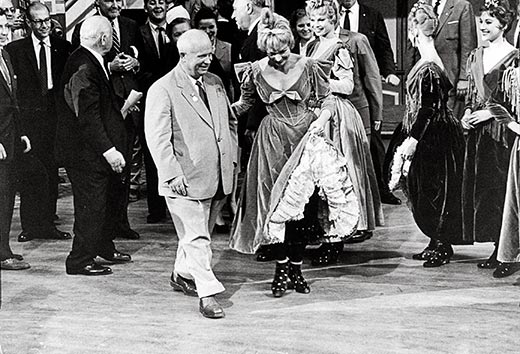
     The following year Khrushchev was in the U.S. for a summit meeting with Eisenhower.   At the Soviet leader’s request, a visit to Hollywood was arranged.  Khrushchev and his wife arrived in Los Angeles, where the day started with a tour of the Twentieth Century Fox Studios in Hollywood and a visit to the sound stage of  Can-Can. Meeting stars Shirley MacLaine and Juliet Prowse pleased the roly-poly dictator even though he had to nyet a chance to dance with MacLaine (probably something to do with the Siberian stare coming from Mrs. K)   A lunch hosted by Frank Sinatra was also a big success even though Sinatra didn’t sing “That Old Bolshevik Magic,” as Nikita requested.

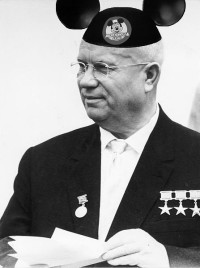
     The day headed downhill when Twentieth Century Fox President Spyros P. Skouras, who wore his anticommunism on his sleeve, got into a bit of a who-will-bury-whom brouhaha with the Russian leader who was known for his temper tantrums.  Shortly afterward, it began to look as though a nuclear exchange were imminent. Meeting Frank Sinatra was nice, but who Nikita really wanted to meet was Mickey Mouse.  His American hosts told him it couldn’t happen.  Security concerns.   Perhaps he’d like to see Cape Canaveral, the White House War Room, the Strategic Air Command. But no Disneyland.  Nicky exploded. “And I say, I would very much like to go and see Disneyland. But then, we cannot guarantee your security, they say. Then what must I do? Commit suicide? What is it? Is there an epidemic of cholera there or something? Or have gangsters taken hold of the place that can destroy me?”

Khrushchev left Los Angeles the next morning, and the Cold War returned to deep freeze.

Put a Cork in It

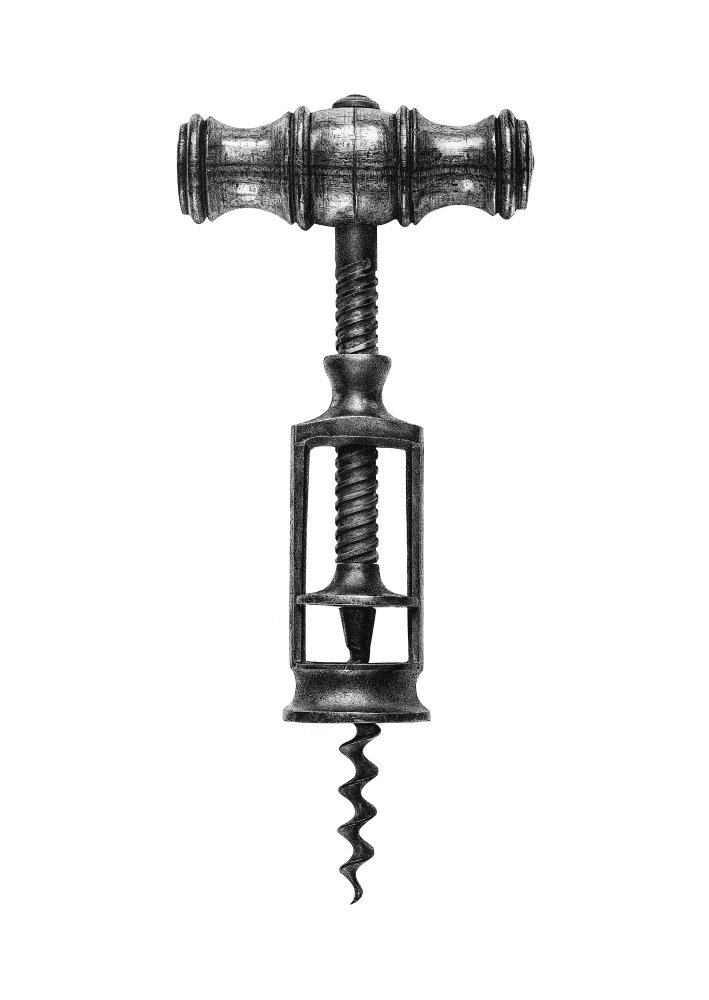
Back through the centuries wine lovers never aged their wines; they consumed it quickly before it went bad.  Then in the 18th century, British glassblowers began to make bottles with narrow necks for wine that made airtight storage possible. Corks were used to seal the bottles. This quickly led to the invention of one of the dandiest little gizmos ever devised — the corkscrew. The design was based on a similar device used to clean muskets. The first corkscrews were T-shaped devices that twisted into the cork and after a certain amount of pulling extracted the cork. Corkscrews were first patented in England and France, then on March 27, 1860, M. L. Byrn of New York City received an American patent.

Since then, hundreds of corkscrews have been designed of every shape, size and mechanics you can imagine — single-lever, double-winged, air pump, electric, mounted. Naturally there are corkscrew books, corkscrew clubs, and corkscrew collectors, helixophiles.

January 13, 1930: Day of the Mouse

He’s short with big ears, a big nose and a skinny tail.  He’s nattily attired in red shorts with two big buttons, big yellow shoes and white gloves.  He hails from Florida these days where he has his own kingdom and is a woke Robin Hood to the state’s evil governor.  Back in 1930 when he made his debut he wasn’t quite so colorful, his venue being a black and white comic strip.  Mickey Mouse was already well known when his comic strip first appeared, having been a film star since his first appearance in 1928 in the cartoon Plane Crazy.  Created by Walt Disney and Ub Iwerks, he has grown in stature through the years to become the face of the Walt Disney organization.

The first comic strip sequence was a reprise of the Plane Crazy cartoon in which Mickey dreams of following in the footsteps of his idol Charles Lindbergh, flying into adventure in his own homemade plane, along with his girlfriend Minnie.

The governor of Florida would probably fare better against a less formidable Disney character.  A DeSantis/Donald Duck debate would be priceless.

If Only It Had Wings

On January 13, 1854,  musical inventor Anthony Foss received a patent for his accordion, a strange device shaped like a box with a bellows that is compressed or expanded while pressing buttons or keys which cause pallets to open and air to flow across strips of brass or steel, creating something that vaguely resembles music. It is sometimes called a squeezebox. The person playing it is called an accordionist (or squeezeboxer?)

The harmonium and concertina are cousins. And, yes, there is a World Accordion Day.

If Only She’d Had a Squeezebox

Born in Russia on January 13, 1887, “the Last of the Red Hot Mamas,” Sophie Tucker immigrated to the United States as an infant and began her long career shortly afterward, singing for tips in her parents’ restaurant. Between taking orders and serving customers, Sophie would stand in a narrow space by the door and belt out songs with all the drama she could muster. “At the end of the last chorus,” she remembered, “between me and the onions, there wasn’t a dry eye in the place.”

She gained stardom using a combination of comic risque and “fat girl” songs such as “Nobody Loves a Fat Girl, But Oh How a Fat Girl Can Love.” Her signature song, however, was “Some of These Days.” She became one of the most popular entertainers in America, following her vaudeville and burlesque career with movies through the 30’s and 40’s and television in the 50’s and 60’s.  She influenced many female performers, including such larger than life performers as Mae West and Bette Midler.

Sophie Tucker continued performing until her death in 1966.

APRIL 27, 1899: I COULDA BEEN A TENOR

Walter Lantz, who was born in 1899 to Italian immigrant parents,  actually had the surname Lanza until an immigration official anglicized it. Had he not, Walter could have grown up to be an opera singer rather than the creator of Woody Woodpecker and many other cartoon characters.

The first of these characters was Oswald the Lucky Rabbit, star of a 1928 cartoon series for Lantz_OswaldUniversal Studios. The character, who bears more than a passing resemblance to Mickey Mouse, had once belonged to Disney. Lantz won it in a game of poker.

Other less memorable characters followed: a trio of chimps, Meany, Miny and Moe; Baby-Face Mouse; Snuffy Skunk; Doxie (a dachshund); and monkeys Jock and Jill. One character stood out from the crowd – Andy Panda became the comic star for 1939.

A year later, Lantz married actress Grace Stafford. While on their honeymoon, Walter and Grace were pestered by an insistent woodywoodpecker02woodpecker pecking on their roof, and Grace suggested that Walter use the bird as a cartoon character. Woody Woodpecker appeared for the first time in an Andy Panda cartoon and soon became a leading character.

Mel Blanc was originally the voice of Woody Woodpecker, but after only three cartoons, he left to join Warner Brothers. Lantz held anonymous auditions for a new Woody. Lantz’s wife Grace made a secret audition tape and was chosen to be the new voice. She continued in the part until production ceased in 1972.

Woody Woodpecker is the only comic character to have his own hit song. Kay Kyser recorded “The Woody Woodpecker Song,” a top hit and Academy Award nominee in 1948.

Ho-ho-ho ho ho! Ho-ho-ho ho ho! Oh, that’s the Woody Woodpecker song.  They don’t write lyrics like that anymore.

AUGUST 18, 1930: A DOG WALKS INTO A BAR

The world of Disney (as opposed to Disney World) is “peopled” by a group of cartoon animals who walk on two legs, talk intelligibly and dress stylishly. Mickey came first. Then Minnie. Add Donald plutoDuck, Daisy Duck, and Goofy, and you have five of the characters known as the Sensational Six — the superstars of the Disney universe. The sixth character joined the group on August 18, 1930, with the release of the cartoon short Chain Gang. But he was different from the other five. He walked on all fours, barked and was completely naked. He was an animal animal.

Pluto was nameless in his debut vehicle. It wasn’t until a month later and a second appearance in The Picnic that he acquired the clever name Rover. In the cartoon, Rover belongs to Minnie Mouse who brings him along on a picnic with Mickey. In a Mitt Romney moment, Mickey ties the dog to the back of the car before driving off and dragging him behind. But when the poor pooch spots a couple of frolicking rabbits, he ends up dragging the car and its mouse occupants on a merry chase.

The following year, Rover returned as Mickey’s pet with the new name Pluto the Pup. The origin of that name is the subject of argument. It was back in 1930 that the now ex-planet Pluto was discovered. Was this the source of his name? Or were both planet and dog named after the Roman god of the underworld? And then there’s that other great mystery: If Pluto’s a dog and Goofy’s a dog, why is the latter anthropomorphic and the former not?  Walt remained mum.