JULY 30, 2003: TAKE A SPIN IN MY KRAFT-DURCH-FREUDE-WAGEN?

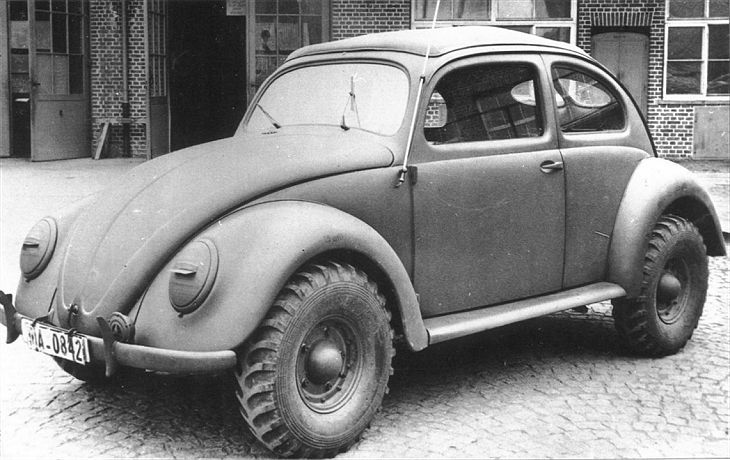
Volkswagen Beetle number 21,529,464 rolled off the production line at the VW plant in Puebla, Mexico, on this day in 2003. It was the last of the Beetles, a car that had been built since World War II. kdf-wagenIt was baby blue and destined for a museum near Volkswagen headquarters in Wolfsburg, Germany, where its oldest ancestors were made.

This was the classic VW Beetle, the real one, not the redesigned retro Beetle that Volkswagen started producing in 1998. It was first visualized back in the 1930s by Austrian automotive engineer Ferdinand Porsche (yes, that Porsche).  Adolf Hitler wanted a small, affordable passenger car to satisfy German transportation needs, something smaller than a Panzer and more family-friendly. Porsche’s auto fit the bill and was introduced in 1939 as the Kraft-durch-Freude-Wagen (or “Strength-Through-Joy” car), not a moniker that would send anyone other than Nazis running to their nearest automobile dealer.  A much-needed name change would later make it the “people’s car” or Volkswagen.

The Kraft-durch-Freude-Wagen was quickly given the nickname “Beetle” for its funny round shape and because — well, would you call it the “Kraft-durch-Freude-Wagen?”  The Wolfsburg factory churned out vehicles until production was halted by Allied bombing in 1944.

Production was resumed after the war, and the Beetle was distributed throughout the world during the following years. After a slow start in the United States, the Beetle became the top import by 1960 as the result of a clever advertising campaign. In 1969, a Beetle named Herbie starred in a hit movie The Love Bug and a couple of sequels.

Hard times hit in 1977, however, as the Beetle was banned in America for failing to meet safety and emission standards. Sales throughout the world declined and, by the late 1980s, the classic Beetle was sold only in Mexico. The Beetle was doomed even in Mexico, thanks to increased competition from other compact cars and burros. And in 2003 it was adios fraulein.


JUNE 5, 1850, 1878, 1895: THRICE UPON A TIME IN THE WEST

When the sheriff of Lincoln County, New Mexico, resigned in 1880, the county appointed Pat Garrett, a former bartender known as something of a gunman to replace him.  Garrett was immediately given the task of apprehending a friend from his saloon keeping days, jail escapee Henry McCarty, aka Henry Antrim, aka William Harrison Bonney, but more widely known as Billy the Kid.  The Kid had supposedly killed 21 men, one for every year of his life, but no one could actually name more than nine.

Later that year, Garrett captured the Kid and his companions at the posh New Mexico spa, Stinking Springs, but the Kid escaped from the Lincoln County Jail, killing his two guards. Garrett learned that the Kid was hiding out at the house of a mutual friend, Pete Maxwell. Late one night, Garrett went to Maxwell’s house while the Kid was sleeping.  Accounts differ as to what happened next. Either the Kid woke up and entered Maxwell’s bedroom, where Garrett, standing in the shadows, shot him as he asked “Who is it?” (“It is I” or even “It’s me,” being the more gentlemanly response). Or Garrett went into Maxwell’s wife’s room and tied her up, and when the Kid walked into her room (for what purpose, we can only guess), Garrett blasted him with a single rifle shot. Either account pretty much tarnished Garrett’s reputation as a straight shooter.

Conspiracy theorists maintain that Billy the Kid was not killed at all and that Garrett staged it all so the Kid could escape. They also insist that Garrett was born (on June 5, 1850) in Kenya.

At about the same time (1878, to be exact) Pancho Villa was born on this same day a bit farther south in the northern Mexican state of Chihuahua. During the early 20th century, he pretty much ran the state.  He and his supporters played Robin Hood, seizing haciendas and land for distribution to peasants and soldiers. They robbed and commandeered trains, and printed their own money to pay for the 1910-20 revolution.

After Villa’s rather infamous incursion into New Mexico in 1916, U.S. Army General John J. Pershing pursued Villa for nine months unsuccessfully (probably because he refused to ambush him in a lady’s bedroom) before turning his attention to World War I. Villa retired in 1920 on a large estate where he could have spent a gracious hero’s retirement, sipping Margaritas in comfort, had he not decided to get back into politics, whereupon he was assassinated.

A few years later, back in the US, William Boyd (born June 5, 1895), was making a name for himself as a straight shooting, upright good guy, that name being Hopalong Cassidy.  Hoppy, as his friends called him, eschewed the role of  a hard-drinking, rough-living wrangler, opting instead to be the very model of a cowboy hero, one who did not smoke, drink or swear and who always let the bad guy strike the first blow (and never ever ambushed a bad guy in a lady’s bedroom).

Conspiracy theorists maintain that Boyd was not a real cowboy, that Hoppy was a fictional character. They point to the 66 Hopalong Cassidy films and the memorabilia such as watches, comic books, dishes, Topps trading cards, and cowboy outfits as proof.  Next they’ll say he was born in Kenya.

There’s always a man faster on the draw than you are, and the more you use a gun, the sooner you’re gonna run into that man. — Gunfight at the O.K. Corral

MAY 5, 1795: Keep Your (Hair) Powder Dry

Unlike today, a nice head of hair made an important fashion statement in the 17th century.  Hair loss and baldness were accompanied by a loss of status and style and, even worse, might indicate the heartbreak of syphilis.  Wigs were often used to cover up such shameful appearance.  Their use became widespread after two monarchs, Louis XIV of France and Charles II of England, victims of premature hair loss, donned wigs.  Courtiers, always quick to jump on a convenient bandwagon, started wearing wigs as well, and a fashion was born.

The first wigs were fashioned from horse and goat hair and, even though they identified the wearer as an elite member of society, they smelled bad and attracted lice and other unwanted critters.  To combat this inconvenience, wig wearers would powder their faux tresses.  Hair powder usually consisted of wheat starch and perfume.  Cheaper powders might be made of flour, ground rice or chalk.

The more popular wigs became, the more elaborate and  bigger they got, hence the term bigwig.  Then in the 18th century, wigs fell out of fashion just as quickly as they had risen.  Late in the century, the clever British, needing revenue to finance another of their endless wars with France, hit upon the idea of taxing hair powder. On May 5, 1795, the government introduced the Hair Powder Act, requiring citizens to purchase a certificate to purchase hair powder.  Well didn’t that put a dent in the use of wigs.  All  of a sudden, in England folks began to wonder what else those wigs might be hiding.  In France, they saw how often wig-wearing dandies ended up with their wigged heads at the wrong end of a guillotine.

Longhair became a word of derision.  Short hair or be square.  But nothing is forever.  Long hair made a comeback in the 20th century.  And you can buy hair powder on Amazon.  Tax-free.

Vamos A Celebrar

In Mexico, Cinco de Mayo is celebrated primarily in the state of Puebla where it is called El Día de la Batalla de Puebla (The Day of the Battle of Puebla) observed to commemorate the Mexican army’s unlikely victory over French forces at the Battle of Puebla on May 5, 1862. France, under the leadership of Napoleon Number Three, sought to establish a Gallic empire in Mexico (possibly because things had gone so well for Napoleon Number One in Russia back in 1812). In 1861, a large French force landed at Veracruz sending the Mexican government into retreat. Moving toward Mexico City, the French army encountered heavy resistance near Puebla from a poorly equipped Mexican army of 4,500 men. The Mexicans were able to soundly defeat the 8,000-strong French army, considered the best in the world.


MARCH 28, 1910: Not with the Mouse Again

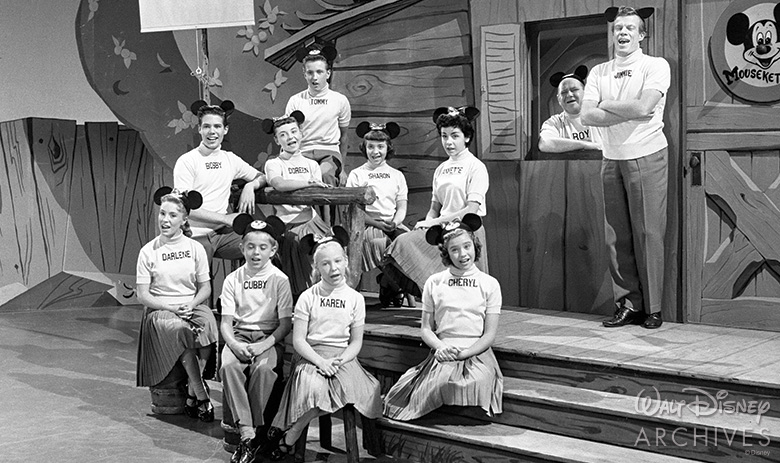
Jimmie Dodd, who was born on March 28, 1910, was an American actor who had small parts in movies during the early 50s. His specialty seemed to be playing taxi drivers (You can check him out in Easter Parade.) His big break came in 1955 when he became the fearless leader of a gang of young teenagers who all performed on TV five times weekly sporting mouse ears.

Dodd was, of course, the head mouseketeer on the Mickey Mouse Club. Dodd also penned the infamous “Mickey Mouse Club March” as well as other songs which he performed on the program accompanying himself on his “mouse-guitar.” It must have been embarrassing enough for teenagers, wearing those mouse ears, but for a guy in his forties — well, chances are he drank heavily.

Kingdoms Can Be Magic or They Can Be Wild
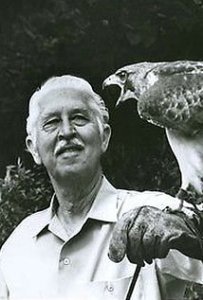
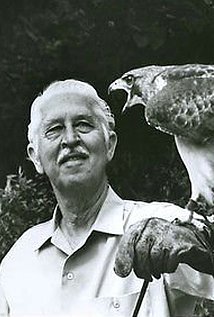
Herding teenagers in mouse ears is one thing, but being chased by wild animals week after week was quite another. It was, however bread and butter for Marlin Perkins, born on this date in 1905. For 35 years beginning in 1950, Perkins was insulted, chased, bitten and stung, first on Zoo Parade and then on Wild Kingdom. Perkins eventually got smart and let his sidekick Jim Fowler interact with the animals while he narrated from a safe distance.

The Nays of Texas

On March 28, 1845, Mexico had a diplomatic temper tantrum over the territory of Texas and broke off relations with the United States. (Either both countries wanted Texas or neither country wanted Texas.)  Said the Mexican president: “We’re going to build a big, beautiful wall, and the United States is going to pay for it.”


MAY 5, 1862: VAMOS A CELEBRAR

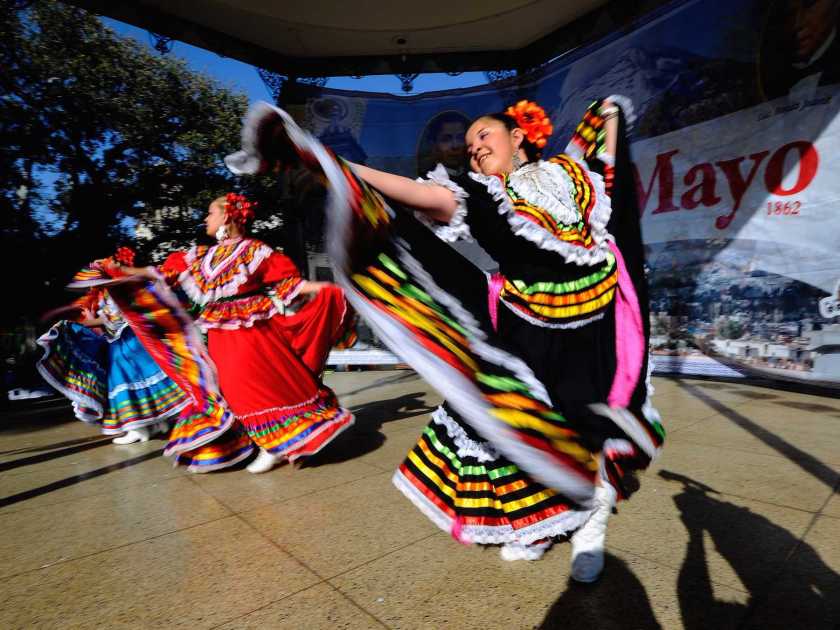
Today is Cinco de Mayo. It is sometimes mistakenly thought of as a major Mexican holiday; it is, rather, a celebration of Mexican heritage and pride by people of Mexican descent living mostly in the United States – and, of course, non-Mexicans looking for an excuse to drink tequila.

In Mexico, Cinco de Mayo is celebrated primarily in the state of Puebla where it is called El Día de la Batalla de Puebla (The Day of the Battle of Puebla) observed to commemorate the Mexican army’s unlikely victory over French forces at the Battle of Puebla on May 5, 1862. France, under the leadership of Napoleon Number Three, sought to establish a Gallic empire in Mexico (possibly because things had gone so well for Napoleon Number One in Russia back in 1812). In 1861, a large French force landed at Veracruz sending the Mexican government into retreat. Moving toward Mexico City, the French army encountered heavy resistance near Puebla from a poorly equipped Mexican army of 4,500 men. The Mexicans were able to soundly defeat the 8,000-strong French army, considered the best in the world.

MARCH 28, 1910: M-O-U-S-E

Jimmie Dodd, who was born on March 28, 1910, was an American actor who had small parts in movies during the early 50s. His specialty seemed to be playing taxi drivers (You can check him out in Easter Parade.) His big break came in 1955 when he became the fearless leader of a gang of young teenagers who all performed on TV five times weekly sporting mouse ears.

Dodd was, of course, the head mouseketeer on the Mickey Mouse Club. Dodd also penned the infamous “Mickey Mouse Club March” as well as other songs which he performed on the program accompanying himself on his “mouse-guitar.” It must have been embarrassing enough for teenagers, wearing those mouse ears, but for a guy in his forties — well, chances are he drank heavily.

Kingdoms Can Be Magic or They Can Be Wild

Herding teenagers in mouse ears is one thing, but being chased by wild animals week after week was quite another. It was, however bread and butter for Marlin Perkins, born on this date in 1905. For 35 years beginning in 1950, Perkins was insulted, chased, bitten and stung, first on Zoo Parade and then on Wild Kingdom. Perkins eventually got smart and let his sidekick Jim Fowler interact with the animals while he narrated from a safe distance.

The Maine and Spain

On March 28, 1898, the United States Naval Court of Inquiry found that the American battleship Maine, which had been blown up in February while on an observation visit, was destroyed by a submerged mine.

William Randolph Hearst had already decided the Spanish were to blame and meant to do something about it. He ran a series of articles pushing for war with Spain. Headlines proclaimed “Spanish Treachery!” and “Destruction of the War Ship Maine Was the Work of an Enemy!” Hearst’s New York Journal offered a $50,000 award for the “detection of the Perpetrator of the Maine Outrage.”

Several months earlier, Hearst had sent Western artist Frederick Remington to get sketches of the brave Cuban insurgents fighting for independence. When Remington sent a report stating that everything was quiet — rum, conch fritters and siestas — that there would be no war, Hearst famously responded. “Please remain. You furnish the pictures and I will furnish the war.”

His hyperbolic and breathless accounts of “atrocities” committed by the Spanish in Cuba and his leading role in inciting the war, earned Hearst the nickname Father of Yellow Journalism (a title not really up there with  Father of Quantum Physics or Father of  the Bride), yellow journalism being the presentation of news of questionable legitimacy using exaggeration, sensationalism and eye-catching headlines to sell more newspapers.  Unless it’s true — then it’s called fake news.

The Nays of Texas

On March 28, 1845, Mexico had a diplomatic temper tantrum over the territory of Texas and broke off relations with the United States. (Either both countries wanted Texas or neither country wanted Texas.)  Said the Mexican president: “We’re going to build a big, beautiful wall, and the United States is going to pay for it.”

Wretched Richard’s Little Literary Lessons — No. 5

rep·ar·tee

ˌrepərˈtē,ˌrepˌärˈtē,ˌrepˌärˈtā/

noun

Conversation or speech characterized by quick, witty comments or replies; amusing and usually light sparring with words

For example:

“So here we are,” said Huey. “stuck on Gilligan’s Island – Chickenshit Crusoe and his faithless companion, Good Friday.”

“I was a Boy Scout for two weeks,” Paul offered.

“What a relief. And to think I was starting to get worried. But you obviously know how to start a fire without matches, forage for food, and carve a comfortable existence out of the cruel jungle.”

“Well I did learn how to tie a square knot.”

“Well there you are. You little rascals are always prepared, aren’t you? And kind and reverent and true and God-fearing and above all helpful. If we only had a little old lady, you could help her back and forth across the beach.”

“Are you through?”

“Probably not.” She sat down next to him.

“Since we may be spending the rest of our lives together, we should probably learn to be cordial.”

“Sure, I know your type, Crusoe,” said Huey. “First you get a girl stranded on an island. Then you want to be cordial. And then – ”

And then?

March 2, 1985: Steering the Ark of Decorum to Saner Shores

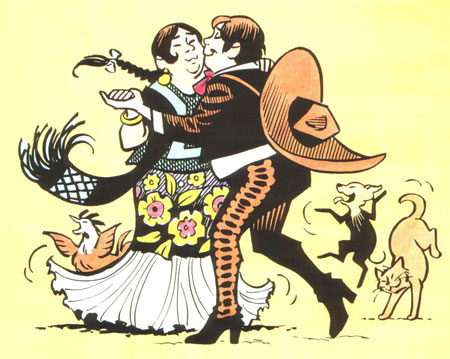
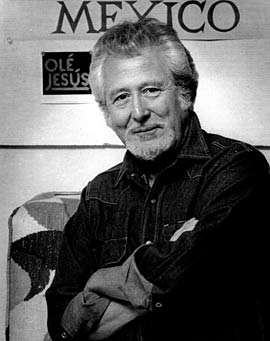
When he put down his pencil on March 2, 1985, Gus Arriola brought to an end a classic comic strip that had endured for 45 years, appearing in as many as 270 newspapers. During that span, Gordo (meaning Fatso) had evolved from a Mexican version of Li’l Abner — a lazy, overweight bean farmer who fit the American stereotype of Mexicans (but not yet as rapist and murderer) — to an “accidental ambassador’ for Mexican culture.

Arriola wrote, illustrated and produced the strip throughout its run except during a stint in the army, although he regularly used tongue in cheek pseudonyms such as Overa Cheever, Liv Anlern, Kant Wynn, and Bob N. Frapples for his Sunday strips.

Along with Gordo, there were his nephew Pepito, poet Paris Juarez Keats Garcia, housekeeper Tehuana Mama and the widow in hot pursuit of bachelor Gordo, Artemesia Rosalinda Gonzalez. And pets Poosy Gato, Señor Dog, and Bug Rogers (a spider).

As Arriola became aware of the strip’s cultural influence over the years, he began to present Gordo as a more complex sympathetic character — more depth, less girth. In 1954, Gordo lost his farm and went to work as a tour guide, traveling throughout Mexico and presenting a more nuanced view of Mexican life.

Charles Schulz said Gordo was “probably the most beautifully drawn strip in the history of the business.” Arriola died in 2008.

Gordo strip for March 2, 1985:

Th-th-that’s All Folks

On March 2, 1935, Warner Brothers introduced a new cartoon character name of Porky Pig.  Next day on his dressing room, they hung a star, and Porky went on with the show for another 153 cartoon appearances,  Warner’s longest running character.

JULY 30, 2003: TAKE A SPIN IN MY KRAFT-DURCH-FREUDE-WAGEN?

Volkswagen Beetle number 21,529,464 rolled off the production line at the VW plant in Puebla, Mexico, on this day in 2003. It was the last of the Beetles, a car that had been built since World War II. kdf-wagenIt was baby blue and destined for a museum near Volkswagen headquarters in Wolfsburg, Germany, where its oldest ancestors were made.

This was the classic VW Beetle, the real one, not the redesigned retro Beetle that Volkswagen started producing in 1998. It was first visualized back in the 1930s by Austrian automotive engineer Ferdinand Porsche (yes, that Porsche).  Adolf Hitler wanted a small, affordable passenger car to satisfy German transportation needs, something smaller than a Panzer and more family-friendly. Porsche’s auto fit the bill and was introduced in 1939 as the Kraft-durch-Freude-Wagen (or “Strength-Through-Joy” car), not a moniker that would send anyone other than Nazis running to their nearest automobile dealer.  A much-needed name change would later make it the “people’s car” or Volkswagen.

The Kraft-durch-Freude-Wagen was quickly given the nickname “Beetle” for its funny round shape and because — well, would you call it the “Kraft-durch-Freude-Wagen?”  The Wolfsburg factory churned out vehicles until production was halted by Allied bombing in 1944.

Production was resumed after the war, and the Beetle was distributed throughout the world during the following years. After a slow start in the United States, the Beetle became the top import by 1960 as the result of a clever advertising campaign. In 1969, a Beetle named Herbie starred in a hit movie The Love Bug and a couple of sequels.

Hard times hit in 1977, however, as the Beetle was banned in America for failing to meet safety and emission standards. Sales throughout the world declined and, by the late 1980s, the classic Beetle was sold only in Mexico. The Beetle was doomed even in Mexico, thanks to increased competition from other compact cars and burros. And in 2003 it was adios fraulein.


JUNE 5, 1850, 1878, 1895: THRICE UPON A TIME IN THE WEST

When the sheriff of Lincoln County, New Mexico, resigned in 1880, the county appointed Pat Garrett, a former bartender known as something of a gunman to replace him.  Garrett was immediately given the task of apprehending a friend from his saloon keeping days, jail escapee Henry McCarty, aka Henry Antrim, aka William Harrison Bonney, but more widely known as Billy the Kid.  The Kid had supposedly killed 21 men, one for every year of his life, but no one could actually name more than nine.

Later that year, Garrett captured the Kid and his companions at the posh New Mexico spa, Stinking Springs, but the Kid escaped from the Lincoln County Jail, killing his two guards. Garrett learned that the Kid was hiding out at the house of a mutual friend, Pete Maxwell. Late one night, Garrett went to Maxwell’s house while the Kid was sleeping.  Accounts differ as to what happened next. Either the Kid woke up and entered Maxwell’s bedroom, where Garrett, standing in the shadows, shot him as he asked “Who is it?” (“It is I” or even “It’s me,” being the more gentlemanly response). Or Garrett went into Maxwell’s wife’s room and tied her up, and when the Kid walked into her room (for what purpose, we can only guess), Garrett blasted him with a single rifle shot. Either account pretty much tarnished Garrett’s reputation as a straight shooter.

Conspiracy theorists maintain that Billy the Kid was not killed at all and that Garrett staged it all so the Kid could escape. They also insist that Garrett was born (on June 5, 1850) in Kenya.

At about the same time (1878, to be exact) Pancho Villa was born on this same day a bit farther south in the northern Mexican state of Chihuahua. During the early 20th century, he pretty much ran the state.  He and his supporters played Robin Hood, seizing haciendas and land for distribution to peasants and soldiers. They robbed and commandeered trains, and printed their own money to pay for the 1910-20 revolution.

After Villa’s rather infamous incursion into New Mexico in 1916, U.S. Army General John J. Pershing pursued Villa for nine months unsuccessfully (probably because he refused to ambush him in a lady’s bedroom) before turning his attention to World War I. Villa retired in 1920 on a large estate where he could have spent a gracious hero’s retirement, sipping Margaritas in comfort, had he not decided to get back into politics, whereupon he was assassinated.

A few years later, back in the US, William Boyd (born June 5, 1895), was making a name for himself as a straight shooting, white-hatted good guy, that name being Hopalong Cassidy.  Hoppy, as his friends called him, eschewed the role of  a hard-drinking, rough-living wrangler, opting instead to be the very model of a cowboy hero, one who did not smoke, drink or swear and who always let the bad guy strike the first blow (and never ever ambushed a bad guy in a lady’s bedroom).

Conspiracy theorists maintain that Boyd was not a real cowboy, that Hoppy was a fictional character. They point to the 66 Hopalong Cassidy films and the memorabilia such as watches, comic books, dishes, Topps trading cards, and cowboy outfits as proof.  Next they’ll say he was born in Kenya.

There’s always a man faster on the draw than you are, and the more you use a gun, the sooner you’re gonna run into that man. — Gunfight at the O.K. Corral