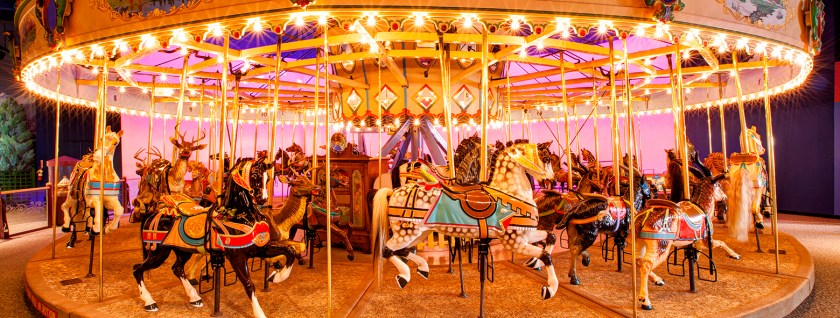
An English traveler happened upon an unusual contraption while passing through what is present-day Bulgaria on May 17, 1620. It was a circular device with seats 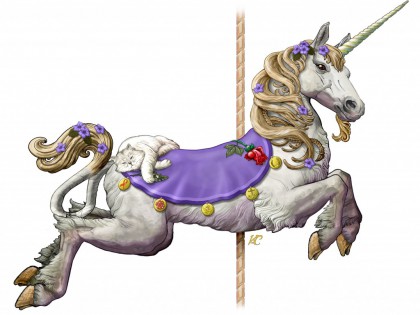 attached to its perimeter. Children were tethered to the seats and the whole device turned round and round. The Englishman approached the device hoping to save these poor tykes. But as he drew near he heard their squealing and laughter. They were not being punished; they were being entertained. The Englishman’s account of this marvelous contraption is the earliest reference to what ultimately became known as the carousel — or merry go-round to those who disdain the French.
 Carousels became popular throughout Europe a century later and in the United States a bit later. These carousels featured carved horses and other fanciful animals — zebras, lions, tigers, unicorns, dragons. At first they were powered by animals or people then eventually by steam engines and finally electricity. Gears and cranks gave the animals their familiar up and down motion.
Today the carousel is mostly favored by those too young or too timid to brave the more heart-pounding rides such as roller coaster, tilt-a-whirl, and loop-the-loop.
Carousels Not Heart-Pounding?
AND KEEP YOUR ELBOWS OFF THE TABLE
As first minister to France’s Louis XIII, Cardinal Richileu was a major player in the politics of the early 17th century, transforming France into a powerful centralized state. On a lesser scale, he was a noted patron of the arts. On an even lesser scale (arguably), he made a singular contribution to the etiquette of French dining, which was at the time anything but refined.

Diners used their hands to move food directly to their mouths or speared pieces of meat with the sharp point of their knives. They even used those same knives to pick their teeth. Having grown weary of these displays of gastronomical unpleasantness, Richileu had an inspiration. On May 17, 1637, he ordered the blades of all the palace dinner knives to be rounded off, thus creating what has become the modern dinner knife.
Talk about a trendsetter. The Richileu dinner knife became le dernier cri, the last word in dining. The craze spread throughout continental Europe, even to England of all places. And the American colonies!
 Wretched Richard's Almanac