JUNE 15, 1937: REEFER MADNESS

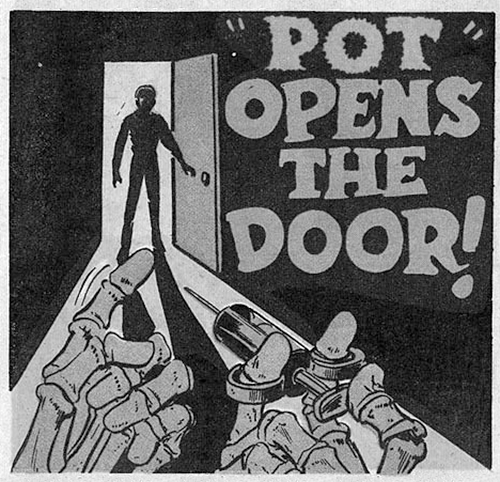
In 1937, Congress passed the Marihuana Tax Act which levied a tax of one dollar on anyone who dealt commercially in marijuana. The bill had been written using the slang term “marihuana” throughout, obscuring the fact that it covered the plant’s legitimate uses in medicine, where it was broadly known as cannabis and in the fiber industry as hemp. The Act did not itself criminalize their possession, but regulations and restrictions on the sale of cannabis as a drug had been around since the previous century.  In effect, the bill made it impossible for anyone to deal with call it what you will in any form.

     Conspiracy theorists maintained that business tycoons Andrew Mellon, Randolph Hearst, and the Du Pont family were behind passage of the Act as a way to reduce the size of the hemp industry. Hemp had became a very cheap substitute for the paper marijuana-propagandapulp that was used in the newspaper industry and as such was a threat to Hearst’s extensive timber holdings. Mellon had invested heavily in the Du Pont family’s new synthetic fiber nylon that was competing with hemp.  The campaign that Hearst’s newspapers had been staging against the dangers of the recreational use of the”powerful narcotic in which lurks MURDER! INSANITY! DEATH!” was therefore disingenuous. (‘Beware the evils of hemp’ didn’t quite cut it.   “Reading newspapers printed on hemp will lead to degradation and reading the New York Post.”)

     The legislation effectively killed the hemp industry and the medical use of cannabis, and the ensuing years of “reefer madness” completed its evolution to the abominable recreational drug it became through the rest of the century.

MARCH 16, 1963: PUFF YOUR OWN MAGIC DRAGON

Peter, Paul and Mary released the single, “Puff The Magic Dragon” in 1963. It became a big hit for the folk trio, peaking at number two on the pop charts in spite of its being banned by several radio stations whose management  figured that the song was about the illicit joys of smoking marijuana. The group denied this, saying: “It’s about a magic dragon named Puff.” “Puff” was followed by “Blowin’ in the Wind,” a song about trying to smoke pot on a stormy day, and “Leaving on a Jet Plane,” which is obviously a poorly disguised reference to getting high on the substance of your choice.

Davy, Davy Crockett

On this day eight years earlier, in 1955, “The Ballad of Davy Crockett,” by Bill Hayes, reached the number one spot on the pop music charts and stayed there for five weeks. The smash hit sold more than seven million records by several different artists. Coonskin caps were everywhere, and the words “born on a mountain top in Tennessee” on everyone’s lips – even though the next line “puffed a magic dragon when he was only three” was always bleeped.

Speaking of Substance Abuse:

Giving Up Smoking with Madame Zorene

I stood watching them — laughing young lovers, sitting on the bench, knees touching, talking conspiratorially.  Around them, lilacs and apple blossoms had burst into color, thanks to the fledgling warmth of spring.  As they puffed at long, sleek cigarettes, the exhaled smoke billowed lazily toward the blue sky.  There, sitting in the park, they created a richly satisfying tableau vivant, and I stood mesmerized as I contemplated descending upon them, ripping the cigarettes from their quivering lips and wildly puffing until my heart and lungs cried out in a tobacco-induced orgasm.  Instead, I popped a tiny square of nicotine gum into my mouth — it makes you burp and hallucinate yellow-toothed Doublemint twins — and stormed off.

People were meant to smoke, of course.  Why else tobacco?  A cigarette is tangible; a smoke-free environment hypothetical at best.  And cold turkey is just a dead bird defrosting for Thanksgiving.  Thus I reasoned, when I reached the store and demanded a pack of cigarettes, any brand, with or without filters, from the cowering clerk.  Back to the park, where I hastily lit a cigarette and let its mellowness caress my lungs.  I then smoked the entire pack, one cigarette after another.  It took me less than an hour.

Remorse naturally followed.  I cried out in anguish, bemoaned my weakness, condemned my cowardice — and I began to realize the hopelessness of my situation.  If I were ever to succeed in this quest –and doubts enveloped me — I needed a hired gun.

That evening, I let my fingers do the hobbling through the hypnosis section of the yellow pages.  The trusty phone book paraded before my anxious eyes a plethora of Ph.D.’s, licensed psychologists and certified hypnotherapists, any one of which, I found when phoning the following morning, would be happy to see me two weeks from now, three weeks from now, a month from now.  I had been decisive coming this far, and decisiveness is a fragile, short-lived thing.  I didn’t have that kind of time.

Then I found her.  She was neither psychologist nor hypnotherapist, but Madame Zorene would see me that evening.  I had my moments of doubt when she asked if I wanted her to put a curse on someone, but when I explained that I wanted to quit smoking through hypnosis, she seemed pleased.  “That’s good, too,” she said.

I chain-smoked on the way to my appointment with Madame Zorene, wondering if each cigarette might perhaps be my last.  Her office was tucked away in the back corner of a modern office complex.  I had feared that I would find her in an old shack in the middle of a bayou, although I was pretty certain there wasn’t a bayou within a thousand miles of here.  Upon opening the door, I faced her receptionist, and my fears returned.  A gaunt, colorless woman with stringy hair and sunken eyes, she had a vocabulary of three words:  “You pay first.”

But Madame Zorene herself was a pleasant surprise; a cheerful, chubby woman in her sixties, she smiled reassuringly and greeted me with a hearty handshake.  “Madame Zorene welcomes you,” she said as she opened a door and led me into her office.  “You are a brave man to attempt the smoking cessation.  Smoking is not good for your teeth or your lungs.  You will be happy when you quit.”  It sounded vaguely like a threat.

“Have a seat and relax yourself,” Madame Zorene continued.  “You must be relaxed.”

I settled into a comfortable chair facing her and tried my best to relax, but it wasn’t easy.  Staring at me over Madame Zorene’s left shoulder from the shelves at the other side of the small room was a human skull.  Several smaller skulls stood in a row next to it, each one staring.  On another shelf there were various jars in which dead toads and lizards were suspended in murky water.  There were no medical books, stethoscopes or sphygmomanometers, although there were masks, feathers and various powders.

“Are you a doctor or anything like that?” I asked.

“No, no.  Of course not.”

“What is your background?”

She saw that I was staring past her at her shelves.  “Ah, my little things, they upset you.  No need for you to worry.  I am a much experienced bokor.”

“A bokor?”

“Yes.  A bokor is a sorcerer in the voudun religion.”

“Voudun?”  I asked, growing steadily more anxious.  “Is that voodoo?”

Her eyes lit up and she grinned.  “Yes, yes.”

“And you do curses and things as well as smoking cessation?”

“Of course,” said Madame Zorene.  “But curses are not why we are here, are they?  Why don’t we start?  First I am going to give to you the great sleep.  Then I will lift from your body your ti bon ange.  That is one of your spirits.  I will talk to your ti bon ange, tell it that you no longer want to smoke.  Then when it returns to your body, it will guide you, so that you will no longer smoke.  Now you must relax.”

Madame Zorene stared at me, looked commandingly into my eyes, and began to speak softly in a language I didn’t recognize.  I wanted to turn away from her gaze, which was intimidating, not relaxing, to close my eyes, to stand, to run.  But I couldn’t move and I found myself growing drowsy,  the nagging worry that I would wake up a zombie growing steadily more distant.  I felt as though I were floating through a void.  I could hear Madame Zorene as she continued to talk, and someone answered her.  Was it me, my ti bon ange?

Then I was awake, and Madame Zorene was smiling at me, that same reassuring smile she had first greeted me with.  “Would you like a cigarette?” she asked, and in her smile I now saw the self-satisfaction.

“No, I don’t think so,” I answered truthfully.  I didn’t want one, and I don’t want one now.   I feel good, have no problems.  Well, I do have one problem — it’s odd, really.  The cat stares at me all the time, an evil, possessed stare.  I think it wants a cigarette.


MARCH 16, 1963: PUFF YOUR OWN MAGIC DRAGON

Peter, Paul and Mary released the single, “Puff The Magic Dragon” in 1963. It became a big hit for the folk trio, peaking at number two on the pop charts in spite of its being banned by several radio stations whose management  figured that the song was about the illicit joys of smoking marijuana. The group denied this, saying: “It’s about a magic dragon named Puff.” “Puff” was followed by “Blowin’ in the Wind,” a song about trying to smoke pot on a stormy day, and “Leaving on a Jet Plane,” which is obviously a poorly disguised reference to getting high on the substance of your choice.

Davy, Davy Crockett

On this day eight years earlier, in 1955, “The Ballad of Davy Crockett,” by Bill Hayes, reached the number one spot on the pop music charts and stayed there for five weeks. The smash hit sold more than seven million records by several different artists. Coonskin caps were everywhere, and the words “born on a mountain top in Tennessee” on everyone’s lips – even though the next line “puffed a magic dragon when he was only three” was always bleeped.

Speaking of Substance Abuse:

Giving Up Smoking with Madame Zorene

I stood watching them — laughing young lovers, sitting on the bench, knees touching, talking conspiratorially.  Around them, lilacs and apple blossoms had burst into color, thanks to the fledgling warmth of spring.  As they puffed at long, sleek cigarettes, the exhaled smoke billowed lazily toward the blue sky.  There, sitting in the park, they created a richly satisfying tableau vivant, and I stood mesmerized as I contemplated descending upon them, ripping the cigarettes from their quivering lips and wildly puffing until my heart and lungs cried out in a tobacco-induced orgasm.  Instead, I popped a tiny square of nicotine gum into my mouth — it makes you burp and hallucinate yellow-toothed Doublemint twins — and stormed off.

People were meant to smoke, of course.  Why else tobacco?  A cigarette is tangible; a smoke-free environment hypothetical at best.  And cold turkey is just a dead bird defrosting for Thanksgiving.  Thus I reasoned, when I reached the store and demanded a pack of cigarettes, any brand, with or without filters, from the cowering clerk.  Back to the park, where I hastily lit a cigarette and let its mellowness caress my lungs.  I then smoked the entire pack, one cigarette after another.  It took me less than an hour.

Remorse naturally followed.  I cried out in anguish, bemoaned my weakness, condemned my cowardice — and I began to realize the hopelessness of my situation.  If I were ever to succeed in this quest –and doubts enveloped me — I needed a hired gun.

That evening, I let my fingers do the hobbling through the hypnosis section of the yellow pages.  The trusty phone book paraded before my anxious eyes a plethora of Ph.D.’s, licensed psychologists and certified hypnotherapists, any one of which, I found when phoning the following morning, would be happy to see me two weeks from now, three weeks from now, a month from now.  I had been decisive coming this far, and decisiveness is a fragile, short-lived thing.  I didn’t have that kind of time.

Then I found her.  She was neither psychologist nor hypnotherapist, but Madame Zorene would see me that evening.  I had my moments of doubt when she asked if I wanted her to put a curse on someone, but when I explained that I wanted to quit smoking through hypnosis, she seemed pleased.  “That’s good, too,” she said.

I chain-smoked on the way to my appointment with Madame Zorene, wondering if each cigarette might perhaps be my last.  Her office was tucked away in the back corner of a modern office complex.  I had feared that I would find her in an old shack in the middle of a bayou, although I was pretty certain there wasn’t a bayou within a thousand miles of here.  Upon opening the door, I faced her receptionist, and my fears returned.  A gaunt, colorless woman with stringy hair and sunken eyes, she had a vocabulary of three words:  “You pay first.”

But Madame Zorene herself was a pleasant surprise; a cheerful, chubby woman in her sixties, she smiled reassuringly and greeted me with a hearty handshake.  “Madame Zorene welcomes you,” she said as she opened a door and led me into her office.  “You are a brave man to attempt the smoking cessation.  Smoking is not good for your teeth or your lungs.  You will be happy when you quit.”  It sounded vaguely like a threat.

“Have a seat and relax yourself,” Madame Zorene continued.  “You must be relaxed.”

I settled into a comfortable chair facing her and tried my best to relax, but it wasn’t easy.  Staring at me over Madame Zorene’s left shoulder from the shelves at the other side of the small room was a human skull.  Several smaller skulls stood in a row next to it, each one staring.  On another shelf there were various jars in which dead toads and lizards were suspended in murky water.  There were no medical books, stethoscopes or sphygmomanometers, although there were masks, feathers and various powders.

“Are you a doctor or anything like that?” I asked.

“No, no.  Of course not.”

“What is your background?”

She saw that I was staring past her at her shelves.  “Ah, my little things, they upset you.  No need for you to worry.  I am a much experienced bokor.”

“A bokor?”

“Yes.  A bokor is a sorcerer in the voudun religion.”

“Voudun?”  I asked, growing steadily more anxious.  “Is that voodoo?”

Her eyes lit up and she grinned.  “Yes, yes.”

“And you do curses and things as well as smoking cessation?”

“Of course,” said Madame Zorene.  “But curses are not why we are here, are they?  Why don’t we start?  First I am going to give to you the great sleep.  Then I will lift from your body your ti bon ange.  That is one of your spirits.  I will talk to your ti bon ange, tell it that you no longer want to smoke.  Then when it returns to your body, it will guide you, so that you will no longer smoke.  Now you must relax.”

Madame Zorene stared at me, looked commandingly into my eyes, and began to speak softly in a language I didn’t recognize.  I wanted to turn away from her gaze, which was intimidating, not relaxing, to close my eyes, to stand, to run.  But I couldn’t move and I found myself growing drowsy,  the nagging worry that I would wake up a zombie growing steadily more distant.  I felt as though I were floating through a void.  I could hear Madame Zorene as she continued to talk, and someone answered her.  Was it me, my ti bon ange?

Then I was awake, and Madame Zorene was smiling at me, that same reassuring smile she had first greeted me with.  “Would you like a cigarette?” she asked, and in her smile I now saw the self-satisfaction.

“No, I don’t think so,” I answered truthfully.  I didn’t want one, and I don’t want one now.   I feel good, have no problems.  Well, I do have one problem — it’s odd, really.  The cat stares at me all the time, an evil, possessed stare.  I think it wants a cigarette.


JUNE 15, 1937: REEFER MADNESS

In 1937, Congress passed the Marihuana Tax Act which levied a tax of one dollar on anyone who dealt commercially in marijuana. The bill had been written using the slang term “marihuana” throughout, obscuring the fact that it covered the plant’s legitimate uses in medicine, where it was broadly known as cannabis and in the fiber industry as hemp. The Act did not itself criminalize their possession, but regulations and restrictions on the sale of cannabis as a drug had been around since the previous century.  In effect, the bill made it impossible for anyone to deal with call it what you will in any form.

     Conspiracy theorists maintained that business tycoons Andrew Mellon, Randolph Hearst, and the Du Pont family were behind passage of the Act as a way to reduce the size of the hemp industry. Hemp had became a very cheap substitute for the paper marijuana-propagandapulp that was used in the newspaper industry and as such was a threat to Hearst’s extensive timber holdings. Mellon had invested heavily in the Du Pont family’s new synthetic fiber nylon that was competing with hemp.  The campaign that Hearst’s newspapers had been staging against the dangers of the recreational use of the”powerful narcotic in which lurks MURDER! INSANITY! DEATH!” was therefore disingenuous. (‘Beware the evils of hemp’ didn’t quite cut it.   “Reading newspapers printed on hemp will lead to degradation and reading the New York Post.”)

     The legislation effectively killed the hemp industry and the medical use of cannabis, and the ensuing years of “reefer madness” completed its evolution to the abominable recreational drug it became through the rest of the century.


face down in a cranberry bog, part 4:  the corpse returns

“Yoo hoo.” I turned and saw her standing in front of a thicket of heath, twenty yards beyond the bogs.

“Where is he?” I demanded when I reached her, even though it sounded as if I were getting a little possessive with this body. She was quite disheveled, as though – as though she’d dragged a body out of a cranberry bog.

“Back there, in the bushes.”

“Why?”

“After you left, I started thinking more clearly and realized that he can’t be found here. That would be terrible. I hope you’re not angry.”

“Angry? The Nantucket police chief thinks I’m a lunatic. And if anyone dies mysteriously on this island in the next ten years, I’m his number one suspect. Angry? Of course not.”

“Oooh, I’m sorry,” she wailed and unleashed her puppy dog eyes.

“Why can’t he be found here?”

“Because he’s supposed to be in Boston. It’s very complicated.”

“You had sex with a man who’s supposed to be in Boston on the edge of a Nantucket cranberry bog and he died and fell in so now he’s back there in the bushes. What’s complicated?”

She looked at me as though she still wasn’t sure I could be trusted even though I had aided and abetted every inch of her little crime other than the actual killing – and the sex, of course. Finally she spoke. “You didn’t recognize him, did you?” I was about to reply that we hadn’t met under ideal conditions. “He’s Alexander Farnsworth.”

“Alexander Farnsworth. The name’s not familiar, nor his face. Why would I recog – ?” I guess my mouth dropped open because she began to shake her head excitedly.

“No,” I said, as if my denial would make it not so, but now the face was familiar, too. “Not Secretary of State Alexander Farnsworth?”

“Yes. Everyone thinks he’s in Boston. But he’s been here for the past week having secret meetings with a Prince Somebody from somewhere important.”

“I thought he was here to fool around with someone in a cranberry bog.”

“That’s not very nice,” she snapped.

“Okay. How did the two of you happen to end up…?”

“I came to Nantucket with him. I work for him. This morning, he wanted to relax for a while so we took a walk and – well, you know the rest. Now you know why he can’t be here. It’s not just me. It’s national security stuff.”

“He’s no better off in those bushes than in the bog.”

“I know,” she said. “I’m going to take him back to Boston.”

“Oh boy.”

“I’ve made up my mind. I’ve got to do it. But I need your help again. Do you have a car?”

“I hope you’re not going to ask me to drive a dead man to Boston.”

“No, I wouldn’t do that.” Then she breathlessly explained to me how she herself was going to drive the dead Secretary of State first onto the ferry then to Boston in an official government vehicle which she would leave with him behind the wheel in the underground parking lot of an exclusive Boston hotel. My mind went a little numb as I listened to her plan and gazed into her conspiring eyes. When she stopped talking, I leaned forward and kissed her. She let me, but then pulled away. “Please,” she said. “Not now. Later, before I go to Boston.”

continued