February 24, 1942: The Bombs Bursting in Air

It had been less than three months since the Japanese attack on Pearl Harbor brought the United States into World War II, and tensions were running high.  And then on the evening of February 24, 1942, in Los Angeles, it appeared that we were being attacked once again.  The United States Navy responded with an anti-aircraft artillery barrage.  The resulting brouhaha lasted through the night with 1,400 shells fired until the Secretary of the Navy announced the end of the air raid.  He also admitted that the entire incident had been a false alarm, a case of “war nerves.”

The attacking force, it seems, was an errant weather balloon, and “once the firing started, imagination created all kinds of targets in the sky and everyone joined in.”  The incident was later derisively dubbed the “Battle of Los Angeles” or the “Great Los Angeles Air Raid.”

A Midsummer Night’s Prayer Meeting

“The Family Shakespeare — in which nothing is added to the original text,censored-shakespeare but those words and expressions are omitted which cannot with propriety be read aloud in a family. My great objects in this undertaking are to remove from the writings of Shakespeare some defects which diminish their value.”
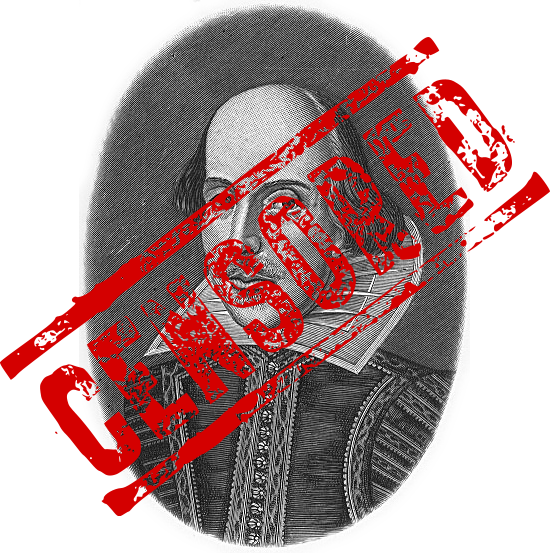
Thus read an introduction for the 1807 edition of Shakespeare’s works, finally made suitable for general audiences by Thomas Bowdler some 200 years after the Bard was safely buried. Certainly Shakespeare, were he alive, could not have objected to having the defects which diminished their value removed from his works. Shakespeare and family values — together at last.

Bowdler undertook this project, along with his sister Henrietta, thanks to childhood memories in which his father had entertained his family with readings from Shakespeare. Only later as an adult did Bowdler realize that his father had been leaving out some of the naughty parts of the plays, anything he felt unsuitable for the ears of his wife and children. Realizing that not all fathers were clever enough to censor on the spot, Bowdler decided it would be worthwhile to publish an edition which came already sanitized.

Shakespeare no doubt would have thanked Thomas Bowdler who joined him in the hereafter on February 24, 1827.

 

FEBRUARY 7, 1908: Been There, Done That

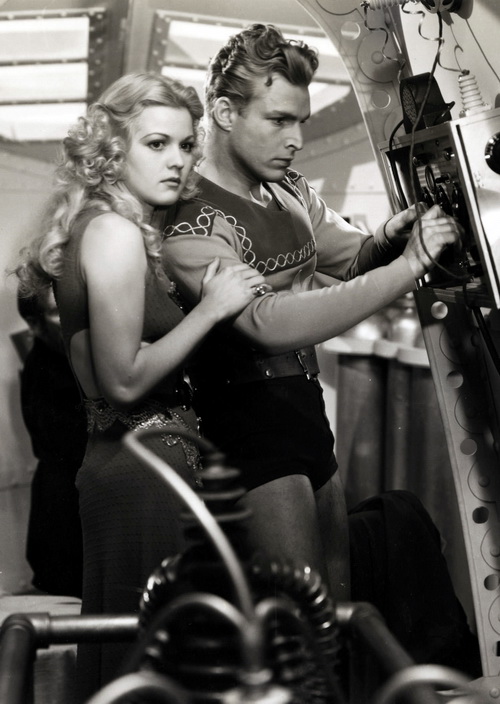
Not another man swinging through the trees in Africa wearing nothing but a loincloth.  Afraid so.  Athlete turned actor, Buster Crabbe (born Clarence Linden Crabbe II, on February 7, 1908), followed in Elmo Lincoln’s footsteps, starring as the ape man in Tarzan the Fearless, a 1933 serial that was later compiled into a full-length movie.  Crabbe dived into his movie career after winning Olympic gold for freestyle swimming in 1932.

Although he was Tarzan only once, passing his loincloth to Johnny Weissmuller, he played a variety of jungle men in movies such as King of the JungleJungle Man, and King of the Congo. When he wasn’t swinging in the jungle, he was speeding through for the far reaches of space as both Buck Rogers and Flash Gordon, taming the West as Billy the Kid and a posseful of other cowboy heroes, or Americanizing the French Foreign Legion His three Flash Gordon serials were Saturday morning staples in the 30s and 40s. The serials were also compiled into full-length movies. They appeared extensively on American television in the 1950s and 60s, and eventually were edited for release on home video.  As his acting career wound down, he became a spokesman for his own line of swimming pools. He died in 1983.

Imagine Jacob Marley in Chains and a Loincloth

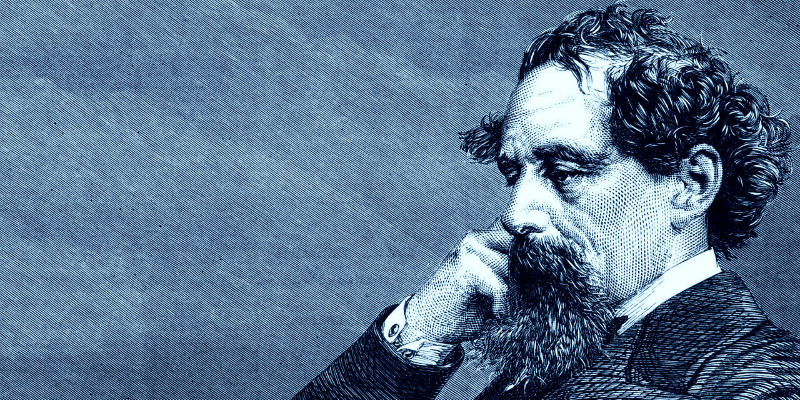
Little Charles Dickens knew the adversity he would later write so effectively about. Born February 7, 1812, he attended school in Portsmouth during his early years but was sent to work in a factory in 1824 at the age of 12, when his father was thrown into debtors’ prison. Dickens learned first-hand about the deplorable treatment of working children and the horrors of the institution of the debtors’ prison.

In his late teens, Dickens went to work as a reporter and soon began publishing humorous short stories. A collection of those stories was released in 1836 under the title Sketches by Boz (later titled The Posthumous Papers of the Pickwick Club). The stories about the quixotic innocent Samuel Pickwick and his fellow club members quickly became popular: 400 copies were printed of the first installment, but by the 15th episode the print run had reached 40,000. Publication of the stories in book form in 1837 established Dickens as the preeminent author of his time.

Oliver Twist followed in 1838 and Nicholas Nickleby in 1839. In 1841, Dickens visited the United States, where he was treated as a conquering hero. As a writer, he kept churning out major novels at almost a yearly pace each one seemingly more masterful than the last, among them: David Copperfield in 1850, Bleak House 1853, Hard Times 1854, A Tale of Two Cities 1859 and Great Expectations in 1861.

Dickens was the literary giant of his age, unparalleled in his realism, social criticism and humor, a master of characterization (think Fagin, the Artful Dodger, Pip, Uriah Heep, Oliver Twist, Tiny Tim and, of course, Ebenezer Scrooge). The 1843 novella that featured Scrooge, A Christmas Carol, is one of the most influential works ever written, still popular after 170 years and still inspiring adaptations in every artistic genre. Dickens even has his own adjective, Dickensian.

Dickens died in 1870 at the age of 58, leaving an enigmatic unfinished novel, The Mystery of Edwin Drood. He has been celebrated by statuary, in museums and even on currency — all against his dying wishes.


January 24, 1940: From This Valley They Say You Are Leaving

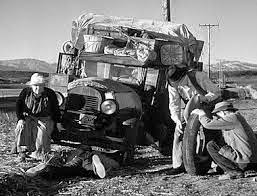
One of the greatest American films of all time, based on one of the greatest American novels of all time, premiered on January 24, 1940. John Ford’s The Grapes of Wrath based on the Pulitzer Prize novel, tells the story of the Joads who lose their Oklahoma farm during the 1930s Depression. They load everything they own into their 1926 Hudson and make a formidable journey across the United States in search of work.

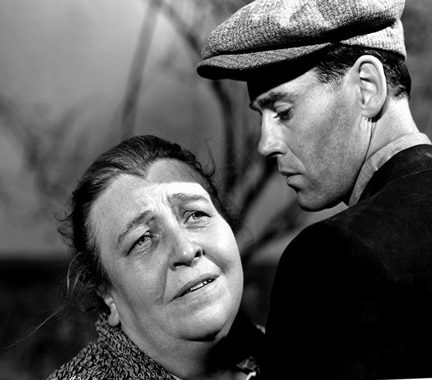
Memorable performances include Henry Fonda as Tom Joad, John Carradine as a preacher who’s “lost the spirit,” and the amazing Jane Darwell in an Oscar-winning portrayal of Ma Joad. It’s her words that conclude the film.

The book was written by John Steinbeck was born and grew up in Salinas, California, a part of the fertile region he would later call the Pastures of Heaven in a collection of short stories and the setting for many of his works. The Nobel-winning novelist was born in 1902.

steinbeckjohnHis first critical and commercial success was Tortilla Flat set in and around Monterey, California, and featuring a small band of ne’er-do-well paisanos living for wine and good times after World War I. The novel was a sort of rogue’s tale, full of rough and earthy humor. From here Steinbeck moved on to more serious portrayals of the economic problems facing the rural working class in the social novels for which he became known — In Dubious Battle in 1936, Of Mice and Men in 1937, and his most important work The Grapes of Wrath in 1939, the saga of America’s migrant workers.

Steinbeck’s California did not take kindly to his portrayal. His books were banned, and in his hometown, twice burned in public protests. In fact, his books were banned in schools and libraries throughout the country and continued to be well into this century. Steinbeck was one of the ten most banned authors from 1990 to 2004 (according to the American Library Association). The Grapes of Wrath and Of Mice and Men are both in the top ten banned books of all time.  They’re most likely being ripped from Florida bookshelves as we speak.  Along with Mickey Mouse

Later novels include Cannery Row, East of Eden, Travels with Charley,  and The Winter of Our Discontent. Steinbeck died in 1968.


December 30, 1865: You’re a Better Man Than I Am

On this the sixth day of Christmas True Love is back to his bird fixation with a gift of six geese a-laying — and presumably a-honking.  The sixth ghost of Christmas has prepared a thoughtful, if lengthy, power point presentation, vividly detailing every zit suffered by the adolescent Scrooge.

Rudyard Kipling was one of the most popular writers in England, in both prose and verse, in the late 19th and early 20th centuries Born in Bombay, India, on December 30, 1865, Kipling is best known for his works of fiction, especially The Jungle Book (a collection of short stories which includes “Rikki-Tikki-Tavi”), Just So Stories, Kim, “The Man Who Would Be King” and such poems as “Gunga Din,” “Mandalay,” and “The White Man’s Burden.” He is considered a major “innovator in the art of the short story,” and his children’s books have become true classics.

Kipling became synonymous with the concept of British “empire” and as a result his reputation fluctuated and his place in literary and cultural history inspired passionate disagreement during most of the 20th century.  Nevertheless, critics agree that he was a skilled interpreter of how empire was experienced.

Young Rudyard’s earliest years in Bombay were blissfully happy, in an India full of exotic sights and sounds. But at the age of five he and his sister were sent back to England, as was the custom, to be educated. In his autobiography, published 65 years later, Kipling recalled the stay with horror, and wondered ironically if the combination of cruelty and neglect he suffered from his foster family might not have hastened the onset of his literary life: “I have known a certain amount of bullying, but this was calculated torture—religious as well as scientific. Yet it made me give attention to the lies I soon found it necessary to tell: and this, I presume, is the foundation of literary effort.”

Kipling traveled extensively throughout the world, and his travels included a stay of several years in Brattleboro, Vermont, an unlikely spot in which to create The Jungle Book, although he did, along with Captains Courageous.

During his long career, he declined most of the many honors offered him, including a knighthood, the Poet Laureateship, and the Order of Merit, but in 1907 he accepted the Nobel Prize for Literature. He died in 1936 in England (even though a few years earlier he had written “Never again will I spend another winter in this accursed bucketshop of a refrigerator called England.”)

December 24, 1843: What a Delightful Boy

Published in 1843, it’s the figgy pudding of Christmas stories.  Don’t go until you get some.  Just one tasty scene for your merriness:

(Scrooge has been visited by the three ghosts on Christmas Eve, and he awakens the following morning.)

“I don’t know what day of the month it is!” said Scrooge. “I don’t know how long I’ve been alastair-sim-as-scrooge-at-windowamong the Spirits. I don’t know anything. I’m quite a baby. Never mind. I don’t care. I’d rather be a baby. Hallo! Whoop! Hallo here!”

He was checked in his transports by the churches ringing out the lustiest peals he had ever heard. Clash, clang, hammer, ding, dong, bell. Bell, dong, ding, hammer, clang, clash! Oh, glorious, glorious!

Running to the window, he opened it, and put out his head. No fog, no mist; clear, bright, jovial, stirring, cold; cold, piping for the blood to dance to; golden sunlight; heavenly sky; sweet fresh air; merry bells. Oh glorious, glorious!

“What’s today?” cried Scrooge, calling downward to a boy in Sunday clothes, who perhaps had loitered in to look about him.

“Eh?” returned the boy, with all his might of wonder.

“What’s today, my fine fellow?” said Scrooge.

“Today!” replied the boy. “Why, Christmas Day.”

“It’s Christmas Day!” said Scrooge to himself. “I haven’t missed it. The Spirits have done it all in one night. They can do anything they like. Of course they can. Of course they can. Hallo, my fine fellow?”

“Hallo!” returned the boy.

“Do you know the Poulterer’s, in the next street but one, at the corner?” Scrooge inquired.

“I should hope I did,” replied the lad.

“An intelligent boy!” said Scrooge. “A remarkable boy! Do you know whether they’ve sold the prize Turkey that was hanging up there? Not the little prize Turkey, the big one?”

“What, the one as big as me?” returned the boy.

“What a delightful boy!” said Scrooge. “It’s a pleasure to talk to him. Yes, my buck!”

“It’s hanging there now,” replied the boy.

“Is it?” said Scrooge. “Go and buy it.”

“Walk-er!” exclaimed the boy.

“No, no,” said Scrooge, “I am in earnest. Go and buy it, and tell ’em to bring it here, that I may give them the direction where to take it. Come back with the man, and I’ll give you a shilling. Come back with him in less than five minutes, and I’ll give you half-a-crown!”

The boy was off like a shot. He must have had a steady hand at a trigger who could have got a shot off half so fast.

“I’ll send it to Bob Cratchit’s!” whispered Scrooge, rubbing his hand, and splitting with a laugh. “He shan’t know who sends it. It’s twice the size of Tiny Tim. Joe Miller never made such a joke as sending it to Bob’s will be!”

scrooge1

scrooged-1988-3

December 19, 1732: The Nack and How To Get It

Filled with proverbs preaching positive virtues such as industry and prudence, Poor Richard’s Almanack debuted on this day in 1732 and was published yearly until 1757. It became one of the most popular publications in colonial America, selling an average of 10,000 copies a year. In addition to its homilies, the almanac offered seasonal weather forecasts, Heloise-style Poor_Richard's_Almanackhousehold hints, puzzles, and various other diversions.

Poor Richard, who was of course Benjamin Franklin, was modeled in part on Jonathan Swift’s Isaac Bickerstaff, a self-described philomath and astrologer who in a series of letters in 1708 and 1709, poked fun at and even predicted the imminent death of another astrologer and almanac maker,  John Partridge. Franklin’s Poor Richard followed suit and, in a running joke in the early editions, predicted and falsely reported the deaths of contemporary astrologers and almanac makers.

Poor Richard’s Almanack extolled a list of 13 virtues to live by – temperance, silence, order, resolution, frugality, industry, sincerity, justice, moderation, cleanliness, tranquility, chastity, and humility – although there’s no evidence that Franklin personally tried to practice any of them. (Wretched Richard subscribes to every one of them.)

Reflecting on Franklin and his almanac, James Russell Lowell wrote that Franklin: “was born in Boston, and invented being struck with lightning and printing and the Franklin medal, and that he had to move to Philadelphia because great men were so plenty in Boston that he had no chance, and that he revenged himself on his native town by saddling it with the Franklin stove, and that he discovered the almanac, and that a penny saved is a penny lost, or something of the kind.”

A sample of Poor Richard’s wisdom:

Three may keep a secret, if two of them are dead.

There cannot be good living where there is not good drinking.

Any society that will give up a little liberty for a little security will deserve neither and lose both.

With the old Almanack and the old Year,
Leave thy old Vices, tho ever so dear.

Fish and visitors stink after three days.

There are more old drunkards than old doctors.

dave-barry5

December 16, 1775: Me Mark, You Jane

Jane Austen, born on December 16, 1775, was a British novelist who wrote of life among England’s landed gentry from the vantage point of being on its outskirts aspiring to be closer in. The concept of gentry is a British foible pretty much disdained by Americans who exist way on its outskirts and secretly aspire to be closer in. (Shut out entirely, early Americans misbehaved with childish pranks such as dumping the grown-ups’ tea in Boston Harbor on this day in 1773).

Basically the gentry (celebrated in a 1940s popular song “Dear Hearts and Gentry People”) were the aristocracy (the haves, the one percent), and Jane Austen’s novels are lousy with them. Jane Austen herself almost married into the thick of it but the fact that the gentleman was a super-sized oaf, both homely and ill-mannered, gave her pause, cold feet, or perhaps writer’s block.

Austen was not wildly popular as a writer during her lifetime – in fact, her greatest popularity seems to have come with the 21st century. Her first novel Lazy Susan became a household word in the 1950s, thanks to the spinning serving dish that bears its name. Other novels had doubled-up attributes such as Pride and Prejudice, Sense and Senility, and Lust and Loquaciousness, except for those that didn’t, Mansfield Park and Northanger Abbey.

Mark Twain was one of Austen’s biggest fans:

“Jane Austen? Why I go so far as to say that any library is a good library that does not contain a volume by Jane Austen. Even if it contains no other book.”

“Jane is entirely impossible. It seems a great pity that they allowed her to die a natural death.”

“Every time I read ‘Pride and Prejudice’ I want to dig her up and beat her over the skull with her own shin-bone.”

December 6, 1882: The Postman Always Writes Twice

Born in 1815, Anthony Trollope had a successful career as one of the most prolific English novelists of the Victorian era. Some of his best-loved works, collectively known as the Chronicles of Barsetshire, revolve around the imaginary county of that name. He also wrote novels on political, social, and gender issues, and on other topical matters. He simultaneously enjoyed a successful career with the General Post Office.

This dual career makes Trollope a role model for would-be writers everywhere.

Trollope’s postal career began somewhat ignominiously in 1834 as a postal clerk, and the first seven years of his official life, during which he gained a reputation for unpunctuality and insubordination, were, according to him, “neither creditable to myself nor useful to the public pillarservice.”

A move to Ireland altered his postal career and began his writing career.

Given a fresh start, Trollope became a model employee. And, having decided to become a novelist, he began writing on the numerous long trips around Ireland his postal duties required. Writing on a rigid schedule from 5 a.m. To 8 a.m. every day, his output was prodigious. He wrote his earliest novels during this time, occasionally dipping into the “lost-letter” box for ideas.

In 1851, Trollope returned to England to reorganize rural mail delivery in southwestern England and southern Wales. The two-year mission took him over much of Great Britain, often on horseback. Trollope describes this time as “two of the happiest years of my life”.

During these travels, he conceived the plot of The Warden, the first of the six Barsetshire novels. The novel was published in 1855, bringing him to the attention of the novel-reading public. He immediately began work on Barchester Towers, the second Barsetshire novel and probably his best-known work. Trollope ‘s postal career was also going well.  By the mid-1860s, he had reached a senior position within the Post Office. He made postal history with his introduction of the pillar box, the ubiquitous bright red mail-box, thousands of which were found in the United Kingdom and throughout the British Empire of the time.

Trollope also aspired to a political career; he had long dreamed of a seat in the House of Commons. He agreed to become a Liberal candidate, and in the election of 1868, he finished number four of four candidates. Trollope called his short-lived dip into political waters “the most wretched fortnight of my manhood”.

Trollope died on December 6, 1882, having written 47 novels as well as numerous short stories, nonfiction works and plays – three hours a day, every day.

OCTOBER 15, 1954: I HAVE PEOPLE TO FETCH MY STICKS

Long before he debuted in his own television show on October 15, 1954, Rin Tin Tin had become an international celebrity. It was as good a rags-to-riches story as Hollywood could churn out. He was rescued rin-tin-tin_from a World War I battlefield by an American soldier who trained him to be an actor upon returning home. He starred in several silent films, becoming an overnight sensation and going on to appear in another two dozen films before his death in 1932.

Rinty (as he was known to his friends) was responsible for a great surge in German Shepherds as pets. The popularity of his films helped make Warner Brothers a major studio and pushed a guy named Darryl F. Zanuck to success as a producer.

During the following years Rin Tin Tin Jr. and Rin Tin Tin III kept the Rin Tin Tin legacy alive in film and on the radio. Rin Tin Tin IV was slated to take the franchise to television in The Adventures of Rin Tin Tin, but he flunked his screen test and was shamefully replaced by an upstart poseur named Flame.

The TV series featured an orphan named Rusty who was being raised by soldiers at a cavalry post known as Fort Apache.  Rin Tin Tin was the kid’s dog. It was a low budget affair, filmed on sets used for other productions with actors frequently called upon to play several soldiers, Apaches, and desperadoes in a single episode. Although it was children’s programming, you might not guess that by the lofty literary titles of many episodes: Rin Tin Tin Meets Shakespeare, Rin Tin Tin and the Barber of Seville, Rin Tin Tin and the Ancient Mariner, Rin Tin Tin and the Connecticut Yankee.

Meanwhile, IV stayed at home on his ranch, fooling visitors into believing he was actually a TV star (and perhaps contemplating a run for President).

Rated P. G.

“Freddie experienced the sort of abysmal soul-sadness which afflicts one of Tolstoy’s Russian peasants when, after putting in a heavy day’s work strangling his father, beating his wife, and dropping the baby into the city’s reservoir, he turns to the cupboards, only to find the vodka bottle wodehouseempty.” One line from someone who had a great knack for them, which he displayed in over 300 stories, 90 books, 30 plays and musicals, and 20 film scripts. Comic novelist P.G. Wodehouse, creator of Jeeves the butler, was born on this day in 1881 in Surrey, England.

He had the look of one who had drunk the cup of life and found a dead beetle at the bottom.

Mike nodded. A sombre nod. The nod Napoleon might have given if somebody had met him in 1812 and said, “So, you’re back from Moscow, eh?”

I could see that, if not actually disgruntled, he was far from being gruntled.

She looked as if she had been poured into her clothes and had forgotten to say ‘when.’

The fascination of shooting as a sport depends almost wholly on whether you are at the right or wrong end of the gun.

Every author really wants to have letters printed in the papers. Unable to make the grade, he drops down a rung of the ladder and writes novels.

It was my Uncle George who discovered that alcohol was a food well in advance of modern medical thought.

And she’s got brains enough for two, which is the exact quantity the girl who marries you will need.

At the age of eleven or thereabouts women acquire a poise and an ability to handle difficult situations which a man, if he is lucky, manages to achieve somewhere in the later seventies.

SEPTEMBER 13, 1916: A TALE OF TWO CHOCOLATE FACTORIES

When Roald Dahl’s mother offered to pay his tuition to Cambridge University, Dahl said: “No thank you. I want to go straight from school to work for a company that will send me to wonderful faraway places like Africa or China.” And Dahl born on September 13, 1916, did go to wonkafaraway places — Newfoundland, Tanzania, Nairobi, and Alexandria, Egypt, where as a fighter pilot a plane crash left him with serious injuries.

Following a recovery that included a hip replacement and two spinal surgeries, Dahl was transferred to Washington, D.C., where he met author C.S. Forrester, who encouraged him to start writing. His becoming a writer was a “pure fluke,” he said. “Without being asked to, I doubt if I’d ever have thought to do it.”

Dahl wrote his first story for children, The Gremlins, in 1942, for Walt Disney, coining the word. He didn’t return to children’s stories until the 1960s, winning critical and commercial success with James and the Giant Peach and Charlie and the Chocolate Factory. Other popular books include Fantastic Mr. Fox (1970), The Witches (1983) and Matilda (1988).

Despite his books’ popularity, some critics and parents have have taken him to task for their portrayal of children’s harsh revenge on adult wrongdoers. In his defense, Dahl claimed that children have a cruder sense of humor than adults, and that he was simply trying to satisfy his readers.  Charlie and the Chocolate Factory was filmed twice, once under its original title and once as Willy Wonka & the Chocolate Factory.

Dahl died in 1990 and was buried with his snooker cues, an excellent burgundy, chocolates, pencils and a power saw. Today, children continue to leave toys and flowers by his grave

Chocolate for the Masses

hersheyAnother really big name in chocolate was born on September 13, 1857. After a few years dabbling in caramel, Milton Snavely Hershey became excited by the potential of milk chocolate, which at that time was a luxury. Hershey was determined to develop a formula for milk chocolate and that he could sell to the mass market. He produced his first Hershey Bar in 1900, Hershey’s Kisses in 1907, and the Hershey’s Bar with almonds was in 1908. Willie Wonka created a chocolate factory; Milton Hershey created a chocolate empire with its own town, Hershey, Pennsylvania.

Researchers have discovered that chocolate produces some of the same reactions in the brain as marijuana. The researchers also discovered other similarities between the two but can’t remember what they are. ~ Matt Lauer