December 4, 1872: Took a Trip on a Sailing Ship

Was the Mary Celeste a cursed ship? Three owners of the brigantine built in Nova Scotia in 1861 didn’t fare so well; they all died during voyages. The ship also suffered a damaging fire and a collision in the English Channel. But it was the voyage from New York harbor headed for Genoa, Italy in November 1872 that is the stuff of legends.

On December 4, 1872, the Dei Gratia, a small British brig spotted the Mary Celeste, sailing marycerratically but at full sail near the Azores Islands in the Atlantic Ocean. The captain and crew of the Dei Gratia boarded the ship. The ship was seaworthy although its sails were slightly damaged and there was some water in the hold. Its cargo of 1,700 barrels of crude alcohol was mostly untouched.  Six months’ worth of food and water remained on board, and the crew’s personal belongings were still in place, including valuables. But the ten persons who had been aboard the Mary Celeste had vanished.

The Mary Celeste had sailed into nautical history as one of its most tantalizing mysteries, a classic ghost ship.

Through the years, a dearth of hard facts has created endless speculation and a host of theories as to what might have taken place. Mutiny? Piracy? Killer waterspouts? Just a few of the least bizarre explanations. In an 1884 short story, Arthur Conan Doyle suggested a capture by a vengeful ex-slave. A 1935 movie featured the irrepressible Bela Lugosi as a homicidal sailor killing off the other passengers.


The more logical speculators agree that for unknown reasons, the ten passengers (the captain, his wife and daughter, and seven crew members) abandoned the ship in the ship’s lifeboat (which was missing) and disappeared at sea. Hardcore conspiracy theorists are having none of that; they’re sticking with the Bermuda Triangle, sea monsters, and the ever-popular alien abductions.

The Mary Celeste, lived to sail another day, but presumably the curse remained. Her last owner intentionally wrecked her off the coast of Haiti in 1885 in an unsuccessful attempt at insurance fraud.


November 28, 1922: Ghost Writers in the Sky

It didn’t take long after the advent of flying for crafty marketing types to come up with a way to use it for advertising.   Skywriting was the way showing the most promise: a small airplane spits out magic smoke during a flight, creating text able to be read by someone on the ground.sky Messages naturally run the gamut from the inane to the weighty. Advertisers had a field day.

The first use of skywriting for advertising came on November 28, 1922, when Captain Cyril Turner of the Royal Air Force flew over New York City, spelling out, “Hello USA. Call Vanderbilt 7200.” Within just a few hours, 47,000 people had done just that. And of course operators were standing by at Vanderbilt 7200 to take their orders although no one had any idea what was being sold.

Pepsi-Cola became the first major brand to use skywriting as a medium to reach a mass market with thousands of flights through the 1930s into the mid-1940s. During the following years, skywriting became more sophisticated with the use of coordinated flights by fleets of planes that could deliver longer and more clearly written text messages.

At one point, rumor has it, an ambitious skywriter produced Pride and Prejudice in its entirety, but most observers fell asleep during the first three paragraphs.

November 6, 1982: Antifreeze and Old Lace

In Arsenic and Old Lace, a delightfully dark stage play adapted into a movie by Frank Capra, Mortimer Brewster (Cary Grant) has an eccentric family that includes two brothers – one of whom thinks he’s Theodore Roosevelt digging the Panama Canal in the basement, the other a killer who’s had plastic surgery to make him look like Boris Karloff – and two spinster aunts who have taken to murdering lonely old men by poisoning them with home-made elderberry wine laced with arsenic, strychnine, and “just a pinch” of cyanide. Generally, poisoners aren’t as sweet as these two old ladies.

Take the case of Shirley Allen, arrested on November 6, 1982, charged with murdering her sixth husband Lloyd. Shirley certainly wasn’t as sweet as the two old ladies, nor nearly as successful. Her first attempt at poisoning was believed to be an early husband, Joe Sinclair, back in 1968. When his coffee began to taste odd, he didn’t buy the idea that it was the newest flavor of the month, reasoning that Juan Valdez Free Trade Almond Praline Decaf should not give him internal injuries.  Joe went to the police, but no charges were filed. He filed for divorce, however.

Another husband, John Gregg, was not so lucky. He died a year after he married Shirley. He must have sensed that something was amiss because he changed the beneficiary of his insurance policy shortly before he died. Shirley got nothing. As you might guess, she was miffed. A pink-haired, large-bosomed barfly was rather happy, however.

Lloyd Allen was Shirley’s sixth husband. He began to complain of a strange taste in his beer. When Shirley said that it was an iron supplement that would put a tiger in his tank, Lloyd believed her and promptly died. This time she was named as beneficiary of a $25,000 life insurance, but alas her daughter told police about the doctored beers. Toxicology reports confirmed that Lloyd’s body tissue contained a lethal amount of ethyl glycol – antifreeze. Shirley went to prison for life. She was never allowed to work in the prison cafeteria.


OCTOBER 31, LONG AGO: THE DEVIL MADE HIM DO IT

One might assume that the carving of jack-o’-lanterns was a clever promotion by the Association of Pumpkin Growers because there just weren’t enough pumpkin pies being eaten in this world. But as it turns out, folks have been making jack-o’-lanterns at Halloween for centuries. And that there’s a proper legend to explain the practice.

It all started with an Irish fellow called Stingy Jack. In addition to being cheap, Jack was a drunkard and a ne’er-do-well. During one of Jack’s benders, the Devil came calling on him with every intention of claiming his miserable soul. As a last request, Jack asked the Devil to have a  drink with him. (It’s a relief to learn the Devil drinks; Hell might not be so bad after all.)

Naturally, Stingy Jack being Stingy Jack had no intention of paying for the drinks, so he convinced the Devil to turn himself into a coin that Jack could use to buy their drinks, and the Devil agreed. (It would appear that the Devil is not the brightest candle in Hell.) Once the Devil had changed himself into a coin, Jack stuffed him into his pocket next to a crucifix, which prevented the Devil from changing back into his original form. Jack, now having all the chips in this game, agreed to free the Devil, on the condition that he would not bother Jack for ten years and that, should Jack die during this time, he would not claim his soul. (Jack wasn’t all that shrewd either.)

Drunkenness tends to make time fly, and before Jack knew it, ten years had passed.   And the Devil, ever prompt, came calling for Jack’s soul once again. And no last drink this time, the Devil said. Then perhaps just one small apple before I go, Jack begged. The Devil acquiesced. Jack lamented that he was in no condition to climb the apple tree, and would the Devil be so kind as to fetch the apple for him? (The Devil is a lot like Charlie Brown and his football. You’d think, being the Evil One, he wouldn’t be so trusting.) So the Devil climbed the tree, and while he was up in the tree, Jack carved a sign of the cross into the tree’s bark. To earn his release this time, the Devil agreed never to take Jack’s soul.

Wouldn’t you know, little time passed before Jack turned up his toes. Jack’s soul foolishly made it’s way toward Heaven where everyone had a good laugh before telling him to get lost. Then Jack journeyed to the Gates of Hell where the Devil, finally wise to Jack’s tricks,  also sent him packing —  to roam the world between good and evil, with only a burning ember inside a hollowed out turnip to light his way.  Jack of the Lantern. Obviously, the Association of Turnip Growers botched this one. Had they been on their toes, we’d all be celebrating Halloween with carved-out rutabagas.


halloween

OCTOBER 30, 1938: JUST ME AND MY RADIO

It’s easy from the comfort of our 21st century recliners to dismiss the mass hysteria of an earlier generation as so many Chicken Littles or Turkey Lurkeys, afraid of their own shadows. We’ve seen it all, any horror one can imagine, right there on the screen in front of us, and should it become too squirmy, well we can always just hit a button. The remote is there to protect us.

But what if you were at home, alone perhaps, on that October night back in 1938. It’s dark out; Halloween and all its spookiness is just a day away. But there’s the radio to keep you company. Like millions of other Americans, you’ll tune in to Edgar Bergen and Charlie McCarthy. That should lighten up a dark night. They finish their comedy routine at ten after eight. A singer you’ve never heard of follows so, like millions of Americans, you surf the radio stations (Wasn’t there supposed to be a dramatic program on?) pausing to hear an unenthusiastic announcer: “. . . the Meridian Room in the Hotel Park Plaza in downtown New York, where you will be entertained by the music of Ramon Raquello and his orchestra.” You listen for a minute; it’s not that great. You’re all set to surf again when the announcer interrupts, reporting that a Professor Farrell of the Mount Jenning Observatory has detected explosions on the planet Mars. The music returns, but only for a minute. The announcer is back with the news that a large meteor has crashed into a farmer’s field in Grovers Mills, New Jersey.

Now your ears are glued to the radio, as announcement after announcement confirms the impossible – a Martian invasion. “Good heavens, something’s wriggling out of the shadow like a gray snake. Now here’s another and another one and another one. They look like tentacles to me … I can see the thing’s body now. It’s large, large as a bear. It glistens like wet leather. But that face, it… it … ladies and gentlemen, it’s indescribable. I can hardly force myself to keep looking at it, it’s so awful. The eyes are black and gleam like a serpent. The mouth is kind of V-shaped with saliva dripping from its rimless lips that seem to quiver and pulsate.”

Now’s the time to surf the radio. If you do, you’ll quickly realize that everything is normal on other radio stations, that you’ve been listening to a realistic but fictional radio drama. But if you don’t, chances are you’ll join the thousands of people jamming highways, trying to flee the alien invasion.

Orson Welles was just 23 years old when his Mercury Theater company broadcast its update of H.G. Wells’ War of the Worlds with no idea of the uproar it would cause. He employed sophisticated sound effects and top notch acting to make the story believable.

And believed it was. In Indianapolis, a woman ran into a church where evening services were being held, yelling: “New York has been destroyed! It’s the end of the world! Go home and prepare to die!”

When the actors got wind of the panic, Welles went on the air as himself to remind listeners that it was just fiction. Afterward, he feared that the incident would ruin his career, but three years later he was in Hollywood working on Citizen Kane.

OCTOBER 11, 1983: DON’T YANK THE CRANK

The title refers to a movement that took place in Maine back in 1981. Movement is probably a pretty strong word for laid-back Maine where crankdemonstrators tend not to get worked up into a chanting frenzy over things. And even less so in a sleepy little town like Woodstock whose population squeaked by 1,200 a couple of years ago.

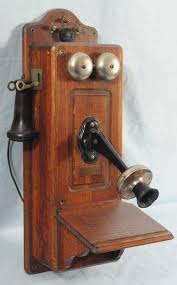
Bryant Pond is Woodstock’s largest settlement and as much of an urban center as you’re likely to find. It captured its fifteen minutes of national fame and media attention during the mid1970s when its family-owned Bryant Pond Telephone Company became the last telephone exchange in the United States to use hand-cranked phones. Then in 1981, the two-position magneto switchboard in the living room of the owners was purchased by the Oxford County Telephone & Telegraph Company, a larger company in the Maine neighborhood. The Bryant Pond Telephone Company was swallowed like so many krill off the shores of Maine.

Two Bryant Pond residents started the “Don’t Yank The Crank” movement to save their crank telephones, financed by the sale of tee shirts – a valiant effort but nonetheless futile. At a meeting in the local school gymnasium warmed by a wood stove, townsfolk spoke out. “We have the oldest pay station in the United States,” said one resident, either complaining or bragging. “You put in a nickel and wind it up.” “You are a person instead of a number.” And did they mention no robocalls?

Alas, to no avail. The last “crank calls” took place on October 11, 1983, and the beloved telephones slipped into history like so much Americana.

Just Put Your Lips Together

Harry “Steve” Morgan and his alcoholic sidekick, Eddie, are a couple of ne’er-do-wells crewing a boat for hire on the island of Martinique. to_have_and_have_not_1944_film_posterLife is okay, but World War II is happening all around them, doing a number on the tourist trade and thus their livelihood. Howard Hawks’ film To Have and Have Not which premiered in New York on October 11, 1944, was notable for bringing together what would become one of Hollywood’s hottest couples, Humphrey Bogart and Lauren Bacall.

The film takes the title from the book by Ernest Hemingway but not much else. Hawks was a Hemingway fan but thought this particular book was a “bunch of junk.” Even so, Hemingway worked with Hawks on the screenplay, in which Bogart once again gives up his professed neutrality in the war to thwart the Nazis. The plot is well thickened by the stormy relationship between Bogart and Bacall who plays Slim, a saucy singer in the club where Morgan drinks away his days.

Another notable member of the cast is Hoagy Charmichael who appears as the club piano player, Cricket. He and Bacall perform several Charmichael songs: “How Little We Know,” “Hong Kong Blues,” and “The Rhumba Jumps.” Bacall does her own singing, even though persistent rumors would have a 14-year-old Andy Williams singing for her.

The most memorable take away from the film is one line of dialogue delivered seductively by Bacall: “You know how to whistle, don’t you, Steve? You just put your lips together and . . . blow . . .”

AUGUST 28, 1963: I HAVE A DREAM

In Washington DC, on  August 28, 1963, Martin Luther King, Jr. spoke to a crowd stretching from the Lincoln Memorial to the Washington Monument.

“Go back to Mississippi, go back to Alabama, go back to South Carolina, go back to Georgia, go back King_Jr_Martin_Luther_093.jpgto Louisiana, go back to the slums and ghettos of our northern cities, knowing that somehow this situation can and will be changed. Let us not wallow in the valley of despair.”

I have a dream that one day this nation will rise up and live out the true meaning of its creed: ‘We hold these truths to be self-evident: that all men are created equal.’ I have a dream that one day on the red hills of Georgia the sons of former slaves and the sons of former slave-owners will be able to sit down together at the table of brotherhood. I have a dream that one day even the state of Mississippi, a state sweltering with the heat of injustice, sweltering with the heat of oppression, will be transformed into an oasis of freedom and justice. I have a dream that my four little children will one day live in a nation where they will not be judged by the color of their skin but by the content of their character. I have a dream today.”

“When we allow freedom to ring, when we let it ring from every village and every hamlet, from every state and every city, we will be able to speed up that day when all of God’s children, black men and white men, Jews and Gentiles, Protestants and Catholics, will be able to join hands and sing in the words of the old Negro spiritual, ‘Free at last! Free at last! Thank God Almighty, we are free at last!'”


Part of that is when they try and demean me unfairly, because we had a massive crowd of people. We had a crowd… I looked over that sea of people, and I said to myself, ‘wow’, and I’ve seen crowds before. Big, big crowds. That was some crowd. — Donald Trump

AUGUST 23, 1618: THIS LITTLE PIG HAD ROAST BEEF

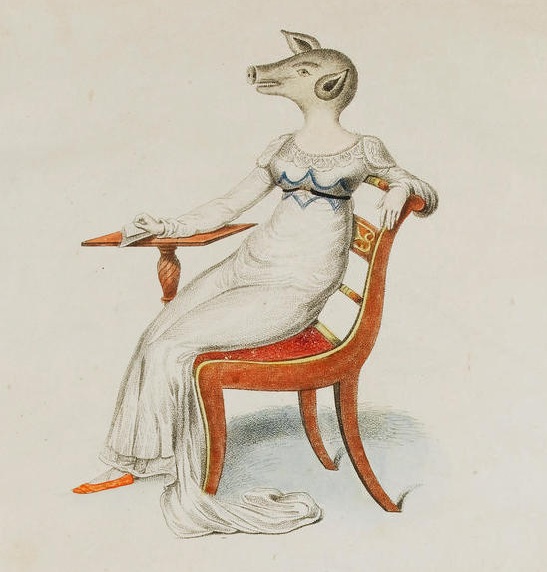
There is no dearth of stories in the realm of pig-faced lady literature; a 17th century Dutch account typifies the genre. This particular pig-faced lady was born at Wirkham on the Rhine in 1618. Her name was Tanakin Skinker. Miss Skinker was a near perfectly formed little girl – one might say beautifully constructed – except that her face (some say her entire head) was that of a swine. She was a dead ringer for a pig.

     The child grew to be a woman and a source of great discomfort to her parents, for although her disposition and carriage were in general unoffending, her table manners fell a bit short of those desirous in a lady. Her voracious and indelicate appetite was appeased by placing large amounts of food in a silver trough to which she would vigorously apply her entire face, accompanied by grunts, snorts and squeals. The maid who served her had to be paid handsomely for enduring this and risking her limbs to the wildly snapping jaws.

     A fortune awaited the man who would consent to marry Miss Skinker, and many suitors came calling, gallants from Italy, France, Scotland, and England – fortune hunters all, naturally – but ultimately they all refused to marry her. Were there no pig-faced men in the world?  Or even a dog-faced boy?  Apparently not, at least not one who saw himself as such.

     In this particular account, our pig-faced lady was sadly left to die an old maid (or sow, if you prefer). Other accounts have happier, if less likely, conclusions. The woman’s pig-like appearance was the result of witchcraft.  A husband was found, and he was granted the choice of having her appear beautiful to him but pig-like to others, or pig-like to him and beautiful to others. When the husband told her that the choice was hers, the enchantment was broken and her pig-like appearance vanished. And in some modern accounts, the pig-faced lady is abducted by aliens.


AUGUST 3, 1946: Beat the Rush, Talk to Santa in August

Louis J. Koch, an Indiana family man and father of nine children, was disappointed when a family trip took him to Santa Claus, Indiana, and he found no Santa Claus, no elves, no reindeer, no workshop –  Indiananothing. Why they named the place Santa Claus was a bit of a mystery.  And he fixated upon the town named Santa Claus that had no Santa Claus, and upon the many children who would suffer the same disappointment. Lying in bed at night perhaps (or working on a third martini), he envisioned a park where children could have fun and visit Santa all year round.

     And he did something about it.  Santa Claus Land opened on August 3, 1946. At no cost, children could visit Santa, a toy shop, toy displays, a restaurant, and themed children’s rides, such as The Freedom Train. Though skeptical, Koch’s son Bill took over as head of Santa Claus Land and continued to add to the park, including the first Jeep-Go-Round ever manufactured, a new restaurant, and a deer farm.

     And it continued to grow, evolving into a huge theme park divided into sections celebrating Christmas, Halloween, Thanksgiving and the Fourth of July with rides, live entertainment, games, and attractions, including three wooden roller coasters: The Raven, The Legend, and The Voyage. Just how many times could a kid throw up in one day? Then came the obligatory water park featuring the world’s two longest water coasters: Wildebeest and Mammoth, slides, pools, a river, and water-play attractions. Whew!

Of course, all of this became too much for a place called Santa Claus Land. Today it goes by the name Holiday World & Splashin’ Safari.  And good luck finding Santa Claus.


JULY 8, 1898: SQUEAKY CLEAN IN SKAGWAY

Soapy Smith, “king of the frontier con men” died in a gunfight celebrated as the Shootout on Juneau Wharf on the evening of July 8, 1898. His last words, while not particularly memorable and certainly not effective, were nevertheless appropriate to the situation: “My God, don’t shoot!”

Soapy’s career began soon after the death of his mother in Fort Worth, Texas. He formed a highly disciplined cadre of ne’er-do-wells to work for him, and rose rapidly to criminal super stardom. He built three major evil empires: in Denver, Colorado, from 1886 to 1895); Creede, Colorado in 1892; and Skagway, Alaska, from 1897 to 1898. It was in Skagway that he finally made his dramatic exit.

Starting off with small-time cons such as three-card monte and shell games, he eventually employed the big con that gave him his nickname. On a busy street corner, Smith would go into an ordinary sales pitch extolling the wonders of his soap cakes. But he proceeded to wrap money around the cakes of soap – ones, tens, a hundred dollar bill.   He then wrapped plain paper around them to hide the money.

He mixed the money-wrapped packages with bars containing no money and began selling the soap for a dollar a cake. Immediately, one of his shills would buy a bar, tear it open, and begin waving around the money he had supposedly won.  People began buying soap, usually several bars. Every few minutes, someone would shout that he had won, always a confederate. Eventually, Smith would announce that the hundred-dollar bill remained unpurchased and began auctioning off the remaining soap bars to the highest bidders. Naturally, the only money was “won” by members of the gang.

Smith used this swindle successfully for twenty years. The proceeds from this scam and others gave him the money to pay graft to police, judges, and politicians, and live as a somewhat shady swell until his comeuppance on the Juneau Wharf at the hand of a man he had cheated.