AUGUST 28, 1963: I HAVE A DREAM

In Washington DC, on  August 28, 1963, Martin Luther King, Jr. spoke to a crowd stretching from the Lincoln Memorial to the Washington Monument.

“Go back to Mississippi, go back to Alabama, go back to South Carolina, go back to Georgia, go back King_Jr_Martin_Luther_093.jpgto Louisiana, go back to the slums and ghettos of our northern cities, knowing that somehow this situation can and will be changed. Let us not wallow in the valley of despair.”

I have a dream that one day this nation will rise up and live out the true meaning of its creed: ‘We hold these truths to be self-evident: that all men are created equal.’ I have a dream that one day on the red hills of Georgia the sons of former slaves and the sons of former slave-owners will be able to sit down together at the table of brotherhood. I have a dream that one day even the state of Mississippi, a state sweltering with the heat of injustice, sweltering with the heat of oppression, will be transformed into an oasis of freedom and justice. I have a dream that my four little children will one day live in a nation where they will not be judged by the color of their skin but by the content of their character. I have a dream today.”

“When we allow freedom to ring, when we let it ring from every village and every hamlet, from every state and every city, we will be able to speed up that day when all of God’s children, black men and white men, Jews and Gentiles, Protestants and Catholics, will be able to join hands and sing in the words of the old Negro spiritual, ‘Free at last! Free at last! Thank God Almighty, we are free at last!'”


Part of that is when they try and demean me unfairly, because we had a massive crowd of people. We had a crowd… I looked over that sea of people, and I said to myself, ‘wow’, and I’ve seen crowds before. Big, big crowds. That was some crowd. — Donald Trump

AUGUST 23, 1618: THIS LITTLE PIG HAD ROAST BEEF

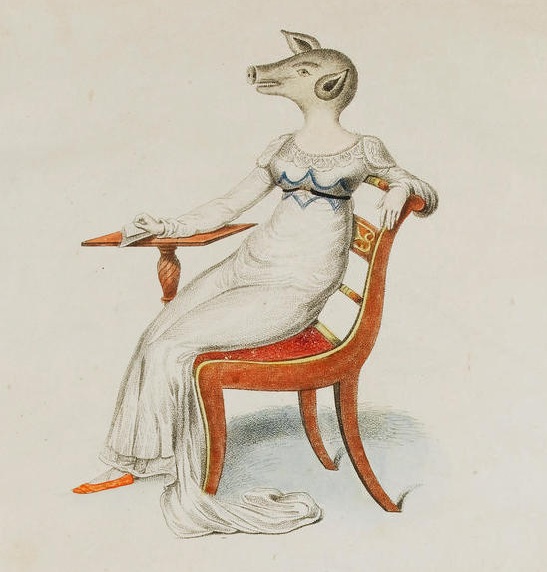
There is no dearth of stories in the realm of pig-faced lady literature; a 17th century Dutch account typifies the genre. This particular pig-faced lady was born at Wirkham on the Rhine in 1618. Her name was Tanakin Skinker. Miss Skinker was a near perfectly formed little girl – one might say beautifully constructed – except that her face (some say her entire head) was that of a swine. She was a dead ringer for a pig.

     The child grew to be a woman and a source of great discomfort to her parents, for although her disposition and carriage were in general unoffending, her table manners fell a bit short of those desirous in a lady. Her voracious and indelicate appetite was appeased by placing large amounts of food in a silver trough to which she would vigorously apply her entire face, accompanied by grunts, snorts and squeals. The maid who served her had to be paid handsomely for enduring this and risking her limbs to the wildly snapping jaws.

     A fortune awaited the man who would consent to marry Miss Skinker, and many suitors came calling, gallants from Italy, France, Scotland, and England – fortune hunters all, naturally – but ultimately they all refused to marry her. Were there no pig-faced men in the world?  Or even a dog-faced boy?  Apparently not, at least not one who saw himself as such.

     In this particular account, our pig-faced lady was sadly left to die an old maid (or sow, if you prefer). Other accounts have happier, if less likely, conclusions. The woman’s pig-like appearance was the result of witchcraft.  A husband was found, and he was granted the choice of having her appear beautiful to him but pig-like to others, or pig-like to him and beautiful to others. When the husband told her that the choice was hers, the enchantment was broken and her pig-like appearance vanished. And in some modern accounts, the pig-faced lady is abducted by aliens.


AUGUST 3, 1946: Beat the Rush, Talk to Santa in August

Louis J. Koch, an Indiana family man and father of nine children, was disappointed when a family trip took him to Santa Claus, Indiana, and he found no Santa Claus, no elves, no reindeer, no workshop –  Indiananothing. Why they named the place Santa Claus was a bit of a mystery.  And he fixated upon the town named Santa Claus that had no Santa Claus, and upon the many children who would suffer the same disappointment. Lying in bed at night perhaps (or working on a third martini), he envisioned a park where children could have fun and visit Santa all year round.

     And he did something about it.  Santa Claus Land opened on August 3, 1946. At no cost, children could visit Santa, a toy shop, toy displays, a restaurant, and themed children’s rides, such as The Freedom Train. Though skeptical, Koch’s son Bill took over as head of Santa Claus Land and continued to add to the park, including the first Jeep-Go-Round ever manufactured, a new restaurant, and a deer farm.

     And it continued to grow, evolving into a huge theme park divided into sections celebrating Christmas, Halloween, Thanksgiving and the Fourth of July with rides, live entertainment, games, and attractions, including three wooden roller coasters: The Raven, The Legend, and The Voyage. Just how many times could a kid throw up in one day? Then came the obligatory water park featuring the world’s two longest water coasters: Wildebeest and Mammoth, slides, pools, a river, and water-play attractions. Whew!

Of course, all of this became too much for a place called Santa Claus Land. Today it goes by the name Holiday World & Splashin’ Safari.  And good luck finding Santa Claus.


JUNE 20, 1890: PAINTING OUTSIDE THE LINES

Oscar Wilde’s only published novel, The Picture of Dorian Gray, appeared as the lead story in Lippincott’s Monthly Magazine in the July 1890 issue, released on June 20.

In the novel, the title character is the subject of a painting by artist Basil Hallward. Basil is impressed by Dorian’s beauty and becomes infatuated with him. Dorian is also infatuated by Dorian’s beauty, especially the beauty in the painting, and more than annoyed that the man in the painting will remain the same, while Dorian himself will get old and wrinkled and forget people’s names and so forth. Obviously the only answer is to put his soul on the market, which he does, with the purchaser (you know who) promising that the painting will age while Dorian himself stays the same.

In an apparent effort to make the painting age as quickly as possible, Dorian embarks on a life of debauchery, and each sin takes its toll on the portrait.

The book had about the same effect on British critics as Dorian’s naughtiness had on the painting. “Vulgar”, “unclean”, “poisonous” and “discreditable” were a few of their nicer comments. “A tale spawned from the leprous literature of the French Decadents – a poisonous book, the atmosphere of which is heavy with the mephitic odours of moral and spiritual putrefaction,” said the Daily Chronicle.   And this was after Wilde’s editor had already deleted a lot of “objectionable” text before it made its first appearance in Lippincott’s, eliminating titillating bits of debauchery and elements of homosexuality.

Deciding that the novel contained things that might upset an innocent woman, the editor cut further, removing many more decadent passages before the book was published in 1891.

MAN THE TOMATOES, FULL SPEED AHEAD

It’s a battlefield out there. Each morning I prepare my weaponry and fortify myself to better face the enemy.  Then it’s out into the morning mist, bellying my way through the trenches, my trusty trowel at my right, my insecticidal soap at my left. Half a league, half a league, half a league onward, into the valley of Death – mine not to reason why, mine but to do or die.  “Huzzah, huzzah,” I shout,  “Be valiant, stout and bold.”

With scant warning, they attack!  Tufts of crabgrass pop up behind every rock, aphids to the right of me, weevils to the left of me. A slug squadron advances relentlessly head on.   Japanese beetles at four o’clock.  The battle is joined.  Almost at once, I’m ambushed by an elite corps of exotic man-eating weeds, snapping at my ankles and calves, while trash-talking thistles peek out from between tomatoes, taunting me with Donald Trump slogans.

But I’ll not be intimidated.

“Forward,” I shout and storm into the mouth of Hell. I manage to free a tiny pepper plant being held prisoner by a half dozen stinging nettle goons.  Moments after I make a clearing to let the cucumbers once again see sunlight, the neighbor’s cat claims it for his own and begins his morning toilette.  He glowers at me, unflinching, as I try to encourage him to move on, his eyes saying I may not be big but I can bring down a gazelle and I can bring down you.  Enjoying the moment, knotweeds laugh merrily and loudly insult my gardenerhood.

I jump in with both feet, hacking and pulling and spraying.  When I’m done, a pile of green debris lies all around me shattered and sundered.  The day is mine.  The tomatoes, cucumbers and beans all nod in appreciation as I holster my trowel and spray bottle and ride off into cocktail time.

Later, exhausted, I’ll sleep, perchance to dream – of late potato blight.

JUNE 2, 1855: GIVE ME A MARTINI OR GIVE ME DEATH

In the early 1850s, the city of Portland, Maine, with a population of 21,000 might be called a sleepy little burg. But that was about to change thanks to a Maine law enacted in 1851 outlawing the manufacture and sale of alcohol anywhere in the state, except for medicinal and mechanical purposes.

Portland Mayor Neal S. Dow was an outspoken prohibitionist who fully supported the law, so much so that he was dubbed the “Napoleon of Temperance. ” However, Dow had authorized a large shipment of “medicinal and mechanical alcohol” that was being stored in the city vaults for distribution to pharmacists and doctors (authorized under the law). The good citizens of Portland got wind of this cache of alcohol and suspected the worst, that Dow was a hypocrite and a secret sot.

The Maine law had an interesting little clause allowing any three voters to apply for a search warrant if they suspected someone was selling liquor illegally. Three men did just that, appearing before a judge who issued a search warrant.

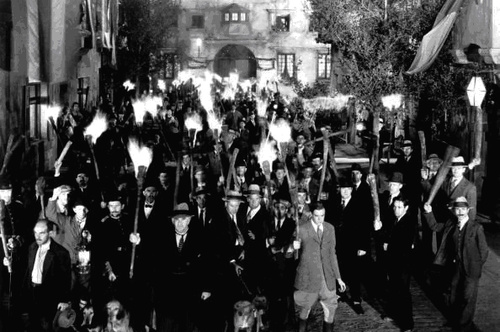
On the afternoon of June 2, a crowd of several hundred people, already irate over the law coming between them and their Harvey Wallbangers, gathered outside the building where the alcohol was being held. The crowd grew larger and surlier as it became obvious that the police were not going to seize the booze. As the crowd swelled, jostling became shoving, and the hurling of angry words became the hurling of rocks. The infamous Portland Rum Riot of 1855 was in full swing.

Police were unable to control the mob, and Mayor Dow called out the militia. When the protesters ignored the order to disperse, the militia, on Dow’s orders, fired into the crowd killing one man and wounding several others.

Dow was widely criticized for his strong-arm tactics during the incident and was later prosecuted for improperly acquiring the alcohol but was acquitted. The Maine Law was repealed the following year.


February 13, 1862: Thaw Out the Holly

With the giving and getting of gifts growing to a crescendo in late December, it is to many a glass of cold water in the face when the merriment suddenly gives way to a bleak long winter with scarcely a box or a bow in sight. The people of Norwich, a city on England’s east coast, a couple of centuries ago found a way to keep on giving by elevating February 13, St. Valentine’s Eve to a Christmas-like celebration.

According to an 1862 account, this Victorian tradition was evidently peculiar to Norwich: visitors to the city were often puzzled to find the shop windows crammed with gifts in early February and newspapers full of advertisements for ‘Useful and Ornamental Articles Suitable for the Season’ available from local retailers.

As soon as it got dark on St. Valentine’s Eve, the streets were swarming with folks carrying baskets of treasures to be anonymously dropped on doorsteps throughout the city. They’d deposit a gift, bang on the door, and rush away before anyone inside could reach the door. Indoors there were excited shrieks and shouts, flushed faces, sparkling eyes and laughter, a rush to the door, examination of the parcels.

Practical jokers  were everywhere as well, ringing doorbells and running off, leaving mock parcels that were pulled away by string when someone attempted to pick them up. Large parcels that dwindled to nothing as the recipient fought through layer after layer of wrapping, and even larger parcels containing live boys who would jump out, steal a kiss, and run away.

As with most holidays that involve children out after dark and mischief, the celebration of St. Valentine’s Eve fell out of favor, to be replaced by the Hallmark-inspired and saintless Valentine’s Day.

No Valentine, This One

Hal Foster had been drawing the Tarzan comic strip based on the books by Edgar Rice Burroughs for several years, but itched to create his own original strip. He began work on a feature called Derek, Son of Thane, set in Arthurian England. Before the strip had its coming out party on February 13, 1937, it had gone through a couple of name changes, first to Prince Arn and eventually to Prince Valiant.

Prince Valiant was five years old when his story began, a continuous story that has been told through 4,000 Sunday episodes. Without a whole lot of deference to historical accuracy, Val’s adventure’s take him throughout Europe, Africa, the Far East and even the Americas in a time frame covering hundreds of years. He does battle with Huns, Vikings, Sorcerers, witches and a slew of monsters from prehistoric to modern, but always big.

Foster drew the strip until 1971 and wrote the continuity until 1980. Since then, other artists have kept it alive. Foster died in 1982, at age 89.

Fore, I mean duck

Golf is thought of as relatively safe sport.  But for the safety of others, there are just some people who should not be allowed on a golf course.  Vice President Spiro Agnew had the dubious distinction of beaning not just one but three spectators on this day in 1971 during the Bob Hope Desert Classic.  On his very first drive, he sliced into the crowd for a two-bagger, bouncing off a man to nail his wife as well.  On his next shot, he hit a woman, sending her to the hospital.  The previous year, Agnew had managed to hit his partner in the back of the head.


JANUARY 11, 1917: YOU GOTTA HAVE HEART

Have a Heart, a musical by a trio new to the Broadway scene opened for the first of 76 performances during the 1916-1917 season.  Although it was a pretty short run for Broadway, the team of Jerome Kern, Guy Bolton and Pelham Grenville Wodehouse would go on to create legendary musicals and forever change the landscape of American musical theater.  The exotic locales and characters of operetta and the over-the-top spectaculars of the Ziegfeld Follies gave way to the lives and loves of ordinary folk and the theatrical style of such giants as Richard Rodgers, Cole Porter and George Gershwin.  The trio only produced five musicals.  Kern would go on to produce such monumental musicals as Showboat.  Bolton would work as librettist with most of the top composers of the day.  And Wodehouse, now better known by the initials P.G. or the nickname Plum would make his mark in the literary world, giving us Bertie Wooster, Jeeves and dozens of characters whose comic entanglements filled 90 books, 40 plays and a couple hundred short stories.  A sampling of his amazing wit:

Freddie experienced the sort of abysmal soul-sadness which afflicts one of Tolstoy’s Russian peasants when, after putting in a heavy day’s work strangling his father, beating his wife, and dropping the baby into the city’s reservoir, he turns to the cupboards, only to find the vodka bottle empty.

He had the look of one who had drunk the cup of life and found a dead beetle at the bottom.

Mike nodded. A sombre nod. The nod Napoleon might have given if somebody had met him in 1812 and said, “So, you’re back from Moscow, eh?”

I could see that, if not actually disgruntled, he was far from being gruntled.

There is only one cure for gray hair. It was invented by a Frenchman. It is called the guillotine.

She looked as if she had been poured into her clothes and had forgotten to say ‘when.’

The fascination of shooting as a sport depends almost wholly on whether you are at the right or wrong end of the gun.

Every author really wants to have letters printed in the papers. Unable to make the grade, he drops down a rung of the ladder and writes novels.

It was my Uncle George who discovered that alcohol was a food well in advance of modern medical thought.

And she’s got brains enough for two, which is the exact quantity the girl who marries you will need.

At the age of eleven or thereabouts women acquire a poise and an ability to handle difficult situations which a man, if he is lucky, manages to achieve somewhere in the later seventies.

Wodehouse was knighted in 1975 at the age of ninety-three and died later that year.

Perhaps You Could Smoke It

We may never know why he did it — perhaps as a joke or prank — but on January 11, 1770, Benjamin Franklin shipped the first ever rhubarb to the United States. Americans were unimpressed until years later when Thomas Jefferson began to cultivate it and it finally caught on.

Rhubarb had been around in other parts of the world for a good 5,000 years. Fried rhubarb was used as a laxative in Imperial China. Greeks and Romans used it as well and gave it its name Rha (Greek for the Volga River) and barbarum (Latin for barbarian , anyone who was not a Roman). Marco Polo waxed poetic about Chinese rhubarb. It was a prized commodity on the Silk Road to Europe. And in Europe heavy demand made it more expensive than cinnamon and twice the price of opium (which explains why there weren’t very many rhubarb dens).

Rhubarb is a vegetable but is treated and cooked as a fruit. It tastes like a very sour apple which is why all rhubarb recipes use copious amounts of sugar. Why bother? Because it’s healthy as all get out, jam packed with such goodies as dietary fiber, vitamins C and K, B complex vitamins, calcium, potassium, magnesium, beta carotene just to mention a few.

Stalk of rhubarb, anyone?
 

JANUARY 4, 390: COME DOWN, COME DOWN FROM YOUR IVORY TOWER

As we work our way through the twelve days of Christmas, we reach a point where True Love’s gifts are somewhat over the top.  Today is no exception — eleven pipers piping, each armed with a monkey wrench, applying their noble trade to clogged pipes and leaking faucets — at time and a half.  It is Christmastide, you know.  The eleventh ghost of Christmas introduces Scrooge to Tiny Tim.  Scrooge takes an instant dislike to the lad until he learns that Tiny Tim whacks his schoolmates with his crutch and takes their milk money.

In addition to celebrating plumbers, the eleventh day celebrates a saint, as many of the twelve days do. Day eleven is dedicated by those folks who dedicate such things to Saint Simeon Stylites also known as Saint Simeon Stylites the Elder to distinguish him from Simeon Stylites the Younger. He is known primarily for spending 37 years on a platform atop a pillar outside of Aleppo in what is now Syria (one could make a pretty good case that in Syria on top of a pillar might be a good place to be).

Why did Simeon choose to live up there like an Arabian Rapunzel, you ask? Simeon was very likely a wise man or at least people thought he was, because they kept coming to him for advice. Many folks would be honored to be sought out for guidance. Not Simeon. Seekers annoyed him. He wanted to be left alone to pray his private prayers and possibly entertain other thoughts as well.

So he went out and found a pillar. His first pillar was a mere nine feet tall and he soon realized that people could easily shout their entreaties to him. He thus began a series of relocations, each pillar being taller than its predecessor. His final pillar was really up there, some 50 feet above the ground and its many pests.

MARCH 27, 1860: Put a Cork in it

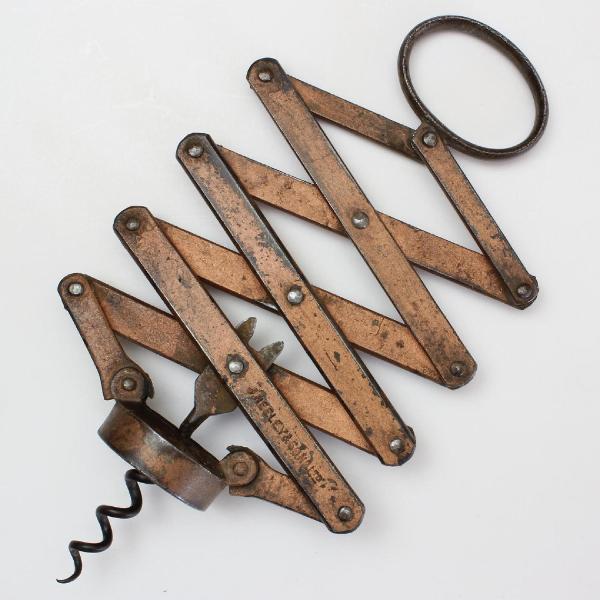
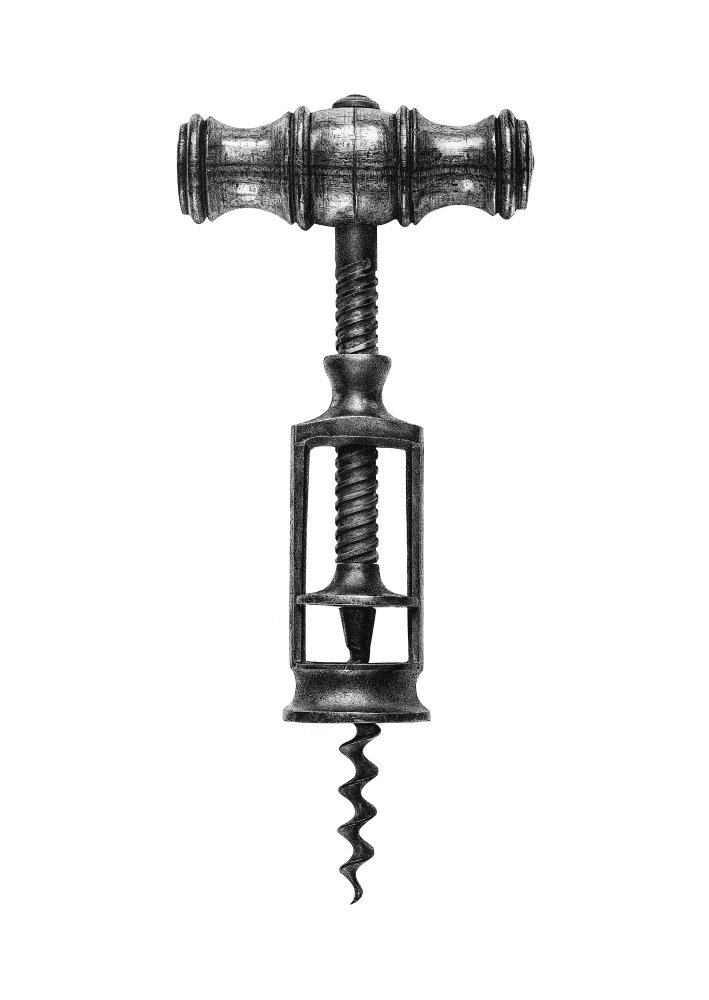
Back through the centuries wine lovers never aged their wines; they consumed it quickly before it went bad.  Then in the 18th century, British glassblowers began to make bottles with narrow necks for wine that made airtight storage possible. Corks were used to seal the bottles. This quickly led to the invention of one of the dandiest little gizmos ever devised — the corkscrew. The design was based on a similar device used to clean muskets. The first corkscrews were T-shaped devices that twisted into the cork and after a certain amount of pulling extracted the cork. Corkscrews were first patented in England and France, then on March 27, 1860, M. L. Byrn of New York City received an American patent.

Since then, hundreds of corkscrews have been designed of every shape, size and mechanics you can imagine — single-lever, double-winged, air pump, electric, mounted. Naturally there are corkscrew books, corkscrew clubs, and corkscrew collectors, helixophiles.

I LEFT MY HEART AND A BUNCH OF QUARTERS . . .

The bane of drivers everywhere, the toll-taker, notably went missing from from San Francisco’s Golden Gate Bridge on March 27, 2013.  Not the tolls themselves,  just those golden gatehuman beings who had previously greeted motorists with smiling faces on and official hands out.  On that morning, officials  threw the switch on a new electronic system of collecting tolls. This was the future; this was progress.

Empty toll booths were joined by a new 27-foot LED sign instructing motorists to keep on moving as the Golden Gate Bridge became the only span in California and one of the few in the world to convert to all-electronic tolls.

Now motorists go online to register license plates and credit card information with the bridge district and pay tolls as they are incurred. Those who don’t have online accounts have about 48 hours after they cross the bridge to pay the toll at one of the payment kiosks located along thoroughfares leading to and from the Golden Gate. Those who don’t pay up receive invoices, because Big Brother knows who they are.

The bridge has been a San Francisco icon since it was opened in 1937. Before that the only practical short route between San Francisco and what is now Marin County was by a half-hour boat trip across San Francisco Bay. During the bridge-opening celebration, before vehicle traffic was allowed, 200,000 people crossed the bridge on foot and roller skate.

In addition to being a major tourist attraction, the bridge is the world’s most popular suicide spot. An official suicide count is kept, sorted according to which of the bridge’s 128 lampposts the jumper was nearest when he or she jumped. (Lamppost #19 is particularly recommended.)  Today,  the suicide count was just a couple of goodbye cruel worlds shy of 2,000.  Formed several decades ago, The Golden Gate Leapers Association, is a sports pool  in which bets are placed on which day the next jump will occur.

A few years ago, savvy officials came up with a plan to thwart would-be jumpers: a “suicide deterrent” net spanning both sides of the bridge that will capture them like hapless butterflies.  The net will have cost $200 million by the time it is completed in 2023.  Most likely there will be a toll collected from those butterflies to help pay for it.

December 23, 2009: Kids Say the Darnedest Things

Reality television reached new heights in October of 2009, as viewers around the world were tethered to their sets by the saga of the “Balloon Boy.” It started shortly before noon when Richard Heene, a Fort Collins, Colorado, handyman, dabbling scientist and father of three boys, called the Federal Aviation Administration to report that a large balloon that had been tied in his family’s backyard  had gotten loose and taken flight. Heene was certain his six-year-old son Falcon had crawled aboard the craft before its takeoff. Heene also phoned a local TV station, requesting a helicopter to track the balloon, and his wife Mayumi called 911.

The homemade dirigible was soon being pursued by two Colorado National Guard helicopters and by search-and-rescue personnel, as well as reporters, on the ground. A runway at Denver International Airport was shut down as the balloon traveled into its flight path. The runaway blimp finally touched down in a Colorado field after a joyride of some 50 miles. Rescue officials quickly discovered the balloon was empty, prompting fears that poor little Falcon Heene had plummeted from on high during the flight. A ground search was initiated. But later that afternoon, Richard Heene made an oops! statement that the boy had been found safe at home, where he supposedly had been hiding.

Conspiracy theorists came out of the woodwork all afternoon and into the evening, voicing their suspicions that the entire incident had hoax written all over it. Then dear little blabbermouth Falcon Heene told his parents during a live interview on CNN: “You guys said we did this for the show.”

In November, Richard Heene pleaded guilty to a felony charge of attempting to influence a public official to initiate a search-and-rescue mission which in turn would attract media attention, frowned on in Colorado; Mayumi Heene pleaded guilty to a misdemeanor count of making a false report. Falcon Heene pleaded guilty to being a sniveling six-year-old dupe (permissible under Colorado law). They confessed that they staged the incident in an attempt to get their own reality TV show, having gotten the entertainment bug when previously appearing on a program, called “Wife Swap.”

On December 23, 2009, the Heenes were sentenced to perform community service not involving flying objects, and ordered to pay $36,000 in restitution for the search effort. Falcon, it is rumored, will have his own reality TV show, “Throw Your Parents Under the Bus.”


wcfields2