Beware. Today is the ides of March, a day once enthusiastically celebrated among the common people with picnics, drinking, and revelry. In the ancient Roman calendar, each of the 12 months had an ides (from the Latin to divide). In March, May, July and October, the ides fell on the 15th day. In all other months, the ides fell on the 13th. There is a reason for this, but the logic declined and fell with Rome, and the ides lost their original intent and purpose and eventually came to mean the day that a bunch of guys are going to stick knives into you.
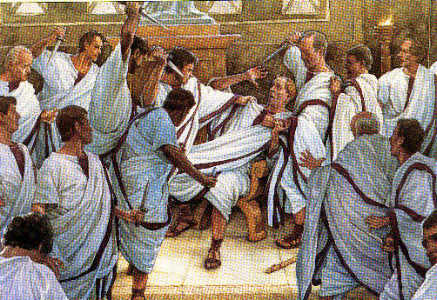
This was thanks to Shakespeare, Julius Caesar, and Caesar’s pals Brutus et al. In Act I, Scene 2, of Shakespeare’s history, the old soothsayer utters these words, dripping with foreboding: “Beware the Ides of March.” Pretty straightforward, but does Caesar pay attention? Of course not. And on March 15, 44 BC, aided by his friends, he buys the forum, so to speak, exiting stage left halfway through the play even though it bears his name.
Despite an occasional pretentious allusion to the Ides of March and the popular song, today’s calendar is pretty much ideless (as ideless as a painted ship upon a painted ocean, to slip in a quick pretentious allusion).
Back in 49 BC, Julius Caesar was a mere governor commissioned by the Roman Senate to oversee a portion of the empire that stretched from Gaul to Illyricum (pretty much most of today’s Europe except Italy). When his term of governorship ended, the Senate ordered Caesar to disband his army and return to Rome. Whatever you do, Julie baby, don’t bring that army across the Rubicon River for that is treason and insurrection and very bad manners. Oh, and the punishment is death.
Caesar may have misunderstood for didn’t he just up and cross the Rubicon into Italy on January 10. His biographer suggests that he was under the control of a supernatural apparition (the Devil made him do it). Willful or not, Caesar is said to have shouted “alia iacta est” as he and his merry men waded across the shallow river (or ‘the die has been cast,” certainly more dramatic in Latin).
Crossing the Rubicon was a declaration of war, but instead of arresting Caesar the Roman Senate fled Rome in fear. Caesar, far from being condemned to death, became dictator for life. Sometimes it’s good to cross the Rubicon. Crossing the Rubicon has endured as a phrase meaning passing a point of no return.
The Hole in My Record Is Bigger Than the Hole in Your Record
RCA Victor it might be said crossed the Rubicon when on January 10, 1949, it introduced a new kind of record — a vinyl disc, just seven inches in diameter with a great big hole in the middle, the 45 (referring to its revolutions per minute). The 45 replaced the big noisy shellac disc that rotated at a breakneck 78 rpm. The first 45 rpm single was “Peewee the Piccolo.” Remember it?
The Bun Knows
On January 10, 1984, 81-year-old Clara Peller first asked the question for which she would become famous:
It’s a new year, a new beginning, a fresh start and all those cliches. It’s a cold slap in the face after last night when you celebrated and then made that resolution while licking the wassail bowl dry. You don’t remember? Your resolution went something like this: I hereby resolve to read Wretched Richard’s Almanac every day so that I might be well informed, sophisticated and attractive. And I will recommend it to all my friends so they too might be well informed, sophisticated and attractive.
Here Come Januarius
As we previously pointed out, today is January 1, New Year’s Day, the start of a brand new year. It wasn’t always thus. There wasn’t always a January. According to legend, the first calendar was created by Romulus who along with his twin brother Uncle Remus founded Rome. This calendar had only ten months (these were leaner times), the ten being Martius, Aprilis, Maius, Innius, Quintilis, Sextilis, Aquarius, Donner, Blitzen, and the ever-popular Decembris.
The year consisted of only 298 regularly scheduled calendar days. The authorities would add bonus days here and there as they saw fit to bring the total number to the magic 365. (Martius 3, a Tuesday, will be postponed so we can bring you a special wear-a-toga-to-work day. Martius 3 will return on Thursday.)
A fellow by the name of Numa Pompilius (no need to memorize his name) succeeded Romulus who had murdered Uncle Remus in a typically Roman display of sibling rivalry. In an effort to Make Rome Great Again, Pompilius added two months to the Roman calendar. The first of these was Januarius, dedicated to the two-faced god Janus, the deity who presided over doors, looking back through the doorway to the past and ahead to the future. Clever, what?
More Wolf-monat, Van Helsing?
Wolf contemplating a Saxon snack
The Saxons (the Almanac is a big tent, they’re welcome too) didn’t hold much with naming things after Roman gods. They had a different and more colorful name for the month of January — Wolf-monat or Wolf-month, because Saxon folks were more likely to be devoured by wolves during Wolf-monat than at any other time of the year. But we digress.
Et Tu, Sosigenes
Even though Januarius was added some 600 years earlier, New Year’s Day was celebrated on Januarius 1 for the first time in 45 B.C. On that day the Julian calendar went into effect — created by Julius Caesar himself — with the aid of his trusty sidekick Sosigenes, an Alexandrian astronomer.
Sosigenes advised Caesar to dump the whole Roman calendar and start from scratch. New Year’s no longer came in March. A one-time bonus of 67 days was thrown in, with the promise of an extra day every four years in February.
But Caesar couldn’t stop there. In 44 B.C. (that’s a year later than 45), he changed the month of Quintilis to Julius (July, to friends). He would no doubt have done more damage had not a group of noble Romans assassinated him that same year. But didn’t Augustus come along and keep fiddling with the calendar. (There’s something about Caesars and fiddling.). Sextilis became (what else?) Augustus. But it only had 30 days, compared to Julius’ 31. What’s a Roman emperor to do? Steal a day from Februarius, of course.
. . .And on the Eighth Day
For those folks who just can’t get enough ’tis the season, today is also the eighth of a dozen days of Christmas. This is infamously celebrated by the carol in which on this day, the first day of Christmas, someone’s True Love bestows upon him or her a gift of a partridge in a pear tree. While we might point out that a crock pot or a circular saw would be a bit more practical, we won’t quibble with the sentiment. A flock followed: turtle doves, French hens, colly birds, geese, swans, all calling, clucking, cooing and squawking around that pear tree.
But now on the eighth day, True Love, having at last run out of feathered friends, has created an entirely new category of giving — the gift of people. The first contribution to this premise consists of eight maids a-milking, a lovely gift with nary a cackle or a caw. Of course this requires the addition of cows — one can’t very well expect the recipient to go out and find his or her own cows (True Love could have added a disclaimer of cows not included, but that would be a cheap trick.) We suppose there might be just one cow with all the maids milking it, but that would be one very sore cow.
Charles Dickens, it would seem, missed the Christmas boat by failing to take advantage of this twelve day gimmick. Imagine if you will the twelve ghosts of Christmas.
Beware. Today is the ides of March, a day once enthusiastically celebrated among the common people with picnics, drinking, and revelry. In the ancient Roman calendar, each of the 12 months had an ides (from the Latin to divide). In March, May, July and October, the ides fell on the 15th day. In all other months, the ides fell on the 13th. There is a reason for this, but the logic declined and fell with Rome, and the ides lost their original intent and purpose and eventually came to mean the day that a bunch of guys are going to stick knives into you.
This was thanks to Shakespeare, Julius Caesar, and Caesar’s pals Brutus et al. In Act I, Scene 2, of Shakespeare’s history, the old soothsayer utters these words, dripping with foreboding: “Beware the Ides of March.” Pretty straightforward, but does Caesar pay attention? Of course not. And on March 15, 44 BC, aided by his friends, he buys the forum, so to speak, exiting stage left halfway through the play even though it bears his name.
Despite an occasional pretentious allusion to the Ides of March and the popular song, today’s calendar is pretty much ideless (as ideless as a painted ship upon a painted ocean, to slip in a quick pretentious allusion).
Wretched Richard’s Little Literary Lessons – No. 2
al·lu·sion
əˈlo͞oZHən/
noun
As a literary device, an allusion is an expression designed to call something to mind without mentioning it explicitly; an indirect or passing reference to another person, event, work etc.
For example:
“That’s a rather abrupt and indifferent exit. Feel guilty?”
“I’m not sure. You don’t approve?”
“Well, I suppose it’s better than ‘I’m running off to hook up with Lolita for a few days. I’ll be back when I’m tuckered out. I hope you don’t mind.”
“Lolita? You’re hardly a nymphet.”
“I beg your pardon,” Huey huffed. “Would you care to elaborate on that point?”
“A nymphet is fourteen or fifteen years old, tops.”
“Maybe I’m only fifteen.”
“You also pointed out that you weren’t trying to seduce me.”
“Maybe I was lying. And maybe I’m no Lolita – as hot as I am – but you most definitely fit the part of Humbert Humbert, you old fart. Just remember you’re here of your own free will. You can’t claim I forced you to come along.”
“I won’t if you won’t,” said Paul.
Not forcing anyone to come along, just inviting: Voodoo Love Song





 Wretched Richard's Almanac