‘St. Swithin’s day if thou dost rain
For forty days it will remain
St. Swithin’s day if thou be fair
For forty days ’twill rain nae mair.’
St. Swithin is the British counterpart to America’s Puxatawney Phil, except that the former is a ninth century bishop and the latter is a ground hog. And just how did the good St. Swithin get his meterological stripes? Here’s how:
 St. Swithin was noted for his great humility, a quality that some may say he carried to excess. On his deathbed, he asked to be buried, not in the church or in some shrine, but outside where his corpse might be watered by rain from the church eaves and his grave stomped on by passers-by. Folks rolled their eyes a bit but complied with his request.
And his remains lay wet and walked on for a good hundred years, until a more modern generation of clergy (those 10th century radicals!) took umbrage at one of their own resting in such a lowly spot. They decided at once to relocate Swithin, who could not object, to a great cathedral. However, on July 15, 971, just as a ceremony with great pomp and circumstance was about to begin, as if on cue, a heavy rain burst forth and continued with nary a break for 40 days (40 days is a popular duration for great rainfalls).
The monks interpreted this tempest as a not-so-subtle warning from on high that their nasty little undertaking was a bit of blasphemy. They immediately abandoned the project. And even without the help of modern social media, word spread throughout the land, and a tradition was born: if it rained on St. Swithin’s Day, it would rain for 40 days.
St. Swithin also planted apple trees (like Johnny Appleseed, who never predicted weather) leading to the popular description of rain: “St Swithin is christening the apples”
Death Visits Aunt Agatha, Part 3: Solomon Grundy et al
Early that evening, after helping herself to a steak she found in the refrigerator, Bridget poured herself a tumblerful of Monty’s gin and returned to the bedroom to console his sick aunt.
 “Seen a lot of people die,” said Bridget. “Usually they do it more quickly.”
Aunt Agatha gurgled.
“Simon Walters took the last count back in ’06. He was about the longest, three days. Course, unlike yourself, he was young and healthy. ‘Til the tractor hit him. Now Lucy Beaconsberry was a lot like you, old and frail, withered, look of death all over her. Gurgled just like you been gurgling. Turned her toes up in less than twelve hours. Just figured what good was she doing anybody, just lying there and gurgling. Thoughtful of her, I’d say.”
Aunt Agatha stirred slightly, but didn’t open her eyes.
“Yes, I’ve seen a lot of folks go. Joshua Higgins gave up the ghost just last week. Eighty-seven he was. Nice ripe old age. You’re close to ten years older than that, aren’t you, dear? Pretty old. Good long life you’ve had. When pneumonia took old Frances Cartwright back in October — just a week after her ninetieth birthday, she said ‘ I figure anyone that lives past ninety is stealing space from someone younger.’ Interesting way to look at it, wouldn’t you say? Smart old lady, Frances. Had some pain though. Just feel lucky you don’t have the pain. At least not yet.”
Bridget gave her charge another nasty look, then got up and left the room. When she returned with a refilled tumbler of gin, she thought for a moment that Aunt Agatha had stopped breathing. But several short hacking coughs dashed her hopes. Damn you, old woman, Bridget thought. What good does your hanging on do you or anyone else? “How about a little verse, my dear?” she said.
“Solomon Grundy,
Born on a Monday,
Christened on Tuesday,
Married on Wednesday,
Took ill on Thursday,
Worse on Friday,
Died on Saturday,
Buried on Sunday:
This is the end
Of Solomon Grundy.
“You see, dear, it’s just a matter of pace. Jeremy Lockless held on bedridden for almost two years. Did you know that? Well, let me tell you, his family grew to hate him so much for just lying there so long that, when he did finally bite the dust, they wouldn’t even bury him. They just threw him in the woods out back for whatever wild animals wanted his carcass.”
Sunday evening and two more tumblers of gin made Bridget frantic. Now she was really losing money. Maybe she could just hurry things along with a pillow. Don’t be foolish, Bridget, she told herself. Use your head. And with a third tumbler, now vodka — Aunt Agatha was still here but the gin was gone — Bridget got an idea.
continued

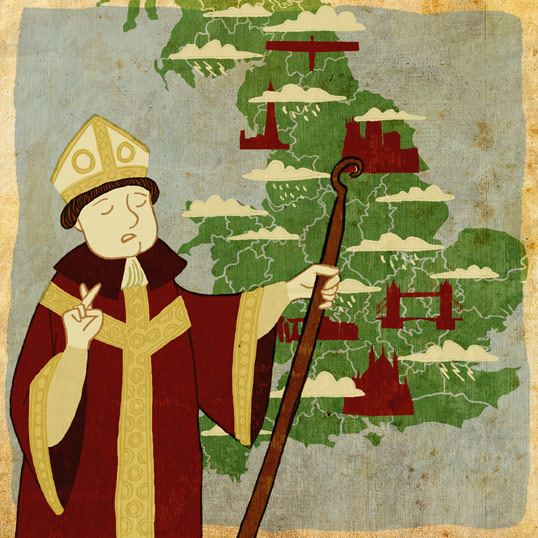
 St. Swithin was noted for his great humility, a quality that some may say he carried to excess. On his deathbed, he asked to be buried, not in the church or in some shrine, but outside where his corpse might be watered by rain from the church eaves and his grave stomped on by passers-by. Folks rolled their eyes a bit but complied with his request.



 Wretched Richard's Almanac