November 7, 1811: Tippecanoe and So Do You

Long before the confederacy of southern states, United States forces faced the uprising of a confederacy under the Shawnee leader and Native American folk hero Tecumseh who had visions of a Midwestern Indian nation allied with the British. Confederacy forces led by Tecumseh’s brother Tenskawatawa (One with Open Mouth) met government forces under the direction of William Henry Harrison, Governor of the Indian Territory, on November 7, 1811, in the Battle of Tippecanoe (and Tyler too).

The battle took place in Indiana, at the confluence of the Tippecanoe and Wabash too Rivers. The day gave government forces an important political and symbolic victory and dealt a devastating blow to Tecumseh’s confederacy. Public opinion in the United States blamed the entire brouhaha on buttinsky Brits. The War of 1812 broke out only six months later.

The Battle of Tippecanoe (and Tyler too) also served as an important springboard for Harrison’s political ambitions which culminated in his becoming president in 1841. At the age of 68 years and 23 days when inaugurated, Harrison was the oldest president to take office until Ronald Reagan in 1981. During the campaign, Democrats characterized Harrison as an out-of-touch old fart (One Who Sits in Log Cabin Drinking Hard Cider). Harrison and running mate John Tyler (and Tippecanoe too) turned the tables on the Dems, adopting the log cabin and hard cider as campaign symbols along with one of the most famous campaign slogans ever (Tippecanoe and you know who).

Harrison caught cold shortly after his inauguration and went quickly from bad to worse. Harrison’s doctors tried applications of opium, castor oil, leeches, and Virginia snakeweed too. But to show his disdain for modern medicine, Harrison became delirious and died. He served only 32 days in office – some would say the perfect tenure for any politician.
 

February 28, 1844: Love Story with Cannons

Cruising down the Potomac on a pleasant day in late winter could serve as the backdrop for romance, despite the fact that your vessel is not a gondola or a sailboat but a U.S. Navy steam frigate, and despite the fact that practically every dignitary in Washington is along for the ride.

Okay, not so romantic, but if you’re the President of the United States, recently widowed, and you’ve just proposed marriage to an enchanting 20-year-old, it may be the best you can do. And so it was, that President John Tyler (Tyler Too of Tippecanoe-And fame), was on board the USS Princeton on February 28, 1844, for a demonstration of a fancy new 27,000-pound cannon lovingly called the Peacemaker. Julia Gardiner, whose yes vote the President was seeking, was there with her sister and father David, a wealthy New Yorker. The co-designer of the cannon, John Ericsson, was on board; so was the Secretary of War, other cabinet members, congressmen, political and business dignitaries, reporters and other various hangers on. An intimate little gathering. One can imagine 400 breaths being held in anticipation of Julia’s answer.

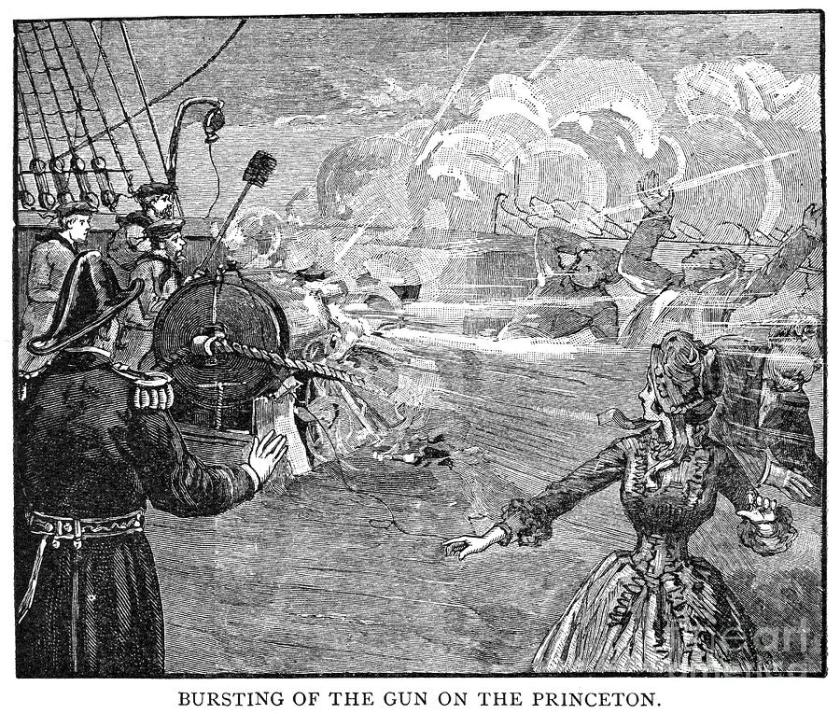
But first we must fire that cannon. Designer Ericsson tried to persuade, pleaded with, the ship’s captain not to actually fire the weapon before such a crowd, fearing it had not been adequately tested. The captain, however, was having none of it; he had a big audience and a big gun, and he was going to have a big bang. The Peacemaker was fired, and it made a jolly big noise, much to the delight of the audience who cheered and applauded and yelled for more (perhaps this is how wars are started). Once more, the cannon was fired and once more the giddy observers whooped, then they all headed below for toasts and libations.

The Secretary of War (being the Secretary of War) was too enthused to settle for just two shots (of either kind). He insisted that the cannon be fired once more in the direction of Mount Vernon, as a tribute to George Washington.  The cannon was fired, and the third time was not a charm. Mount Vernon was left standing, but the cannon itself exploded into the worst peacetime disaster in the nation’s short history, killing several on board including a couple of cabinet members and the father of the would-be bride. While others counted the dead left by the explosion, oddsmakers recalculated the President’s chances of getting the desired answer out of Julia.

The ship docked, and in a brilliant display of presidential heroics, Tyler carried Julia off to safety. Her answer was delayed a bit, but it was an affirmative, and later that year, Julia became Mrs. Tippecanoe and Tyler Too.

chan9


November 7, 1811: Tippecanoe and So Do You

Long before the confederacy of southern states, United States forces faced the uprising of a confederacy under the Shawnee leader and Native American folk hero Tecumseh who had visions of a Midwestern Indian nation allied with the British. Confederacy forces led by Tecumseh’s brother Tenskawatawa (One with Open Mouth) met government forces under the direction of William Henry Harrison, Governor of the Indian Territory, on November 7, 1811, in the Battle of Tippecanoe (and Tyler too).

The battle took place in Indiana, at the confluence of the Tippecanoe and Wabash too Rivers. The day gave government forces an important political and symbolic victory and dealt a devastating blow to Tecumseh’s confederacy. Public opinion in the United States blamed the entire brouhaha on buttinsky Brits. The War of 1812 broke out only six months later.

The Battle of Tippecanoe (and Tyler too) also served as an important springboard for Harrison’s political ambitions which culminated in his becoming president in 1841. At the age of 68 years and 23 days when inaugurated, Harrison was the oldest president to take office until Ronald Reagan in 1981. During the campaign, Democrats characterized Harrison as an out-of-touch old fart (One Who Sits in Log Cabin Drinking Hard Cider). Harrison and running mate John Tyler (and Tippecanoe too) turned the tables on the Dems, adopting the log cabin and hard cider as campaign symbols along with one of the most famous campaign slogans ever (Tippecanoe and you know who).

Harrison caught cold shortly after his inauguration and went quickly from bad to worse. Harrison’s doctors tried applications of opium, castor oil, leeches, and Virginia snakeweed too. But to show his disdain for modern medicine, Harrison became delirious and died. He served only 32 days in office – some would say the perfect tenure for any politician.