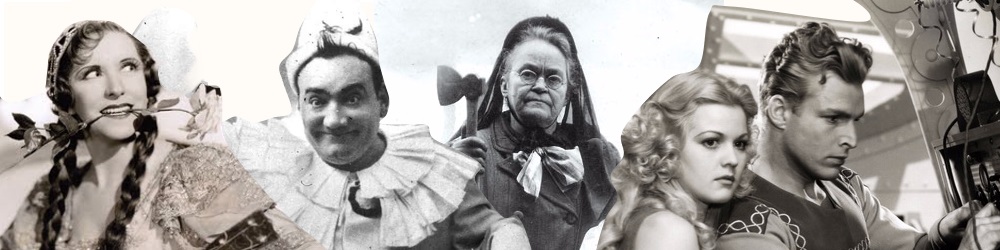

The town of Zion, Illinois, banned all jazz performances on this musicless day, labeling them sinful, right up there with tobacco and alcohol and sexting as things its citizens could well do without. The very word jazz was thought (correctly) to have a sexual connotation. The decadent rhythms and wild dancing it elicited were feared (correctly) to be leading young people down the road to sexual abandon (remember Footloose, barely a degree of Kevin Bacon from Satan himself), degeneracy, and bad manners. “Oh, you got trouble right here in Zion city.”
Zion, Illinois is a bunch of degrees from New Orleans, the birthplace of jazz with its Bourbon Street, bordellos and sin, sin, sin. Zion was founded in 1901 by John Alexander Dowie as a place where people of faith could come together and live in a moral environment, reading the Good Book from Fri ’til Monday. The population was 24,655 as of the 2020 census. Zion is one of only a few cities in the world to have been completely planned out before building. And Dowie thought of just about everything. The north-south roads in the original plan were all named from the Bible –Ezekiel Place; Gabriel, Galilee, and Gideon Avenues; Matthew, Mark, and Luke, but no John. And no Duke Ellington Circle or Thelonious Monk Boulevard.
During the same year that Zion proscribed jazz, the town nixed evil alcohol, In what can only be described as a binge, the citizens poured 80,000 pints of beer into Zion sewers. Did they actually have 80,000 pints on hand? Or did they have to borrow from nearby towns? Perhaps Gabriel and Galilee Avenues harbored a lot of closet imbibers. And maybe even a Louis Armstrong record or two.
Pencil Me In
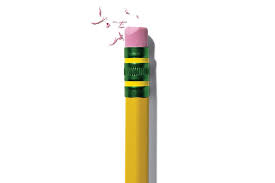
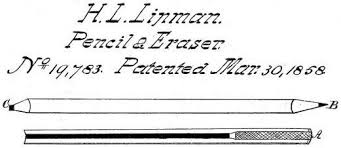
Hymen J. Lipman one of the Philadelphia’s leading stationers, founded the first ever envelope company in the United States. Lipman didn’t just content himself with envelopes. His vision took him to pencils as well. And on March 30, 1858, the forward-looking Lipman earned himself a patent for a pencil with an eraser built right into one end of it. This was a giant step for the pencil industry.
 Joseph Reckendorfer looked at Lipman’s pencil and saw dollar signs. He also saw himself as a titan of the pencil industry. He would be to pencils what Rockefeller was to oil, what Vanderbilt was to railroads. He bought the pencil patent from Lipman for $100,000 (the equivalent of a couple million today).
But alas it wasn’t to be. Pencil manufacturer A. W. Faber began producing eraser-tipped pencils without paying a penny in royalties to Reckendorfer. Reckendorfer sued Faber. In 1875, the lawsuit made its way to the Supreme Court which declared the patent invalid, reasoning that Lipman’s design combined a known technology, the pencil, with another known technology, the eraser, not creating a new use. Bad news for Reckendorfer.



 Wretched Richard's Almanac