OCTOBER 11, 1944: All the Presidents’ Dogs

Republicans were on the political attack and the President was angry. At a campaign dinner with the Teamsters union, on this day in 1944, President Franklin D. Roosevelt struck back. It was one thing for the Republicans to spread “malicious falsehoods” about him and Eleanor, but they had stepped over the line, making libelous statements about Fala, his small, black Scottish terrier.

After addressing weighty labor and war issues, Roosevelt blasted Republican critics for circulating a claim that he had accidentally left Fala behind while visiting the Aleutian Islands earlier that year and had, at a taxpayer cost of $20 million, sent a Navy destroyer to pick up the dog. Although Fala slept at the foot of President’s bed and received a bone every morning with Roosevelt’s breakfast tray, Roosevelt accused his critics of attempting to tarnish a defenseless dog’s reputation just to distract Americans from more pressing issues facing the country.

Did Richard Nixon, eight years later to the day, take a page out of the Roosevelt playbook to defend his own honor when critics accused him of accepting improper gifts and making funny with campaign funds? The story broke two months after Nixon’s selection as Dwight D. Eisenhower’s running mate, threatening Nixon’s place on the ticket. Nixon interrupted a whistle-stop tour of the West Coast to fly to Los Angeles for a television and radio broadcast to the nation in which he vowed he would not return one gift: a black-and-white dog who had been named Checkers by his children. But unlike Roosevelt, who took Fala to meetings with heads of state such as Winston Churchill, there is no evidence that Nixon even touched Checkers, let alone fed him.

Just Put Your Lips Together

Harry “Steve” Morgan and his alcoholic sidekick, Eddie, are a couple of ne’er-do-wells crewing a boat for hire on the island of Martinique. to_have_and_have_not_1944_film_posterLife is okay, but World War II is happening all around them, doing a number on the tourist trade and thus their livelihood. Howard Hawks’ film To Have and Have Not which premiered in New York on October 11, 1944, was notable for bringing together what would become one of Hollywood’s hottest couples, Humphrey Bogart and Lauren Bacall.

The film takes the title from the book by Ernest Hemingway but not much else. Hawks was a Hemingway fan but thought this particular book was a “bunch of junk.” Even so, Hemingway worked with Hawks on the screenplay, in which Bogart once again gives up his professed neutrality in the war to thwart the Nazis. The plot is well thickened by the stormy relationship between Bogart and Bacall who plays Slim, a saucy singer in the club where Morgan drinks away his days.

Another notable member of the cast is Hoagy Charmichael who appears as the club piano player, Cricket. He and Bacall perform several Charmichael songs: “How Little We Know,” “Hong Kong Blues,” and “The Rhumba Jumps.” Bacall does her own singing, even though persistent rumors would have a 14-year-old Andy Williams singing for her.

The most memorable take away from the film is one line of dialogue delivered seductively by Bacall: “You know how to whistle, don’t you, Steve? You just put your lips together and . . . blow . . .”

JUNE 16, 1917: WHIPPING BOY

Harrison Ford cracked a mean bullwhip as the title character in the Indiana Jones series of films. Ford wasn’t born brandishing a bullwhip; he had to learn it for the films. And he was taught by bullwhip master, Lash LaRue born on June 16, 1917.

Like many actors in the 40s and 50s, LaRue spent most of his career making B-Westerns. Originally hired because he looked enough like Humphrey Bogart that producers thought this would draw in more viewers, he used his real last name as the name for most of his film characters. He was given the name Lash because, although he carried a gun, he was noted for preferring to use an 18-foot-long bullwhip to take on bad guys. Lash not only disarmed bad guys, he performed many stunts such as saving people about to fall to their doom by wrapping his whip around them — often while at full gallop on Black Diamond, his trusty horse — and pulling them to safety. Lash, like a guy named Cash, was also known for always wearing black.

After starting out as a sidekick to singing cowboy Eddie Dean, he earned his own series of Western films and his own sidekick, Fuzzy Q. Jones (Al St. John), inherited from Buster Crabbe. He also got his very own villain — an evil, cigar-smoking twin brother, The Frontier Phantom.

His films ran from 1947 to 1951. The comic book series that was named after his screen character lasted even longer, appearing in 1949 and running for 12 years as one of the most popular western comics published.


OCTOBER 11, 1983: DON’T YANK THE CRANK

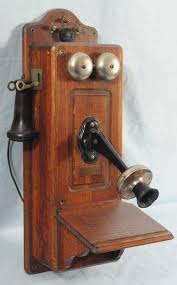
The title refers to a movement that took place in Maine back in 1981. Movement is probably a pretty strong word for laid-back Maine where crankdemonstrators tend not to get worked up into a chanting frenzy over things. And even less so in a sleepy little town like Woodstock whose population squeaked by 1,200 a couple of years ago.

Bryant Pond is Woodstock’s largest settlement and as much of an urban center as you’re likely to find. It captured its fifteen minutes of national fame and media attention during the mid1970s when its family-owned Bryant Pond Telephone Company became the last telephone exchange in the United States to use hand-cranked phones. Then in 1981, the two-position magneto switchboard in the living room of the owners was purchased by the Oxford County Telephone & Telegraph Company, a larger company in the Maine neighborhood. The Bryant Pond Telephone Company was swallowed like so many krill off the shores of Maine.

Two Bryant Pond residents started the “Don’t Yank The Crank” movement to save their crank telephones, financed by the sale of tee shirts – a valiant effort but nonetheless futile. At a meeting in the local school gymnasium warmed by a wood stove, townsfolk spoke out. “We have the oldest pay station in the United States,” said one resident, either complaining or bragging. “You put in a nickel and wind it up.” “You are a person instead of a number.” And did they mention no robocalls?

Alas, to no avail. The last “crank calls” took place on October 11, 1983, and the beloved telephones slipped into history like so much Americana.

Just Put Your Lips Together

Harry “Steve” Morgan and his alcoholic sidekick, Eddie, are a couple of ne’er-do-wells crewing a boat for hire on the island of Martinique. to_have_and_have_not_1944_film_posterLife is okay, but World War II is happening all around them, doing a number on the tourist trade and thus their livelihood. Howard Hawks’ film To Have and Have Not which premiered in New York on October 11, 1944, was notable for bringing together what would become one of Hollywood’s hottest couples, Humphrey Bogart and Lauren Bacall.

The film takes the title from the book by Ernest Hemingway but not much else. Hawks was a Hemingway fan but thought this particular book was a “bunch of junk.” Even so, Hemingway worked with Hawks on the screenplay, in which Bogart once again gives up his professed neutrality in the war to thwart the Nazis. The plot is well thickened by the stormy relationship between Bogart and Bacall who plays Slim, a saucy singer in the club where Morgan drinks away his days.

Another notable member of the cast is Hoagy Charmichael who appears as the club piano player, Cricket. He and Bacall perform several Charmichael songs: “How Little We Know,” “Hong Kong Blues,” and “The Rhumba Jumps.” Bacall does her own singing, even though persistent rumors would have a 14-year-old Andy Williams singing for her.

The most memorable take away from the film is one line of dialogue delivered seductively by Bacall: “You know how to whistle, don’t you, Steve? You just put your lips together and . . . blow . . .”
JUNE 16, 1917: WHIPPING BOY

Harrison Ford cracked a mean bullwhip as the title character in the Indiana Jones series of films. Ford wasn’t born brandishing a bullwhip; he had to learn it for the films. And he was taught by bullwhip master, Lash LaRue born on June 16, 1917.

Like many actors in the 40s and 50s, LaRue spent most of his career making B-Westerns. Originally hired because he looked enough like Humphrey Bogart that producers thought this would draw in more viewers, he used his real last name as the name for most of his film characters. He was given the name Lash because, although he carried a gun, he was noted for preferring to use an 18-foot-long bullwhip to take on bad guys. Lash not only disarmed bad guys, he performed many stunts such as saving people about to fall to their doom by wrapping his whip around them — often while at full gallop on Black Diamond, his trusty horse — and pulling them to safety. Lash, like a guy named Cash, was also known for always wearing black.

After starting out as a sidekick to singing cowboy Eddie Dean, he earned his own series of Western films and his own sidekick, Fuzzy Q. Jones (Al St. John), inherited from Buster Crabbe. He also got his very own villain — an evil, cigar-smoking twin brother, The Frontier Phantom.

His films ran from 1947 to 1951. The comic book series that was named after his screen character lasted even longer, appearing in 1949 and running for 12 years as one of the most popular western comics published.


face down in a cranberry bog, part 5: driving mr. corpse

We needed my car because she had asked me, and I had agreed, to mind the body for a few hours while she got a government car and fussed with the paperwork so that the vehicle would never have been on the island. I had agreed to this cloak-and-dagger enterprise only because I couldn’t come up with a better one and, face it, I was seduced. When I returned I found her standing at the scene of the accident, looking down into the bog. For a moment, I was afraid she’d moved him again. She smiled and took my hand as I reached her, then led me off toward the bushes, our arms swinging between us – a most romantic portrait, except for the corpse. He was still lying face down and I was happy for that. The red boxer shorts had been cloaked by a distinguished dark gray governmental suit.

“You dressed him,” I said.

“It was the least I could do,” she said, with a little laugh. “After all, I undressed him.”

We lugged the body out of the bushes and slipped it into the trunk of my car, keeping a wary watch for prying policemen until the deed was done.

We agreed to meet at my place – foolish, perhaps, but my garage is more private than most places. I slept for two hours – fitfully, even though the morning had exhausted me – and, once up, puttered impatiently, waiting for her arrival. Finally I turned on the TV and watched two senators calling each other names over an appropriations bill. The political repartee immediately brought to mind the politician in my trunk and I felt the need to check up on him – possibly afraid he’d disappear again. I went to the garage and, with just a little foreboding, carefully opened the trunk. Unwarranted foreboding, for he was still there. I never thought I’d be relieved to find a body in the trunk of my car. Unfortunately, he had shifted, and his ghostly face now looked up chidingly, suggesting that I was somehow unAmerican. I tried to push him back over and felt something hard in the jacket pocket. I reached in and pulled the object out – a knife, an ugly knife. Working almost mechanically now in the grip of this new fear, I unbuttoned the crisp white shirt and – to no great surprise – found a wound in his chest. Looking back to the knife, I was certain it was the father of the wound.

I returned to the house. On TV the smiling anchor paused to glare at me as though I had been holding up his news program and only now could he continue . . . “And boarding a private jet at Logan Airport, here is Prince Leopold, chief of state of this tiny but strategically important nation. No one has indicated why the Prince made this secretive trip to the United States, but rumors suggested that he was seeking financial backing to save his crumbling empire. Those rumors, and his own angry statements, suggest also that he is going home empty-handed. His companion, thought by many to actually be his mistress….”

And there she was, my bicyclist, my co-conspirator, my would-be lover, once again gazing at me. Even though she was getting on that plane and even though the smile wasn’t there, I could see it in her eyes – she probably still loved me.

The knife is sitting on the table in front of me. I’m sure mine will be the only prints on it. Did she seduce him for the cause, hoping to blackmail him, or did she kill him because he turned them down? Did she actually make love to him? Probably not. Probably just the promise of it, like the promise to me. I probably should feel sorry for myself. A lot of people bicycle to ‘Sconset, but I’m pushing sixty and had to stop halfway. And now there’s a knife on my table, a dead Secretary of State in the trunk of my car, and the chief of police doesn’t like me much.

The snarl at the other end of the line tells me I’ve reached him. “Hello there. I don’t know if you remember me. I’m the one who found the body this morning – you know, the body that disappeared. Well, you’re not going to believe this. No, let me put that another way. This is quite extraordinary, but I’m sure if you look at it logically and carefully, you will believe it. Anyway . . .”


This story is included in the collection Naughty Marietta and Other Stories.