
SEPTEMBER 6, 1899: Is Your Cow Really Happy?

Elbridge Amos Stuart was a man who knew his cows. He learned cows on his father’s farm in North Carolina and carried that knowledge into his own adult enterprises. Eventually he went west, young man, finding his way to the state of Washington where on September 6, 1899, he founded a company that was all about cows and a new process that evaporated the milk from those cows and canning it, thus creating a sanitary milk product that required no refrigeration.

The business grew, and he gave it a new identity, the Carnation Evaporated Milk Company (the name taken from a box of cigars he had seen in a tobacco shop window).  Then in 1907 he introduced the promotional slogan that would from then on be the company’s mantra: “Carnation, the milk from contented cows.”

And were those cows contented. Stuart’s conviction that the best milk came from cows that were healthy, wealthy and wise was the company’s guiding principle. And Stuart didn’t just fall off the turnip truck. Those happy cows were also the most productive. Carnation cows led world milk production for over 30 years. One really contented cow, Segis Pietertje Prospect (Possum Sweetheart to friends), delivered a record 37,381 pints during one year. A statue in Tolt, Washington (now Carnation, Washington) commemorated this achievement.

That’s Some Cow

Possum Sweetheart, a Holstein, achieved her record output in 1920. She was born in 1913 at the Carnation Milk Farms, sired by a bull known as Old Buckshot. The first time her milker (contented cows evidently have personal milkers) milked her, she produced twice as much milk as any of the other less contented cows. And she did it again and again, producing her own weight in milk every three weeks.

Her fame spread. Officials from agricultural colleges throughout the world came to see her. Reporters and photographers reported and photographed. Celebrities and politicians dropped by.

Possum Sweetheart died at the age of 12, five years after her record output. Her offspring were sold to breeders throughout the world, and many of her heifers’ offspring became productive Carnation cows themselves.

Then There’s Elsie

What Contented Cows Listen To

Known throughout his career as the Texas Troubadour, Ernest Tubb was a pioneer of country music who helped to popularize the honky tonk style with his major 1941 hit “Walking the Floor Over You.” His career went on to span another four decades. He died on September 6, 1984.

 

Sept 5, 1786: Watch it with that Thing, You’ll Poke Someone’s Eye Out

Jonas Hanway who died on September 5, 1786, was well-know in several British spheres — a vice president of the Foundling Hospital, founder of Magdalen Hospital, revolutionizing London birth registration and in charge of “victuallizing” the Navy. On the other hand, he was also known for tirades against tipping and tea-drinking and his support for the concept of solitary confinement.

But what he is most remembered for is bringing the umbrella to Britain. Now the umbrella had been around for a long time. It was invented in China back in the 11th century B.C. It was popular in Greece and Egypt as a sunshade. It was also used in Rome, but when the empire declined and fell, so did use of the umbrella. It was finally reintroduced in the 15th century, and by the 17th century had become quite popular among sophisticated women in France and even some British women. But a man?

Hanway is credited with being the first male Londoner to carry an umbrella, much to the chagrin of hackney coachmen who thought it their proprietary right to protect Londoners from rainfall. For years, they jeered at him with vigor as being a feminine sissy and even worse, a French sissy. But by the time of his death, umbrellas were commonplace throughout London.

Brolliology is of course the study of umbrellas. Of course. Does anyone actually know a brolliologist? What inspires someone to become one? What are their conventions like? We will study the umbrella a little further on September 7, the date of another noted umbrella in history.

Taxi Dancers and Tango Pirates

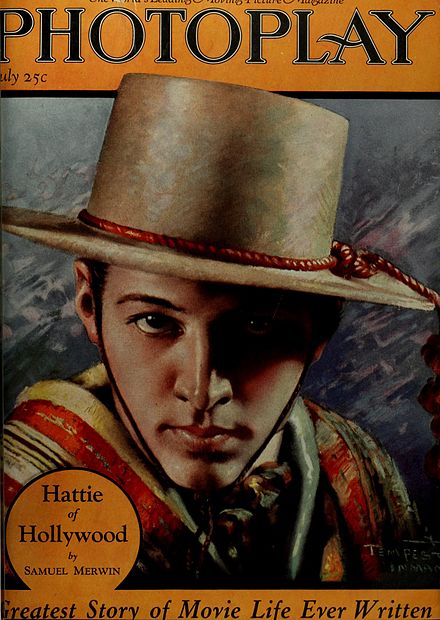
As America roared through the 20s, Hollywood’s fledgling film industry was itself roaring, the screen filled with stars such as Charlie Chaplin, Rudolph_ValentinoDouglas Fairbanks, Greta Garbo, and the roaring MGM lion. Come 1926, a new star would jump to the top of the heap, blazing a trail of sex and seduction. It almost didn’t happen.

Italian born Rodolfo Alfonso Rafaello Pierre Filibert Guglielmi di Valentina D’Antonguolla arrived at Ellis Island in 1913, at the age of 18. The young man who would eventually be known as the Latin Lover Rudolph Valentino took up residence in Central Park and on the streets of New York City. He found work as a taxi dancer (think “ten cents a dance”)at Maxim’s and became a”tango pirate,” a gigolo who sought out wealthy women at dances who were willing to pay for the company of handsome young men.

Valentino developed a relationship with a Chilean heiress who was unhappily married to a wealthy businessman. When she sued for divorce in 1915, Valentino testified that he had evidence of the husband’s having had multiple affairs. The ex-husband didn’t let bygones be bygones and on September 5, 1916, at his instigation, Valentino was arrested and charged with luring a young man into a whorehouse for white slavery. Valentino was jailed for several days before being cleared and released. A short time later the heiress shot her husband, and Valentino thought it wise to exit the scene. He headed to the opposite coast and began his meteoric rise to stardom.


Speaking of Tangoing Pirates

Another devilishly clever segue.

And it only takes one to tango here.

September 4, 1992: They’ll Never Replace Fart Jokes

You’ve got this great idea. Take all those funny home videos people sent you that were too risqué for the TV program Funniest Home Videos and use them to create a brand new TV program called Naughtiest Home Videos. Better still call it Australia’s naughtiestNaughtiest Home Videos because that’s where the racy adult program aired on September 4, 1992.

How racy? Well, there were shots of various animals’ private parts, both animals and humans humorously having sex (which not only begs the question how do you have sex humorously but also blurs the line between human and animal), people losing their clothing in unusual ways, an elderly woman removing an envelope from a male stripper’s skivvies using her dentures, two men lifting a barbell without using their hands . . . well, one could continue listing these hilarious bits but one would be in danger of laughing so hard one would pee one’s pants.

“I’d like to sincerely say that if we’ve offended just one of you, we’ve failed,” said the show’s host returning from the first commercial break. “We were hoping for half a million offended viewers by now.”

It took an agonizing 34 minutes for the network owner, who was enjoying a quiet dinner out with friends, to hear about the program and call the studio to cancel the program or, in his words, “get that shit off the air.” Almost immediately, a network announcer said: “We apologize for this interruption. Unfortunately, a technical problem prevents us continuing our scheduled program for the moment ” and the show made history, being the shortest running television series ever.

The following morning was not a pleasant one for anyone who had had anything to do with airing the program. They were berated loudly and had their careers cut just as short as Australia’s Naughtiest Home Videos.

Rabbits Behaving Badly?

As far as we know, there were no racy bits featuring anthropomorphic rabbits scheduled for the unseen portion of Naughtiest Videos. A much tamer depiction of the same had it’s beginnings a century earlier in a letter written on September 4, 1893, peterrabthat included an illustrated story about a rabbit named Peter. The letter was written by Beatrix Potter to the five-year-old son of her former governess, Annie Moore. Moore suggested that the story be made into a book.

Potter further developed the storyline, added additional illustrations, and in 1901, self-published 250 copies of The Tale of Peter Rabbit. Today with 45 million copies sold it remains one of the most popular children’s books of all time.

You Are So Rare

Howie Morris, born September 4, 1919, ( died 2005) was best known for his portrayal of Ernest T. Bass on the Andy Griffith Show and numerous characters on Sid Caesar’s Your Show of Shows.


SEPTEMBER 3, 1967: Swedish Switcheroo

The countdown to Dagen H (shorthand for Högertrafikomläggningen) had begun some four years earlier when the Swedish parliament passed the enabling legislation that would impact every Swede down in Swedenville. A commission (Statens Högertrafikkommission) would implement a major re-education program under the guidance of a team of psychologists.

On H Day, Sunday, September 3, 1967, at 1 a.m, all nonessential traffic was banned from roads throughout the country and at exactly 4:50, all remaining vehicles would come to a complete stop then carefully move from the traditional left side of the road to the right and stop again, taking care to avoid vehicles on this side moving to their right. At 5, traffic movement would resume with all drivers now (and forevermore) driving on the right side of the road.

The people of Sweden didn’t really want to switch to the right side of the road. They were perfectly happy of the left (being the liberals they are, perhaps) even though many of them drove vehicles with steering wheels on the left, a contributor to many accidents. And their nearest neighbors, Norway and Finland drove on the right. Five million vehicles crossed those borders every year and had to switch sides in the process.

Perhaps that explains the psychologists and all the commemorative items and the Dagen H logos on everything from milk cartons to underwear. There was even a popular song to celebrate the switch –“Håll dig till höger, Svensson” (‘Keep to the right, Svensson’).

And Svensson and all his or her fellow Swedes kept to the right and still do.

Heading South (Driving on the Right, Of Course)

It’s fortunate that the people of San Marino drive on the right, what with it being the only country with more automobiles than people. Not that there are all that many of either. Nestled high in the Apennine Mountains, the Most Serene Republic of San Marino is the world’s fifth smallest country and one of only three surrounded entirely by another country (Italy).

San Marino was founded as a monastic community by Saint Marinus, a Roman stonemason, on September 3, 301, making it the oldest sovereign state still in existence. It is one of the wealthiest countries in the world, with a stable economy, low unemployment, no national debt and a budget surplus. And all those cars.

Infinite Monkeys

Back to Sweden: In Stockholm, the newspaper Expressen gave five stock analysts and a chimpanzee the equivalent of $1,250 each to make as much money as they could on the stock market in one month.

Mats Jonnerhag, publisher of the newsletter Bourse Insight, turned in a nice performance. His stock portfolio gained $130. Not good enough. The stock-picking chimp (who went by the name Ola) saw the value of his portfolio climb by $190 for an easy victory.

While the stock experts carefully assembled their portfolios using a variety of analytical tools, Ola put aside such things as price/earnings ratios, volatility measures and technical factors in favor of darts, which he tossed at the Stockholm Stock Exchange listings.

Naysayers will no doubt bring up the infinite monkey theorem: that an infinite number of monkeys with an infinite number of typewriters and an infinite amount of time could eventually write the works of Shakespeare. Or the lesser quoted corollary that seven monkeys with seven typewriters in seven weeks could write the Republican Party Platform.

In a reported real-life attempt to prove either of these theories, two chimpanzees and an orangutan were put in a room with three typewriters. By the end of just 24 hours, they had written “jid;lwer fivcjfdoske flfjwlsjfpos p3mzds[sk,43l;cv kdid,ewodkdjss;djelldsd kdjhdps ddodlsps psvvspap39djk3^jh& jfioermcjd,ud3$m kidelqqwerty” Even more amazing: They had used exactly 140 characters which they tweeted (using the orangutan’s twitter account). It went viral.


You wouldn’t believe how many monkeys on how many beaches it took to create the stories in Calypso: Stories of the Caribbean.  Why not procure a copy and figure it out.

SEPTEMBER 2, 44 BC: O Tempora, O Mores

Some 2,000 years give or take before our current leader (?) kicked up his first tweetstorm another statesman/orator/philosopher launched the Roman equivalent of a tweetstorm. On September 2, 44 BC, Marcus Tullius Cicero delivered the first of a series of speeches known as the Philippics (or Philippicae in Latin) hectoring his favorite enemy Mark Antony.

As every schoolchild knows, a group of unhappy Roman senators had removed Julius Caesar from office a year earlier. Cicero had not taken part in the affair, but he heartily approved of it. In a letter written afterward, he said: “How I wish that you had invited me to that most glorious banquet on the Ides of March!”
Cicero was not a fan of Caesar’s protege, Mark Antony, either. He was convinced that Antony was planning revenge upon the Ides gang. Cicero’s attacks on Antony rallied the Senate in his favor and established him as the leading politician of his age.

Antony did not take these insults lightly (Cicero had called him a sheep and said he had small hands). He and his supporters prepared to march on Rome and “lock him up, lock him up,” forcing Cicero to hit the road.  But to no avail; Cicero was intercepted and executed.

“O tempora! O mores!” (Oh what times. Oh what standards.)

O Tempora, O Swine

Another Cicero might be more familiar to a lot of us. That would be Cicero Pig, a diminutive version of his famous Uncle Porky. He first appeared in the cartoon “Porky’s Naughty Nephew” as a bit of a brat. He was called Pinky at the time, then Algernon, and finally Cicero. He never went by the name Marcus Tullius, and no one ever called Marcus Tullius Pinky — although Mark Antony probably would have had he thought of it.

Never try to teach a pig to sing; it wastes your time and it annoys the pig.  — Robert Heinlein

Carry a Big Shtick

Vice President Theodore Roosevelt was somewhat of an orator himself.  He delivered a speech at the Minnesota State Fair On September 2, 1901 in which he publicly used the phrase with which he would always be associated:  Speak softly and carry a big stick; you will go far.  Four days later, President William McKinley was shot by an assassin and following his death eight days later, Roosevelt became President.

My father always wanted to be the center of attention.  When he went to a wedding, he wanted to be the bridegroom.  When he went to a funeral, he wanted to be the corpse. — Alice Roosevelt Longworth


SEPTEMBER 1, 1422: WHO’S GOING TO BURP THE KING?

On September 1, 1422, young Henry VI crawled (or perhaps toddled) onto the throne of England, succeeding his father Henry V. Little Henry was nine months old, a rather tender age to be an English monarch and, a few months later, King of France as well. A regency council ran the kingdoms until Henry hit 16 and was considered old enough to rule.

Kinging two countries isn’t a piece of cake. First off, its a killer commute, usually undertaken only by one country to invade the other. The French were not overjoyed at being ruled by an Englishman.  And one of them, Joan of Arc, was making a real nuisance of herself. Eventually Henry lost France and fell into a deep funk followed by an “inertia.” To use a more scientific description, he went wacko. (Observant readers will notice the inescapable connection between this incident and the Pat Boone hit song: When I lost France, I almost lost my mind.)

When Henry recovered 18 months later, he was surprised to discover he had a toddler of his own and that the toddler was named Edward, not Henry. Oh, and the War of the Roses was getting underway, during which Henry would lose the throne, regain it, lose it again, and end up murdered.

Henry VI remains the youngest king to ascend to the British throne and the only monarch to be both King of England and King of France.

TARZAN WOULDN’T LOSE FRANCE

Tarzan_of_the_Apes_1918Born on September 1, 1875, Edgar Rice Burroughs enjoyed a successful career as a pencil sharpener salesman. An honest occupation, but what do you do when you’re on the road, stuck in some cheesy motel with a bunch of sharp pencils? You either see how many you can fit into your ears or you write. Burroughs wrote. Prodigiously. In 1912, his most famous creation swung through a jungle near you in Tarzan of the Apes. And he kept on swinging through the decades, in two dozen books, including a few released after Burroughs’ death in 1953.

Tarzan was born with the rather ho-hum name, John Clayton. It was the apes who gave him the name we know him by. In their language (yes, they speak) tar means white, and zan means skin: Tarzan, clever, what? And Tarzan didn’t just swing around the jungle, as a short list of Tarzan adventures will demonstrate: Tarzan at the Earth’s Core, Tarzan and the Huns, Tarzan and the Foreign Legion, Back to the Stone Age, and Tarzan Rescues the Moon.

Tarzan became the star of radio, television, comics, stage, video and computer games, action figures and over 200 movies. Elmo Lincoln was the first of a whole gaggle of Tarzans which included Johnny Weissmuller, Buster Crabbe, and Lex Barker.  Burroughs didn’t like any of them.  And he didn’t like Enid Markey, the original Jane.  In fact, he disliked her performance so much that he killed Jane off in his next story.

tar4

Me Tarzan, you Jane.

This famous quote did not appear in either the original books or any of the movies.  Johnny Weissmuller uttered the words as a joke in an interview.

Me Paul, you Huey

If only I’d known it was available

Pencil it in to your copy wherever it seems appropriate.  Don’t have a copy?  Fix that here.

AUGUST 31, 1928: LOOK OUT FOR LOTTE LENYA

With music by Kurt Weill and words by Bertolt Brecht, Die Dreigoschenoper premiered in Berlin in 1928. By 1933, when Brecht and Weill were forced to leave Germany, the musical comedy which offers a socialist view of a capitalist world had been translated into 18 languages and performed more than 10,000 times. We of course are more familiar with the English title, The Threepenny Opera.  And we’re mostly familiar with the opening song which has been sung by practically everyone, most notably, Frank Sinatra, Louis Armstrong, Ella Fitzgerald in a grammy-winning performance, and Bobby Darin who made it the top song of 1959 – “Die Moritat von Mackie Messer” (“The Ballad of Mack the Knife”). The song was added just before the premiere, when the actor playing Macheath threatened to quit if his character did not receive an introduction.


At the beginning of the play, we meet Jonathan Jeremiah Peachum, a London entrepreneur who runs the city’s begging operation, training the beggars and taking a nice chunk of their earnings. He is the perfect capitalist, a man who today would work for Goldman Sachs.

But Peachum has problems: his grown daughter Polly did not return home the previous night, and Peachum fears she has been misbehaving, and worse still, misbehaving with the ne’er-do-well Macheath.  Peachum does what any worried father would do – he determines to thwart this budding relationship by taking away her cell phone and having her paramour hanged.

Fade to Macheath who is preparing to marry Polly once his gang has stolen her trousseau. After the gang has stolen some food and a table, they all enjoy a wedding banquet. Polly entertains with a charming little song about a maid who becomes a pirate queen and executes her former bosses and customers. The Chief of Police, Tiger Brown, joins the party. It seems he had served with Macheath during the wars and had, over the years, exerted his influence to keep Macheath out of jail. He and Macheath sing. Polly returns home and lays the fact that she has married Macheath on her parents who are not amused. She sings a charming little song advising them to go fuck themselves, bringing the first act to a conclusion.

In Act Two, Polly warns Macheath that her father is gunning for British bear and that he must leave London. He agrees and leaves his gang in Polly’s hands. On his way out of town, Macheath stops at his favorite brothel, where he sees his ex-lover, Jenny. They sing a charming little song (“Pimp’s Ballad”) about their days together, but (the plot having thickened) Jenny has been bribed by Mrs Peachum to turn him in. Despite Brown’s apologies, he’s powerless and must drag Macheath away to jail. Macheath sings a charming little song about his life being over.   Another girlfriend, Lucy (Brown’s daughter) and Polly arrive at the same time from stage right and stage left, respectively.  A nasty argument ensues and together they sing a charming little duet about scratching each other’s eyes out. After Polly leaves, Lucy engineers Macheath’s escape, bringing the act to a tidy conclusion.

In Act Three, Jenny selfishly demands her money for the betrayal of Macheath, which Mrs Peachum refuses to pay.  Jenny nevertheless reveals that Macheath is at Suky Tawdry’s house, and he is once again arrested. Back in jail and scheduled to be executed, Macheath desperately tries to raise the bribe money to get out again, even as the gallows are being erected.  But no one comes to his aid, and Macheath prepares to die.  He laments his fate in a charming little song.  But what’s this? A deus ex machina enters stage left. Peachum announces that in this opera mercy will prevail over justice, and in a parody of a happy ending, a messenger from the Queen arrives to pardon Macheath and grant him a title, a castle and a pension. The play then ends with a plea that wrongdoing not be punished too harshly as life is harsh enough.

AUGUST 30, 1794: PENNY WISE, POUND FOOLISH

In the late 1800s, many of the unfortunates who found themselves in English prisons were there as a result of debts they could not pay. Benjamin Pope had a different story; he found his way to prison for a debt he could easily have paid. Pope was a tanner and quite successful in his trade, enough so that he gave up tanning and became a money-lender and mortgagee. He proved successful at this endeavor as well, earning the nickname “Plum Pope.”

     Alas, his good fortune began to desert him, in no small part because of his greed. His grasping ways in the lending of money led him afoul of the usury laws, and he was frequently brought before the court. In one particularly blatant case, he was fined £10,000.

Instead of paying the fine, he stole away to France with all his property. There, he complained bitterly to anyone who would listen about the unfairness of the English laws. The French naturally commiserated. Nevertheless, he eventually returned to England, but still refused to pay the fine. He went to prison instead. At one point, he could have secured his release by paying just £1000 of the £10,000 fine. Not Plum Pope.

     While in prison, he carried on his avocation as a money lender, albeit on a more limited and cautious scale. While always a penny-pincher, he became more so and more eccentric about it. He would drink beer with anyone who would give it to him, but would never buy it. He would not eat meat unless it was given to him. He chewed his gum twice. When he died on August 30, 1794, after 12 years in prison, he still owed the debt that had sent him there, even though he left behind more than enough to pay it.

Any man who would walk five miles through the snow, barefoot, just to return a library book so he could save three cents — that’s my kind of guy. — Jack Benny

AUGUST 29, 1769: WICKED WITCH OF THE WHIST

In 1769 London, a gentleman died at the ripe old age of 97. Although little is known about the gentleman himself, his name has traveled down through the years and is more familiar to us today than to those who might have rubbed elbows with the man back in the eighteenth century. His name was Edmond Hoyle, and although he was a barrister by trade, he is now known for law only as it applies to games of chance. And he is much more recognized by his nickname ‘According to.”

     Hoyle laid down the law for the game of Whist in a widely circulated treatise on the subject. He also had a great deal to say about backgammon, quadrille, piquet, and chess. He was, we might surmise, one of those wet blankets who must rain on card-game parades (to jumble metaphors, about which Hoyle had nothing to say) with their whining “but the rules say” or “according to Hoyle.”

     But Whist was his long suit. This venerable game provides ample material on which to pontificate, and pontificate Hoyle did. A forerunner of Bridge, Whist is all about taking tricks. Who takes them, and when and how and why gives the game a wide variety of flavors from which to choose. There’s Knockout Whist, a game in which a player who wins no trick is eliminated, sent to stand in a corner; Solo Whist, a game where individuals can bid to win 5, 9 or 13 tricks or to lose every trick; Kleurenwiezen, an elaborate Belgian version of the game, filled with Gallic mischief; Minnesota Whist, played to win tricks or to lose tricks (talk about flexibility); Romanian Whist, a game in which players try to predict the exact number of tricks they will take; German Whist for two very aggressive players who take tricks from Poland without prior warning; Bid Whist in which players bid to determine trump and one player is a dummy who sits out the hand; and Danish Whist, in which the dummy brings pastries to the other players.  But England lays claim to most of the true Whist players. It is easy to imagine a group of eighteenth century British aristocrats at their club. “Shall we have a go at a spot of Whist?” “Capital idea.” “Jolly.” “According to Hoyle . . .”


AUGUST 27, 1938: POETS GONE WILD

Some say the world will end in fire, / Some say in ice. / From what I’ve tasted of desire / I hold with those who favor fire.

     It is pretty well agreed that Robert Frost was among the best American poets of the twentieth century. Both popularly and critically acclaimed, he received four Pulitzer Prizes for Poetry. It’s also pretty much agreed that Frost was not a warm and fuzzy individual, that he leaned more toward nasty and tyrannical behavior. It was also said “that he tolerated rivals badly, that he was a prima donna who was never content to share the center of the stage.”

     Perhaps the incident of August 27, 1938, was just an accident or Frost’s mind was wrapped up in his poem, “Fire and Ice.” Nevertheless, his behavior – or misbehavior – looked a bit suspicious.  On this night, writer Archibald MacLeish visited the Breadloaf Writers Conference to read his poems and radio plays at a gathering in the hills above Middlebury, Vermont. Frost was among the attendees, sitting in the back. As MacLeish read from his poetry, Frost began heckling him. “Archie’s poems all have the same tune,” he said in a stage whisper. Then just as MacLeish read the single-sentence poem, “You, Andrew Marvell,” smoke filled the room. Frost had somehow set fire to some papers and was busily beating them out and waving away the smoke.

     Most people accepted Frost’s explanation that it was an accident, and the reading continued. MacLeish, still the center of attention, was asked to read from one of his plays. Frost was not finished. His wisecracks from the back of the room became steadily harsher and more barbed. He interrupted, he commented, he took exception. What may have been innocent literary give and take turned into a clear effort to frustrate and humiliate MacLeish, and the situation became increasingly painful to those in the room.  Finally, Bernard DeVoto, a scholar and friend of Frost, had had enough. He shouted: “For God’s sake, Robert, let him read!” Frost ignored him, but a few minutes later snarled savagely and stomped out of the room and down the road not taken.

Pausing for a moment to wish Linda a happy birthday.