November 16, 1620: Kansas in August

After having lived for months on board ship in cramped, dirty, smelly quarters, the Pilgrims finally sailed into Provincetown Harbor in November of 1620. On November 16, a group of 16, led by Myles Standish (also known as Captain Shrimp behind his back, being a tad short of stature) set off to explore the nearby environs.

They found fresh water at a place called Pilgrim Springs. (It wasn’t called that at the time they arrived.) Then at the top of a hill, hidden in a teepee, they found a cache of a funny sort of food — long ears with tidy little rows of yellow kernels. They called it corn and promptly stole it. The hill itself they called Hill Where We Stole the Corn from the Natives. That being quite a mouthful, it quickly got shortened to Corn Hill.

From this point the long historical march began to “I’m as corny as Kansas in August” and high fructose corn syrup.

What, you’re shouting — they just up and called it corn?

Yes kids, they did, but it’s really not that a-maize-ing (sorry). The word corn to Europeans at the time simply referred to grain, any grain. In England, wheat was “corn,” in Ireland oats were “corn” and in Indonesia rice was “corn.”

Today, Americans, Canadians and Australians are the only ones that call the yellow ears corn, To most people, it’s maize as in “I’m as maizy as Kansas in August.”

November 15, 1492: According to the Surgeon General

Rodrigo de Jerez secured his place in history as a trailblazer way back in 1492. He and a companion, Luis de Torres were crewmen who sailed to the Americas aboard the Santa Maria as part of Christopher Columbus’ first voyage.

While in Cuba, which members of the voyage assumed to be China (Columbus knew the world was round but thought it rather tiny), Rodrigo and Luis, hoping to meet the great Khan of Cathay, ran into some native Cubans. Perhaps they had never actually seen a native of China or perhaps, to Spaniards, everyone else in the world looked alike. Nevertheless, they were columbus_tobaccobefriended by the Cubans, never realizing they might just as easily have been eaten.

The Cubans were taking a smoke break, and they invited Rodrigo and Luis to join them. According to Rodrigo, they had wrapped some dried leaves in something that looked sort of like a paper musket. To the Spaniards’ surprise, they lit one end with a flame and pushed the thing into their mouths, “drinking the smoke” from the other end. Luis wanted nothing to do with it, finding it a filthy habit, most likely addictive, and socially repugnant. But Rodrigo being, as previously mentioned, a trailblazer, jumped right in, thereby becoming, right there on November 15, 1492, the first European to ever smoke tobacco.

The natives believed that tabacos, as they called it, was a gift from the Creator and that the exhaled tobacco smoke was capable of carrying one’s thoughts and prayers to heaven. Rodrigo just thought smoking was sophisticated and cool.  Almost immediately, he became a confirmed two-pack-a-day man.

Rodrigo brought the habit back to his hometown (despite signs posted all over the Santa Maria saying Thank you for not smoking), but the cloud of smoke billowing from his mouth and nose gave his neighbors such a fright that the holy inquisitors imprisoned him for seven years. By the time he left prison, smoking was de rigueur.

November 14, 2006: Wings on a Pig

When the first Pig Stand opened, it was a restaurant like no other that had gone before. The year was 1921, the onset of the Roaring Twenties. Americans were in love with their pigstandautomobiles. More than eight million Fords and Oldsmobiles and Pierce Arrows roamed newly created highways.

Located on a Texas highway between Dallas and Fort Worth, the Pig Stand catered to those automobile folks – the first drive-in restaurant in the United States. The restaurant’s owner, Dallas entrepreneur Jessie Kirby, reckoned that all those drivers would flock to a roadside barbecue where they could drive up, fill their faces with good Texas vittles, and drive off, without ever stepping out of their automobile. “People with cars are so lazy,” said Kirby, “they don’t want to get out of them.”

Kirby was a showman who knew how to attract customers. The Pig Stand had a red-tiled pagoda-like roof set on a rectangular building framed of wood and covered in stucco. As a customer was pulling in, teenage boys in spiffy white shirts and black bow ties would dash over to the car, hop onto the running board, and take an order – before the driver even came to a stop. For this derring-do, the servers were given the nickname carhops. Food historians credit the Pig Stand with the introduction of deep-fried onion rings, chicken-fried steak sandwiches, Texas Toast and high cholesterol.

The Pig Stand was a big hit with hungry drivers, and it soon became a chain, through one of the first franchising arrangements in restaurant history. Pig Stands popped up everywhere. By 1934, there were more than 130 of them in nine states, sporting the slogan “America’s Motor Lunch.” And dinner – Pig Stands boasted that more than 5,000 people enjoyed pig sandwich dinners every evening in Dallas alone. Pig Stand drive-ins soon replaced male carhops with attractive young women on roller skates, but maintained the formula that had got them this far: good-looking young carhops, tasty food, and speedy service – all in the comfort of your automobile.

Wartime gasoline and food rationing took its toll on the Pig Stand chain. And then came McDonald’s.  And Burger King.  And Wendy’s. By the end of the 1950s, all of the Pig Stand franchises outside of Texas had closed. And by 2005, only six remained in the state. Then on November 14, 2006, state officials closed the last two Pig Stands restaurants for unpaid sales taxes. And an icon oinked off into the Texas sunset.


November 13, 1953: When Red, Red Robin Comes Bobbin’ Along

In the early 50s, folks worked themselves up into a real dither searching for Bolsheviks here, there, wherever they may be hiding. There was a commie round every corner; any person you met might be a secret pinko, hoping to lead you down the slippery slope to socialism and the dreaded one world.

We remember Joseph McCarthy and the infamy of his search for traitors in the State Department, Hollywood and the PTA. But there were many McCarthy wannabes – good folk just itching to unveil a neighbor or loved one’s clandestine proclivities and nefarious schemes to indoctrinate the unaware.

Mrs. Thomas J. White of the Indiana Textbook Commission, was a bit of a zealot when it came to finding Communist propaganda in the seemingly innocent written word. On November 13, 1953, she announced an amazing discovery in textbooks used by the state’s schools. She called for the banning of the book Robin Hood and any references to it.

There was, she said, “a Communist directive in education now to stress the story of Robin Hood because he robbed the rich and gave it to the poor. That’s the Communist line. It’s just a smearing of law and order and anything that disrupts law and order is their meat.” On somewhat of a roll, she went on to attack Quakers because they “don’t believe in fighting wars.” This philosophy, she argued, played into communist hands.

Not everyone in Indiana jumped on her bandwagon. Reacting to criticism, White claimed that she never argued for the actual removal of offensive texts, but reiterated her position that the “take from the rich and give to the poor” theme was the Communist’s favorite policy. “Because I’m trying to get Communist writers out of textbooks, my name is mud. Evidently I’m drawing blood or they wouldn’t make such an issue out of it.” The response to Mrs. White’s charges was mixed.

Indiana’s governor defended the Quakers, but sidestepped the textbook issue. The superintendent of education, having it both ways, said that the book should not be banned, but agreed that Communists had twisted the meaning of the Robin Hood legend. Commentators throughout the world were thoroughly amused. The “enrollment of Robin Hood in the Communist Party can only make sensible people laugh,” said the Russians. Even the current sheriff of Nottingham chimed in: “Robin Hood was no Communist.”

Robin Hood was spared, free to rob from the rich another day. Other books during the Red Scare were not so fortunate: The Grapes of Wrath, Civil Disobedience, 1984, Johnny Got His Gun to name a few. Hollywood also felt the pressure to produce pro-American stories. And then there was that other obviously Communist-inspired phenomenon, rock and roll.  We won’t even mention those merry men.

November 12, 1933: It Came from Beneath the Sea

Hugh Gray was walking along a loch after church when he spotted a brouhaha in the nearby water. As he looked on, a massive creature rose up from the lake. The quick-thinking Scotsman took several pictures of it (why he had a camera when he had been to church is anyone’s guess). Only one of the pictures he took on November 12, 1933, turned out; it looked a lot like a plesiosaur frolicking in the water. Some naysayers suggest it looked more like a dog carrying a stick swimming towards the camera, but the legend of the Loch Ness Monster was born nevertheless, as was the science of cryptozoology, the study of animals that don’t exist (such as Bigfoot and Rudy Giuliani).

While Nessie, as those on a first-name basis call it, is a bona fide cryptid, the monster that showed up on a beach just south of Florence, Oregon, on November 12, 1970, was not. It was the real thing – an 8-ton, 45-foot-long sperm whale. For a while the creature, which had been dead for some time, was a curiosity for locals and visitors alike, something more dramatic than the typical flotsam and seashells they usually found on the beach. But then it began to smell.

The task of dealing with the carcass fell to the state Highway Division, and it presented a monster problem. If the carcass were buried, it would simply be uncovered by the ocean tides. Oregon officials consulted U.S. Navy officials (division of cetacean disposal) and hatched the ingenious plan to blast the behemoth into a billion bits of blubber using a bunch of dynamite – little morsels that would then be devoured by seagulls.

The engineer in charge of the operation said that he wasn’t exactly sure how much dynamite would be needed, but a half ton of dynamite was finally applied to the carcass. Walter Umenhofer, a military veteran with explosives training, happened to be beachcombing at the scene. He warned the engineer that the amount of dynamite he was using was a tad excessive – 20 sticks was about right, not the 20 cases that were being used. Umenhofer said the engineer was not interested in his advice.

Needless to say, the explosion didn’t go as planned. The blast pulverized only part of the whale, sending pieces soaring — not toward the ocean, as hoped, but toward people watching from the dunes. No onlookers were seriously hurt, but they were pelted by bits of smelly blubber. And as an added thanks for butting in, Walter Umenhofer’s brand-new Oldsmobile was flattened by a chunk of falling blubber after the blast. He had just bought the Ninety-Eight in Eugene, during a “Get a Whale of a Deal” promotion.

After onlookers scurried away, the Highway Division crew buried the remaining whale. The seagulls who were supposed to dine on whale tidbits were found wandering in a daze in Utah and Wyoming.

November 11, 1817: If You Believe This You’ll Swallow Anything

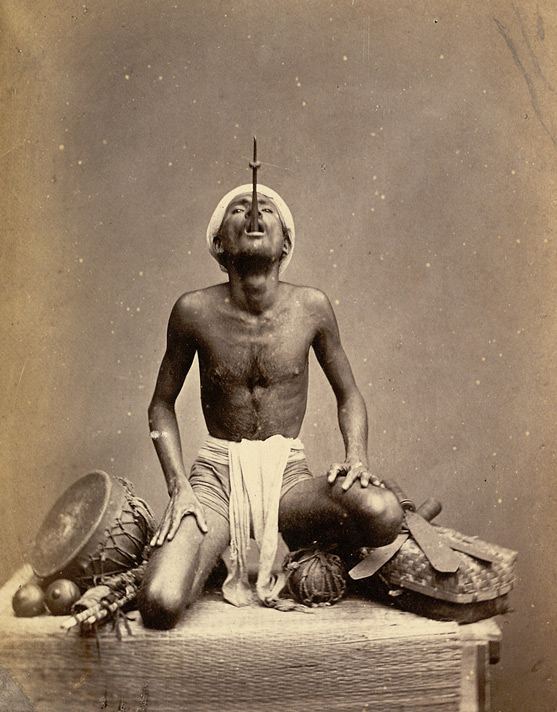
When New Yorkers paid their $1 admission price to enter St. John’s Hall swordon November 11, 1817, they were prepared to be amazed. And amazed they were, by an Indian juggler Ramo Sammee (also known as Senna Samma or Samaa because to Americans all Indian names sound alike).

What New Yorkers witnessed that day was not just another juggling act; no, Ramo stupefied the spectators by swallowing a sword. Now Indian street performers had been swallowing swords for centuries — along with climbing ropes into mid-air and staring down cobras –but this was a first for this continent. Sword swallowing in this country presented its own kind of danger as demonstrated later that month by the announcement that Ramo would be swallowing a new sword of American manufacture as “a substitute for the one lately stolen from him by some villain.”

Ramo continued to swallow that sword and others, gaining a certain fame, until his death in 1850. Live by the sword . . .

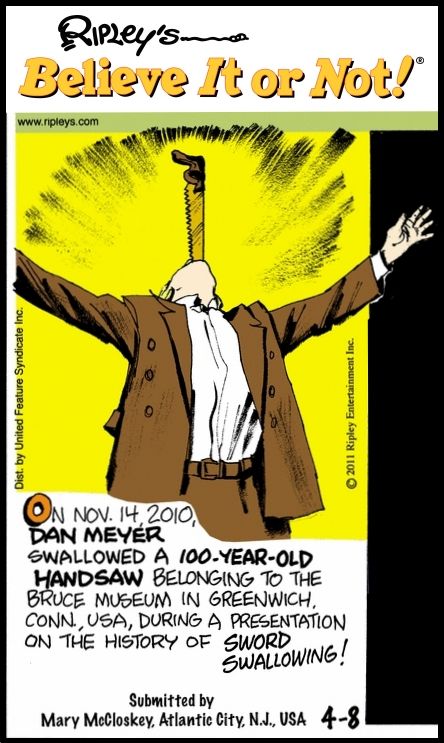
Those who followed Ramo, particularly in this country, sought to distinguish themselves with longer swords, multiple swords, hot swords, cutlasses, bayonets and even glowing neon Star-Wars swords.

The Sword Swallowers Association International (yes, there is one) reports that there are fewer than a dozen professional sword swallowers actively performing today. That led the association to create World Sword Swallowers Day (yes, there is one) “to honor and celebrate these courageous and daring performers” and to bring together dozens of amateurs and professionals for a sword swallowing extravaganza. The celebrations help raise funds for the Injured Sword Swallowers Relief Fund (yes, there are injuries).

And occasional deaths. But — mea culpa for misleading you — Ramo Sammee did not die by the sword.

November 10, 1903: Cold, Cold, Cold Was the Trolley

It was a typically nasty winter day — wet and cold — in New York City at the dawn of the 20th century, when Mary Anderson, an out-of-towner took a typical tourist trolley ride. There wasn’t a whole lot to see with sleet clinging to the windows. In fact, Mary observed that the driver of the streetcar himself could barely see through the front windshield. The trolley’s front window had supposedly been designed for bad-weather visibility: it was made up of individual panes that could be opened when covered by rain or snow, allowing the driver to peer out through the opening. Hardly high tech. Not only did it do little to improve the driver’s ability to see where he was going, it left him with an ice-encrusted face, and chilled the passengers as well.

Right there, while sitting in the cold trolley, Mary began to sketch a mechanical device that would wipe the trolley’s windshield. Her invention had arms made of wood and rubber that were attached to a lever near the steering wheel of the drivers’ side. By pulling the lever, the driver could drag the spring-loaded arm across the window and back again, wiping away raindrops, snowflakes, sleet, dead birds, what-have-you. The wipers could easily be removed when meteorologists prophesied sunny skies.

Mary returned home to Birmingham, Alabama, and applied for a patent. On November 10, 1903, she received U.S. Patent No. 743,801 for her “window cleaning device for electric cars and other vehicles to remove snow, ice or sleet from the window.” Alas, she was an inventor ahead of her time. She made not a penny for her cleverness. And yet within ten years windshield wipers were standard issue in passenger cars everywhere.

In 1917, another woman, Charlotte Bridgewood, patented the “Electric Storm Windshield Cleaner,” an automatic wiper system that used rollers instead of blades. (Her daughter had already invented the turn signal.) But like Mary Anderson, Charlotte Bridgewood never made any money from her invention. Another type of automatic windshield wiper came onto the scene in 1921. Called “Folberths,” after their inventors, these wipers were powered by a device connected by a tube to the inlet pipe of the car’s motor.

The male Folberths profited from their invention, which may lead some to believe that wiping devices were at work on glass ceilings as well as windshields.


November 8, 1957: Flying Too High

Pan Am’s Flight 7 was known as the Clipper Romance of the Skies, an around-the-world flight that originated in San Francisco and flew west, eventually arriving in Philadelphia. The plane itself was a Boeing B-377 Stratocruiser. Introduced in 1947, the aircraft was the biggest, the fastest, and the fanciest, called “the ocean liner of the air.”

Pullman-style sleeping berths, separate men’s and women’s dressing rooms, a cocktail lounge in the belly of the airplane, reclining seats that offered 60 inches of something they used to have called legroom. Seven-course dinners, with champagne and caviar, catered by Maxim’s of Paris. This you could happily go through searched luggage and patdowns for, but there weren’t any.

Of course it was expensive – a $1,600 round-the-world fare (equivalent to $10,500 today).

When the November 8, 1957, flight left the gate shortly before noon for its first leg, the nine-and-a-half-hour flight to Honolulu, 38 passengers were aboard. They included the vice president of Renault Auto, a French flying ace, the general manager of Dow Chemical in Tokyo, a well-known Phoenix dress designer, a Louisville surgeon, a spice company honcho, and a U.S. Air Force major on a mysterious mission to southeast Asia with a briefcase full of classified documents.

At 4:04 p.m., the flight captain radioed a routine position report from an altitude of 10,000 feet to the Pontchartrain, a Coast Guard weather ship stationed in the Pacific. Romance of the Skies had just passed the point of no return, on course and on schedule, 1,160 miles from Honolulu and about 10 miles east of the Pontchartrain. The skies were clear and the seas calm, the sun low in the western sky. The plane was never heard from again.

The biggest air-sea search since the disappearance of Amelia Earhart ended just days later with the discovery of 19 bodies and floating wreckage about 1,000 miles northeast of Honolulu. And the little that was recovered from the flight only deepened the mystery. There had been no distress call; the location of the debris showed that the Clipper was well off course; and, finally, elevated levels of carbon monoxide were found in several of the recovered bodies.

The definitive cause of the accident has never been determined. Speculation includes a malfunctioning engine, a disgruntled flight crew member, and insurance related fraud that involving an explosive device. And then there’s that mysterious major.

Way Bigger Than a Breadbox

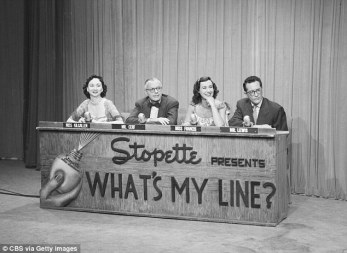
To most people, Dorothy Kilgallen was known as a long-time panelist on the television game show What’s My Line? (Does ‘Is it bigger than a breadbox?’ ring a bell?) or as a high society New York newspaper columnist. She was also throughout her career a rather enterprising reporter. Her journalism coming out party was a 1936 race around the world against two male colleagues. Her cabled columns and a book Girl Around the World made her a celebrity.
In 1963, she once again took up the role of daring reporter. According to a biographer, Kilgallen was devastated when President Kennedy was shot by Lee Harvey Oswald. She was among those who refused to believe that Oswald acted alone. She spent the next two years in her own investigation of the assassination, gathering evidence and conducting interviews. She was the only reporter to interview Jack Ruby, and she somehow got hold of an advance copy of the Warren Commission report even before President Lyndon Johnson had seen it. He was miffed.

So was J. Edgar Hoover. The FBI and CIA both began to follow her and her friends. She was interrogated, and her phone was tapped. In 1965, she told her lawyer that she was going to break the real story and that it would be the scoop of the century. She planned to meet a secret informant in New Orleans.

On November 7, she appeared on What’s My Line? as usual, and afterward wound down with a few drinks along with other members of the show before returning to her apartment. The next day — November 8, 1965 — she was found dead, sitting up in bed in a blue bathrobe and still wearing in her hair a floral accessory from the previous evening. On her nightstand, an empty sleeping pill bottle and a drinking glass. The police playing the bumblers they traditionally play in detective fiction found nothing suspicious. Her death was attributed to an accidental overdose.

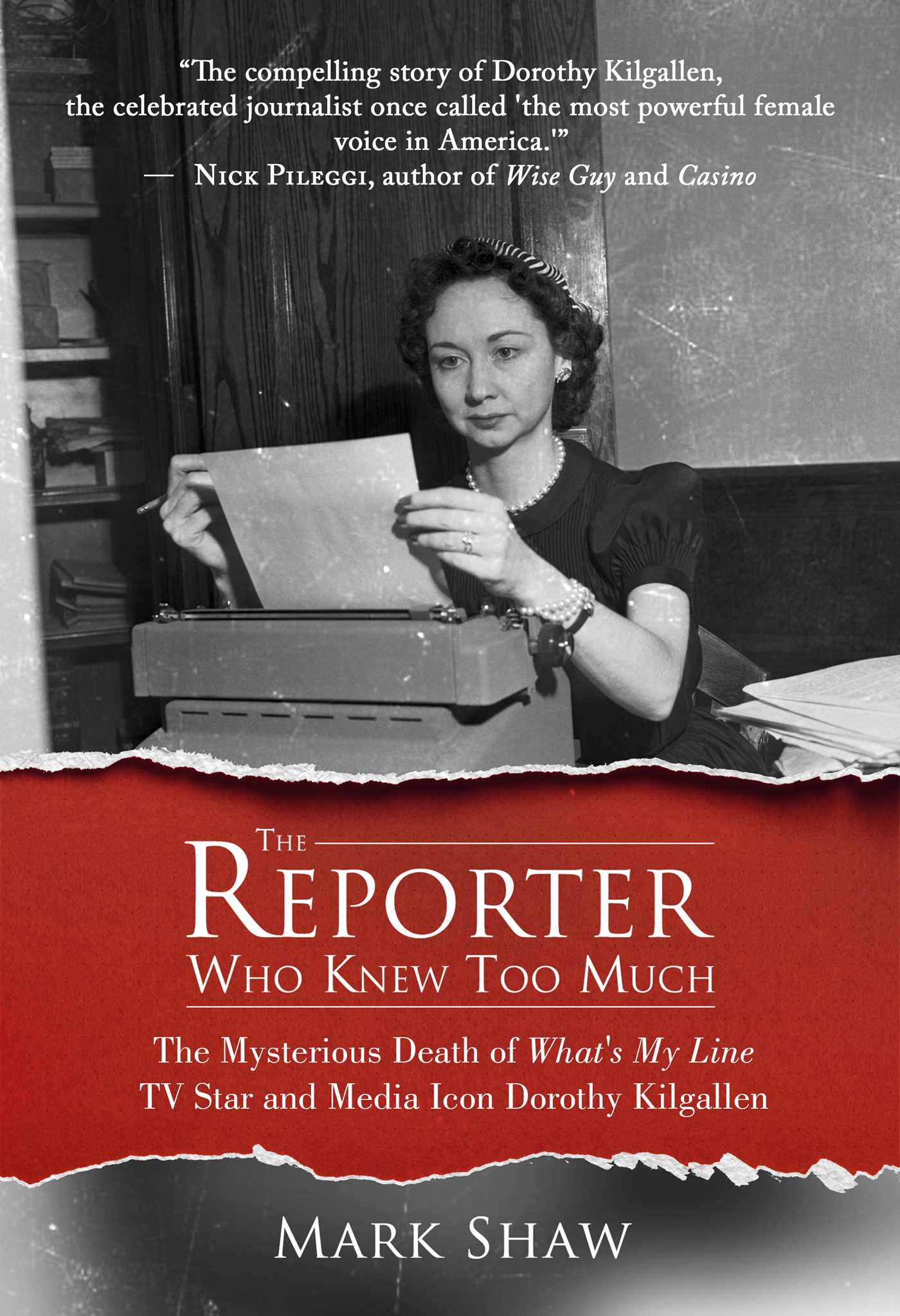
Loose ends included the fact that her accumulated evidence had gone missing, that she was found in a bed she never slept in wearing clothes she never wore to bed, that she had recently bought a gun telling her hairdresser she was ‘scared for her life.’ Lawyer and author Mark Shaw suggested in a 2016 book The Reporter Who Knew Too Much that Kilgallen’s death was orchestrated by a mobster who feared her book would name him as the mastermind behind Kennedy’s assassination.


November 7, 1811: Tippecanoe and So Do You

Long before the confederacy of southern states, United States forces faced the uprising of a confederacy under the Shawnee leader and Native American folk hero Tecumseh who had visions of a Midwestern Indian nation allied with the British. Confederacy forces led by Tecumseh’s brother Tenskawatawa (One with Open Mouth) met government forces under the direction of William Henry Harrison, Governor of the Indian Territory, on November 7, 1811, in the Battle of Tippecanoe (and Tyler too).

The battle took place in Indiana, at the confluence of the Tippecanoe and Wabash too Rivers. The day gave government forces an important political and symbolic victory and dealt a devastating blow to Tecumseh’s confederacy. Public opinion in the United States blamed the entire brouhaha on buttinsky Brits. The War of 1812 broke out only six months later.

The Battle of Tippecanoe (and Tyler too) also served as an important springboard for Harrison’s political ambitions which culminated in his becoming president in 1841. At the age of 68 years and 23 days when inaugurated, Harrison was the oldest president to take office until Ronald Reagan in 1981. During the campaign, Democrats characterized Harrison as an out-of-touch old fart (One Who Sits in Log Cabin Drinking Hard Cider). Harrison and running mate John Tyler (and Tippecanoe too) turned the tables on the Dems, adopting the log cabin and hard cider as campaign symbols along with one of the most famous campaign slogans ever (Tippecanoe and you know who).

Harrison caught cold shortly after his inauguration and went quickly from bad to worse. Harrison’s doctors tried applications of opium, castor oil, leeches, and Virginia snakeweed too. But to show his disdain for modern medicine, Harrison became delirious and died. He served only 32 days in office – some would say the perfect tenure for any politician.


November 6, 1982: Antifreeze and Old Lace

In Arsenic and Old Lace, a delightfully dark stage play adapted into a movie by Frank Capra, Mortimer Brewster (Cary Grant) has an eccentric family that includes two brothers – one of whom thinks he’s Theodore Roosevelt digging the Panama Canal in the basement, the other a killer who’s had plastic surgery to make him look like Boris Karloff – and two spinster aunts who have taken to murdering lonely old men by poisoning them with home-made elderberry wine laced with arsenic, strychnine, and “just a pinch” of cyanide. Generally, poisoners aren’t as sweet as these two old ladies.

Take the case of Shirley Allen, arrested on November 6, 1982, charged with murdering her sixth husband Lloyd. Shirley certainly wasn’t as sweet as the two old ladies, nor nearly as successful. Her first attempt at poisoning was believed to be an early husband, Joe Sinclair, back in 1968. When his coffee began to taste odd, he didn’t buy the idea that it was the newest flavor of the month, reasoning that Juan Valdez Free Trade Almond Praline Decaf should not give him internal injuries.  Joe went to the police, but no charges were filed. He filed for divorce, however.

Another husband, John Gregg, was not so lucky. He died a year after he married Shirley. He must have sensed that something was amiss because he changed the beneficiary of his insurance policy shortly before he died. Shirley got nothing. As you might guess, she was miffed. A pink-haired, large-bosomed barfly was rather happy, however.

Lloyd Allen was Shirley’s sixth husband. He began to complain of a strange taste in his beer. When Shirley said that it was an iron supplement that would put a tiger in his tank, Lloyd believed her and promptly died. This time she was named as beneficiary of a $25,000 life insurance, but alas her daughter told police about the doctored beers. Toxicology reports confirmed that Lloyd’s body tissue contained a lethal amount of ethyl glycol – antifreeze. Shirley went to prison for life. She was never allowed to work in the prison cafeteria.