March 2, 1985: Steering the Ark of Decorum to Saner Shores

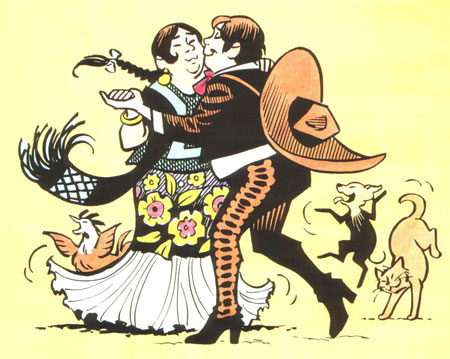
When he put down his pencil on March 2, 1985, Gus Arriola brought to an end a classic comic strip that had endured for 45 years, appearing in as many as 270 newspapers. During that span, Gordo (meaning Fatso) had evolved from a Mexican version of Li’l Abner — a lazy, overweight bean farmer who fit the American stereotype of Mexicans (but not yet as rapist and murderer) — to an “accidental ambassador’ for Mexican culture.

Arriola wrote, illustrated and produced the strip throughout its run except during a stint in the army, although he regularly used tongue in cheek pseudonyms such as Overa Cheever, Liv Anlern, Kant Wynn, and Bob N. Frapples for his Sunday strips.

Along with Gordo, there were his nephew Pepito, poet Paris Juarez Keats Garcia, housekeeper Tehuana Mama and the widow in hot pursuit of bachelor Gordo, Artemesia Rosalinda Gonzalez. And pets Poosy Gato, Señor Dog, and Bug Rogers (a spider).
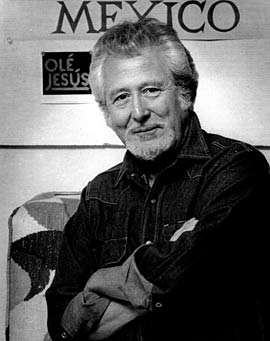
As Arriola became aware of the strip’s cultural influence over the years, he began to present Gordo as a more complex sympathetic character — more depth, less girth. In 1954, Gordo lost his farm and went to work as a tour guide, traveling throughout Mexico and presenting a more nuanced view of Mexican life.

Charles Schulz said Gordo was “probably the most beautifully drawn strip in the history of the business.” Arriola died in 2008.

Gordo strip for March 2, 1985:

Th-th-that’s All Folks

On March 2, 1935, Warner Brothers introduced a new cartoon character name of Porky Pig.  Next day on his dressing room, they hung a star, and Porky went on with the show for another 153 cartoon appearances,  Warner’s longest running character.

December 31, 1920: Don’t Go Near the Indians

New Year’s Eve, aka the seventh day of Christmas, is the day we shuck off this year with a lot of over the top partying, letting mirth run rampant before we face the sobering of the coming year. Two of the more noble New Year’s Eve traditions are Drinking and the making of Resolutions. The former is often accomplished with Wassail, a bowl of spiced ale around which folks gather and drink to each other’s health until someone gets sick.  The latter is the solemn promise we make to the empty Wassail bowl never to drink again. Mark Twain on resolutions: “Next week you can begin paving hell with them as usual. Yesterday, everybody smoked his last cigar, took his last drink, and swore his last oath. Today, we are a pious and exemplary community. Thirty days from now, we shall have cast our reformation to the winds and gone to cutting our ancient short comings considerably shorter than ever. We shall also reflect pleasantly upon how we did the same old thing last year about this time.” ~Mark Twain

A proper resolution might go something like this: I hereby resolve to read Wretched Richard’s Almanac every day so that I might be well informed, sophisticated and attractive. And I will recommend it to all my friends so they too might be well informed, sophisticated and attractive.

The seventh ghost of Christmas enjoyed his wassail while regaling Scrooge with the painful memory of his Junior Prom when the girl of his dreams broke their date because her grandmother died, she had a hangnail or she was grounded for misbehaving with the captain of the football team — take your pick.  True Love celebrated in his or her predictable fashion with a gifts of the avian persuasion, to be specific seven swans a-swimming.  That’s a bird count of 28 thus far.  No, make the 27; one of the calling birds made the mistake of calling the cat.

About Those Indians

It was 1949 and executives at Republic Pictures had a brainstorm – let’s take that nice clean-cut guy hanging around the studio and make him a cowboy – maybe even a singing cowboy – he’ll be a God-fearing American hero of the Wild West, wearing a white Stetson hat; he’ll love his faithful horse (platonic, of course); and maybe he could have a loyal sidekick who shares his adventures. We’ll call him the Arizona Cowboy (Arizona isn’t already taken, is it?) And so Rex Allen, born December 31, 1920, came to a silver screen near you,  joining such singing cowboys as Roy Rogers and Gene Autry. His horse was Koko, and his comic relief sidekick was Buddy Ebsen (later Slim Pickens). He rode out of the West just as the West was losing interest for moviegoers. He did get a quick 19 movies in the can (and a comic book) before the genre played out. And in 1954, he starred in Hollywood’s last singing western. Then, like other cowboy stars, he rode into the sunset and onto TV in a series called Frontier Doctor. Allen had written and recorded a number of the songs featured in his movies. He continued recording, and in 1961, had a hot country single with a song called “Don’t Go Near The Indians,” featuring the Merry Melody Singers. The song told the story of a young man who disobeys his father’s titular advice and develops a relationship (platonic, of course) with a beautiful Indian maiden named Nova Lee. The father reveals a deep dark secret out of the past: his biological son was killed by an Indian during one of those skirmishes between the white man and a nearby tribe. In retaliation, he kidnapped an Indian baby and raised him as his son who grew up to be you-know-who. And there’s another jaw-dropping secret: Nova Lee is the boy’s biological sister! (But poppa, it’s purely platonic; our kids won’t be imbeciles.) They don’t write them like that anymore. Rex Allen turned in his spurs in 1999 at the age of 79.  

December 29, 1852: Of Virile Toggery

Today, if you were wondering, is the fifth day of Christmas.  The fifth ghost of Christmas has taken Ebeneezer back to his childhood and a festive party.  The children are all very merry, playing a game of pin the tale on the donkey.  Unfortunately, Scrooge is the donkey.

True Love has sworn off birds and has sent a  lovely gift — five gold rings.  But wait, some scholars, having precious little to do, have studied this gift and have determined that those rings actually refer to — you guessed it — ring-necked pheasants.  Birds.

Folks who were not wrapped up in fifth day of Christmas activities in late 1852 were most likely following the activities of Frederick Douglass or newly elected President Franklin Pierce.  In Boston, however they were following the escapades of Emma Snodgrass. On December 29, Boston police arrested her again, another of many run-ins with the law beginning that Fall. This desperado was a tiny 17-year-old daughter of a New York policeman who had set Bostonian tongues awagging by appearing in public “donning the breeches.” Wearing pants, that is. She was arrested the first time in November and Emma-Snodgrass1promptly sent back to New York.

But didn’t she just come back again and set right in “visiting places of amusement around Boston.” She circulated among “all the drinking houses, made several violent attempts to talk ‘horse,’ and do other things for which “‘fast’ boys are noted” breathlessly reported one of the local papers.

Her notoriety spread.  She was ‘the wanderer in man’s apparel,’ the ‘foolish girl who goes around in virile toggery’ and ‘an eccentric female who roams about town.’ Back in New York, the Daily Times wondered: “what her motive may be for thus obstinately rejecting the habiliments of her own sex.”

She didn’t return to Boston. But during the next several months, there were Emma Snodgrass sightings practically everywhere else. She was reportedly sent home from Richmond, Virginia, sent before a judge in Albany, New York, spotted in Buffalo and Cleveland.

Emma Snodgrass, “the girl in pantaloons” was last seen in Louisville, on her way to California or Australia, reported the Fort Wayne Times and Peoples. But then a strange news report came out of Lancaster, Wisconsin: “Emma Snodgrass has repented, gone home, taken off her breeches, and sworn eternal attachment to petticoats and propriety.”

Could it be? We’ll never know, since it was the last news report. Emma Snodgrass had disappeared.

December 28, 1900: Abstinence? On the Fourth Day of Christmas?

On the fourth day of Christmas, True Love proffered even more poultry in the form of four calling birds (originally colly birds, i.e. blackbirds). In case you haven’t been keeping track, we now have ten such creatures, calling, clucking, cooing and generally squawking around the pear tree.

Thanks to the fourth ghost of Christmas, Scrooge is now reliving is early childhood as a skinny kindergartener in whose face the bigger kids loved to kick sand.  Even the dainty Molly Malone picked on Ebenezer, whacking him daily upside the head with a dead fish until he turned over his milk money.

Abstinence Makes the Heart Grow Fonder

The names of many desperadoes struck fear into the hearts of saloon patrons during the late nineteenth century – Billy the Kid, Jesse James, Doc Holiday, the Younger Brothers. In Wichita, Kansas, at the turn of the century, a six-foot, 175 pound, hatchet-wielding woman terrorized would-be tipplers.

Carrie Nation had led a lifelong battle against the evils of alcohol, preaching abstinence until she was blue in the face. Her first husband had a drinking problem that eventually destroyed their marriage and killed him in the bargain. Nation then married a minister from Texas. She and her new husband moved to Medicine Lodge, Kansas, in 1889, when it was still part of the wild and woolly frontier. With her husband’s blessing, Nation began to battle the dark forces of drunkenness with a new vigor, traveling throughout the state of Kansas with a message of temperance.

But her dandy rhetoric against demon rum fell on the deaf ears of the more depraved people of Kansas. Finally on December 28, 1900, Nation took up her little hatchet in an effort to to get their attention. Storming into the barroom like a runaway locomotive, Nation hacked away with a fervor that sent grown men scurrying for the nearest exit – furniture, mirrors, paintings all succumbed to her moral righteousness.

Since the sale of alcohol was already illegal in Kansas, Nation felt justified in enforcing the laws that the more timid officials were not. She felt that chopping up saloons was her duty as a law-abiding citizen. Local law authorities did not usually agree, and she served her share of jail time.

Although Nation’s handiness with an ax brought her national fame, her cause didn’t really catch on – at least not until several years after her 1911 death when, in 1920, the U.S. undertook the “noble experiment” of prohibition.

December 27, 1895: It’s the Third Day of Christmas, But Don’t You Touch My Stetson

The night was clear and the moon was yellow
And the leaves came tumbling down,

but back to that in a moment.  First we’ll have a quick celebration of the third day of Christmas.  True Love celebrated with three more birds – trois poules françaises, three French hens, that is.  Some say they stand for faith, hope and charity; others say they stand for dinner on Sunday, Monday and Tuesday.

The third ghost of Christmas celebrated by remembering for Scrooge his crawling days when he was often mistaken for the family dog Fido and given kibble, while Fido got the yummy pablum.

Precious Little Faith, Hope and Charity Here

Many of us remember the hit recording from 1959 about an unfortunate bit of  barroom business between Billy Lyon and his good friend Stagger Lee. “Stagger Lee” topped the pop charts for Lloyd Price that year. Fewer of us will remember 1928’s “Stack O’ Lee Blues,” a version of the story by Mississippi John Hurt. And fewer still will remember the incident that inspired the song. It took place on December 27, 1895, in St. Louis, Missouri.

Shooting, fighting and general mayhem have found their way into many songs over the years, and often pop songs are based on true incidents – “Tom Dooley,” the “Wreck of the Edmund Fitzgerald,” “Itsy Bitsy Teeny Weeny Yellow Polka Dot Bikini.” The case of “Stag” Lee was duly reported by the St. Louis Daily Globe-Democrat under the headline “Shot in Curtis’s Place.”

I was standing on the corner
When I heard my bulldog bark
He was barkin’ at the two men
Who were gamblin’ in the dark

It was Stagger Lee and Billy
Two men who gambled late
Stagger Lee threw seven
Billy swore that he threw eight

The Globe-Democrat didn’t mention any gambling. According to its account, Stagger Lee and Billy were in “exuberant spirits” thanks to several rounds of John Barleycorn when they got to discussing politics. Well, a couple of “nattering nabobs” and “right-wing Neanderthals” later, the discussion took on heat, and Billy, in a precipitous move, snatched Stagger Lee’s hat from right atop his head. Such a move cannot go unanswered, and it didn’t.

Stagger Lee told Billy
I can’t let you go with that

You have won all my money
And my brand new stetson hat

Stagger Lee went home
And he got his forty-four
Said, I’m goin’ to the barroom
Just to pay that debt I owe

Go Stagger Lee

Stagger Lee drew his revolver and shot Billy in the stomach. When that poor boy fell to the floor Stagger Lee just took his hat from the dead man’s head and coolly strutted away into musical immortality. Go Stagger Lee, Go Stagger Lee.

December 24, 1843: What a Delightful Boy

Published in 1843, it’s the figgy pudding of Christmas stories.  Don’t go until you get some.  Just one tasty scene for your merriness:

(Scrooge has been visited by the three ghosts on Christmas Eve, and he awakens the following morning.)

“I don’t know what day of the month it is!” said Scrooge. “I don’t know how long I’ve been alastair-sim-as-scrooge-at-windowamong the Spirits. I don’t know anything. I’m quite a baby. Never mind. I don’t care. I’d rather be a baby. Hallo! Whoop! Hallo here!”

He was checked in his transports by the churches ringing out the lustiest peals he had ever heard. Clash, clang, hammer, ding, dong, bell. Bell, dong, ding, hammer, clang, clash! Oh, glorious, glorious!

Running to the window, he opened it, and put out his head. No fog, no mist; clear, bright, jovial, stirring, cold; cold, piping for the blood to dance to; golden sunlight; heavenly sky; sweet fresh air; merry bells. Oh glorious, glorious!

“What’s today?” cried Scrooge, calling downward to a boy in Sunday clothes, who perhaps had loitered in to look about him.

“Eh?” returned the boy, with all his might of wonder.

“What’s today, my fine fellow?” said Scrooge.

“Today!” replied the boy. “Why, Christmas Day.”

“It’s Christmas Day!” said Scrooge to himself. “I haven’t missed it. The Spirits have done it all in one night. They can do anything they like. Of course they can. Of course they can. Hallo, my fine fellow?”

“Hallo!” returned the boy.

“Do you know the Poulterer’s, in the next street but one, at the corner?” Scrooge inquired.

“I should hope I did,” replied the lad.

“An intelligent boy!” said Scrooge. “A remarkable boy! Do you know whether they’ve sold the prize Turkey that was hanging up there? Not the little prize Turkey, the big one?”

“What, the one as big as me?” returned the boy.

“What a delightful boy!” said Scrooge. “It’s a pleasure to talk to him. Yes, my buck!”

“It’s hanging there now,” replied the boy.

“Is it?” said Scrooge. “Go and buy it.”

“Walk-er!” exclaimed the boy.

“No, no,” said Scrooge, “I am in earnest. Go and buy it, and tell ’em to bring it here, that I may give them the direction where to take it. Come back with the man, and I’ll give you a shilling. Come back with him in less than five minutes, and I’ll give you half-a-crown!”

The boy was off like a shot. He must have had a steady hand at a trigger who could have got a shot off half so fast.

“I’ll send it to Bob Cratchit’s!” whispered Scrooge, rubbing his hand, and splitting with a laugh. “He shan’t know who sends it. It’s twice the size of Tiny Tim. Joe Miller never made such a joke as sending it to Bob’s will be!”

scrooge1

scrooged-1988-3

December 23, 2009: Kids Say the Darnedest Things

Reality television reached new heights in October of 2009, as viewers around the world were tethered to their sets by the saga of the “Balloon Boy.” It started shortly before noon when Richard Heene, a Fort Collins, Colorado, handyman, dabbling scientist and father of three boys, called the Federal Aviation Administration to report that a large balloon that had been tied in his family’s backyard  had gotten loose and taken flight. Heene was certain his six-year-old son Falcon had crawled aboard the craft before its takeoff. Heene also phoned a local TV station, requesting a helicopter to track the balloon, and his wife Mayumi called 911.

The homemade dirigible was soon being pursued by two Colorado National Guard helicopters and by search-and-rescue personnel, as well as reporters, on the ground. A runway at Denver International Airport was shut down as the balloon traveled into its flight path. The runaway blimp finally touched down in a Colorado field after a joyride of some 50 miles. Rescue officials quickly discovered the balloon was empty, prompting fears that poor little Falcon Heene had plummeted from on high during the flight. A ground search was initiated. But later that afternoon, Richard Heene made an oops! statement that the boy had been found safe at home, where he supposedly had been hiding.

Conspiracy theorists came out of the woodwork all afternoon and into the evening, voicing their suspicions that the entire incident had hoax written all over it. Then dear little blabbermouth Falcon Heene told his parents during a live interview on CNN: “You guys said we did this for the show.”

In November, Richard Heene pleaded guilty to a felony charge of attempting to influence a public official to initiate a search-and-rescue mission which in turn would attract media attention, frowned on in Colorado; Mayumi Heene pleaded guilty to a misdemeanor count of making a false report. Falcon Heene pleaded guilty to being a sniveling six-year-old dupe (permissible under Colorado law). They confessed that they staged the incident in an attempt to get their own reality TV show, having gotten the entertainment bug when previously appearing on a program, called “Wife Swap.”

On December 23, 2009, the Heenes were sentenced to perform community service not involving flying objects, and ordered to pay $36,000 in restitution for the search effort. Falcon, it is rumored, will have his own reality TV show, “Throw Your Parents Under the Bus.”


wcfields2

December 22, 1864: Georgia on His Mind

A tie might have been more appropriate. But it was 1864, the country was locked in a nasty civil war and the Christmas spirit was shermanwearing a little thin, even among the Whos down in Whoville. Union General William T. Sherman had spent most of his holiday season marching from Atlanta toward the Atlantic Ocean, being quite the Grinch along the way, destroying pretty much everything in his path. “I’ll stop Christmas from coming” he was heard to frequently mutter.

Sherman and his troops reached Savannah just before Christmas and, as the story goes, his heart grew three sizes that day. He didn’t destroy Savannah. Instead he sent a junior officer all the way back to Washington D.C. to personally deliver a Christmas card to President Lincoln on December 22. A message in the card read: “I beg to present you, as a Christmas gift, the city of Savannah, with 150 heavy guns and plenty of ammunition, and also about 25,000 bales of cotton.” And a partridge in a pear tree.

christmas

December 20, 1880: Remember Me to Herald Square

On December 20, 1880, the stretch of Broadway between Union Square and Madison Square in New York City was illuminated by electric lights for the first time, becoming one of the first streets in the country to be lit up.  It had been exactly one year since over in New Jersey, in Menlo Park, Thomas Edison had demonstrated his incandescent light.  By the 1890s, the section of Broadway from 23rd Street to 34th Street had become so brightly illuminated by electrical advertising signs, that it was dubbed “The Great White Way.”  Later, when the theater district moved uptown to the Times Square area, the name moved with it.

Broadway is the oldest north-south thoroughfare in New York City, dating back to the first New Amsterdam settlement.  The name Broadway is an English translation of the Dutch breede weg, which means something like “street of hot pretzel vendors.”  Although best known for the boulevard portion that runs through Manhattan, Broadway also runs through the Bronx and north for another 18 miles through Westchester County to Sleepy Hollow.  There are countless landmarks along the route, but the one that first springs to mind this time of year is Macy’s Herald Square department store, between 34th and 35th Streets, where Christmas begins with Macy’s annual parade,  and its windows spectacularly celebrate the season.

Talk About Holiday Spirit

On December 20, 1989, Vice President Dan Quayle mailed out 30,000 Christmas cards with the inscription “May our nation continue to be the beakon of hope.”

miracle

December 19, 1732: The Nack and How To Get It

Filled with proverbs preaching positive virtues such as industry and prudence, Poor Richard’s Almanack debuted on this day in 1732 and was published yearly until 1757. It became one of the most popular publications in colonial America, selling an average of 10,000 copies a year. In addition to its homilies, the almanac offered seasonal weather forecasts, Heloise-style Poor_Richard's_Almanackhousehold hints, puzzles, and various other diversions.

Poor Richard, who was of course Benjamin Franklin, was modeled in part on Jonathan Swift’s Isaac Bickerstaff, a self-described philomath and astrologer who in a series of letters in 1708 and 1709, poked fun at and even predicted the imminent death of another astrologer and almanac maker,  John Partridge. Franklin’s Poor Richard followed suit and, in a running joke in the early editions, predicted and falsely reported the deaths of contemporary astrologers and almanac makers.

Poor Richard’s Almanack extolled a list of 13 virtues to live by – temperance, silence, order, resolution, frugality, industry, sincerity, justice, moderation, cleanliness, tranquility, chastity, and humility – although there’s no evidence that Franklin personally tried to practice any of them. (Wretched Richard subscribes to every one of them.)

Reflecting on Franklin and his almanac, James Russell Lowell wrote that Franklin: “was born in Boston, and invented being struck with lightning and printing and the Franklin medal, and that he had to move to Philadelphia because great men were so plenty in Boston that he had no chance, and that he revenged himself on his native town by saddling it with the Franklin stove, and that he discovered the almanac, and that a penny saved is a penny lost, or something of the kind.”

A sample of Poor Richard’s wisdom:

Three may keep a secret, if two of them are dead.

There cannot be good living where there is not good drinking.

Any society that will give up a little liberty for a little security will deserve neither and lose both.

With the old Almanack and the old Year,
Leave thy old Vices, tho ever so dear.

Fish and visitors stink after three days.

There are more old drunkards than old doctors.

dave-barry5