January 8, 1310: How Cold Was It?

In England, this stretch of January  is considered the coldest of the year, probably because of the great frost that began on January 8 in 1310 with such cold that the Thames froze over so thickly bonfires could be lit on it.  Snow and piles of ice lasted through March.  In many subsequent years, folks would hold festivals with thousands of them stomping around on the frozen Thames.

How cold was it?   It was so cold that

. . . pickpockets were sticking their hands in strangers’ pockets just to keep them warm.

. . .  politicians had their hands in their own pockets.

. . . the squirrels in the park were throwing themselves at an electric fence.

. . . when I turned on the shower I got hail.

. . . mice were playing hockey in the toilet bowl.

Ode to Snow

Warning – the following is quite lyrical.

O glorious snow surrounding me with immense drifty mounds!

What do thy mounds conceal?  How many cocker spaniels, small children, miniCoopers have you swallowed, not to be seen again until May.  I am quite conscious of those mounds surrounding me, looming, as I go to fetch the mail, keeping close to the shoveled path lest I too be lost in the mounds ‘til May.

But the path is icy (for that’s what winter is about – snow and ice, ice and snow) and my feet, which have been more accustomed to soft earth, grassy carpeting, fly out from neath me.

I fall to the cruel ice.

And here I am in a place from which I never thought I’d be needing to shout:  “Help me.  I’ve fallen and I can’t get up.”  But I’m not going to shout, for it seems my mouth is frozen to the icy path.  O glorious ice!  Ice that holds me close to its vast but damn cold bosom.

I wait, hoping that someone will come along – a girl scout  peddling cookies, a hot dog vendor, or the UPS man delivering a package of lip warmers.  Or have they too been swallowed by the shifting, whispering mounds of snow?

I tell myself it could be worse; I could be in Chicago.  It doesn’t help.

Now my life flashes before me, especially the part where I’m on a beach in the Caribbean.   But what’s this?  My face is stuck in the sand.  Children frolic nearby, pointing and laughing.  “Hey, mon, why’s your face in the sand?”  Tanned beauties stroll by at a safe distance whispering about senility and too many pina coladas.    A sand crab sidles up and pinches my nose, and I’m suddenly back in frozen Vermont.

But help seems to be at hand.

Two Jehovah’s Witnesses approach.   They look down at me and ask,  “Are you ready to be saved?”  “Doesn’t it look like I’m ready to be saved?” I shout, but no words come out.   They chip me free from the ice with their Watchtowers.  I thank them, accept an armload of their publications, and they ask me if I’m ready for the end of the world.

You betcha.


JANUARY 7, 1784: sultan of squash

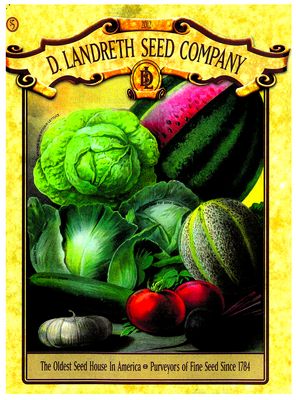
In 1780, David Landreth and his family sailed from England to Montreal, Canada, with the intention of starting a seed company. Finding Canada a little too cold for their liking, the Landreths moved south to Philadelphia in 1783, where on January 7, 1784, they opened the first seed company in the United States. D. Landreth & Sons numbered among their clients gardening enthusiasts such as George Washington and Thomas Jefferson.

During the following years, Landreth, in addition to selling seeds, applied adventurous horticultural tinkering to  such exotic new flowers and vegetables as tomatoes, zinnias and spinach.  He developed a potato that was white and an extra early pea.  The latter would surely have given Gregor Mendel goosebumps as he did his own pea tinkering  many years later (as celebrated in yesterday’s entry).

Landreth minded his peas and cukes and became one of the most influential forces in American horticulture — a sultan of squash, a watermelon wizard, a parsley poobah. His company, now headquartered in Shelburne, Vermont, continues to be a purveyor of seeds and remains the oldest seed company in the United States.

Dorothy Parker was once asked to use the word horticulture in a sentence.  “You can lead a horticulture,” she replied, “but you can’t make her think.”

Tiny Tomato Killer Strikes Again

It is better to light a candle than curse the darkness, or so says some annoying pundit.  Likewise, I suppose, it is better to do something positive than curse the mounds of snow still encircling us.  I’ve always been of the curse the darkness ilk, but occasionally I do try and rise above the winter of my discontent and light a candle in the snow.  One of the better remedies for my malaise is the old seed catalog – tiptoeing through the tulips, tomatoes and zinnias almost brings warmth to my icy heart.

If you ever order anything from a seed catalog, you will never have to worry about being without one again.  They will arrive every January just as reliably as freezing rain.  There’s Seed City, Happy Seeds, Seeds R Us and many more.  Funny thing is they all come from the same little town in the Midwest.  One could develop a dandy conspiracy theory about this: a single little old lady – Granny Burpee – taking seeds out of great big jars and putting them in little envelopes with all those different names so that every spring every one of us plants the same seeds in every garden everywhere.  Are we really planting radishes and marigolds?

Nevertheless I jump in full seed ahead.  Seven tomato varieties, a couple of cucumbers, greens, beans, okra.  Snapdragons, sweet peas, exotic species I’ve never heard of.  “And there’s no such thing as too many sunflowers,” I’m reminded.

There is such a thing as too many seeds, however.  Granny Burpee doesn’t hold back – a hundred seeds here, two hundred there, a thousand.  I’d like to order six tomato seeds, please.  I really only need two cucumber seeds.  The theory seems to be that you must over plant, just in case some of them don’t sprout.

But they all sprout.

I wanted a couple of tomatoes.  I planted a plastic seed-starting tray, two or three seeds in each of its six cubicles.  Twenty tomato plants emerge.  Just thin out the extra plants, the catalogs advise, leaving one healthy tomato plant in each cubicle.  That’s theory again.  From over my shoulder, as I carefully pull out the runts of the seedlings:  “You’re not going to murder those little plants, are you?”

Come June, I have twenty tomato plants, a dozen cucumbers, a dozen nasturtium, I don’t know how many dozen sunflowers, a sea of seedlings that I forgot to label, and six zucchini.   With six zucchini plants, I’ll be able to place a giant zucchini on the back seat of every unlocked car in Vermont.

Maybe I’ll curse the darkness for a while.


January 6, 1884: Pea Picking 101

Gregor Mendel was a friar/scientist/pea picker born in Austria in 1822. Had he been born later he would have been a Czech friar/scientist/pea picker since the part of Austria in which he was born is now the Czech Republic. He is remembered today for minding his peas and cukes, and even has a law named after him.

Gregor had this strange fascination with the propagation of peas. This and his inquiring mind led him to crossbreed short plump green peas with tall skinny yellow peas. Well wasn’t he surprised when all the little baby peas from this union were tall, skinny and yellow. He pondered this at great length and eventually had a forehead-slapping moment.

“Peas have genes!” he probably shouted. (Jeans, on the other hand, were just a twinkle in Levi Strauss’ eyes at the time.) Not only did peas have genes; some of them were dominant and some were recessive — just like kids on a playground or in the House of Representatives.

As any dominant kid of five knows, Mendel’s pea play became the science of genetics and Mendel became (posthumously) the father of same. He died on January 6, 1884, eleven years after the birth of blue jeans.

Elementary, my dear Mendel

Consulting detective Sherlock Holmes, a master of observation and deduction was born on January 6, 1854. The greatest detective in history, he has been depicted in more than 25,000 stories, plays and films. Guinness lists him as the “most portrayed movie character” of all time. His legion of fanatical fans — Sherlockians, Holmesians and Baker Street Babes — celebrate the day annually.  Holmes would have approved of Mendel’s scientific methods.

Many other fictional detectives have vied for our attention over the years.  And while not as versed in scientific methodology as Sherlock, they all could turn a catchy phrase now and then:

The truth must be quite plain, if one could just clear away the litter.”Jane Marple

I don’t mind your showing me your legs. They’re very swell legs and it’s a pleasure to make their acquaintance. —Phillip Marlowe

‘And when you’re slapped you’ll take it and like it.’ — Sam Spade

Because I am Hercule Poirot! I do not need to be told.”

It was a Friday night. I was tooling home from the Mexican border in a light blue convertible and a dark blue mood.” –Lew Archer

All right, talk, but do you mind putting the gun away? My wife doesn’t care, but I’m pregnant.” — Nick Charles

(Nero) Wolfe still paid no attention to me. As a matter of fact, I didn’t expect him to, since he was busy taking exercise. He had recently got the impression he weighed too much- which was about the same as if the Atlantic Ocean had decided it was too wet…” — Archie Goodwin

Have two ears, but can only hear one thing at time.” — Charlie Chan


JANUARY 5: Twelfth Day, Twelfth Night

Here we are — the last day of Christmas, number twelve, the big climax.  And what a thundering climax for True Love.  We already have milking maids, dancing ladies, leaping lords, piping pipers and all those birds.  And now twelve drummers drumming, furiously wielding those drumsticks on snare drums, bass drums, tomtoms, steel drums, bongos even.  For Scrooge, it’s an anticlimax; the twelfth ghost of Christmas made it clear that Scrooge was not off the hook, that he would be seeing more ghosts come Valentines.  Scrooge was nevertheless relieved.  He went to his window and called down to a passing boy “What day is it?” “It’s night, you old fool. Twelfth night.” “What a clever boy.  Does the poulterer still have that great big turkey?” “How should I know?” “Quick, run and see and fetch it for me.” “It’ll cost you.” “What a lad.”  The boy returned a few minutes later.  “The turkey’s gone, so I brought you something else instead.”  “What my boy?” “There’s seven swans a-swimming, six geese a-laying, five . . .”

Night Falls

Twelfth Night is a celebration.  Traditionally, once everyone is pleasantly plastered, they all head out into the fields where they toast oxen and trees and rocks until they get cold and decide to go back inside only to find that they’ve been locked out and will not be admitted until they sing a few songs. Those that don’t sing freeze to death. Everybody else goes back inside where they divide up a cake that someone has baked a bean into. Whoever gets the bean gets to be King or Queen of the Bean and boss everyone around.

Then they watch a little Shakspeare, a play coincidentally called Twelfth Night or Whatever.  In it, Viola and Sebastian, twins, have been shipwrecked, and each thinks the other has drowned. Viola disguises herself as a man, Cesario, and goes to work as a servant for the Duke, Orsino.

Orsino loves Olivia, but she’s mourning her dead brother and has no time for Orsino. He sends Cesario (Viola)  to woo Olivia on his behalf. But Olivia falls in love with Cesario who is really Viola.  Viola (Cesario) meanwhile has fallen in love with Orsino  So at halftime, Viola loves Orsino, Orsino loves Olivia and Olivia loves Cesario who is Viola.

Sebastian (remember him?) returns.  He meets Olivia. She thinks he’s Cesario and asks him to marry her, and he says okay.  So at the homestretch, we have Olivia and Sebastion and Cesario and — well, let’s just say they all live happily ever after.  Especially the revelers who have all passed out.

And the twelve drummers finally stop drumming.

JANUARY 4, 390: COME DOWN, COME DOWN FROM YOUR IVORY TOWER

As we work our way through the twelve days of Christmas, we reach a point where True Love’s gifts are somewhat over the top.  Today is no exception — eleven pipers piping, each armed with a monkey wrench, applying their noble trade to clogged pipes and leaking faucets — at time and a half.  It is Christmastide, you know.  The eleventh ghost of Christmas introduces Scrooge to Tiny Tim.  Scrooge takes an instant dislike to the lad until he learns that Tiny Tim whacks his schoolmates with his crutch and takes their milk money.

In addition to celebrating plumbers, the eleventh day celebrates a saint, as many of the twelve days do. Day eleven is dedicated by those folks who dedicate such things to Saint Simeon Stylites also known as Saint Simeon Stylites the Elder to distinguish him from Simeon Stylites the Younger. He is known primarily for spending 37 years on a platform atop a pillar outside of Aleppo in what is now Syria (one could make a pretty good case that in Syria on top of a pillar might be a good place to be).

Why did Simeon choose to live up there like an Arabian Rapunzel, you ask? Simeon was very likely a wise man or at least people thought he was, because they kept coming to him for advice. Many folks would be honored to be sought out for guidance. Not Simeon. Seekers annoyed him. He wanted to be left alone to pray his private prayers and possibly entertain other thoughts as well.

So he went out and found a pillar. His first pillar was a mere nine feet tall and he soon realized that people could easily shout their entreaties to him. He thus began a series of relocations, each pillar being taller than its predecessor. His final pillar was really up there, some 50 feet above the ground and its many pests.

JANUARY 3, 1871: OLEO OLEO OXEN FREE

It’s the tenth day of Christmas and True Love is on a roll.  His gift is on a jump: ten lords a-leaping, leaping here, leaping there, leaping everywhere — leaping over French hens, over geese, over swans. Leaping . . . oh no, cover your eyes.    During a Zoom conference with the tenth ghost of Christmas, Scrooge relives some of the happier moments of his career, evicting widows in the dead of winter, sending orphans off to workhouses, oh how jolly.

Oleo Oleo Oxen Free

In 1871 Henry Bradley received a patent for an amorphous concoction of cottonseed oil and animal fats that had the appearance, texture and perhaps the taste of silly putty. He called his creation oleomargarine (margarine to its close friends) to be used as a substitute for butter.
While Real Butter from Real Cows had a pleasant yellow color, Bradley’s faux butter was a stark, pasty white, lard look alike that turned a lot of people off. No one spreading this white stuff on their toast would ever dream of exclaiming “I can’t believe it’s not butter.”

The answer, of course, was to color the stuff to make it look like Real Butter. But not so fast. It seems that discontented cows saw yellow margarine as a threat to the butter industry.  They rose up and secured legislation prohibiting the sale of yellow margarine.  Ever the outlier, New Hampshire went so far as to require pink-colored margarine.

Margarine manufacturers used various tactics to bring color to their products. One of the oddest was a method devised by the W.E. Dennison Co. that used a capsule of yellow dye inside a plastic baggie of margarine The consumer would knead the package, breaking the capsule, allowing the dye to eventually spread throughout the margarine. Some consumers were still kneading their first lump of margarine when, in 1955, the ban on yellow margarine was lifted. Today margarine remains a glorious shade of yellow, and the naked eye cannot tell it from Real Butter. It does still taste like silly putty, however.

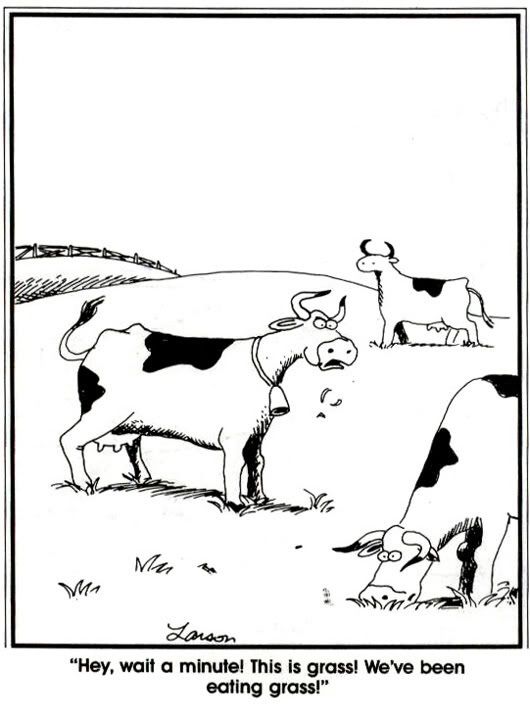
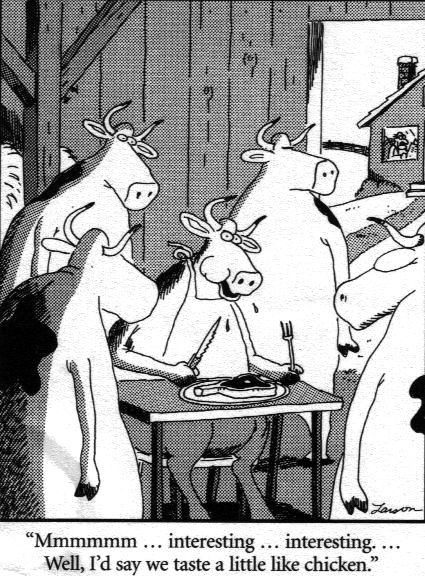
Of course the biggest difference between Real Butter and that phony stuff is cows or the lack of them.  Cows are warm and cuddly.  And they’re fun.  Just ask Gary Larson.

January 1, 2024: Deconstructing the New Year

It’s a new year, a new beginning, a fresh start and all those cliches.  It’s a cold slap in the face after last night when you celebrated and then made that resolution while licking the wassail bowl dry.  You don’t remember?  Your resolution went something like this:  I hereby resolve to read Wretched Richard’s Almanac every day so that I might be well informed, sophisticated and attractive. And I will recommend it to all my friends so they too might be well informed, sophisticated and attractive.

Here Come Januarius

As we previously pointed out, today is January 1, New Year’s Day, the start of a brand new year. It wasn’t always thus. There wasn’t always a January. According to legend, the first calendar was created by Romulus who along with his twin brother Uncle Remus founded Rome. This calendar had only ten months (these were leaner times), the ten being Martius, Aprilis, Maius, Innius, Quintilis, Sextilis, Aquarius, Donner, Blitzen, and the ever-popular Decembris.

The year consisted of only 298 regularly scheduled calendar days. The authorities would add bonus days here and there as they saw fit to bring the total number to the magic 365. (Martius 3, a Tuesday, will be postponed so we can bring you a special wear-a-toga-to-work day. Martius 3 will return on Thursday.)

A fellow by the name of Numa Pompilius (no need to memorize his name)  succeeded Romulus who had murdered Uncle Remus in a typically Roman display of sibling rivalry.   In an effort to Make Rome Great Again, Pompilius added two months to the Roman calendar. The first of these was Januarius, dedicated to the two-faced god Janus, the deity who presided over doors, looking back through the doorway to the past and ahead to the future. Clever, what?

More Wolf-monat, Van Helsing?

Wolf contemplating a Saxon snack

The Saxons (the Almanac is a big tent, they’re welcome too) didn’t hold much with naming things after Roman gods. They had a different and more colorful name for the month of January — Wolf-monat or Wolf-month, because Saxon folks were more likely to be devoured by wolves during Wolf-monat than at any other time of the year.  But we digress.

Et Tu, Sosigenes

Even though Januarius was added some 600 years earlier, New Year’s Day was celebrated on Januarius 1 for the first time in 45 B.C. On that day the Julian calendar went into effect — created by Julius Caesar himself — with the aid of his trusty sidekick Sosigenes, an Alexandrian astronomer.

Sosigenes advised Caesar to dump the whole Roman calendar and start from scratch. New Year’s no longer came in March. A one-time bonus of 67 days was thrown in, with the promise of an extra day every four years in February.

But Caesar couldn’t stop there. In 44 B.C. (that’s a year later than 45), he changed the month of Quintilis to Julius (July, to friends). He would no doubt have done more damage had not a group of noble Romans assassinated him that same year.  But didn’t Augustus come along and keep fiddling with the calendar. (There’s something about Caesars and fiddling.). Sextilis became (what else?) Augustus. But it only had 30 days, compared to Julius’ 31.  What’s a Roman emperor to do?  Steal a day from Februarius, of course.

. . .And on the Eighth Day

For those folks who just can’t get enough ’tis the season, today is also the eighth of a dozen days of Christmas.  This is infamously celebrated by the carol in which on this day, the first day of Christmas, someone’s True Love bestows upon him or her a gift of a partridge in a pear tree.  While we might point out that a crock pot or a circular saw would be a bit more practical, we won’t quibble with the sentiment.  A flock followed: turtle doves, French hens, colly birds, geese, swans, all calling, clucking, cooing and squawking around that pear tree.

But now on the eighth day, True Love, having at last run out of feathered friends, has created an entirely new category of giving — the gift of people. The first contribution to this premise consists of eight maids a-milking, a lovely gift with nary a cackle or a caw. Of course this requires the addition of cows — one can’t very well expect the recipient to go out and find his or her own cows (True Love could have added a disclaimer of cows not included, but that would be a cheap trick.) We suppose there might be just one cow with all the maids milking it, but that would be one very sore cow.

Charles Dickens, it would seem, missed the Christmas boat by failing to take advantage of this twelve day gimmick.  Imagine if you will the twelve ghosts of Christmas.


MAY 10, 1893: THE SUPREME COURT SAYS TOMAHTO

An 1883 tariff act required a tax to be paid on imported vegetables, but not fruit. The Nix family, tomato entrepreneurs, went to court to recover back duties paid to the Port of New York under protest, claiming that they owed nothing because, botanically, a tomato is a fruit, a seed-bearing structure growing from the flowering part of a plant. The case made it to the Supreme Court where, on May 10, 1893, the justices unanimously ruled that, botany be damned, a tomato is a vegetable.

At the hearing, both the plaintiffs’ counsel and the defendant’s counsel made extensive use of dictionaries. The plaintiffs’ counsel read in evidence the definitions of the word tomato, while the defendant’s counsel read the definitions of the words pea, eggplant, cucumber, squash, and pepper. In a clear case of one-upmanship, the plaintiff then read in evidence the definitions of potato, turnip, parsnip, cauliflower, cabbage, carrot and bean.

The court decided in favor of the defense and found that the tomato should be classified under the customs regulations as a vegetable, based on the ways in which it is used, and the popular perception to this end.  Justice Horace Gray, in a horticultural burst of logic, stated that:

“The passages cited from the dictionaries define the word ‘fruit’ as the seed of plants, or that part of plants which contains the seed, and especially the juicy, pulpy products of certain plants, covering and containing the seed. These definitions have no tendency to show that tomatoes are ‘fruit,’ as distinguished from ‘vegetables,’ in common speech, or within the meaning of the tariff act.”

He acknowledged that botanically, tomatoes are classified as a “fruit of the vine”; nevertheless, they are seen as vegetables because they were usually eaten as a main course instead of being eaten as a dessert. In making his decision, Justice Gray brought up another case in which the court found that although a bean is botanically a seed, in common parlance a bean is seen as a vegetable. While on the subject, Gray clarified the status of the cucumber, squash, pea, and turnip for good measure.

It would take another century to declare ketchup a vegetable.

MAY 9, 1671: STALKING THE CROWN JEWELS

In the movie The Adventures of Sherlock Holmes, Holmes’ nemesis Professor Moriarty is out to steal the crown jewels. His  battle of wits with Holmes over England’s great treasure lasts about an hour.  Earlier, an Irishman, Colonel Thomas Blood, attempted the same feat with a much more elaborate plan.

Colonel Blood set the plan in motion in April with a visit to the Tower of London. Dressed as a parson and accompanied by a woman pretending to be his wife, Blood made the acquaintance of Talbot Edwards, an aged but trustworthy keeper of the jewels. During this time, the jewels could be viewed by the payment of a fee. After viewing the regalia, Blood’s “wife” pretended to be taken ill, upon which they were conducted to Edward’s lodgings where he gave her a cordial and treated her with great kindness. Blood and his accomplice thanked the Edwardses and left.

Blood returned a few days later with a half dozen gloves as a present to Mrs. Edwards as a gesture of thanks. As Blood became ingratiated with the family, he made an offer for a fictitious nephew of his to marry the Edwardses’ daughter, whom he alleged would be eligible upon their marriage to an income of several hundred pounds. It was agreed that Blood would bring his nephew to meet the young lady on May 9, 1671.  At the appointed time, Blood arrived with his supposed nephew, and two of his friends, and while they waited for the young lady’s appearance, they requested to view the jewels. Edwards accommodated the men but as he was doing so, they threw a cloak over him and struck him with a mallet, knocking him to the floor and rendering him senseless.

Blood and his men went to work. Using the mallet, Blood flattened out the crown so that he could hide it beneath his clerical coat. Another filed the sceptre in two to fit in a bag, while the third stuffed the sovereign’s orb down his trousers.

The three ruffians would probably have succeeded in their theft but for the opportune arrival of Edwards’ son and a companion, Captain Beckman. The elder Edwards regained his senses and raised the alarm shouting, “Treason! Murder! The crown is stolen!” His son and Beckman gave pursuit.

As Blood and his gang fled to their horses waiting at St. Catherine’s Gate, they dropped the sceptre and fired on the guards who attempted to stop them. As they ran along the Tower wharf, they were chased down by Captain Beckman. Although Blood shot at him, he missed and was captured before reaching the Iron Gate.  The crown, having fallen from his cloak, was found while Blood struggled with his captors, declaring, “It was a gallant attempt, however unsuccessful, for it was for a crown!” — a rather eloquent comeuppance speech which today would be something more along the lines of “Oh fuck!”

MAY 8, 1854: A MILE IN WHOSE SHOES?

Celebrated pedestrian Robert Barclay Allardice, 6th Laird of Ury, generally known simply as Captain Barclay, died on May 8, 1854. During his life he accomplished many feats in the world of walking, and is, in fact, considered the father of pedestrianism, a popular sport of the 19th century.


His first feat, at the age of fifteen, was to walk six miles in an hour ‘fair heel and toe.’ Heel and toe was a rather vague rule of pedestrianism, that the toe of one foot could not leave the ground before the heel of the other foot touched down. It was randomly enforced. In 1801, at the age of 22, Barclay walked from Ury to Boroughbridge, a distance of 300 miles in five oppressively hot days, and in that same year, he walked 90 miles in 21 and a half hours, winning 5000 guineas for his fancy footwork.


His most famous feat came in 1809 when he undertook the task of walking 1000 miles in 1000 successive hours, a mile within each hour, a challenge in which many had failed and none had succeeded. At stake was 100,000 pounds (roughly 8 million dollars today). This feat captured the imagination of the public, and 10,000 people came to watch over the course of the event, cheering him on or wishing him ill fortune depending on the direction of their own wagers. He began his course at midnight on June 1 and finished it at 3 p.m. on July 12.


Pedestrian races were popular with both the media and the public throughout the 19th century, drawing throngs of spectators, along with bookies, touts and other unsavory characters who frequent such competitions. With the coming of the automobile, however, pedestrianism became an endangered sport as pedestrians themselves became an endangered species, serving mostly as targets for mechanized sporting types.  It does remain in our popular culture, however, with such paeans to pedestrianism as “The Stroll,” “Walk on the Wild Side,” “Walk Like a Man,” and “Walk This Way.”


Walking the Dogs

On May 8, 1877, 1,201 of the classiest American canines convened at the Hippodrome in New York City to compete for the the title of top dog.  This was the first dog show to be held under the guidance of the Westminster Kennel Club, and it has been held annually ever since.  Among the luminaries at that first event were two Staghounds from the pack of the late General George Custer and two Deerhounds bred by Queen Victoria.

Eighteen years later, on May 8, 1895, felines had their turn in the spotlight at the first cat show held in New York at Madison Square Garden.  This was a more down to earth affair with prizes given in several categories including the best stray alley cat.