January 18, 970: The Mice That Roared

On an island in the Rhine River near the German village of Bingen am Rhein, there’s a structure known as Mäuseturm, the Mouse Tower.  The tower was first erected by the Romans, and in 968 it was restored by Hatto II, the Archbishop of Mainz.  It has, if you choose to believe it, a curious history which features the untimely death of the Archbishop on January 18, 970.

Hatto was not one of Germany’s nicer guys. Aided by archers and crossbowmen, he used his tower to extract “tolls” from passing ships, all in all a lucrative sideline to his religious duties. He also filled his barns with grain in anticipation of a future rainy day which soon came in the form of a famine. The nearby peasants ran out of food and you know who was ready to sell it to them at prices they could not afford. Naturally, the peasants were not a happy lot, and Hatto got wind of a possible rebellion. Hatto assembled the peasants at his castle and promised to feed them.  He sent the hungry but now happy peasants to an empty barn to wait for the food he would bring.  But when Hatto and his servants arrived at the barn, they were not armed with food. Hatto ordered the barn doors locked, and immediately set the barn on fire. Hearing the screams from inside, Hatto was said to have remarked: “Hear the mice squeak!”

Hatto’s amusement was short-lived. When he returned to his castle, he was set upon by thousands of mice. With the mice in pursuit, Hatto fled the castle and crossed the river to his tower, in hopes that the mice would drown if they followed. They didn’t. They swarmed the island, gnawed their way through the tower door, and — well, as a poet described it:

They have whetted their teeth against the stones,
And now they pick the bishop’s bones;
They gnawed the flesh from every limb,
For they were sent to punish him!

The Kid’s Got Talent?

As the program began, the spinning of a wheel would determine the contestants’ order of appearance. As the wheel spun, Ted Mack would chant the magic words: “Round and round she goes, and where she stops nobody knows.” It was January 18, 1948, and The Original Amateur Hour, episode number one, was on the air. And each week, we would be informed how many episodes had aired. The final broadcast in 1970 was number 1,651.

Ted Mack brought the Amateur Hour to television from radio where it amateurhourhad been a fixture for over a decade under the command of Major Edward Bowes. Mack’s television version was one of only six shows to appear on all four major TV networks – ABC, CBS, NBC, and DuMont. (the others were The Arthur Murray Party; Down You Go; The Ernie Kovacs Show; Pantomime Quiz; and Tom Corbett, Space Cadet).
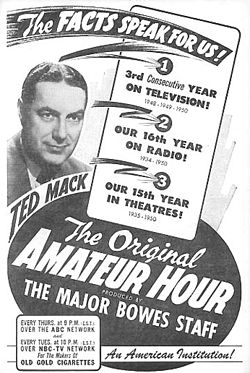
Contestants were often singers and other musicians, although acts included jugglers, tap dancers, baton twirlers, and such. The television audience voted for their favorites by postcard or by calling JUdson 6-7000. Winners returned for another appearance, and three-time winners became eligible for the annual championship and the chance to win a $2000 scholarship.

During 22 years on television, you might guess that the program would discover a throng of celebrities, but you’d be wrong. Gladys Knight, Ann-Margret, Irene Cara, and Tanya Tucker were a few of the handful of future stars. Pat Boone was a winner, but his appearances caused a bit of a tempest in a TV pot. After his winning appearances, it was discovered that he had appeared on the rival program Arthur Godfrey’s Talent Scouts, and was therefore not an “amateur” singer. Boone was booted from the program, but his fame was already a given, and within a few years he was hosting his own variety show The Pat Boone Chevy Showroom (Ted Mack was never a guest).

Elvis Presley, on the other hand, was turned down for the show.

Caucus Race

As she stepped through the door which was now the perfect size for a person of her size, Alice spotted a sign that read Donaldland, Center of the Universe, brilliantly ruled by our most revered Queen. Everything on this side of the door was the right size. “I think I’m going to like this place,” she predicted..

She set off to explore, passing through lovely meadows and gardens filled with colorful flowers, past dear little ponds. The only things marring the beauty of the place were the many signs saying Make Donaldland Great Again. At one of those ponds, she spotted a queer-looking group of animals marching around it. “Curiouser and curiouser,” she said, although everything was curious today. There was an Auk, an Emu, an Ostrich, a Tasmanian Devil and several other strange animals. And leading the parade was a Dodo. They moved about the pond, each at its own pace, some faster, some slower, some stopping now and then, some bumping into one another, until the Dodo suddenly cried out: “The Caucus-race is over.”

“Who has won?” the others all shouted.

The Dodo thought for a moment then said: “Everyone. We all have won.” The animals all cheered. Alice, who was now standing among them, asked: “What is a Caucus-race?”

The Dodo pressed a finger to its forehead and thought some more. “It’s like a real caucus only it’s not, because we’re not invited to real Caucuses anymore. We used to be GOPs, but we’re outcasts now. We’ve been tweetstormed by the Queen.”

Alice was filled with questions, and she blurted them right out: “What’s a GOP? What’s a tweetstorm? What kind of animal are you?”

“I’m a Dodo.”

“Aren’t Dodos extinct?”

“Might as well be. I guess I’m a Dodo In Name Only. And a GOP in Name Only.”

“You haven’t told me what a GOP is,” Alice complained.

“A Grouchy Old Poop. I was once proud to be one — to wear a campaign button on my lapel, a flag on my butt, and make patriotic noise. But that was then and this is now. I’ve — we’ve all been tossed from the poopdeck, bundled off, shown the exit ramp. Unfriended. Tweetstormed.” The Queen doesn’t know us and therefore we don’t exist.”

Stay tuned, same time same place — a royal revelation

Going Down

Alice was growing sleepy, sitting next to her sister who was reading a book. “What’s the use of a book if it can’t get you online?” she muttered to herself. Just as she was beginning to drift off, a large White Rabbit ran by. This was rather remarkable in and of itself but even more so as the Rabbit pulled a watch out of its waist-coat pocket and said “Oh dear! Oh dear! I shall be too late. The Queen will have my head for sure.”

Now wide awake with curiosity, Alice jumped up and chased after the Rabbit, just in time to see it pop down a large rabbit hole. Alice went right down the hole herself, never giving it a thought, and found herself falling. The hole was very deep and she was falling very slowly, for she had time to look around. The sides of the hole had become walls, covered with pictures. Mostly they were grumpy looking old men, but one of them looked like a Queen. She wore a royal gown, the kind you see on a playing card, and a royal crown nestled in a strange outcropping of very orange hair. The Queen had big hands and — Alice didn’t finish the thought for she landed with a thud on the floor of an ornate room.

The room had no windows and just one tiny door barely big enough for a mouse. It was certainly too tiny for Alice to go through it. The only furniture in the room was a single table. On the top of the table was a small bottle with a note attached that read: Drink me, if you want to become small enough to go through the door. She took a sip from the bottle and waited. Nothing happened. She finished it off. Still nothing. Then she saw more writing on the back of the note: I lied. The only way to get small is to think small. It’s like pulling yourself up by your own bootstraps, except there are no boots or straps and it’s down rather than up.

Alice sat down in front of the little door and recited “I am small. I am small.” As she continued to repeat these words, she saw that the little door was growing larger. Or was she getting smaller? When the door looked like a normal-sized door she said loudly: “I really am small.” She took a deep breath and opened the door.

Stay tuned, same time, same place — a caucus-race

January 15, 1797: Flamboyant Haberdashery

John Hetherington, a London haberdasher was hauled before the Lord Mayor on January 15, 1797, charged with inciting a riot. His breach of the peace had caused passers by to panic, women to faint, children to run screaming, dogs to yowl and one poor lad to suffer a broken arm from being trampled by the mob.

What had Hetherington done to cause such turmoil? According to authorities, he had appeared in public wearing upon his head “a tall structure having a shiny luster calculated to frighten timid people.” That is, he was the first person to wear a top hat on the streets of London. And for his act of flamboyant haberdashery, he was forced to post a ₤500 bond.

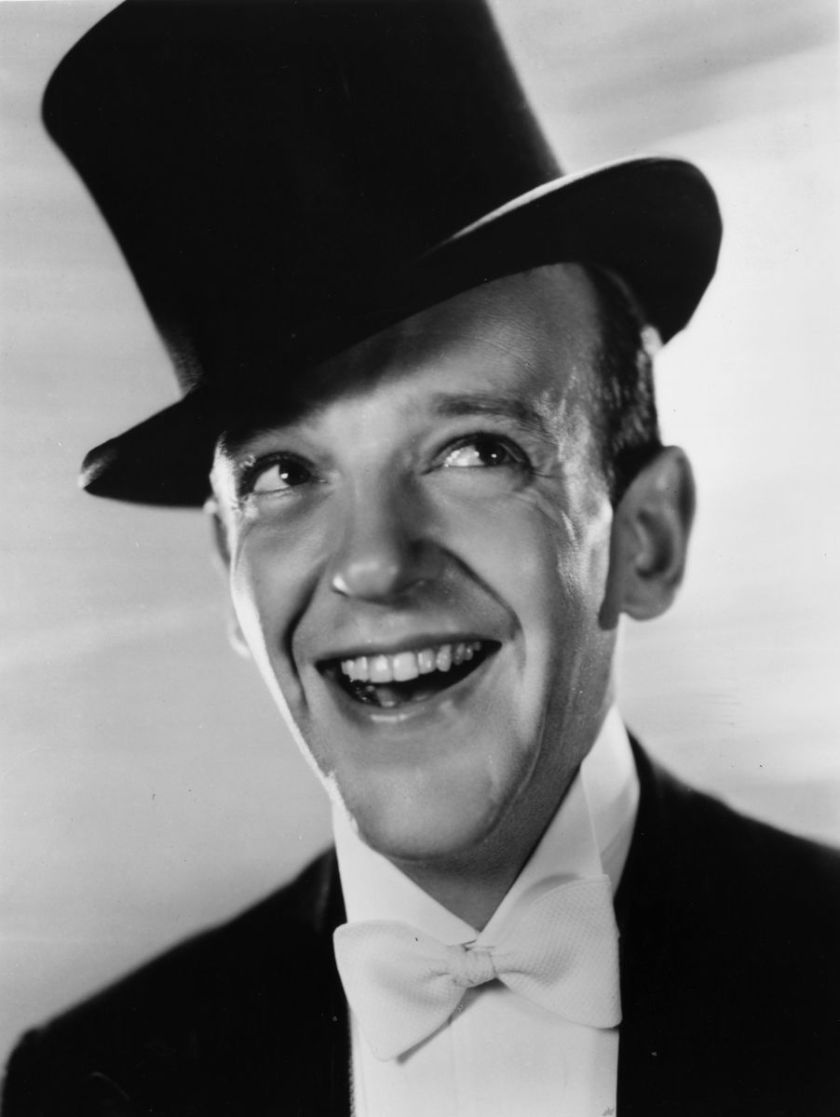
Hetherington’s chapeau was a silk topper also known as a high hat, silk hat, beaver hat, or stove pipe hat. It became popular soon after Hetherington’s breach and remained so through the middle of the 20th century. Folks associated with the top hat include Fred Astaire, Charlie McCarthy, Uncle Sam, and Rich Uncle Pennybags (the Monopoly man).

In 1814, Louis Comte became the first magician to pull a rabbit out of a top hat, and in 1961, John F. Kennedy became the last president to be inaugurated in one.


Don’t Be Nasty, Thomas

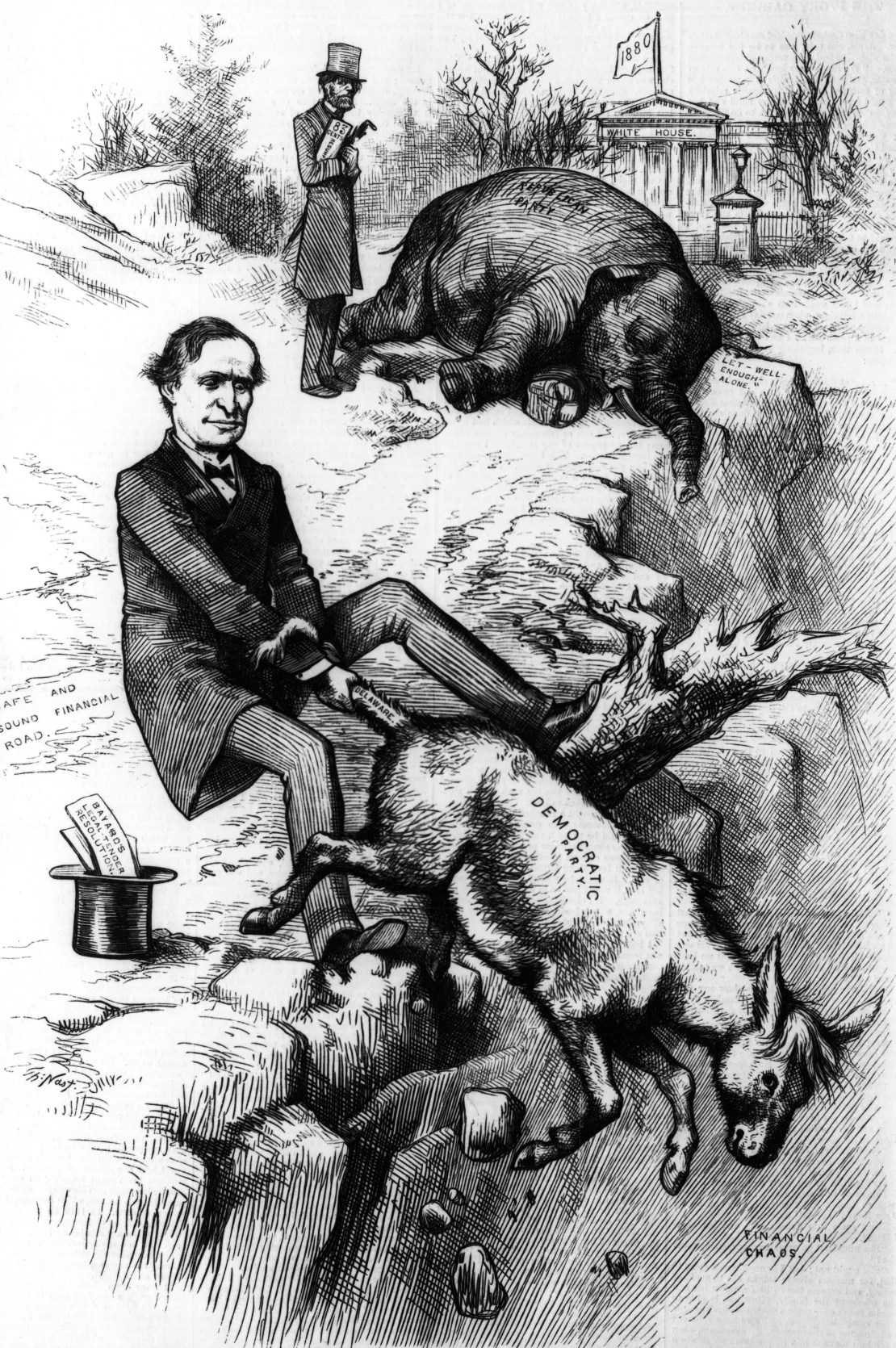
No, the adjective nasty did not refer to the noted political cartoonist Thomas Nast, but one could certainly be forgiven for thinking so.  Nast was the first  artist to picture the Democratic Party as a donkey– in Harper’s Weekly, January 15 1870. He also gave us the modern concepts of both Uncle Sam (with a top hat) and Santa Claus.

Democraticjackass

While the Democratic party was a hopelessly stubborn creature, Nast would go on to characterize the Republican party as an oversized oafish elephant, lumbering about in a clueless daze.  Neither animal wore as top hat.


The Democrats seem to be basically nicer people, but they have demonstrated time and again that they have the management skills of celery.  They’re the kind of people who’d stop to help you change a flat, but would somehow manage to set your car on fire.  I would be reluctant to trust them with a Cuisinart, let alone the economy.  The Republicans, on the other hand, would know how to fix your tire, but they wouldn’t bother to stop because they’d want to be on time for Ugly Pants Night as the country club. — Dave Barry

January 14, 1500: For the Ass Was a Donkey, You See

The Feast of the Ass held on January 14 from around 1100 until 1500 was meant as much as a teach-in as a party-in, a way to present religious doctrine to the illiterati who had no books or Internet access. This festival, held primarily in France as a cousin to the Feast of Fools, celebrated the flight of Joseph, Mary and Jesus into Egypt.

Traditionally, the most beautiful young woman in the village splendidly attired in gold-embroidered cloth, carrying a small child and riding a donkey would be led in a solemn procession through the town to the church. The donkey would stand beside the altar while a mock Mass was performed. Instead of the usual responses to the priest, the congregation would “hee-haw.” At the end of the service, instead of the usual benediction, the priest would bray three times and the congregation would respond with another round of hee-hawing. The choir would then offer up a hymn and everyone would bray along — except for the ass who thought the whole thing rather ridiculous and that these people were all making you know whats of themselves.

Talk to the Donkey

Yes, Doctor Doolittle could talk to the animals, including donkeys. And much more. He ran a post office, a circus and a zoo, took voyages to exotic places around the world, went to the moon. According to the neighborhood mussel-man, he was a nacheralist – “a man who knows all about animals and butterflies and plants and rocks an’ all.” Not only could he talk to and understand animals, he had written history books in monkey-talk, poetry in canary language and songs for magpies to sing. He didn’t just talk to your normal animals like pigs, rats, owls, seals and badgers but to  pushmi-pullyus and wiff-waffs as well.

January 1lofting4 is a red letter day for children who love to read and love animals. Two major authors who spent their lifetimes entertaining the younger set were born on this day 12 years and an ocean apart.

Hugh Lofting, creator of the amazing Doctor Doolittle from Puddleby-on-the-Marsh, was born in 1886 in Maidenhead, England. He wrote a dozen books featuring the doctor , a character he first created in letters to his children during his World War I service in the Irish Guards. The Story of Doctor Doolittle: Being the History of His Peculiar Life at Home and Astonishing Adventures in Foreign Parts Never Before Printed began the series in 1920 and was followed two years later by The Voyages of Doctor Dolittle.

Born on Cape Cod in 1874, Thornton Burgess was a conservationist and prolific writer of burgess1children’s books, producing 170 books between 1910 and 1965.  His books celebrated nature, featuring the many animals that lived in the Green Meadow and Green Forest.

Mother West Wind “How” Stories, an early collection of 16 stories, told how Lightfoot the Deer learned to jump, how the eyes of Old Mr. Owl became fixed, how Drummer the Woodpecker came by his red cap and so on. Other collections told when, where and why various animal things happened – Wild Kingdom without Marlin Perkins or TV commercials The anthropomorphic forest and meadow creatures that had their own adventure books included Peter Rabbit, Jimmy Skunk, Grandfather Frog, Little Joe Otter, Granny Fox, Jerry Muskrat and Digger the Badger to name just a few.


January 13, 1930: Day of the Mouse

He’s short with big ears, a big nose and a skinny tail.  He’s nattily attired in red shorts with two big buttons, big yellow shoes and white gloves.  He hails from Florida these days where he has his own kingdom and is a woke Robin Hood to the state’s evil governor.  Back in 1930 when he made his debut he wasn’t quite so colorful, his venue being a black and white comic strip.  Mickey Mouse was already well known when his comic strip first appeared, having been a film star since his first appearance in 1928 in the cartoon Plane Crazy.  Created by Walt Disney and Ub Iwerks, he has grown in stature through the years to become the face of the Walt Disney organization.

The first comic strip sequence was a reprise of the Plane Crazy cartoon in which Mickey dreams of following in the footsteps of his idol Charles Lindbergh, flying into adventure in his own homemade plane, along with his girlfriend Minnie.

The governor of Florida would probably fare better against a less formidable Disney character.  A DeSantis/Donald Duck debate would be priceless.

If Only It Had Wings

On January 13, 1854,  musical inventor Anthony Foss received a patent for his accordion, a strange device shaped like a box with a bellows that is compressed or expanded while pressing buttons or keys which cause pallets to open and air to flow across strips of brass or steel, creating something that vaguely resembles music. It is sometimes called a squeezebox. The person playing it is called an accordionist (or squeezeboxer?)

The harmonium and concertina are cousins. And, yes, there is a World Accordion Day.

If Only She’d Had a Squeezebox

Born in Russia on January 13, 1887, “the Last of the Red Hot Mamas,” Sophie Tucker immigrated to the United States as an infant and began her long career shortly afterward, singing for tips in her parents’ restaurant. Between taking orders and serving customers, Sophie would stand in a narrow space by the door and belt out songs with all the drama she could muster. “At the end of the last chorus,” she remembered, “between me and the onions, there wasn’t a dry eye in the place.”

She gained stardom using a combination of comic risque and “fat girl” songs such as “Nobody Loves a Fat Girl, But Oh How a Fat Girl Can Love.” Her signature song, however, was “Some of These Days.” She became one of the most popular entertainers in America, following her vaudeville and burlesque career with movies through the 30’s and 40’s and television in the 50’s and 60’s.  She influenced many female performers, including such larger than life performers as Mae West and Bette Midler.

Sophie Tucker continued performing until her death in 1966.

JANUARY 12, 1896: I CAN SEE CLEARLY NOW

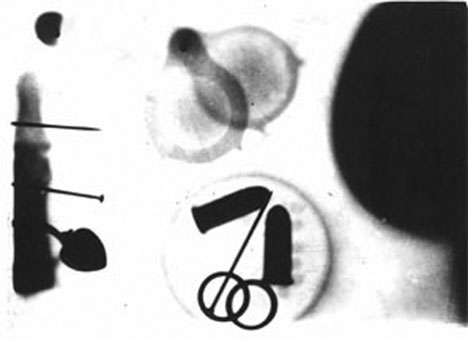
x-rayDr. Henry Louis Smith was a professor of physics at Davidson College in North Carolina where he was pioneering the use of X-rays in America. He planned to duplicate the work of the German physicist who discovered x-rays.  Smith made the mistake of telling his students about his plans.  On the night of January 12, 1896, three of Smith’s students bribed a janitor to let them into the medical laboratory on campus, where they played around until the wee hours, finally producing an X-ray photograph of two .22 caliber rifle cartridges, two rings and a pin inside a pillbox,some pills, a magnifying glass and a human finger they had sliced from a cadaver with a pocketknife — a historical first in the United States (the x-ray photograph not the finger).  Smith went on to create his own images and to spread the use of x-rays throughout the medical community.  The students kept their little adventure a secret until years later when they decided they would probably be forgiven for their naughtiness if they revealed their part in making history.

Surely There’s Some Noble Use for X-rays

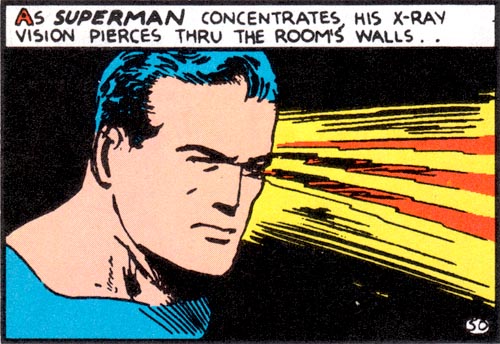
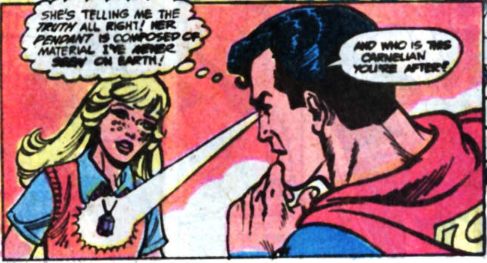
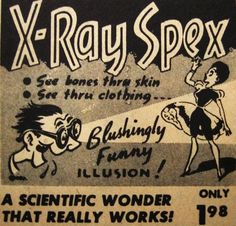
X-rays have since then become an important tool in medicine, saving many lives and other such noble stuff, but what has been more important to generations of boys is the concept of x-ray vision — the xrayvision1ability to see what’s on the other side of a wall, in a box, or under various articles of clothing.  Most boys learned about x-ray vision from Superman, easily the most famous employer of the art.  Superman only used his powers of x-ray vision for completely innocent pursuits such as the apprehension of bad guys.  However, those bad boys who sent for the x-ray spectacles advertised in comic books are quite another story.xspecs

A Man’s Home Is His Stonehenge

Stonemason, sculptor and oddball Edward Leedskalnin was born on January 12, 1887, in Latvia. He left Latvia for the United States at the age of 26 after 16-year-old Agnes Skuvst broke their engagement on the day before they were to be married.

Edward eventually purchased a parcel of land in Florida City and began what would become his life’s work — the construction of a massive structure he called “Rock Gate” and which he dedicated to his lost love Agnes. Working alone, he quarried and sculpted 1,100 tons of limestone into the titanic structure that came to be known as The Coral Castle and which was often called America’s stonehenge.

When asked how he moved all that heavy stone by himself, he answered: “I understand the laws of weight and leverage and I know the secrets of the people who built the pyramids.” He eventually opened his castle to the public, charging ten cents admission.

Ever the eccentric, he lived as a recluse and existed on a diet of crackers and sardines. He also published several pamphlets, the first being a dissertation on morality with text only on the left-hand pages so that his readers might offer their own opinions on the right. He got particularly worked up on the subject of teenage lust: “. . . everybody knows there is nothing good that can come to a girl from a fresh boy. When a girl is sixteen or seventeen years old, she is as good as she ever will be, but when a boy is sixteen years old, he is then fresher than in all his stages of development.”

And he probably owns x-ray glasses.

JANUARY 11, 1917: YOU GOTTA HAVE HEART

Have a Heart, a musical by a trio new to the Broadway scene opened for the first of 76 performances during the 1916-1917 season.  Although it was a pretty short run for Broadway, the team of Jerome Kern, Guy Bolton and Pelham Grenville Wodehouse would go on to create legendary musicals and forever change the landscape of American musical theater.  The exotic locales and characters of operetta and the over-the-top spectaculars of the Ziegfeld Follies gave way to the lives and loves of ordinary folk and the theatrical style of such giants as Richard Rodgers, Cole Porter and George Gershwin.  The trio only produced five musicals.  Kern would go on to produce such monumental musicals as Showboat.  Bolton would work as librettist with most of the top composers of the day.  And Wodehouse, now better known by the initials P.G. or the nickname Plum would make his mark in the literary world, giving us Bertie Wooster, Jeeves and dozens of characters whose comic entanglements filled 90 books, 40 plays and a couple hundred short stories.  A sampling of his amazing wit:

Freddie experienced the sort of abysmal soul-sadness which afflicts one of Tolstoy’s Russian peasants when, after putting in a heavy day’s work strangling his father, beating his wife, and dropping the baby into the city’s reservoir, he turns to the cupboards, only to find the vodka bottle empty.

He had the look of one who had drunk the cup of life and found a dead beetle at the bottom.

Mike nodded. A sombre nod. The nod Napoleon might have given if somebody had met him in 1812 and said, “So, you’re back from Moscow, eh?”

I could see that, if not actually disgruntled, he was far from being gruntled.

There is only one cure for gray hair. It was invented by a Frenchman. It is called the guillotine.

She looked as if she had been poured into her clothes and had forgotten to say ‘when.’

The fascination of shooting as a sport depends almost wholly on whether you are at the right or wrong end of the gun.

Every author really wants to have letters printed in the papers. Unable to make the grade, he drops down a rung of the ladder and writes novels.

It was my Uncle George who discovered that alcohol was a food well in advance of modern medical thought.

And she’s got brains enough for two, which is the exact quantity the girl who marries you will need.

At the age of eleven or thereabouts women acquire a poise and an ability to handle difficult situations which a man, if he is lucky, manages to achieve somewhere in the later seventies.

Wodehouse was knighted in 1975 at the age of ninety-three and died later that year.

Perhaps You Could Smoke It

We may never know why he did it — perhaps as a joke or prank — but on January 11, 1770, Benjamin Franklin shipped the first ever rhubarb to the United States. Americans were unimpressed until years later when Thomas Jefferson began to cultivate it and it finally caught on.

Rhubarb had been around in other parts of the world for a good 5,000 years. Fried rhubarb was used as a laxative in Imperial China. Greeks and Romans used it as well and gave it its name Rha (Greek for the Volga River) and barbarum (Latin for barbarian , anyone who was not a Roman). Marco Polo waxed poetic about Chinese rhubarb. It was a prized commodity on the Silk Road to Europe. And in Europe heavy demand made it more expensive than cinnamon and twice the price of opium (which explains why there weren’t very many rhubarb dens).

Rhubarb is a vegetable but is treated and cooked as a fruit. It tastes like a very sour apple which is why all rhubarb recipes use copious amounts of sugar. Why bother? Because it’s healthy as all get out, jam packed with such goodies as dietary fiber, vitamins C and K, B complex vitamins, calcium, potassium, magnesium, beta carotene just to mention a few.

Stalk of rhubarb, anyone?


JANUARY 10, 49 BC: WADE IN THE WATER

Back in 49 BC, Julius Caesar was a mere governor commissioned by the Roman Senate to oversee a portion of the empire that stretched from Gaul to Illyricum (pretty much most of today’s Europe except Italy). When his term of governorship ended, the Senate ordered Caesar to disband his army and return to Rome. Whatever you do, Julie baby, don’t bring that army across the Rubicon River for that is treason and insurrection and very bad manners. Oh, and the punishment is death.

Caesar may have misunderstood for didn’t he just up and cross the Rubicon into Italy on January 10. His biographer suggests that he was under the control of a supernatural apparition (the Devil made him do it). Willful or not, Caesar is said to have shouted “alia iacta est” as he and his merry men waded across the shallow river (or ‘the die has been cast,” certainly more dramatic in Latin).

Crossing the Rubicon was a declaration of war, but instead of arresting Caesar the Roman Senate fled Rome in fear. Caesar, far from being condemned to death, became dictator for life. Sometimes it’s good to cross the Rubicon. Crossing the Rubicon has endured as a phrase meaning passing a point of no return.

The Hole in My Record Is Bigger Than the Hole in Your Record

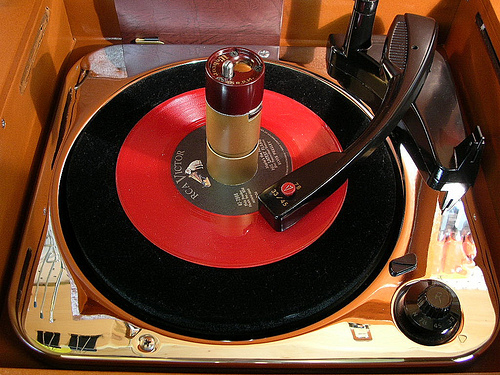
RCA Victor it might be said crossed the Rubicon when on January 10, 1949, it introduced a new kind of record — a vinyl disc, just seven inches in diameter with a great big hole in the middle, the 45 (referring to its revolutions per minute). The 45 replaced the big noisy shellac disc that rotated at a breakneck 78 rpm. The first 45 rpm single was “Peewee the Piccolo.” Remember it?

The Bun Knows

On January 10, 1984, 81-year-old Clara Peller first asked the question for which she would become famous:

JANUARY 9, 1493: I HAVE HEARD THE MERMAIDS SINGING

Do mermaids exist? These creatures – half woman, half fish – have found their way into the lore of seafaring cultures at least as far back as ancient Greece. You’ve seen them depicted; a woman’s head and torso and the tail of a fish instead of legs. They’re most often quite attractive, gazing upon their own countenance in a mirror and combing their long flowing tresses (like Darryl Hannah in the movie Splash, for example).

But believe in them? One might just as well believe in sirens, the half-woman, half-bird creatures who dwell on islands from where they sing seductive songs to lure sailors to their deaths. Yet there have been some notable sightings. No one less than Italian explorer Christopher Columbus has written of an encounter. On January 9, 1493, the intrepid New World traveler spotted not one but three mermaids frolicking somewhere near the Nina, Pinta or the Santa Maria (or maybe one entertaining each ship?)

He described the sighting in his ship’s journal: “They were not as beautiful as they are painted, although to some extent they have a human appearance in the face.” Columbus’ account would give ammunition to conspiracy theorists who claim that most mermaid sightings are actually manatees —  sea cows, although they’re said to share a common ancestor with elephants. Manatees are slow-moving aquatic beasts, weighing a good thousand pounds with bulbous faces but Bette Davis eyes. Most moviegoers would not mistake them for Darryl Hannah.

Would you mistake this . . .

. . . for this?

Henry Hudson, a British and therefore more reliable explorer, also sighted a mermaid “come close to the ship’s side, looking earnestly on the men. A little while after, a sea came and over-turned her. From the navel upward her back and breast were like a woman’s . . .her body as big as one of ours; her skin very white, and long hair hanging down behind . . . In her going down they saw her tail, which was like the tail of a porpoise, and speckled like a mackerel.” Much better, except for the mackerel part.

A few years later, Captain John Smith, of Pocahontas fame, spotted a mermaid off the coast of Massachusetts. He wrote that the upper part of her body perfectly resembled that of a woman and that she swam about with style and grace. She had “large eyes,

rather too round, a finely shaped nose (a little too short), well-formed ears, rather too long. . .” And she probably thought Smith was a little too much of a jerk.

Naturally, there is a male counterpart for the mermaid: the merman.  Collectively we might call them merfolk.

The most famous of the mermen was the Greek god Triton, the messenger of the sea who played a conch shell as though it were a trumpet and he were Louis Armstrong.  He wasn’t.  Another notable was Ethel the Merman.

A Merman

Lights! Camera! Gesundheit!

A major motion picture debuted in 1894 and became the first copyrighted film in the United States on January 9. Filmed by the Thomas Edison Studio a few days earlier, it starred a gentleman named Fred Ott. This five-second epic was officially titled “Edison Kinetoscopic Record of a Sneeze,” but became more familiar as “Fred Ott’s Sneeze.” Next day on Fred Ott’s dressing room, they did not hang a star.