MAY 12, 1812: POETRY WITHOUT NAUGHTY WORDS

Edward Lear, born in England in 1812, was a true dabbler — artist, illustrator, musician, author, poet. Starting off his career as an illustrator, he was employed to illustrate birds and animals first for the Zoological Society and then for Edward Stanley, the Earl of Derby, who had a private menagerie. He also made drawings during his journeys that later illustrated his travel books. and illustrations for the poetry of Alfred Lord Tennyson. As a musician, Lear played the accordion, flute, guitar, and piano (not simultaneously). He also composed music for a number of Romantic and Victorian poems, most notably those of Tennyson.

Lear is remembered chiefly for his work as a writer of literary nonsense. He might easily have been given the title Father of the Limerick for bringing the much maligned form into popularity (without the raunchiness that later found its way into the form). In 1846, he published A Book of Nonsense, a volume of limericks that went through three editions. In 1871 he published Nonsense Songs, Stories, Botany and Alphabets, which included his most famous nonsense song, The Owl and the Pussycat, which he wrote for the children of the Earl of Derby.

Lear’s nonsense books were successful during his lifetime, but he found himself fighting rumors that he was just a pseudonym and that the books were actually written by the Earl of Derby. Conspiracy theorists cited as evidence the facts that both men were named Edward, and that Lear is an anagram of Earl. A few even suggested he was born in Kenya, not England.

The Owl and the Pussy-cat went to sea
In a beautiful pea green boat,
They took some honey, and plenty of money,
Wrapped up in a five pound note.
The Owl looked up to the stars above,
And sang to a small guitar,
‘O lovely Pussy! O Pussy my love,
What a beautiful Pussy you are,
You are,
You are!
What a beautiful Pussy you are!’

Pussy said to the Owl, ‘You elegant fowl!
How charmingly sweet you sing!
O let us be married! too long we have tarried:
But what shall we do for a ring?’
They sailed away, for a year and a day,
To the land where the Bong-tree grows
And there in a wood a Piggy-wig stood
With a ring at the end of his nose,
His nose,
His nose,
With a ring at the end of his nose.

‘Dear pig, are you willing to sell for one shilling
Your ring?’ Said the Piggy, ‘I will.’
So they took it away, and were married next day
By the Turkey who lives on the hill.
They dined on mince, and slices of quince,
Which they ate with a runcible spoon;
And hand in hand, on the edge of the sand,
They danced by the light of the moon,
The moon,
The moon,
They danced by the light of the moon.

Naughty Words Without Poetry

Stand-up comedian, social critic, satirist, actor, writer/author George Carlin was born on May 12, 1937 (died 2008). Noted for his black humor as well as his thoughts on politics, the English language, psychology, religion, and various taboo subjects, he won five Grammy Awards for his comedy albums. Carlin and his classic “Seven Dirty Words” comedy routine were central to the 1978 U.S. Supreme Court case in which the justices affirmed the government’s power to regulate indecent material on the public airwaves.

In his own words:

george

Swimming is not a sport. Swimming is a way to keep from drowning. That’s just common sense!

Honesty may be the best policy, but it’s important to remember that apparently, by elimination, dishonesty is the second-best policy.

george-carlin2

The very existence of flamethrowers proves that sometime, somewhere, someone said to themselves, “You know, I want to set those people over there on fire, but I’m just not close enough to get the job done.”

Religion has convinced people that there’s an invisible man…living in the sky, who watches everything you do every minute of every day. And the invisible man has a list of ten specific things he doesn’t want you to do. And if you do any of these things, he will send you to a special place, of burning and fire and smoke and torture and anguish for you to live forever, and suffer and burn and scream until the end of time. But he loves you. He loves you and he needs money.


MAY 10, 1893: THE SUPREME COURT SAYS TOMAHTO

An 1883 tariff act required a tax to be paid on imported vegetables, but not fruit. The Nix family, tomato entrepreneurs, went to court to recover back duties paid to the Port of New York under protest, claiming that they owed nothing because, botanically, a tomato is a fruit, a seed-bearing structure growing from the flowering part of a plant. The case made it to the Supreme Court where, on May 10, 1893, the justices unanimously ruled that, botany be damned, a tomato is a vegetable.

At the hearing, both the plaintiffs’ counsel and the defendant’s counsel made extensive use of dictionaries. The plaintiffs’ counsel read in evidence the definitions of the word tomato, while the defendant’s counsel read the definitions of the words pea, eggplant, cucumber, squash, and pepper. In a clear case of one-upmanship, the plaintiff then read in evidence the definitions of potato, turnip, parsnip, cauliflower, cabbage, carrot and bean.

The court decided in favor of the defense and found that the tomato should be classified under the customs regulations as a vegetable, based on the ways in which it is used, and the popular perception to this end.  Justice Horace Gray, in a horticultural burst of logic, stated that:

“The passages cited from the dictionaries define the word ‘fruit’ as the seed of plants, or that part of plants which contains the seed, and especially the juicy, pulpy products of certain plants, covering and containing the seed. These definitions have no tendency to show that tomatoes are ‘fruit,’ as distinguished from ‘vegetables,’ in common speech, or within the meaning of the tariff act.”

He acknowledged that botanically, tomatoes are classified as a “fruit of the vine”; nevertheless, they are seen as vegetables because they were usually eaten as a main course instead of being eaten as a dessert. In making his decision, Justice Gray brought up another case in which the court found that although a bean is botanically a seed, in common parlance a bean is seen as a vegetable. While on the subject, Gray clarified the status of the cucumber, squash, pea, and turnip for good measure.

It would take another century to declare ketchup a vegetable.

MAY 9, 1671: STALKING THE CROWN JEWELS

In the movie The Adventures of Sherlock Holmes, Holmes’ nemesis Professor Moriarty is out to steal the crown jewels. His  battle of wits with Holmes over England’s great treasure lasts about an hour.  Earlier, an Irishman, Colonel Thomas Blood, attempted the same feat with a much more elaborate plan.

Colonel Blood set the plan in motion in April with a visit to the Tower of London. Dressed as a parson and accompanied by a woman pretending to be his wife, Blood made the acquaintance of Talbot Edwards, an aged but trustworthy keeper of the jewels. During this time, the jewels could be viewed by the payment of a fee. After viewing the regalia, Blood’s “wife” pretended to be taken ill, upon which they were conducted to Edward’s lodgings where he gave her a cordial and treated her with great kindness. Blood and his accomplice thanked the Edwardses and left.

Blood returned a few days later with a half dozen gloves as a present to Mrs. Edwards as a gesture of thanks. As Blood became ingratiated with the family, he made an offer for a fictitious nephew of his to marry the Edwardses’ daughter, whom he alleged would be eligible upon their marriage to an income of several hundred pounds. It was agreed that Blood would bring his nephew to meet the young lady on May 9, 1671.  At the appointed time, Blood arrived with his supposed nephew, and two of his friends, and while they waited for the young lady’s appearance, they requested to view the jewels. Edwards accommodated the men but as he was doing so, they threw a cloak over him and struck him with a mallet, knocking him to the floor and rendering him senseless.

Blood and his men went to work. Using the mallet, Blood flattened out the crown so that he could hide it beneath his clerical coat. Another filed the sceptre in two to fit in a bag, while the third stuffed the sovereign’s orb down his trousers.

The three ruffians would probably have succeeded in their theft but for the opportune arrival of Edwards’ son and a companion, Captain Beckman. The elder Edwards regained his senses and raised the alarm shouting, “Treason! Murder! The crown is stolen!” His son and Beckman gave pursuit.

As Blood and his gang fled to their horses waiting at St. Catherine’s Gate, they dropped the sceptre and fired on the guards who attempted to stop them. As they ran along the Tower wharf, they were chased down by Captain Beckman. Although Blood shot at him, he missed and was captured before reaching the Iron Gate.  The crown, having fallen from his cloak, was found while Blood struggled with his captors, declaring, “It was a gallant attempt, however unsuccessful, for it was for a crown!” — a rather eloquent comeuppance speech which today would be something more along the lines of “Oh fuck!”

MAY 8, 1854: A MILE IN WHOSE SHOES?

     Celebrated pedestrian Robert Barclay Allardice, 6th Laird of Ury, generally known simply as Captain Barclay, died on May 8, 1854. During his life he accomplished many feats in the world of walking, and is, in fact, considered the father of pedestrianism, a popular sport of the 19th century.

     His first feat, at the age of fifteen, was to walk six miles in an hour ‘fair heel and toe.’ Heel and toe was a rather vague rule of pedestrianism, that the toe of one foot could not leave the ground before the heel of the other foot touched down. It was randomly enforced. In 1801, at the age of 22, Barclay walked from Ury to Boroughbridge, a distance of 300 miles in five oppressively hot days, and in that same year, he walked 90 miles in 21 and a half hours, winning 5000 guineas for his fancy footwork.

     His most famous feat came in 1809 when he undertook the task of walking 1000 miles in 1000 successive hours, a mile within each hour, a challenge in which many had failed and none had succeeded. At stake was 100,000 pounds (roughly 8 million dollars today). This feat captured the imagination of the public, and 10,000 people came to watch over the course of the event, cheering him on or wishing him ill fortune depending on the direction of their own wagers. He began his course at midnight on June 1 and finished it at 3 p.m. on July 12.

     Pedestrian races were popular with both the media and the public throughout the 19th century, drawing throngs of spectators, along with bookies, touts and other unsavory characters who frequent such competitions. With the coming of the automobile, however, pedestrianism became an endangered sport as pedestrians themselves became an endangered species, serving mostly as targets for mechanized sporting types.  It does remain in our popular culture, however, with such paeans to pedestrianism as “The Stroll,” “Walk on the Wild Side,” “Walk Like a Man,” and “Walk This Way.”


Walking the Dogs

On May 8, 1877, 1,201 of the classiest American canines convened at the Hippodrome in New York City to compete for the the title of top dog.  This was the first dog show to be held under the guidance of the Westminster Kennel Club, and it has been held annually ever since.  Among the luminaries at that first event were two Staghounds from the pack of the late General George Custer and two Deerhounds bred by Queen Victoria.

Eighteen years later, on May 8, 1895, felines had their turn in the spotlight at the first cat show held in New York at Madison Square Garden.  This was a more down to earth affair with prizes given in several categories including the best stray alley cat.

MAY 6, 1782: YOU’VE GOT THAT MIDAS TOUCH

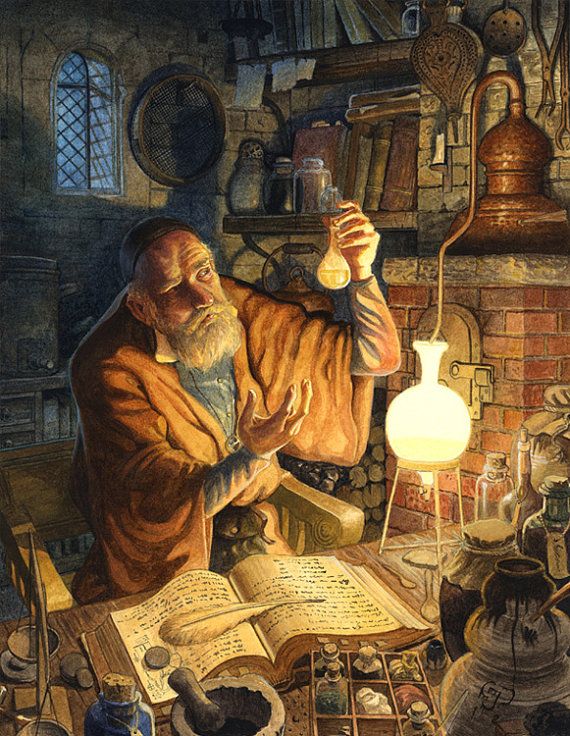
     On this day, one James Price, a distinguished amateur chemist and a Fellow of England’s Royal Society began a series of remarkable experiments. The seven experiments were witnessed by peers, baronets, clergymen. lawyers and chemists – men of unimpeachable public character. In these experiments, mercury was apparently transmuted into various quantities of gold and silver. Some of the gold was presented to His Majesty George III.

     Price became a celebrated figure, and many saw in his work the dawning of an era of unparalleled prosperity for England. Naysayers claimed that Price was merely a clever juggler or that he had deceived himself. In his favor were the facts that he was already a wealthy man and no needy adventurer and that he had already distinguished himself in chemistry.

     A fierce paper battle ensued over the veracity of the experiments, and eventually the Royal Society stepped in, calling upon Price as a Fellow of the society to prove to the satisfaction of his fellow Fellows the truth of his transmutations by repeating his experiments in their presence.

     Price dithered, making various excuses for not repeating the experiments (one of which was that it cost more to produce gold than the gold was worth).  Finally, however, he yielded to their exhortations and announced that he would leave London for his laboratory in the country to prepare for the experiment. He pledged to return in a month, but the month passed, and a second and a third. Six months passed, and even his friends had given up on him.  Just when everyone was convinced he had fled to France or some other criminal haven, he  reappeared, inviting members of the Royal Society to meet him at his laboratory for the experiment.

     Although only a year earlier they were contending for the honor of witnessing the experiments, only three society Fellows accepted his invitation. Stepping before them, Price hastily produced a flask and swallowed its contents. Noting a sudden change in his appearance, the visitors called for medical assistance, but in a few moments Price was dead.

     One thing was sure.  Price had not transmuted himself to gold.  It is speculated that in the beginning he had probably deceived himself, then in the usual slippery slope of skullduggery  attempted to deceive others, and finally,  lacking the moral courage to confess his mistake, checked himself out. In any event, the last belief in the possibility of alchemy among England’s scientific community came to an end in 1782 with Price’s death.

MAY 5, 1795: Keep Your (Hair) Powder Dry

Unlike today, a nice head of hair made an important fashion statement in the 17th century.  Hair loss and baldness were accompanied by a loss of status and style and, even worse, might indicate the heartbreak of syphilis.  Wigs were often used to cover up such shameful appearance.  Their use became widespread after two monarchs, Louis XIV of France and Charles II of England, victims of premature hair loss, donned wigs.  Courtiers, always quick to jump on a convenient bandwagon, started wearing wigs as well, and a fashion was born.

The first wigs were fashioned from horse and goat hair and, even though they identified the wearer as an elite member of society, they smelled bad and attracted lice and other unwanted critters.  To combat this inconvenience, wig wearers would powder their faux tresses.  Hair powder usually consisted of wheat starch and perfume.  Cheaper powders might be made of flour, ground rice or chalk.

The more popular wigs became, the more elaborate and  bigger they got, hence the term bigwig.  Then in the 18th century, wigs fell out of fashion just as quickly as they had risen.  Late in the century, the clever British, needing revenue to finance another of their endless wars with France, hit upon the idea of taxing hair powder. On May 5, 1795, the government introduced the Hair Powder Act, requiring citizens to purchase a certificate to purchase hair powder.  Well didn’t that put a dent in the use of wigs.  All  of a sudden, in England folks began to wonder what else those wigs might be hiding.  In France, they saw how often wig-wearing dandies ended up with their wigged heads at the wrong end of a guillotine.

Longhair became a word of derision.  Short hair or be square.  But nothing is forever.  Long hair made a comeback in the 20th century.  And you can buy hair powder on Amazon.  Tax-free.

Vamos A Celebrar

In Mexico, Cinco de Mayo is celebrated primarily in the state of Puebla where it is called El Día de la Batalla de Puebla (The Day of the Battle of Puebla) observed to commemorate the Mexican army’s unlikely victory over French forces at the Battle of Puebla on May 5, 1862. France, under the leadership of Napoleon Number Three, sought to establish a Gallic empire in Mexico (possibly because things had gone so well for Napoleon Number One in Russia back in 1812). In 1861, a large French force landed at Veracruz sending the Mexican government into retreat. Moving toward Mexico City, the French army encountered heavy resistance near Puebla from a poorly equipped Mexican army of 4,500 men. The Mexicans were able to soundly defeat the 8,000-strong French army, considered the best in the world.


MAY 3, 1840: JIMMY’S LITTLE LETTUCE PILLS

James Morison was a British merchant turned physician who died on May 3, 1840, at the ripe old age of 70 after suffering through a mid-life crisis of intolerable pain which he cured by magic little pills of his own devising. Thanks to his little pills created from flora and their miracle cure, he became throughout his later life a notorious advocate of “vegetable medicines.”

Although many of his peers considered him a bit of a quack, he came to his calling in a fairly honorable way; having tried every known cure for his maladies in vain, he devised the vegetable pills and found them to be “the only rational purifiers of the blood.”

He became, at age 50, a new man. He regained his youthfulness; his pains were gone; he enjoyed sound sleep and high spirits. In short, he was healthy, fearing neither heat nor cold, dryness nor humidity.  And all because of his dear little pills and a morning glass of lemonade.  Would it have been fair for him to keep this medical miracle to himself? Wasn’t he morally bound to spread this blessing among his fellow creatures? Of courses he was. And what if he profited handsomely from his doing so? One can grow wealthy arcimboldowith a much clearer conscience peddling carrots and turnip pills than peddling many other things.

He established a vegetable pill emporium with the rather lofty title of  British College of Health, retired to the south of France where he remained healthy, wealthy and wise until his 1840 death.  His work led to the later discovery of the powers of penicillin taken with a glass of lemonade.

arcimboldo

“The Vegetable Gardener” by Giuseppe Arcimbaldo

Vegetables are interesting but lack a sense of purpose when unaccompanied by a good cut of meat. — Fran Lebowitz

MAY 3, 1840: JIMMY’S LITTLE LETTUCE PILLS

James Morison was a British merchant turned physician who died on May 3, 1840, at the ripe old age of 70 after suffering through a mid-life crisis of intolerable pain which he cured by magic little pills of his own devising. Thanks to his little pills created from flora and their miracle cure, he became throughout his later life a notorious advocate of “vegetable medicines.”

Although many of his peers considered him a bit of a quack, he came to his calling in a fairly honorable way; having tried every known cure for his maladies in vain, he devised the vegetable pills and found them to be “the only rational purifiers of the blood.”

He became, at age 50, a new man. He regained his youthfulness; his pains were gone; he enjoyed sound sleep and high spirits. In short, he was healthy, fearing neither heat nor cold, dryness nor humidity.  And all because of his dear little pills and a morning glass of lemonade.  Would it have been fair for him to keep this medical miracle to himself? Wasn’t he morally bound to spread this blessing among his fellow creatures? Of courses he was. And what if he profited handsomely from his doing so? One can grow wealthy arcimboldowith a much clearer conscience peddling carrots and turnip pills than peddling many other things.

He established a vegetable pill emporium with the rather lofty title of  British College of Health, retired to the south of France where he remained healthy, wealthy and wise until his 1840 death.  His work led to the later discovery of the powers of penicillin taken with a glass of lemonade.

arcimboldo

“The Vegetable Gardener” by Giuseppe Arcimbaldo

Vegetables are interesting but lack a sense of purpose when unaccompanied by a good cut of meat. — Fran Lebowitz

MAY 2, 1843: THE LITTLE TOWN THAT CRIED WOLF

     Chances are you’ve never heard of Champoeg — unless maybe you’re from Oregon which is where it is, or was. Champoeg had the historical significance of being the first American government on the West Coast, having been established by representatives of Willamette Valley settlers on May 2, 1843, by a vote of 52-50. These representatives had held a series of meetings starting back in February to entertain measures to deal with the threat of wolves. During these so-called “Wolf Meetings,” the conferees established a series of civil codes (although its doubtful the wolves paid much attention to them).

     When the Oregon Territory was created in 1848, Champoeg was cold-shouldered as upstart Oregon City became its capital. This despite the fact that Champoeg had become rather a bustling little metropolis with a steamboat landing, a ferry across the Willamette River, a stagecoach office, a granary and a warehouse. Ten streets ran north to south, crossed by six east-west thoroughfares.

     Champoeg chugged along through the years as Oregon grew and gained statehood. Then in 1861, the Willamette River reared its ugly head, rising 55 feet above its normal stage, flooding the town and destroying every structure in it with the exception of two saloons (there’s a lesson here somewhere). Champoeg was never rebuilt after the flood; all that remains is a small monument describing its place in history and a stake marking a street corner (probably the one where a saloon stood).

“Well!”

     Although he was first heard on radio as a guest of Ed Sullivan, Jack Benny debuted his own radio show for NBC on May 2, 1932. After six months he moved to CBS and then in 1933 back to NBC. Although he continued to jump back and forth on networks, his radio program lasted until 1955, some five years after his television program appeared.

     Benny was a fixture on radio and TV for three decades, and is still considered one of the best. He was a master of comic timing, creating laughter with pregnant pauses or a single expression, such as his signature “Well!

     Appearing with him over the years were Eddie “Rochester” Anderson, Don Wilson, Dennis Day, Mary Livingston, Phil Harris, Mel Blanc and Sheldon Leonard. Leonard helped Benny produce what was said to be the longest laugh in radio history. Leonard as a holdup man approached Benny and demanded “your money or your life.” Benny remained silent. Finally, Leonard said “Well!?” and Benny answered “I’m thinking it over!”

APRIL 30, 1803: AND FOR ONE TULIP MORE, GALVESTON

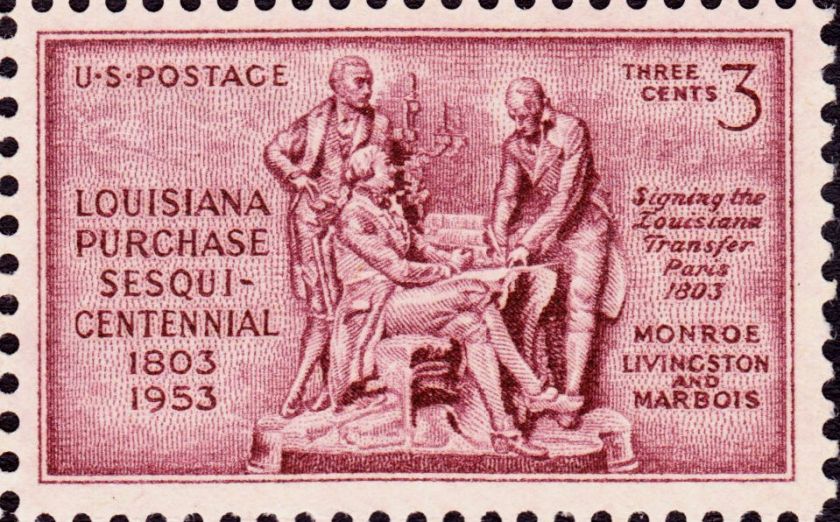
The United States purchased the Louisiana Territory from France in 1803, more than doubling the size of the nation. In addition to the city of New Orleans and western Louisiana, the purchase included Arkansas, Missouri, Iowa, Oklahoma, Kansas, and Nebraska; most of North and South Dakota; parts of Minnesota, New Mexico Montana, Wyoming, and Colorado (portions of Texas were included for ordering before 1804).

The price paid was 50 million francs (55 million without Texas). With the Dutch purchase of Manhattan in mind, President Jefferson had hoped to pay for the acquisition using beads. The frontierspeople would have none of it (“We may die without our boots on, but we won’t wear no sissy beads.”) and the people of New Orleans already had so many beads they held a party each year to give them away.

The purchase was pricey compared to the Dutch purchase of Manhattan ($15 million versus $24 in American currency; but since there was no American currency when the Dutch bought Manhattan, the comparison is like comparing guilders and tulips – and guilders and tulips went a lot farther back in 1626).  In another comparison, the United States paid 223 million rubles for Alaska. That’s 7.2 million dollars, 32 million francs, 18 million guilders, or 41 million tulips.

And Maybe a Few Brownies

In the 1968 movie I Love You Alice B. Toklas, Peter Sellers places an uptight lawyer who gets lost in the San Francisco counter-culture.  Featured prominently in the story is a notorious marijuana-laced brownie first introduced in a book by Alice Babette Toklas, an American writer born on April 30, 1877 in San Francisco.

Shortly after the 1906 earthquake, Toklas moved to Paris where she and her life-long companion, Gertrude Stein, immersed themselves in an earlier counterculture, the Parisian avant-garde of the early 20th century. They hosted a steady parade of American expats including such writers as F. Scott Fitzgerald, Thornton Wilder and Ernest Hemingway.

Toklas’ 1954 book, The Alice B. Toklas Cookbook, was a curious mix of recipes and reminiscences, most notably featuring the recipe for Haschich Fudge, the brownie that became a film star.