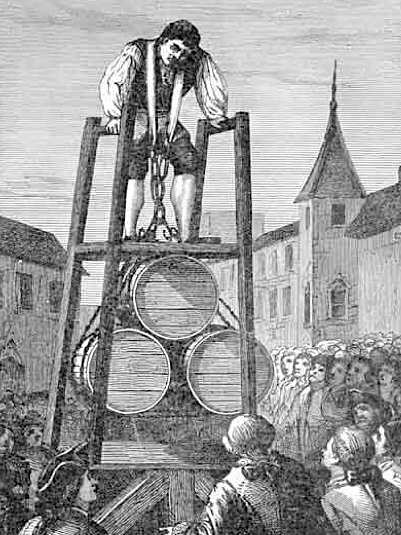
AUGUST 10, 1749: MORE POWERFUL THAN . . .

Thomas Topham, born in London about 1710, was brought up in the trade of carpentry and eventually found himself as the landlord of a small pub, the Red Lion Inn. Though he was by no means remarkable in size, he was endowed with extraordinary muscular powers and was able to entertain the patrons by performing various feats of strength. Crowds began to gather at the inn, not to drink but to see him perform.  To entertain the crowds, he might break a broomstick by striking it against his bare arm or lift a horse and toss it over a fence or roll up a pewter plate weighing seven pounds as another man would roll up a sheet of paper. In addition to his freakish strength, Topham could also sing in a basso profundo voice said to be so deep and resonant that it was scarcely human.

Strong as he was, he had basically a gentle nature. Sure, he might wrap an iron pipe around the neck of a man who irked him, but all in all he was a good-natured soul.  Naturally, the fame of this amazing strong man spread throughout England, and he became known as the Modern Samson.  He continued to wow bigger and bigger crowds – lifting 200-pound weights on his little finger or a six foot long oak table with his teeth, smashing a coconut by striking it against his ear, bending a one-inch thick iron bar around his bare arm with one blow.

     Alas, great fortune was not to continue for our Modern Samson. Like his biblical namesake, he was done in by the wiles of his very own Delilah. On August 10, 1749, his world came crashing down like that ancient temple when he discovered his wife’s infidelity.   After stabbing her to death, he used the knife on himself; dying from his wounds shortly thereafter.

AUGUST 9, 1639: TIPTOE THROUGH THE BOROUGHS

Jonas Bronck was the Norwegian son of a Lutheran minister born sometime around 1600. Or he was a Swedish sailor in the Danish Merchant Marine. Or a Dutch Mennonite who fled the Netherlands because of religious persecution. Or German.

In any event, he was an immigrant to the Dutch colony of New Netherland during a time when the greetings-bronxDutch were trying to increase its colonial population by relocating folks who had gone broke during the bursting of the tulip mania bubble in 1637. The English, who didn’t give a whit about tulips, were copulating and populating the New World like so many limey rabbits, and the Dutch were urged to get out of those wooden shoes and get with it.

Thus, Jonas Bronck arrived in New Netherland in 1639 aboard a ship ostentatiously named The Fire of Troy, whereupon he purchased himself a large tract of land from the local Lenape tribe for 400 beads. (You will remember that Dutch wheeler-dealer, Peter Minuit, who snapped up Manhattan for 26 bucks.)

Bronck’s 500 acres was just across the river from the village of Harlem, an easy commute to the Apollo Theater even then. Although Bronck traded with the locals, relations were not good, thanks to the Dutch practice of frequently murdering large numbers of them. Eventually, the they told Bronck to take his 400 beads and shove them, then killed him to reinforce the point.

Eventually, those populating English took over the Dutch lands. Jonas Bronck might have been completely forgotten, but for the river that retained Bronck’s name, mangled a bit to become the Bronx River. By extension, the land around it became The Bronx (and living there known as Bronxitis). This is fortunate, for the original Lenape name was Rananchqua.

We’ll have Manhattan, Rananchqua and Staten Island, too?

AUGUST 8, 1988: CRAZY EIGHTS

Numerologists had a field day back on 8/8/88. To start, the temperature in New York City reached a high of 88 degrees. Out in Minnesota, the Twins scored their second triple play of the season and eightyeightbeat Cleveland – by a score of 6-2. Meanwhile, the Cubs and the Phillies attempted to play the first ever night game at Wrigley Field but were rained out in the fourth inning with the score 3-1 (you do the math). The number was not lucky for Alan Napier, who played Alfred the butler in the Batman television series. He died. He was in his eighties.

     You might guess that the celebration in Eighty Eight, Kentucky, was a dandy one and it was. Numerologists descended on the little town in hordes, taking advantage of the 88 cents per gallon gasoline and the 88 cents meatloaf special at the Eighty Eight Restaurant. The celebration was over ten times (11) more festive than the one in Eight, West Virginia.

     But the numerology prize goes to a young lady named Kelly in Hackensack, New Jersey.  She was born at 8:08 in the morning, the eighth baby delivered that day, by a doctor who had eight of his own children. She naturally weighed in at 8 pounds 8 ounces.   And all the while her father paced nervously in the waiting room, humming “Beat Me Daddy, Eight to the Bar.”


AUGUST 7, 1966: CINCO DE CUGAT

Francesc d’Asís Xavier Cugat Mingall de Bru i Deulofeu was born in Spain and emigrated to Cuba when he was five. He was trained as a classical violinist and played with the Orchestra of the cugatTeatro Nacional in Havana before coming to the United States in 1915, where he rode the tango craze to stardom in movies and night clubs. Eventually Cugat and his orchestra became the resident musicians at New York’s Waldorf Astoria.

     On August 7, 1966, Cugat took his fifth stab at marriage with Charo, a Spanish guitarist and comic actress. One can only wonder why the 60-year-old Cugat would marry a 20-year-old who could barely speak English. It must have been her flamenco ability. Cugat’s previous wife, the sultry Abbe Lane, couldn’t play a lick.

     As a recording artist, Cugat followed dance trends carefully; his tango years were succeeded by  takes on the conga, the mambo, the cha-cha-cha, and the twist when each was in fashion. He had major hits with his recordings of “Pefidia” and “Brazil.”

     Cugat is the only bandleader in the Conductors-Who-Hold-Chihuahuas-While-Performing Hall of Fame.


I would rather play Chiquita Banana and have my swimming pool than play Bach and starve. ―Xavier Cugat

AUGUST 6, 1874: SAVING BODY PARTS II, THE EARS OF TEXAS ARE UPON YOU

Western justice once more prevailed when law officers killed one Jim Reed, a black hat of minimal notoriety who would probably have passed quietly into desperado oblivion had he not married Myra Maybelle Shirley. Myra Maybelle came from a once prosperous family whose business in Carthage, Missouri, had been wiped out by the Civil War. The family moved to Texas when she was 16 years old, and it was there that she fell in love with Jim Reed, a family acquaintance from Missouri who had served as a Confederate mercenary. They were married in 1866.

Reed was a lousy husband, more into horse racing and gambling than farming. He gravitated toward a nasty Cherokee named Tom Starr, who led a brutal gang of thieves. Starr (who wore a string tie fashioned from the ears of the men he had killed) mentored Reed in the art of rustling and running whiskey (and possibly a murder here and there).

Myra Maybelle, or Belle as she was now called, was the mother of two children. Nevertheless, she began to take part in her husband’s career, attending several robberies as though they were fancy dress balls, wearing velvet skirts and plumed hats. As fame and the law began to dog them, the Reeds went back to farming in Texas where they could give their children a more respectable upbringing. Too respectable for Reed evidently, for he soon grew antsy and returned to crime, holding up a stagecoach.  And once again they had the long arm of the law all over them.

With a hefty reward offered for Reed’s capture – dead or alive – bounty hunters joined the hunt. Reed was able to elude them for a bit, but on August 6, 1874, one of his fellow gang members killed him for the reward money. Two years later, Belle married Sam Starr, the son of Reed’s Cherokee partner, and became famous as the Bandit Queen, Belle Starr. Sam Starr died in a gun battle, and three years later Belle too cashed in her ill-gotten gains, bushwhacked by hombres unknown.


AUGUST 5, 642: SAVING BODY PARTS I, ARM AND THE MAN, I SING

A lock of hair from Elvis’ head, a scrap of material from something worn by a Beatle – we know how these things are sought, treasured, and fought over by modern day groupies. We should not be surprised to learn that it was always thus, although, if anything, this practice was far less civilized in the past. Take the case of Saint Oswald, English King of Northumbria, son of the pagan King Aethelfrith, the Ravager of Bernicia.

     Though both pagan and Ravager Jr., Oswald was a benefactor of the poor. Legend has it (as legend will) that Oswald was sitting at meal one day when a throng of beggars came to his gate for relief. This generous man sent them the meat from his own table, and there not being enough to feed them all, had one of his silver dishes cut into pieces to distribute among the rest. Aidanus, a Scottish bishop visiting Oswald, upon witnessing this gesture, took Oswald by the hand and said: “Nunquam inveterascat haec manus!” (“May this hand live forever”).

     Nice thought, but this being the Dark Ages, forever lasted only until August 5, 642, when Oswald was killed in battle by a neighboring king. Oswald’s comrades, remembering Aidanus’ blessing, sorted through his body parts and took care to preserve his arm. The arm was saved and treasured and eventually sold to a wealthy collector of saints’ arms. Rumor has it that it eventually found its way to a secret private collection where it stands alongside a lock of Elvis’ hair and a scrap of skivvies once worn by a Beatle.


AUGUST 4, 1855: FAMILIARITY BREEDS CONTEMPT (PAGE 76A)

People in Cambridge, Massachusetts, used to pester John Bartlett, who ran the University Book Store, asking for quotations on various subjects. Finally, to make his life easier, he assembled a collection of the more popular quotations. So beginning August 4, 1855, when people asked for a quotepithy quote, he could reply, “Look it up in your Bartlett’s Familiar Quotations and stop bugging me.”  His book contained 258 pages of quotations by 169 authors, primarily from the Bible, Shakespeare, and the important English poets. This was a bit of an undertaking, Bartlett pointed out. How does one decide if a quotation is familiar? A quote may be on a first-name basis with one person while completely unknown to another.

Nevertheless, the book was a big success, and Bartlett authored three more editions before becoming a partner in the publishing firm of Little, Brown, and Company. In all, he supervised nine editions of the work before his death in 1905.

Various other editors stepped in for a series of editions, and in 1955, the 13th Edition was celebrated as the Centennial Edition.  Along about the 15th Edition, the work started annoying critics. One critic said it would be the downfall of the series: “Donning the intellectual bell-bottoms and platform shoes of its era, Bartlett’s began sprouting third-rate Third World, youth-culture, and feminist quotes,” part of “a middle-aged obsession with staying trendy.”  The 16th Edition offended some folks because it included only three minor Ronald Reagan quotations (FDR had 35 quotes, and JFK 28). The editor answered the criticism by saying he didn’t like Reagan.

In the 17th Edition (2003) he took heat for including the likes of J.K. Rowling, Jerry Seinfeld, and Larry David while cutting classic quotes.  He did include six Reagan quotes but admitted “I was carried away by prejudice. Mischievously I did him dirty.”

“Me want cookie!” — Cookie Monster as quoted in Bartlett’s

AUGUST 3, 1946: Beat the Rush, Talk to Santa in August

Louis J. Koch, an Indiana family man and father of nine children, was disappointed when a family trip took him to Santa Claus, Indiana, and he found no Santa Claus, no elves, no reindeer, no workshop –  Indiananothing. Why they named the place Santa Claus was a bit of a mystery.  And he fixated upon the town named Santa Claus that had no Santa Claus, and upon the many children who would suffer the same disappointment. Lying in bed at night perhaps (or working on a third martini), he envisioned a park where children could have fun and visit Santa all year round.

     And he did something about it.  Santa Claus Land opened on August 3, 1946. At no cost, children could visit Santa, a toy shop, toy displays, a restaurant, and themed children’s rides, such as The Freedom Train. Though skeptical, Koch’s son Bill took over as head of Santa Claus Land and continued to add to the park, including the first Jeep-Go-Round ever manufactured, a new restaurant, and a deer farm.

     And it continued to grow, evolving into a huge theme park divided into sections celebrating Christmas, Halloween, Thanksgiving and the Fourth of July with rides, live entertainment, games, and attractions, including three wooden roller coasters: The Raven, The Legend, and The Voyage. Just how many times could a kid throw up in one day? Then came the obligatory water park featuring the world’s two longest water coasters: Wildebeest and Mammoth, slides, pools, a river, and water-play attractions. Whew!

Of course, all of this became too much for a place called Santa Claus Land. Today it goes by the name Holiday World & Splashin’ Safari.  And good luck finding Santa Claus.


AUGUST 2, 1922: YOUR CALL IS IMPORTANT TO US

phone1Alexander Graham Bell was one of those curious inventive sort of kids, the kind that love to experiment and blow up the garage with their chemistry set when they’re eight. Although he was normally quiet (except for the explosions), he loved mimicry and ventriloquism, throwing his voice here and there to baffle guests and leave his family carrying on conversations with the dog and the cat and plants.

     Troubled by his mother’s near deafness, he developed a technique of speaking directly into her forehead instead of her ears which for some reason enabled her to hear him. That evidently awakened a dream within him: If he could speak to his mother’s forehead and she could hear, he must be able to speak to a forehead in China or some other faraway place and be heard.

     This of course led to his study of acoustics, and his greatest invention. By 1876, he had developed a theory of forehead to forehead long distance transmission, and just days after receiving a patent, Bell succeeded in getting his invention to work.  He held the device to his forehead and spoke the now famous sentence: “Mr Watson – Come here – I want to see you.” In an adjoining room, Watson, listening at the receiving end (he held it to his ear but probably never told Bell), heard the words clearly.  He shouted to Bell the equally famous words: “Not now.  I’m on the phone.”

Oddly enough, Bell considered his most famous invention an annoyance and refused to have a telephone in his study.

     Bell died on August 2, 1922 before he could invent many improvements to his telephone, leaving it for others to come up with such refinements as the busy signal, call waiting, “Do you have Prince Albert in a can?”, cell phones and smart phones, obnoxious ringtones during concerts, and robocalls from Wayne LaPierre.   As another famous inventor put it: “What hath God wrought?”


JULY 31, 1718: LUST IN THE BARLEY OR MAKING LOVE TO THUNDEROUS APPLAUSE

A tragedy occurred on the last day of July in the English countryside, and eighteenth century poets were all over it like paparazzi on today’s celebrities. Gay wrote about it, and even Pope versified the unfortunate event.  John Hewit was a well-set man of 25, the comely Sara Drew about the same age, when they were both struck dead by a single lightning bolt. An anonymous poet (neither Gay nor Pope) told the sad story:

loversmeadowSara and Johnnie were lovers.

Oh, how those two kids could love.

Vowed to be true to each other,

As true as the stars above

He was her man,  And they were doing no wrong.


They were out in the meadow,

Picking flowers they say.

They lay down in the barley

Just to pass the time of day.

She was his woman, And they were doing no wrong.


The rain began, pitter patter.

It soaked them right through to the skin.

The great storm of 1718,

Yet the lovers didn’t come in.

He was her man, And they were doing no wrong.


Then came loud peals of thunder.

Guess what? They stayed there outside.

Lightning struck all around them.

Alas, our lovers were fried.

She was his woman, And they’ll be doing no wrong.


When the neighbors went searching, they saw the barley smoking. Then they spied the faithful pair – Sara, lifeless, with just a tiny burn mark on her breast;  John lying upon her in a vain attempt to shield her from the lightning, black all over.  Their tombstone, penned by Pope, read:

Near this place lie the bodies

OF JOHN HEWIT AND SARA DREW

an industrious young man

and virtuous maiden of this parish

who, being at harvest-work

were in one instant killed by lightning

the last day of July 1718


Either Pope didn’t know the sordid truth or he wasn’t telling.