APRIL 7, 1864: IT WAS A HUGE HUMPY BEAST

The first camel race in the United States was held in Sacramento, California, on April 7, 1864. The dromedaries belonged to Samuel McLeneghan who had paid $1,495 for 35 of them at an auction in Benicia, California. The camels had a curious history, one that began with an American military expedition to northern African nations along the coast of the Mediterranean Sea. The idea of the expedition and the importing of camels belonged to Secretary of War Jefferson Davis (this is of course the Jefferson Davis who later led the Confederacy, which had no camels that we know of). Davis convinced Congress to go along with this scheme and his vision of a Camel Corps that would carry military supplies across the country from east to west, it being reasoned that camels could carry heavier loads than horses on less food and water (sort of the same idea behind today’s guest worker programs for foreigners).

Unfortunately, the Camel Corps looked better on paper than in reality. The camels did not get along with their fellow animals or people: they stampeded horses and mules, attacked and bit pedestrians and chewed laundry off clotheslines. Camel caravans were only allowed to pass through some towns at night. With the Civil War getting underway (and Jefferson Davis going to the other side), interest in the project flagged and the Camel Corps disbanded. Of the camels that didn’t go to the races with McLeneghan, some joined the circus; some were employed by private companies. Eventually, many were abandoned in the desert. And for years afterward, prospectors and drifters might come rushing into a bar, raving about the strange apparition they had seen in the desert.

APRIL 6, 1722: AND TWO RUBLES FOR A FIVE 0’CLOCK SHADOW

In 1722, Peter the Great of Russia abolished a tax he had introduced some twenty years earlier, it having proved to be a rather hairy source of national income. The tax had been the result of an 18-month European tour to seek the aid of European monarchs, and to observe how other militias and armies were trained. During the tour, he learned that many European customs and styles were far superior to the antiquated ways in Russia. One of the first rulings he made upon his return was that all of his courtiers and officials shave off their long beards, as being clean-shaven was the European style. Anyone who kept their beard was subject to an annual Beard Tax of 100 rubles. Upon payment of the tax, bearded Russians were given a token; on one side of the token was an image of the lower part of a face with a full beard and the inscription “the beard is a superfluous burden.”

The idea of a beard tax had a bit of a history. Nearly 200 years earlier, King Henry VIII of England, who wore a beard himself, had introduced a tax on beards, although he probably didn’t pay the tax himself (it’s good to be the king). The tax was a graduated tax, varying with the wearer’s social position, not the length of his beard. Some years later, his daughter, Elizabeth I, reintroduced the beard tax, taxing every beard of more than two weeks’ growth, although she probably didn’t pay the tax herself (it’s good to be the queen).

APRIL 3, 1667: THE LIONS ARE COMING, THE LIONS ARE COMING

In addition to being a member of the British peerage, Edward, Marquis of Worcester, who died on April 3, 1667, was a bit of a dabbler, a sort of ersatz inventor, and author of an odd little book called A Century of Inventions. The book, written some ten years earlier, describes, as the title suggests, a hundred speculative projects, none of them, however, detailed enough to allow a reader to actually put them into practice: secret writing with peculiar inks, explosive devices that would sink any ship, ships that would resist any explosive devices, floating gardens, a method to prevent sands from shifting, automatic assault pistols and cannons, a timer for lighting candles at any time during the night, a hundred-foot pocket ladder, flying machines.

Although many of his ideas foreshadowed later inventions, it is unclear whether he had thought through the methods by which they would work. One idea was put to work with success although unusually so. As the owner of Raglan Castle, he had constructed some hydraulic engines and wheels for bringing water from the moat to the top of the castle tower.  During the Civil War, Roundheads had approached the castle with not the best of intentions. The Marquis had his waterworks put into play. “There was such a roaring,” he later wrote, “that the unwelcome visitors stood transfixed, not knowing what to make of it.” On cue, one of the Marquis’ men came running toward them shouting that the lions were loose. The intruders tumbled over one another down the stairs in an effort to escape, never looking back until the castle was out sight.

Fifty more clever ideas

The Marquis’ 100 nifty inventions most likely did not inspire Time Magazine to create its list of inventions at the turn of this century, although it could have.  The Time list heralded fifty creations that it called the worst of all time.  Wretched Richards Almanac has visited some of these in the past and will visit others in the future (like on April 5).  The list includes such sure-fire ideas as Hair in a Can, Tanning Beds, Venetian-Blind Sunglasses, Smell-o-Vision, Hula Chair and many more.


MARCH 22, 238: GORDIAN ANGELS

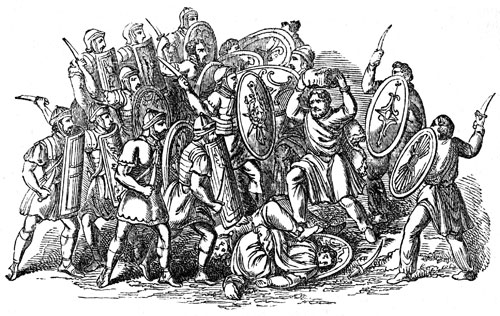
Romans got two emperors for the price of one, when in 238, Gordian I and II became father-and-son tag-team Caesars after an insurrection against Maximinus Thrax, a rather unpopular emperor who had come to the position by the popular tradition of assassinating his predecessor.  Gordian I was a bit long in the tooth so the younger Gordian was attached to the imperial throne and acclaimed Augustus too – sort of like if Poppa Bush and W had been presidents together, mano e mano so to speak.

Some supporters of Maximinus Thrax who were not happy with this turn of events staged a rebellion in Africa. Gordian II fought against them in the Battle of Carthage but lost and was killed for good measure. Hearing the bad news, Gordian I took his own life.  All of this happened within a month. Fortunately, there was no dearth of Gordians in Rome, and Gordian II’s 13-year-old nephew Gordian III soon became emperor. During his six-year reign, the teenage ruler endured pimples, the fickleness of teenage girls, and Persians until he was done in by the latter in yet another battle. He was succeeded by Philip the Arab (son of Ahab) sometimes referred to as the Gordian Not.

Slow and steady wins the race

Back in 1767, Lord Robert Clive of the East India Company was given a gift of four Aldabra tortoises from the Seychelle Islands. Three soon died, but the fourth, a gent named Addwaita “the one and only,” prospered.  He was transferred to a Calcutta zoo in 1875.

Addwaita was a bit of a loner, content to pass the decades in his zoo cubicle, munching on carrots, lettuce, chick peas, bran, bread and grass, growing to a stately 550 pounds and living  to the ripe old age of 250, give or take a year or two.

Alas, Addwaita bought the reptilian ranch on March 22, 2006. Foul play was not suspected.

Charlie Chan’s Words of Wisdom

March 11, 1958: And Then We’ll Nuke North Carolina

In 1958, the U.S. Air Force bombed South Carolina. Surprisingly, the bombing of Mars Bluff, a rural area near Florence, was not intentional. The bomb was a nuclear weapon carried by a B-47 Stratojet en route from Savannah, Georgia, to the United Kingdom. (The Air Force was not planning to bomb the Brits; the plane was on its way to military exercises and was required to carry nuclear weapons in the event of a sudden Dr. Strangelovian incident with the Soviet Union.)  A fault light in the cockpit indicated that the bomb harness locking pin for the transatlantic flight did not engage, and the navigator was summoned to the bomb bay to investigate. As he reached around the bomb to pull himself up, he mistakenly grabbed Printthe emergency release pin. The bomb dropped to the floor of the B-47, its weight forcing the bomb bay doors open and sending the bomb 15,000 feet down to unsuspecting Mars Bluff. Oops.

Because the removable core of fissionable uranium and plutonium was stored separately on board the plane, the bomb was not actually atomic, but it did contain 7,600 pounds of explosives. And it created a pretty good mushroom cloud over Mars Bluff, leaving a 75-foot wide and 35-foot deep crater where Walter Gregg’s home and vegetable garden had been. The only real casualties were several chickens who bought the farm so to speak.

The crater is still preserved but grown over, pretty much just a big hole. Steven Smith, who chaired a 50th anniversary event a few years ago, couldn’t understand why it never became a real tourist attraction. “It sure could be,” he said. “This is a national treasure!”

Take This Verb and Parse It

Diagramming sentences – what fond memories that brings back.  Shuffling nouns and verbs and predicate adjectives around until they find their proper position on the diagram.  Those were the days, my friend.  However, it’s with some sorrow that I contemplate our dear parts of speech.  One of their number has fallen upon some hard times.

“Snow White bit into the apple,” said the brothers grimly.

Pity the poor adverb.  Modern writing mavens pretty much eschew the adverb today – plucking it from the garden of good writing (or the garden of bad metaphors, if you prefer) as though it were an insignificant weed.  Okay, maybe it’s sometimes overused, but in moderation, like alcohol, caffeine and fat, it serves a noble purpose.

It wasn’t always considered a sin to associate with an adverb.  Some important folks have — as I will demonstrate.  Going way back to cite an example from a good book (or as many prefer The Good Book)  “Verily, I say unto you . . .”  Okay, all together now, what part of speech is that word verily?  You got it.  And it’s used more than once by you know who.  Okay, who wants to go first? Just step right up and say “Lose that adverb.”  I’d say that’s inviting a smiting.

Thomas Mann:  Hold fast to time!  Use it!  Be conscious of each day, each hour!  They slip away unnoticed all too easily and swiftly.

E. B. White: Be obscure clearly.

Mark Twain:  The intellect is stunned by the shock but gropingly gathers the meaning of the words.

Or you may remember that catchy tune by Francis Scott Key with words that go something like this: Whose broad stripes and bright stars, thru the perilous fight, O’er the ramparts we watched, were so gallantly streaming?  Call the adverb police.

And finally, moving into the future, I quote just three words from one Captain Kirk: “to boldly go.”  Now there’s a strong, sassy adverb coming to the rescue of a puny little verb and splitting an infinitive just for good measure.


March 9, 1974: Lay Down Your Arms

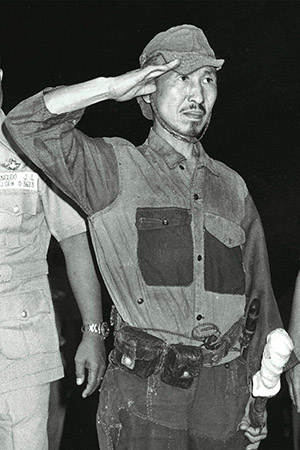
soldierLt. Hiroo Onoda, a soldier in the Japanese army, was sent to the remote Philippine island of Lubang in 1944 to conduct guerrilla warfare. Onoda was supposed to blow up the pier at the harbor and destroy the Lubang airfield. Unfortunately, his commanders, who were worried about other matters, decided not to help Onoda on his mission and soon the island was overrun by the Allies.  Time passed, the war ended, but nobody officially told Onoda; so for 29 years, Onoda remained a dedicated soldier, living in the jungle, eating coconuts and bananas and deftly evading searching parties. Hiding out in the dense jungles, Onoda ignored the leaflets, newspapers, photographs and letters from relatives dropped by planes during the years; he was convinced they were all part of an Allied plot.

In 1974, a college dropout named Norio Suzuki traveled to the Philippines, telling his friends he was out to find a panda, the Abominable Snowman and Lt. Onoda. Where others had failed, Suzuki succeeded. He found Lt. Onoda and tried to convince him that the war was over. However, Onoda refused to leave the island until his commander ordered him to do so. Suzuki traveled back to Japan and found Onoda’s former commander, who had become a bookseller. On March 9, 1974, Suzuki and the commander/bookseller met Onoda and delivered orders that all combat activity was to be ceased, and Onoda laid down his arms.

Tiny Tomato Killer Strikes Again

It is better to light a candle than curse the darkness, or so says some annoying pundit.  Likewise, I suppose, it is better to do something positive than curse the mounds of snow encircling us.  I’ve always been of the curse the darkness ilk, but occasionally I do try and rise above the winter of my discontent and light a candle in the snow.  One of the better remedies for my malaise is the old seed catalog – tiptoeing through the tulips, tomatoes and zinnias almost brings warmth to my icy heart.

If you ever order anything from a seed catalog, you will never have to worry about being without one again.  They will arrive every January just as reliably as the foot of snow they said would be an inch.  There’s Seed City, Happy Seeds, Seeds R Us and many more.  Funny thing is they all come from the same little town in the Midwest where a single little old lady – Granny Burpee – takes seeds out of great big jars and puts them in little envelopes with all those different names.

Nevertheless full seed ahead.  Seven tomato varieties, a couple of cucumbers, greens, beans, okra.  Snapdragons, sweet peas, exotic species I’ve never heard of.  “And there’s no such thing as too many sunflowers,” I’m reminded.

There is such a thing as too many seeds, however.  Granny Burpee doesn’t hold back – a hundred seeds here, two hundred there, a thousand.  I’d like to order six tomato seeds, please.  I really only need two cucumber seeds.  The theory seems to be that you must overplant, just in case some of them don’t sprout.

But they all sprout.

I wanted a couple of tomatoes.  I planted a plastic seed-starting tray, two or three seeds in each of its six cubicles.  Twenty tomato plants emerge.  Just thin out the extra plants, the catalogs advise, leaving one healthy tomato plant in each cubicle.  That’s theory again.  From over my shoulder, as I carefully pull out the runts of the seedlings:  “You’re not going to murder those little plants, are you?”

Come June, I have twenty tomato plants, a dozen cucumbers, a dozen nasturtium, I don’t know how many dozen sunflowers, a sea of seedlings that I forgot to label, and six zucchini.   With six zucchini plants, I’ll be able to place a giant zucchini on the back seat of every unlocked car in Vermont.

Maybe I’ll curse the darkness for a while.

March 4, 1925: Swain Song

On this date in 1925, the United States annexed Swain’s Island. If your history or geography course somehow skipped over this event, here’s practically everything you need to know (and then some).  Swain’s Island is a 461-acre atoll in the Pacific (and not to be confused with Newfoundland’s Swain’s Island). A Portuguese navigator was the first European explorer to southvisit Swain’s Island, arriving in 1606, although it was not called Swain’s Island then. It wasn’t called anything then, so he named it Isla de la Gente Hermosa, which in Spanish means “island of the beautiful people” (and some would say, a much nicer name than Swain’s Island).

Years later, Fakaofoan invaders (folks from a nearby island — no need to memorize their name) killed or enslaved all the gente hermosas. It was a Pyrrhic victory, however, since the island became infertile thanks to a curse placed on it by the chief of the gente hermosas (who evidently had a mean streak under all that beauty). Everyone died, and the island remained uninhabited until an American, Eli Hutchinson Jennings, founded a community with his Samoan wife, Malia, claiming to have received title to the atoll from a British Captain Turnbull for fifteen shillings per acre and a bottle of gin. The curse had expired, and the Jennings developed a thriving copra (coconuts, not snakes) business.

In 1907, Britain claimed ownership of Swain’s Island, demanding payment of a tax of $85. Jennings paid the tax, but he complained to the U.S. State Department, and his money was ultimately refunded. The British government also conceded that Swain’s Island was an American possession, and it officially became part of American Samoa on March 4, 1925.

Because it is in the middle of nowhere, Swain’s Island is considered an amateur radio “entity” and has become a mecca for ham operators, straining the hospitality of the island’s 17 permanent residents, none of whom would be called gente hermosas.

.


March 3, 1605: And a Decaf Peppermint Almond Latte

Ippolito Aldobrandini was born into a prominent Florentine family in 1536. As a child he was told that any little boy could grow up to be Pope. And didn’t he just do it, becoming a noted canon lawyer, a Cardinal Priest, and in 1592, Pope Clement VIII. He led the church until March 3, 1605. VIII’s enduring papal legacy for most of the world is not his bringing France back into the Catholic fold or leading the opposition to the Ottoman Empire, but rather his blessing of a certain beverage.

“The grain or berry called coffee groweth upon little trees only in the deserts of Arabia,” an early handbill proclaimed. “It is a simple, innocent thing, composed into a drink, by being dried in an oven, and ground to powder, and boiled up with spring water . . . and to be taken as hot as possibly can be endured.”

sheepCoffee had been around for centuries from the time when shepherds noticed that the beans when eaten by their sheep caused those sheep to become rather frisky. Naturally, the shepherds were anxious to try it themselves. Eventually, after a lot of broken teeth, they learned to roast it, grind it and brew it.

It didn’t take long for coffee to become wildly popular throughout the Muslim world. Not so in Europe however; no civilized Christian could share the drink of those infidels they had been battling practically forever.  The beverage came to be known as “Satan’s drink.” and Christians pleaded with Pope Clement to ban the evil liquid and declare that anyone who drank it would be destined to burn in Hell or some other nasty spot.

Clement considered this request, but being reasonable as well as infallible, would not condemn the drink without a fair trial. Thus a steaming cup of coffee was placed before him. He took a sip, and immediately became as frisky as those Muslim sheep.. “This devil’s drink is delicious.” he declared. “We should cheat the devil by baptizing it.”

And then came Starbucks.

Note: The popular folk song that came much later was not named for Clement VIII. It was “Oh My Darling Clement IX.”

December 29, 1852: Of Virile Toggery

Today, if you were wondering, is the fifth day of Christmas.  The fifth ghost of Christmas has taken Ebeneezer back to his childhood and a festive party.  The children are all very merry, playing a game of pin the tale on the donkey.  Unfortunately, Scrooge is the donkey.

True Love has sworn off birds and has sent a  lovely gift — five gold rings.  But wait, some scholars, having precious little to do, have studied this gift and have determined that those rings actually refer to — you guessed it — ring-necked pheasants.  Birds.

Folks who were not wrapped up in fifth day of Christmas activities in late 1852 were most likely following the activities of Frederick Douglass or newly elected President Franklin Pierce.  In Boston, however they were following the escapades of Emma Snodgrass. On December 29, Boston police arrested her again, another of many run-ins with the law beginning that Fall. This desperado was a tiny 17-year-old daughter of a New York policeman who had set Bostonian tongues awagging by appearing in public “donning the breeches.” Wearing pants, that is. She was arrested the first time in November and Emma-Snodgrass1promptly sent back to New York.

But didn’t she just come back again and set right in “visiting places of amusement around Boston.” She circulated among “all the drinking houses, made several violent attempts to talk ‘horse,’ and do other things for which “‘fast’ boys are noted” breathlessly reported one of the local papers.

Her notoriety spread.  She was ‘the wanderer in man’s apparel,’ the ‘foolish girl who goes around in virile toggery’ and ‘an eccentric female who roams about town.’ Back in New York, the Daily Times wondered: “what her motive may be for thus obstinately rejecting the habiliments of her own sex.”

She didn’t return to Boston. But during the next several months, there were Emma Snodgrass sightings practically everywhere else. She was reportedly sent home from Richmond, Virginia, sent before a judge in Albany, New York, spotted in Buffalo and Cleveland.

Emma Snodgrass, “the girl in pantaloons” was last seen in Louisville, on her way to California or Australia, reported the Fort Wayne Times and Peoples. But then a strange news report came out of Lancaster, Wisconsin: “Emma Snodgrass has repented, gone home, taken off her breeches, and sworn eternal attachment to petticoats and propriety.”

Could it be? We’ll never know, since it was the last news report. Emma Snodgrass had disappeared.

December 25: Tis the Season

Today is of course Christmas Day in much of the world.  To some folks who pack a lot into their ’tis the season, it is the beginning of Christmastide or Twelvetide, the first of a dozen days of Christmas.  This is infamously celebrated by the carol in which on this day, the first day of Christmas, someone’s True Love bestows upon him or her a gift of a partridge in a pear tree.  While we might point out that a crock pot or a circular saw would be a bit more practical, we won’t quibble with the sentiment.

It would also seem that Charles Dickens missed the boat.  Imagine the twelve ghosts of Christmas:  The first ghost of Christmas shows Ebenezer Scrooge how happy his parents were before he was born.  Stay tuned, Ebenezer; there’s more to come.

Over There

Just after midnight on December 25, 1914, British, French and Russian troops at European battle fronts were stunned as German joyeauxtroops ceased firing and began to sing Christmas carols — in some cases, even backed up by oompah bands.

World War I had begun five months earlier and would continue for another devastating four years. This spontaneous Christmas truce continued through the night and into daylight when many of the German soldiers emerged from their trenches and called out “Merry Christmas” in their enemies’ native tongues. Finally, Allied soldiers, seeing that the Germans were unarmed, climbed out of their trenches as well. Men from both sides ventured through the so-called No Man’s Land to shake hands with the enemy. The men exchanged small presents and sang carols and songs. In one case, soldiers played an international soccer game.

It was, of course, short-lived as both sides went back to their business of killing each other.  (This true story is told in the 2005 French film Joyeux Noel.)

On Christmas Day in 1941 Bing Crosby introduced a new Christmas song on his weekly NBC radio program. The song, written by composer and lyricist Irving Berlin, went on to become the gold standard of Christmas music — the top-selling Christmas single ever and the top-selling single of any kind for another 55 years.

The success of “White Christmas” came as no surprise to Berlin, who was already a musical legend. He modestly called it “the best song I ever wrote . . . the best song anybody ever wrote.” And written by a man who did not celebrate Christmas.