Millard Fillmore ominously assumed the presidency as number 13 when President Zachary Taylor, “Old Rough and Ready,”  pushed up presidential daisies in 1850. As the Last of the Red Hot Whigs to hold the office of president, Fillmore had a rather lackluster four years in office before receiving the boot from his own party. He is consistently a cellar dweller in historical POTUS rankings.

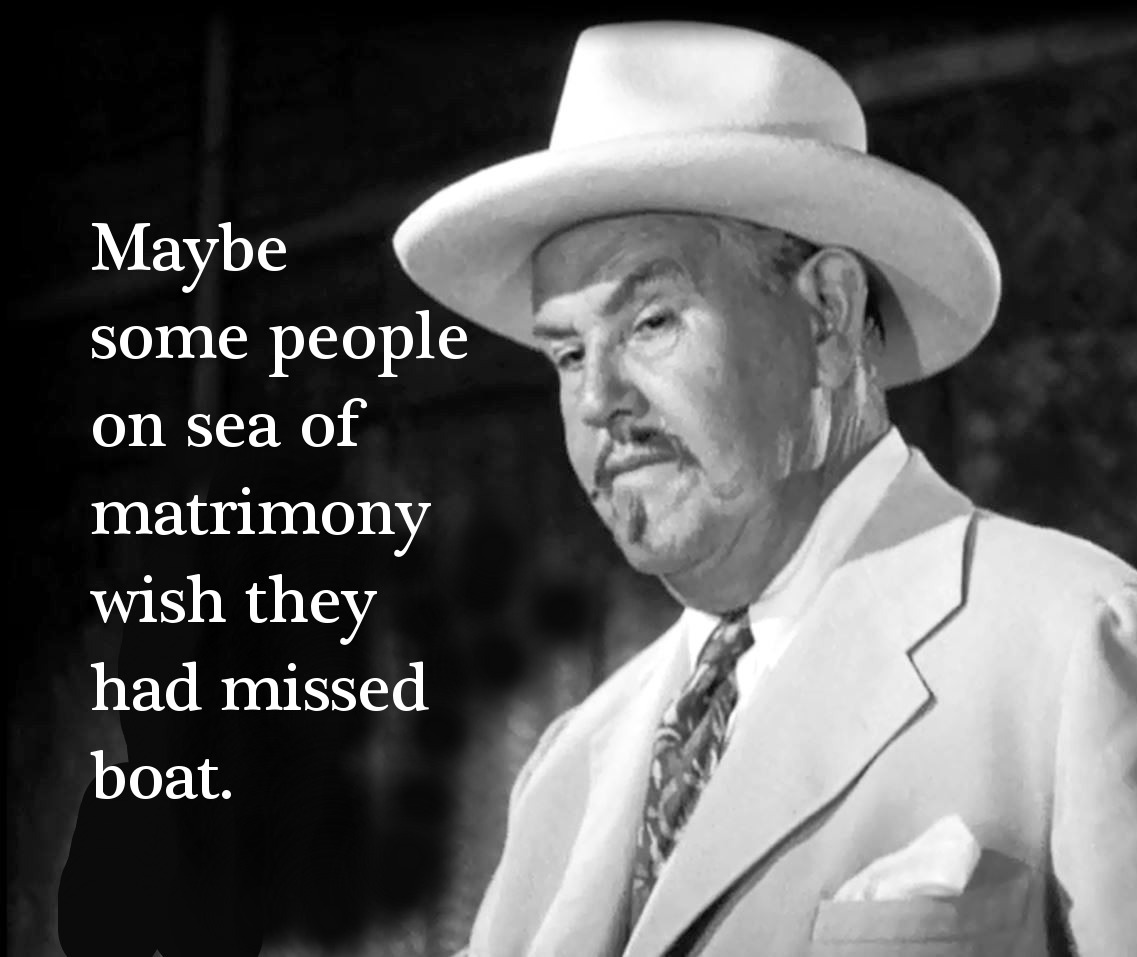
Fillmore’s most lasting legacy, trumpeted in a 1917 article, was the installation of a bathtub, a mahogany model, in the White House, giving the device an imprimatur that paved its way for wider distribution in the United States. This bit of sudsy statesmanship is frequently cited in reference to the Fillmore presidency. The whole story was of course a hoax, fabricated by one of the nation’s less reliable historians, H. L. Mencken. Even though the article was blatantly false and “a tissue of somewhat heavy absurdities,” it was widely quoted as fact for years. “My motive,” Mencken later explained, “was simply to have some harmless fun in war days. It never occurred to me that it would be taken seriously. Soon I began to encounter my preposterous “facts” in the writings of other men…. The chiropractors and other such quacks collared them for use as evidence of the stupidity of medical men. They were cited by medical men as proof of the progress of public hygiene. They got into learned journals and the transactions of learned societies. They were alluded to on the floor of Congress. The editorial writers of the land, borrowing them in toto and without mentioning my begetting of them, began to labor them in their dull, indignant way. They crossed the dreadful wastes of the North Atlantic, and were discussed horribly by English uplifters and German professors. Finally, they got into the standard works of reference, and began to be taught to the young.”

Old Rub-a-Dub-Dub joined Old Rough and Ready on March 8, 1874.

.

For every complex problem there is an answer that is clear, simple, and wrong. — H. L. Mencken

March 8, 1874: Old Rub-a-Dub-Dub

March 4, 1925: Swain Song

On this date in 1925, the United States annexed Swain’s Island. If your history or geography course somehow skipped over this event, here’s practically everything you need to know (and then some).  Swain’s Island is a 461-acre atoll in the Pacific (and not to be confused with Newfoundland’s Swain’s Island). A Portuguese navigator was the first European explorer to southvisit Swain’s Island, arriving in 1606, although it was not called Swain’s Island then. It wasn’t called anything then, so he named it Isla de la Gente Hermosa, which in Spanish means “island of the beautiful people” (and some would say, a much nicer name than Swain’s Island).

Years later, Fakaofoan invaders (folks from a nearby island — no need to memorize their name) killed or enslaved all the gente hermosas. It was a Pyrrhic victory, however, since the island became infertile thanks to a curse placed on it by the chief of the gente hermosas (who evidently had a mean streak under all that beauty). Everyone died, and the island remained uninhabited until an American, Eli Hutchinson Jennings, founded a community with his Samoan wife, Malia, claiming to have received title to the atoll from a British Captain Turnbull for fifteen shillings per acre and a bottle of gin. The curse had expired, and the Jennings developed a thriving copra (coconuts, not snakes) business.

In 1907, Britain claimed ownership of Swain’s Island, demanding payment of a tax of $85. Jennings paid the tax, but he complained to the U.S. State Department, and his money was ultimately refunded. The British government also conceded that Swain’s Island was an American possession, and it officially became part of American Samoa on March 4, 1925.

Because it is in the middle of nowhere, Swain’s Island is considered an amateur radio “entity” and has become a mecca for ham operators, straining the hospitality of the island’s 17 permanent residents, none of whom would be called gente hermosas.

.


March 3, 1605: And a Decaf Peppermint Almond Latte

Ippolito Aldobrandini was born into a prominent Florentine family in 1536. As a child he was told that any little boy could grow up to be Pope. And didn’t he just do it, becoming a noted canon lawyer, a Cardinal Priest, and in 1592, Pope Clement VIII. He led the church until March 3, 1605. VIII’s enduring papal legacy for most of the world is not his bringing France back into the Catholic fold or leading the opposition to the Ottoman Empire, but rather his blessing of a certain beverage.

“The grain or berry called coffee groweth upon little trees only in the deserts of Arabia,” an early handbill proclaimed. “It is a simple, innocent thing, composed into a drink, by being dried in an oven, and ground to powder, and boiled up with spring water . . . and to be taken as hot as possibly can be endured.”

sheepCoffee had been around for centuries from the time when shepherds noticed that the beans when eaten by their sheep caused those sheep to become rather frisky. Naturally, the shepherds were anxious to try it themselves. Eventually, after a lot of broken teeth, they learned to roast it, grind it and brew it.

It didn’t take long for coffee to become wildly popular throughout the Muslim world. Not so in Europe however; no civilized Christian could share the drink of those infidels they had been battling practically forever.  The beverage came to be known as “Satan’s drink.” and Christians pleaded with Pope Clement to ban the evil liquid and declare that anyone who drank it would be destined to burn in Hell or some other nasty spot.

Clement considered this request, but being reasonable as well as infallible, would not condemn the drink without a fair trial. Thus a steaming cup of coffee was placed before him. He took a sip, and immediately became as frisky as those Muslim sheep.. “This devil’s drink is delicious.” he declared. “We should cheat the devil by baptizing it.”

And then came Starbucks.

Note: The popular folk song that came much later was not named for Clement VIII. It was “Oh My Darling Clement IX.”

March 1, 1504: The Curious Case of Christopher Columbus and the Disappearing Moon

Christopher Columbus was not particularly known for his genius. After all, he thought a manatee was a mermaid (January 9) and the Bahamas were India. But in the wee hours of March 1, 1504, he showed himself to be a bit of a clever fellow and quite the showman to boot. Having stopped in Jamaica to make ship repairs during his fourth voyage (chances are, he had finally figured out that this was not India) he befriended the local natives (whom he referred to as the Pakistanis). However, Columbus’ crew was a surly lot and they soon wore out their welcome.

“When are you guys leaving?” the natives asked subtly. Then, when the Europeans refused to leave, the Jamaicans cut off their food and ganja.

The Europeans wanted to slaughter their rude hosts, but Columbus had a plan. He invited the Jamaican leaders to a late night pow wow. After a few rums and tokes, Columbus told his guests that his god was quite annoyed at their behavior and he was going to do something really nasty like smite them all dead. The Jamaicans were quite amused. Columbus then relented on the smiting part, but as punishment he said he would take away their moon. They were still quite amused, but when the moon began to disappear they changed their tune in a hurry, begging Columbus to please return their moon. Columbus said he would return their moon in exchange for all their papayas and all their pot.

It is lost to history how or if Columbus knew the moon would disappear that night. Perhaps it was just a lucky guess. Nevertheless, smug after his performance, Columbus warned the Jamaicans that they’d best behave or he’d send them packing back to India.

February 28, 1844: Love Story with Cannons

Cruising down the Potomac on a pleasant day in late winter could serve as the backdrop for romance, despite the fact that your vessel is not a gondola or a sailboat but a U.S. Navy steam frigate, and despite the fact that practically every dignitary in Washington is along for the ride.

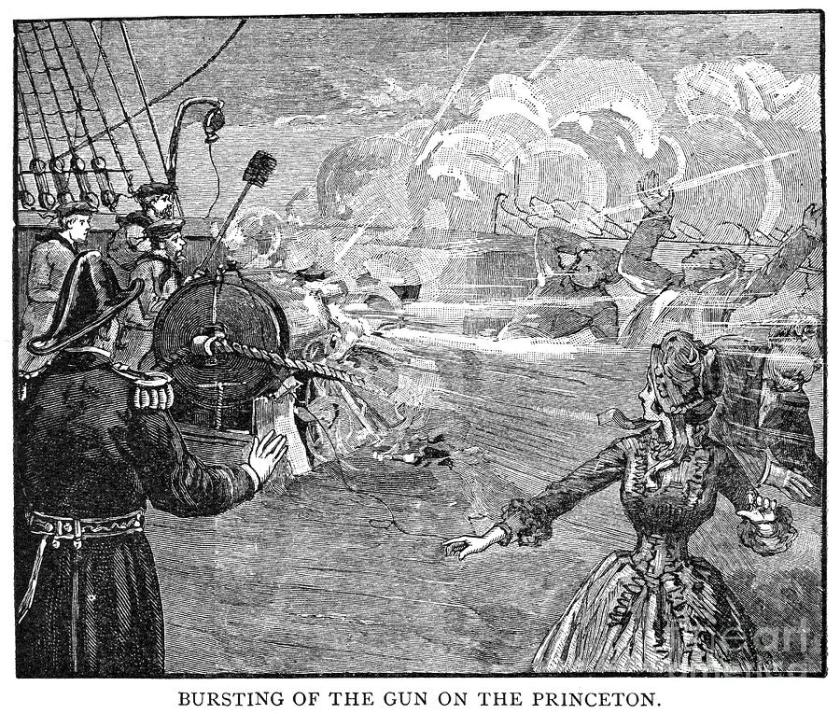
Okay, not so romantic, but if you’re the President of the United States, recently widowed, and you’ve just proposed marriage to an enchanting 20-year-old, it may be the best you can do. And so it was, that President John Tyler (Tyler Too of Tippecanoe-And fame), was on board the USS Princeton on February 28, 1844, for a demonstration of a fancy new 27,000-pound cannon lovingly called the Peacemaker. Julia Gardiner, whose yes vote the President was seeking, was there with her sister and father David, a wealthy New Yorker. The co-designer of the cannon, John Ericsson, was on board; so was the Secretary of War, other cabinet members, congressmen, political and business dignitaries, reporters and other various hangers on. An intimate little gathering. One can imagine 400 breaths being held in anticipation of Julia’s answer.

But first we must fire that cannon. Designer Ericsson tried to persuade, pleaded with, the ship’s captain not to actually fire the weapon before such a crowd, fearing it had not been adequately tested. The captain, however, was having none of it; he had a big audience and a big gun, and he was going to have a big bang. The Peacemaker was fired, and it made a jolly big noise, much to the delight of the audience who cheered and applauded and yelled for more (perhaps this is how wars are started). Once more, the cannon was fired and once more the giddy observers whooped, then they all headed below for toasts and libations.

The Secretary of War (being the Secretary of War) was too enthused to settle for just two shots (of either kind). He insisted that the cannon be fired once more in the direction of Mount Vernon, as a tribute to George Washington.  The cannon was fired, and the third time was not a charm. Mount Vernon was left standing, but the cannon itself exploded into the worst peacetime disaster in the nation’s short history, killing several on board including a couple of cabinet members and the father of the would-be bride. While others counted the dead left by the explosion, oddsmakers recalculated the President’s chances of getting the desired answer out of Julia.

The ship docked, and in a brilliant display of presidential heroics, Tyler carried Julia off to safety. Her answer was delayed a bit, but it was an affirmative, and later that year, Julia became Mrs. Tippecanoe and Tyler Too.

chan9


February 25, 1797: We Have Met the Enemy, and He’s . . .

In February  1797, a French invasion force, La Légion Noire (“The Black Legion”), under the leadership of Colonel William Tate sailed into Fishguard Bay in Wales.  The somewhat less than elite fighting force of 1400 men, formed partly by emptying French jails, landed on a beach near the small village of Llanwnda.  Men, arms and gunpowder were unloaded, and the ships headed back to France.  The last invasion of England had begun.

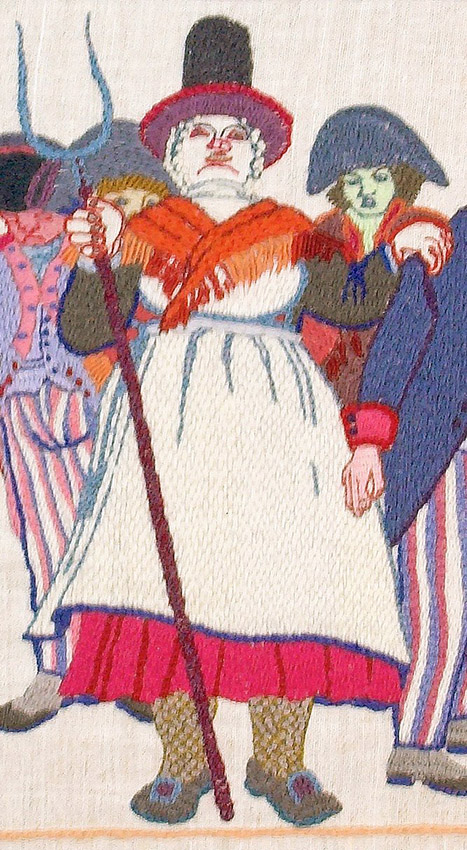
Preparations for a battle got underway.  Unfortunately,  the invasion force, having endured years of prison food, prepared by  liberating food and wine from a grounded Portuguese ship, eating and drinking well into the wee hours.  By dawn, the invaders were too drunk to fight.  The wife of a Fishguard cobbler, Jemima Nicholas (who would become known as Jemima the Great), armed with a pitchfork, marched into the enemy camp, captured a dozen Frenchmen, marched them back to the local jail, and went back to find some more.  And the Frenchmen saw British troops, following her, advancing toward them, seemingly numbering in the thousands.  And on February 25, they surrendered.  Turns out, however, that there were no British troops.  The advancing army was actually a few hundred Welsh women dressed in traditional red outfits with tall black felt hats who had come to watch the battle.
Jemima died at the age of 82. in 1832. Her grave in Fishguard was marked with a plaque in 1897, during the invasion’s centennial.

Monkey See . . .

In what would prove to be an endless parade, the first performance by a trained monkey in the United States was said to have been in New York City on February 25. 1751. Folks paid a shilling to watch the little creature dance, cavort, walk a tightrope and generally make a human of himself. Through the years such acts have gotten steadily bigger and better — think Clyde Beatty’s trained lions, dancing elephants, King Kong.

Monkeys have always been a favorite of course. As Haney’s Art of Training Animals pointed out back in 1869, monkeys have an ingrained passion for mimicking human beings (monkey see, monkey do) and they cut a fine figure in fine clothes. “Dressed in male or female apparel, the monkey’s naturally comical appearance is greatly heightened. Thus, one might be dressed to represent a lady of fashion, while another personates her footman, who, dressed in gorgeous livery supports her train. This is elaborated into quite a little scene at some exhibitions. A little barouche, drawn by a team of dogs, is driven on the stage, a monkey driving while a monkey footman sits solemn and erect on his perch behind. A monkey lady and gentleman are seated inside, she with a fan and parasol, he with a stovepipe hat. . . . Each performer is taught what he is to do, the most intelligent monkey being generally assigned the footman’s character.”

Now that’s entertainment.

FEBRUARY 11, 1847: TOM SWIFT AND HIS ELECTRIC THINGUMAJIG

With over a thousand inventions, many of which have touched the lives of nearly everyone in the world, Thomas Alva Edison is considered by many to be the greatest inventor of the modern era. But it wasn’t always thus. Al, as he was known, was a lousy student whose mother finally decided to home-school him. Edison’s first job was operating a newsstand on a train that ran from Port Huron to Detroit. To make the trips more interesting, he put together a chemistry lab in a boxcar (On the Atchison, Topeka and the Kaboom!). Then working as a telegraph operator, he continued to do scientific experiments in his free time. In 1869, he decided to devote himself full time to inventing.

     His first invention was patented that same year on June 1, a voting machine for use by legislative bodies such as Congress. Having heard that both the Washington, D.C., City Council and the New York State legislature were planning to install electric vote recorders, he stepped up to the plate. Edison’s somewhat Rube-Golbergish system, started with a switch that each legislator could move to either a yes or a no position. The vote would then be transmitted by a signal to a central recorder that listed the names of the legislators in two columns of metal type headed “Yes” and “No.” A recording clerk would then place a sheet of magic paper over the columns of type and move a metallic roller over the paper and type. As an electric current passed through the paper, chemicals in the paper decomposed, leaving the imprint of the name in a manner similar to that of chemical recording automatic telegraphs. Dials on the machine recorded the total number of yeas and nays.

     A fellow telegrapher bought a stake in the invention for $100 and took it to Washington, D.C. to demonstrate it before a Congressional committee. The chairman of the committee less than enthusiastically told him that “if there is any invention on earth that we don’t want down here, that is it.” It seemed legislators liked the slow pace of voting which allowed them to lobby or trade votes or do those other fun legislative things. Edison’s vote recorder was never used.

     Edison persevered, resolving never again to invent something that would not sell. His next invention, an improved stock market tickertape machine, earned him a tidy $40,000. And he went on to invent such other clever devices as the electric light bulb.

A Sport?  Really?

The Westminster Dog Show is the second longest running sports event in the United States, just two years younger than the Kentucky Derby.  More than 2,500 dogs competed in the 2003 running (walking? barking?), in which a Kerry Blue Terrier won for the first time.  Would you know one if you saw one?  The champ’s name was Torums Scarf Michael.  That’s a moniker that one might tire of in a hurry.  “Here Torums Scarf Michael.”  “Heel Torums Scarf Michael.”  “Sit . . .

January 28, 1393: I Don’t Want To Set the World on Fire

A rather unusual celebration took place in France on January 28, 1393 — a masked ball, given by Isabeau of Bavaria, wife of King Charles VI. The ball, which was later given the name Bal Des Ardents or Ball of the Burning Men, celebrated the remarriage of one of the Queen’s ladies-in-waiting. The quaint French custom on such an occasion called for rowdiness and tomfoolery.

At one point during the festivities, six men capered about in costumes portraying wood savages. Their linen outfits were soaked with resin to which flax was attached, making them shaggy from head to toe. They howled like wolves, shouted obscenities, and taunted the audience, inviting them to guess their identities. One of the six men was King Charles himself.

The King’s brother and a drinking buddy arrived late to the party, already drunk. They held torches close to the savages in an attempt to guess their identities — too close, setting the men ablaze. A Duchess, standing near the King, threw her gown over him to protect him. One of the other men jumped into a tub of ale. The other four perished.

Whether or not there was any cause and effect, it was about this time that Charles began to suffer bouts of mental instability, during which he would attack and frequently kill those near him. Modern psychologists, with their advanced knowledge, might refer to the King as mad as a hatter. Charles himself insisted that he was a stable genius and the best king in the history of France.

One of his most celebrated bouts with reality was his belief that he was made of glass and might be easily broken. As a result he allowed no one to touch him and anyone who approached him was required to tread lightly on tiptoe. The windows of the castle remained shut at all times to create an absolutely quiet environment, lest any sudden noise might — well, you know. Modern psychologists refer to this malady as glass delusion or if you break it, you buy it syndrome.

Charles endured his various idiosyncrasies until he was finally shattered in 1422.

Adios Mis Amigos

On January 28, 1948, a DC-3 plane carrying 32 passengers crashed in California’s Diablo Mountain Range, killing everyone aboard. News reports listed only the pilot, first officer and stewardess by name; the others were identified as deportees. The Hispanic victims were buried in a mass grave marked “Mexican Nationals.” At least they were not identified as rapists and murderers and other really bad people.

Woody Guthrie wrote a song about the incident:

January 15, 1797: Flamboyant Haberdashery

John Hetherington, a London haberdasher was hauled before the Lord Mayor on January 15, 1797, charged with inciting a riot. His breach of the peace had caused passers by to panic, women to faint, children to run screaming, dogs to yowl and one poor lad to suffer a broken arm from being trampled by the mob.

What had Hetherington done to cause such turmoil? According to authorities, he had appeared in public wearing upon his head “a tall structure having a shiny luster calculated to frighten timid people.” That is, he was the first person to wear a top hat on the streets of London. And for his act of flamboyant haberdashery, he was forced to post a ₤500 bond.

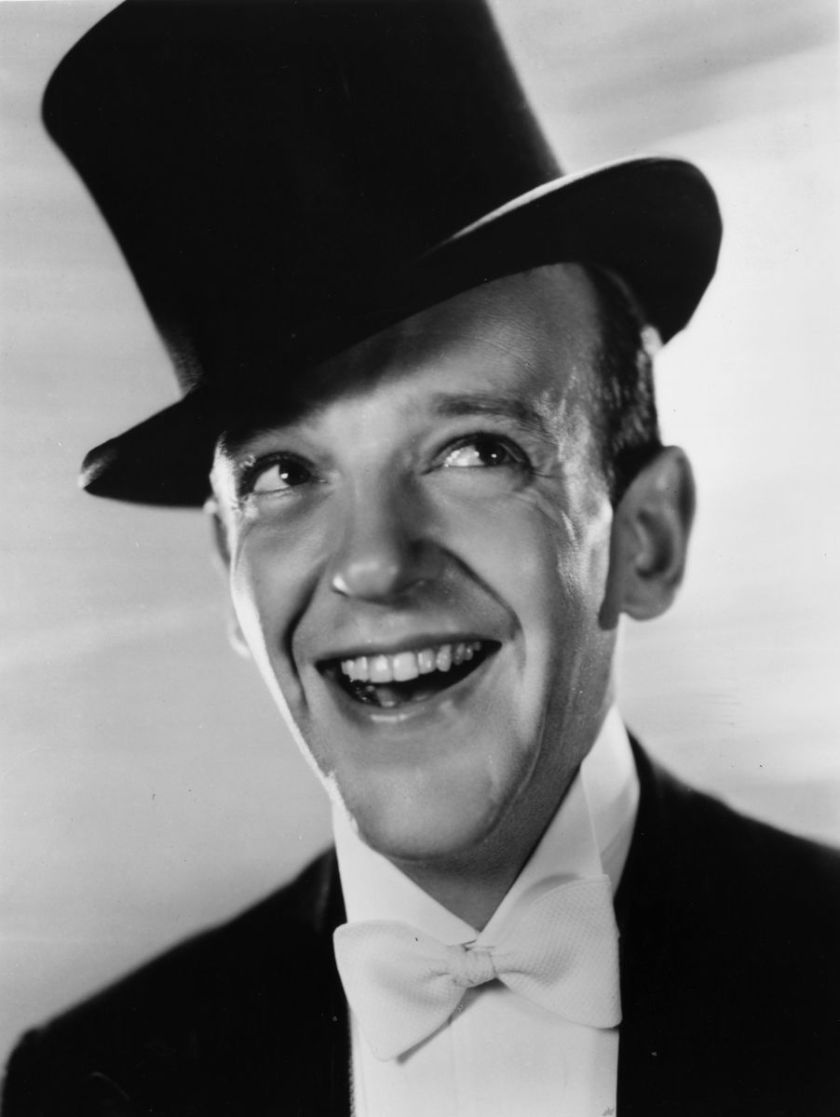
Hetherington’s chapeau was a silk topper also known as a high hat, silk hat, beaver hat, or stove pipe hat. It became popular soon after Hetherington’s breach and remained so through the middle of the 20th century. Folks associated with the top hat include Fred Astaire, Charlie McCarthy, Uncle Sam, and Rich Uncle Pennybags (the Monopoly man).

In 1814, Louis Comte became the first magician to pull a rabbit out of a top hat, and in 1961, John F. Kennedy became the last president to be inaugurated in one.


Don’t Be Nasty, Thomas

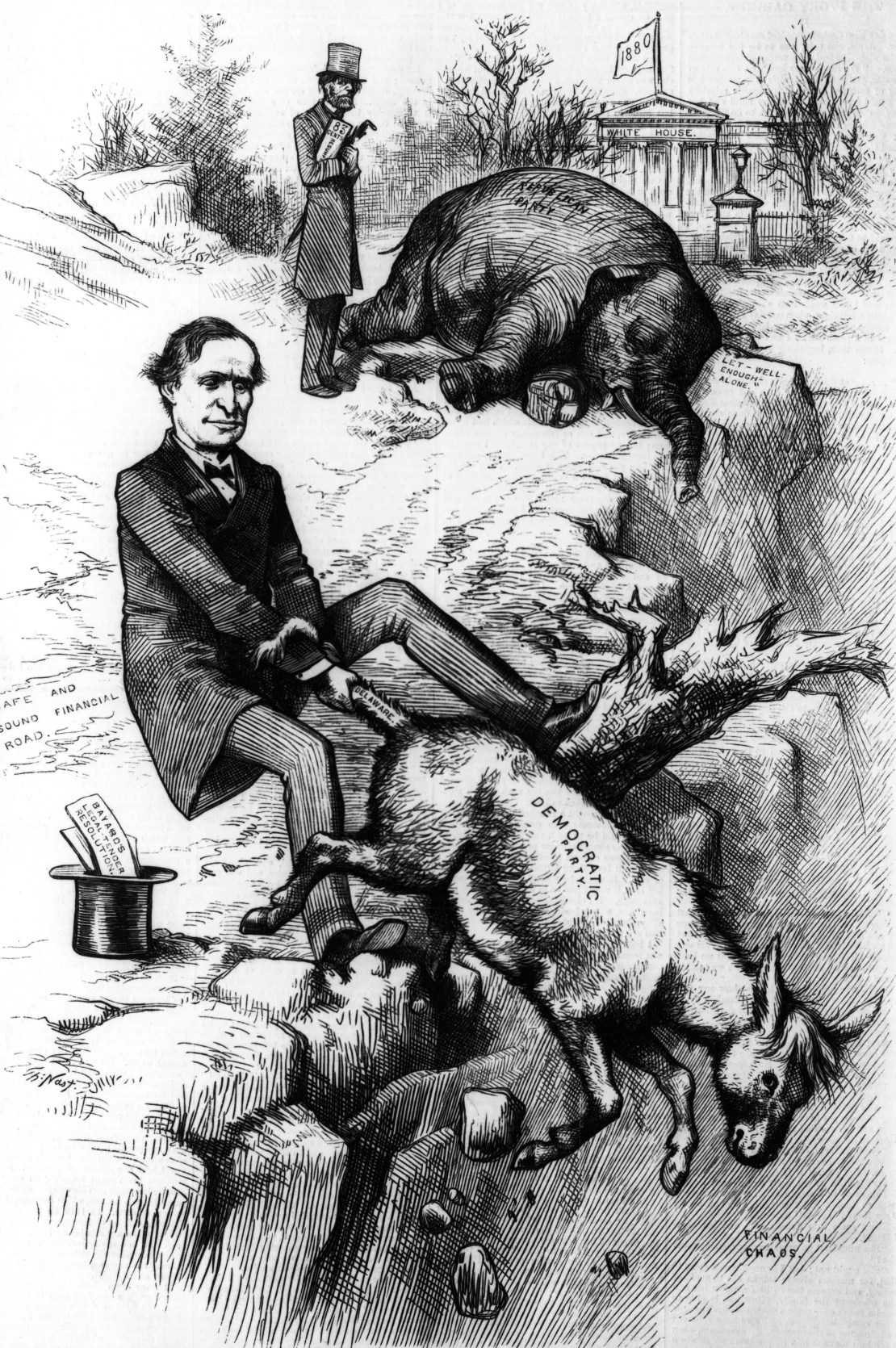
No, the adjective nasty did not refer to the noted political cartoonist Thomas Nast, but one could certainly be forgiven for thinking so.  Nast was the first  artist to picture the Democratic Party as a donkey– in Harper’s Weekly, January 15 1870. He also gave us the modern concepts of both Uncle Sam (with a top hat) and Santa Claus.

Democraticjackass

While the Democratic party was a hopelessly stubborn creature, Nast would go on to characterize the Republican party as an oversized oafish elephant, lumbering about in a clueless daze.  Neither animal wore as top hat.


The Democrats seem to be basically nicer people, but they have demonstrated time and again that they have the management skills of celery.  They’re the kind of people who’d stop to help you change a flat, but would somehow manage to set your car on fire.  I would be reluctant to trust them with a Cuisinart, let alone the economy.  The Republicans, on the other hand, would know how to fix your tire, but they wouldn’t bother to stop because they’d want to be on time for Ugly Pants Night as the country club. — Dave Barry

JANUARY 10, 49 BC: WADE IN THE WATER

Back in 49 BC, Julius Caesar was a mere governor commissioned by the Roman Senate to oversee a portion of the empire that stretched from Gaul to Illyricum (pretty much most of today’s Europe except Italy). When his term of governorship ended, the Senate ordered Caesar to disband his army and return to Rome. Whatever you do, Julie baby, don’t bring that army across the Rubicon River for that is treason and insurrection and very bad manners. Oh, and the punishment is death.

Caesar may have misunderstood for didn’t he just up and cross the Rubicon into Italy on January 10. His biographer suggests that he was under the control of a supernatural apparition (the Devil made him do it). Willful or not, Caesar is said to have shouted “alia iacta est” as he and his merry men waded across the shallow river (or ‘the die has been cast,” certainly more dramatic in Latin).

Crossing the Rubicon was a declaration of war, but instead of arresting Caesar the Roman Senate fled Rome in fear. Caesar, far from being condemned to death, became dictator for life. Sometimes it’s good to cross the Rubicon. Crossing the Rubicon has endured as a phrase meaning passing a point of no return.

The Hole in My Record Is Bigger Than the Hole in Your Record

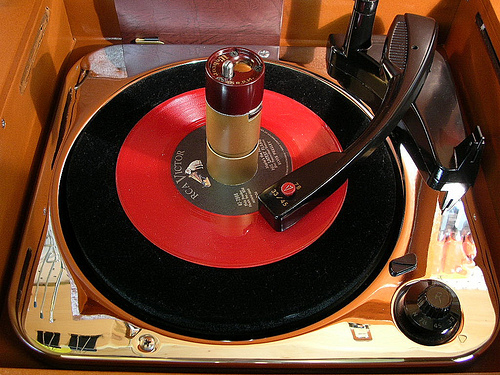
RCA Victor it might be said crossed the Rubicon when on January 10, 1949, it introduced a new kind of record — a vinyl disc, just seven inches in diameter with a great big hole in the middle, the 45 (referring to its revolutions per minute). The 45 replaced the big noisy shellac disc that rotated at a breakneck 78 rpm. The first 45 rpm single was “Peewee the Piccolo.” Remember it?

The Bun Knows

On January 10, 1984, 81-year-old Clara Peller first asked the question for which she would become famous: