JUNE 5, 1850, 1878, 1895: THRICE UPON A TIME IN THE WEST

When the sheriff of Lincoln County, New Mexico, resigned in 1880, the county appointed Pat Garrett, a former bartender known as something of a gunman to replace him.  Garrett was immediately given the task of apprehending a friend from his saloon keeping days, jail escapee Henry McCarty, aka Henry Antrim, aka William Harrison Bonney, but more widely known as Billy the Kid.  The Kid had supposedly killed 21 men, one for every year of his life, but no one could actually name more than nine.

Later that year, Garrett captured the Kid and his companions at the posh New Mexico spa, Stinking Springs, but the Kid escaped from the Lincoln County Jail, killing his two guards. Garrett learned that the Kid was hiding out at the house of a mutual friend, Pete Maxwell. Late one night, Garrett went to Maxwell’s house while the Kid was sleeping.  Accounts differ as to what happened next. Either the Kid woke up and entered Maxwell’s bedroom, where Garrett, standing in the shadows, shot him as he asked “Who is it?” (“It is I” or even “It’s me,” being the more gentlemanly response). Or Garrett went into Maxwell’s wife’s room and tied her up, and when the Kid walked into her room (for what purpose, we can only guess), Garrett blasted him with a single rifle shot. Either account pretty much tarnished Garrett’s reputation as a straight shooter.

Conspiracy theorists maintain that Billy the Kid was not killed at all and that Garrett staged it all so the Kid could escape. They also insist that Garrett was born (on June 5, 1850) in Kenya.

At about the same time (1878, to be exact) Pancho Villa was born on this same day a bit farther south in the northern Mexican state of Chihuahua. During the early 20th century, he pretty much ran the state.  He and his supporters played Robin Hood, seizing haciendas and land for distribution to peasants and soldiers. They robbed and commandeered trains, and printed their own money to pay for the 1910-20 revolution.

After Villa’s rather infamous incursion into New Mexico in 1916, U.S. Army General John J. Pershing pursued Villa for nine months unsuccessfully (probably because he refused to ambush him in a lady’s bedroom) before turning his attention to World War I. Villa retired in 1920 on a large estate where he could have spent a gracious hero’s retirement, sipping Margaritas in comfort, had he not decided to get back into politics, whereupon he was assassinated.

A few years later, back in the US, William Boyd (born June 5, 1895), was making a name for himself as a straight shooting, upright good guy, that name being Hopalong Cassidy.  Hoppy, as his friends called him, eschewed the role of  a hard-drinking, rough-living wrangler, opting instead to be the very model of a cowboy hero, one who did not smoke, drink or swear and who always let the bad guy strike the first blow (and never ever ambushed a bad guy in a lady’s bedroom).

Conspiracy theorists maintain that Boyd was not a real cowboy, that Hoppy was a fictional character. They point to the 66 Hopalong Cassidy films and the memorabilia such as watches, comic books, dishes, Topps trading cards, and cowboy outfits as proof.  Next they’ll say he was born in Kenya.

There’s always a man faster on the draw than you are, and the more you use a gun, the sooner you’re gonna run into that man. — Gunfight at the O.K. Corral

JUNE 1, 1869: TOM EDISON AND HIS ELECTRIC THINGUMAJIG

With over a thousand inventions, many of which have touched the lives of nearly everyone in the world, Thomas Alva Edison is considered by many to be the greatest inventor of the modern era. But it wasn’t always thus. Al, as he was known, was a lousy student whose mother finally decided to home-school him. Edison’s first job was operating a newsstand on a train that ran from Port Huron to Detroit. To make the trips more interesting, he put together a chemistry lab in a boxcar (On the Atchison, Topeka and the Kaboom!). Then working as a telegraph operator, he continued to do scientific experiments in his free time. In 1869, he decided to devote himself full time to inventing.

     His first invention was patented that same year on June 1, a voting machine for use by legislative bodies such as Congress. Having heard that both the Washington, D.C., City Council and the New York State legislature were planning to install electric vote recorders, he stepped up to the plate. Edison’s somewhat Rube-Golbergish system, started with a switch that each legislator could move to either a yes or a no position. The vote would then be transmitted by a signal to a central recorder that listed the names of the legislators in two columns of metal type headed “Yes” and “No.” A recording clerk would then place a sheet of magic paper over the columns of type and move a metallic roller over the paper and type. As an electric current passed through the paper, chemicals in the paper decomposed, leaving the imprint of the name in a manner similar to that of chemical recording automatic telegraphs. Dials on the machine recorded the total number of yeas and nays.

     A fellow telegrapher bought a stake in the invention for $100 and took it to Washington, D.C. to demonstrate it before a Congressional committee. The chairman of the committee less than enthusiastically told him that “if there is any invention on earth that we don’t want down here, that is it.” It seemed legislators liked the slow pace of voting which allowed them to lobby or trade votes or do those other fun legislative things. Edison’s vote recorder was never used.

     Edison persevered, resolving never again to invent something that would not sell. His next invention, an improved stock market tickertape machine, earned him a tidy $40,000. And he went on to invent such other clever devices as the electric light bulb.

And today in 1880, another inventor’s bright idea gone awry, the first pay telephone was made available to the public in the New Haven office of the Connecticut Telephone Company. No “deposit ten cents for another ten minutes” here. A proud attendant stood next to the phone collecting those dimes.

MAY 26, 1755: READ HIS FRENCH LIPS

Louis Mandrin was to France what Robin Hood was to England and Rob Roy to Scotland. Having served in the war of 1740 in a light brigade noted for undertaking dangerous missions to surprise the enemy, he was left idle and without income by peace, which made a remarkable appearance in 1748. He had no way of supporting his life other than by continually risking it. Thus he came up with the idea of assembling a corps of men like himself with himself as their leader and waging war against the fermiers, collectors of royal revenues from taxes  levied on salt, tobacco, and farming. The fermiers paid an agreed upon amount to the king, but could exact unspecified sums themselves. They naturally became fat and rich in the process – and hated.

Mandrin became the master of a portion of central France, pillaging public treasuries to pay his troops, whom he also put to work forcing the wealthy to buy his stolen merchandise. He successfully warded off the many detachments of government troops sent against him, instilling fear among their numbers and in the government itself. Eventually the people came to consider him their protector against the oppression of government revenue officers.

Finally, a regiment did attack and destroy his corps, but Mandrin himself escaped into the Duchy of Savoy. From there, he continued to make forays across the border and a terrible nuisance of himself. The French government was not not happy. The fermiers entered the Duchy illegally, disguising 500 men as peasants. Mandrin was betrayed by two of his men, seized, and whisked across the border. When the King of Savoy, learned of the French intrusion into his territory, he immediately wrote to the French King, demanding that the prisoner be turned over to him. But before the message arrived, Mandrin was hurriedly tried, condemned to be broken at the wheel, and executed on May 26, 1755.


MAY 24, 1626: FOR TWO GUILDERS MORE, WE’LL THROW IN QUEENS

In what is often called the greatest real estate deal ever, Peter Minuit bought Manhattan from native Americans on May 24, 1626, for goods valued at 60 guilders. Popular history identifies these goods as baubles, bangles and bright shiny beads (celebrated in song by Alexander Borodin in his String Quartet in D, routinely hummed on special Dutch occasions, since the words were not written until 1953 for the musical Kismet which in Dutch means “we could have bought the Brooklyn Bridge for a wedge of cheese had it been built.”)


The actual figure of 60 guilders was determined in the seventeenth century using a Dutch version of Generally Recognized Accounting Practices (GRAP) – known back then as Chicanery (C). In 1846, a New York historian converted this figure to dollars and came up with an amount of $24. Since then, people have regularly tried to update the $24 amount to today’s dollars. But as Edwin G. Burrows and Mike Wallace pointed out in their history of New York,”[A] variable-rate myth being a contradiction in terms, the purchase price remains forever frozen at twenty-four dollars.” Nevertheless people continue to point out what those baubles were worth in today’s dollars, euros or guilders. All the results are rather boring.


The transaction is often viewed as one-sided and beneficial to the Dutch, although some evidence suggests that Minuit actually purchased the island from a traveling beaver hide salesman who happened to be passing through and who had never heard of, let alone owned, Manhattan. At about the same time, Minuit was involved in another land purchase, that of Staten Island, for much more mundane goods such as kettles and cloth and garden tools (hence the phrase “we’ll buy Manhattan, the Bronx and Staten Island too.”)

Strangely enough, the aforementioned Brooklyn Bridge (remember that?) was opened to traffic on this very day in 1883.  And a Dutch tourist bought it for 100 guilders from a New York cabbie who claimed to be a full-blooded Manhattan Indian.


MAY 23, 1701: HERE’S LOOKING AT YOU, KIDD

William “Captain” Kidd was a Scottish sailor who was tried and executed for piracy on May 23, 1701. Some modern historians consider his reputation unjust, suggesting that Kidd acted only as a privateer, not a pirate. A pirate plundered ships; a privateer, under government authorization,  plundered ships belonging to another government. (See the difference?) Pirate or privateer, Kidd was among the most famous of his lot and one of the handful that people today can name – unusual because he was not the most successful nor the most bloodthirsty. Perhaps it’s because he did bury treasure, an important undertaking for any pirate worth his sea salt.

Several English nobles engaged Kidd to attack pirates or French vessels, sharing his earnings for their investment. He had substantial real estate holdings in New York, a wife and children, a membership in an exclusive club.   In short, he was respectable. But, foolish man, he decided to engage in one more privateering mission. Kidd set sail for Madagascar and the Indian Ocean, then a hotbed of pirate activity, but found very few pirate or French vessels to take. About a third of his crew died of diseases, and the rest were getting out of sorts for the lack of plunder. In 1697, he attacked a convoy of Indian treasure ships, an act of piracy not in his charter. Also, about this time, Kidd killed a mutinous gunner named William Moore by hitting him in the head with a heavy wooden bucket, also a no-no.

In 1698, he and his men took an Armenian ship loaded with satins, muslins, gold, and silver. When this news reached England, it confirmed Kidd’s reputation as a pirate, and naval commanders were ordered to “pursue and seize the said Kidd and his accomplices” for acts of piracy.

Pursued, seized, and hanged he was.   After his death, the belief that Kidd had left a large buried treasure contributed considerably to the growth of his legend. This belief made its contributions to literature in Edgar Allan Poe’s “The Gold-Bug”, Washington Irving’s The Devil and Tom Walker, and Robert Louis Stevenson’s Treasure Island. It also gave rise to never-ending treasure hunts in Nova Scotia, Long Island in New York, and islands off Connecticut and in the Bay of Fundy.

MAY 22, 1856: SENATORS WILL BE SENATORS

It all started in the Senate chamber in 1856 when Senator Charles Sumner, a Massachusetts Republican, addressed the Senate on the explosive issue of whether Kansas should be admitted to the Union as a slave state or a free state. Three days later on May 22 the “world’s greatest deliberative body” became a donnybrook fair.

In his speech entitled “Crime Against Kansas,” Sumner identified two Democratic senators as the principal culprits in this crime—Stephen Douglas of Illinois and Andrew Butler of South Carolina. In a little bit of overkill, Sumner called Douglas to his face a “noise-some, squat, and nameless animal . . . not a proper model for an American senator.”  Andrew Butler, who was not present at the time, received an even more elaborate characterization.  Mocking the South Carolina senator’s image as a chivalrous Southerner, the Massachusetts senator charged him with taking “a mistress . . . who, though ugly to others, is always lovely to him; though polluted in the sight of the world, is chaste in his sight—I mean,” added Sumner, “the harlot, Slavery.”

Representative Preston Brooks was a fellow South Carolinian to Butler. He read a certain amount of ridicule into the remarks, and he took great umbrage on Butler’s behalf.  In one of the Senate’s most dramatic moments ever, Brooks stormed into the chamber shortly after the Senate had adjourned for the day, where he found Sumner busily attaching his postal frank to copies of his “Crime Against Kansas” speech.

Brooks claimed that if he had believed Sumner to be a gentleman, he might have challenged him to a duel.  Instead, he chose a light cane of the type used to discipline unruly dogs. Moving quickly, Brooks slammed his metal-topped cane onto the unsuspecting Sumner’s head.   As Brooks struck again and again, Sumner rose and staggered helplessly about the chamber, futilely attempting to protect himself.  After a very long minute, it ended with Sumner lying unconscious. As Sumner was carried away, Brooks walked calmly out of the chamber without being detained by the stunned onlookers.  Overnight, both men became heroes in their home states.

Surviving a House censure resolution, Brooks resigned, was immediately reelected, and promptly died at age 37.  Sumner recovered slowly and returned to the Senate, where he remained for another 18 years. But the incident symbolized the breakdown of civility and reason in the capital and serves as a reminder to current legislators to always play nice with one another.

MAY 15, 1856: Over the Rainbow

Glinda the Good stepped down from her ruby throne to give the little girl a good-bye kiss, and Dorothy thanked her for all the kindness she had shown to her friends and herself.

Dorothy now took Toto up solemnly in her arms, and having said one last good-bye she clapped the heels of her shoes together three times saying, “Take me home to Aunt Em!

Lyman Frank Baum, born in Chittenango, New York, on May 15, 1856 (died 1919), was best known for writing The Wonderful Wizard of Oz, although he wrote a total of 55 novels, 83 short stories, over 200 poems, and made many attempts to bring his works to the stage and screen.

In 1897, after several abortive early careers, Baum wrote and published Mother Goose in Prose, a collection of Mother Goose rhymes written as prose stories, and illustrated by Maxfield Parrish. The book was a moderate success, allowing Baum to quit his door-to-door sales job and devote time to his writing. In 1899, Baum partnered with illustrator W. W. Denslow, to publish Father Goose, His Book, a collection of nonsense poetry. The book was a success, becoming the best-selling children’s book of the year. Then in 1900, the duo published The Wonderful Wizard of Oz to critical acclaim and financial success.   The book was the best-selling children’s book for two years after its initial publication.

Oz was a popular destination long before the famous 1939 screen version of the book.  A  musical  based closely upon the book,  the first to use the shortened title “The Wizard of Oz”, opened in Chicago in 1902, then ran on Broadway for 293 performances.   Baum went on to write another 13 Oz novels.

Baum’s intention with the Oz books, and other fairy tales, was to tell American tales in much the same manner as the Brothers Grimm and Hans Christian Andersen , modernizing them and removing the excess violence.  He is often credited with the beginning of the sanitization of children’s stories, although his stories do include eye removals, maimings of all kinds and an occasional decapitation.

Most of the books outside the Oz series were written under pseudonyms. Baum was variously known as Edith Van Dyne, Laura Bancroft, Floyd Akers, Suzanne Metcalf, Schuyler Staunton, John Estes Cooke, and Capt. Hugh Fitzgerald.

Baum wrote two newspaper editorials about Native Americans that have tarnished his legacy because of his assertion that the safety of white settlers depended on the wholesale genocide of American Indians. Some scholars take them at face value, others suggest they were satire. Decide for yourself.

The Pioneer has before declared that our only safety depends upon the total extermination of the Indians. Having wronged them for centuries we had better, in order to protect our civilization, follow it up by one more wrong and wipe these untamed and untamable creatures from the face of the earth. In this lies safety for our settlers and the soldiers who are under incompetent commands. Otherwise, we may expect future years to be as full of trouble with the redskins as those have been in the past.

Way Over the Rainbow

Paolo Toscanelli, born in 1397, was your typical Italian Renaissance Man, dabbling in everything from astronomy to mathematics to philosophy to cartography. He rubbed elbows (and influenced) the likes of Leonardo da Vinci and Christopher Columbus. In fact, that fickle finger of fate could have just as easily pointed at Paolo instead of Columbus.

As we all know, Christopher Columbus as a boy used to sit on the docks in Genoa watching ships slowly disappear over the horizon. While all the other boys sitting on the docks attributed this phenomenon to the ships falling off the edge of the world, Christopher determined that ships were gradually disappearing because the world was actually round. A fairy tale, of course. Columbus knew the world was round because Paolo Toscanelli told him it was round. Toscanelli even gave Columbus a map (a flat map admittedly) that showed Asia to the left on the other side of the Atlantic. Neither of them had reckoned on that other continent lying in-between. Yet Columbus got an October holiday and a city in Ohio while Toscanelli got squat.

Another near miss for Paolo was his observation of a comet in 1456. Although Paolo was the first to identify it, it remained known only as the Comet of 1456 until 300 years later when English astronomer Edmond Halley predicted its 1759 return and got naming rights.

Paolo died on May 15, 1482, ten years before Columbus sailed the ocean blue and some 350 years before “Halley’s” Comet did an encore.


MAY 13, 1619: WALK A MILE IN HIS WOODEN SHOES

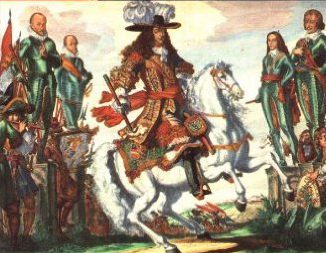
     Johan van Olden Barneveldt was a statesman who played an important role in the Dutch struggle for independence from Spain. His name is also associated – at least, according to British accounts – with a nation’s lack of gratitude for those who devote their lives to its service.  (The English have frequently displayed an antipathy toward the Dutch which has manifested itself in the language. A Dutch uncle is the opposite of a kindly relative; Dutch courage is a synonym for drunkenness; a Dutch treat is a demonstration of stinginess.)

     As Land’s Advocate for the States of Holland, an office he held for 32 years, Olden Barneveldt was the chief civil officer with tremendous influence in a republic without any central executive authority. And it was Olden Barneveldt who obtained for his country a footing among the powers of Europe, gaining peace and prosperity, freeing it from debt. He restored Dutch integrity by gaining back towns which had been surrendered to England as collateral for a loan and gained recognition of Dutch independence from Spain.

     The country owed nearly everything to this capable and upright administrator. Yet he had enemies. One Prince Maurice of Orange, head of the military forces, along with other military and naval leaders and the Calvinist clergy, were opposed to the peace with Spain, contending that the Spanish king was merely seeking time to recuperate his strength for a renewed attack against Dutch independence.

     This coalition against Olden Barneveldt proved to be overwhelming as well as nefarious. In 1619, he was arraigned before a special court of 24 members, only half of whom were Hollanders, and nearly all of whom were his personal enemies. In a mockery of justice, this kangaroo court ( a phrase showing English antipathy toward Australians?) condemned him to death, a sentence which was promptly carried out the following day, May 13, 1619, when the 72-year-old statesman was executed at the Hague.

Dutch Bad, Americans Good?

Fred Turner believed that people are basically  good.  In May of 1992 he set out from Beaufort, South Carolina, on a walk across America to underscore that belief.  A week into his walk, on May 13, Turner was crossing the Tuckaseking Bridge in Georgia when he met several men.  They asked him if he was the one whose walk they had read about in the paper.  When he told them he was they said: “Good, then give me your wallet.”  And when he complied, they beat him up and shoved him off the bridge.  He floated to a nearby island where he spent the night nursing two black eyes and a lot of bruises.  And perhaps reassessing his opinion of mankind.

MAY 9, 1671: STALKING THE CROWN JEWELS

In the movie The Adventures of Sherlock Holmes, Holmes’ nemesis Professor Moriarty is out to steal the crown jewels. His  battle of wits with Holmes over England’s great treasure lasts about an hour.  Earlier, an Irishman, Colonel Thomas Blood, attempted the same feat with a much more elaborate plan.

Colonel Blood set the plan in motion in April with a visit to the Tower of London. Dressed as a parson and accompanied by a woman pretending to be his wife, Blood made the acquaintance of Talbot Edwards, an aged but trustworthy keeper of the jewels. During this time, the jewels could be viewed by the payment of a fee. After viewing the regalia, Blood’s “wife” pretended to be taken ill, upon which they were conducted to Edward’s lodgings where he gave her a cordial and treated her with great kindness. Blood and his accomplice thanked the Edwardses and left.

Blood returned a few days later with a half dozen gloves as a present to Mrs. Edwards as a gesture of thanks. As Blood became ingratiated with the family, he made an offer for a fictitious nephew of his to marry the Edwardses’ daughter, whom he alleged would be eligible upon their marriage to an income of several hundred pounds. It was agreed that Blood would bring his nephew to meet the young lady on May 9, 1671.  At the appointed time, Blood arrived with his supposed nephew, and two of his friends, and while they waited for the young lady’s appearance, they requested to view the jewels. Edwards accommodated the men but as he was doing so, they threw a cloak over him and struck him with a mallet, knocking him to the floor and rendering him senseless.

Blood and his men went to work. Using the mallet, Blood flattened out the crown so that he could hide it beneath his clerical coat. Another filed the sceptre in two to fit in a bag, while the third stuffed the sovereign’s orb down his trousers.

The three ruffians would probably have succeeded in their theft but for the opportune arrival of Edwards’ son and a companion, Captain Beckman. The elder Edwards regained his senses and raised the alarm shouting, “Treason! Murder! The crown is stolen!” His son and Beckman gave pursuit.

As Blood and his gang fled to their horses waiting at St. Catherine’s Gate, they dropped the sceptre and fired on the guards who attempted to stop them. As they ran along the Tower wharf, they were chased down by Captain Beckman. Although Blood shot at him, he missed and was captured before reaching the Iron Gate.  The crown, having fallen from his cloak, was found while Blood struggled with his captors, declaring, “It was a gallant attempt, however unsuccessful, for it was for a crown!” — a rather eloquent comeuppance speech which today would be something more along the lines of “Oh fuck!”

MAY 2, 1843: THE LITTLE TOWN THAT CRIED WOLF

     Chances are you’ve never heard of Champoeg — unless maybe you’re from Oregon which is where it is, or was. Champoeg had the historical significance of being the first American government on the West Coast, having been established by representatives of Willamette Valley settlers on May 2, 1843, by a vote of 52-50. These representatives had held a series of meetings starting back in February to entertain measures to deal with the threat of wolves. During these so-called “Wolf Meetings,” the conferees established a series of civil codes (although its doubtful the wolves paid much attention to them).

     When the Oregon Territory was created in 1848, Champoeg was cold-shouldered as upstart Oregon City became its capital. This despite the fact that Champoeg had become rather a bustling little metropolis with a steamboat landing, a ferry across the Willamette River, a stagecoach office, a granary and a warehouse. Ten streets ran north to south, crossed by six east-west thoroughfares.

     Champoeg chugged along through the years as Oregon grew and gained statehood. Then in 1861, the Willamette River reared its ugly head, rising 55 feet above its normal stage, flooding the town and destroying every structure in it with the exception of two saloons (there’s a lesson here somewhere). Champoeg was never rebuilt after the flood; all that remains is a small monument describing its place in history and a stake marking a street corner (probably the one where a saloon stood).

“Well!”

     Although he was first heard on radio as a guest of Ed Sullivan, Jack Benny debuted his own radio show for NBC on May 2, 1932. After six months he moved to CBS and then in 1933 back to NBC. Although he continued to jump back and forth on networks, his radio program lasted until 1955, some five years after his television program appeared.

     Benny was a fixture on radio and TV for three decades, and is still considered one of the best. He was a master of comic timing, creating laughter with pregnant pauses or a single expression, such as his signature “Well!

     Appearing with him over the years were Eddie “Rochester” Anderson, Don Wilson, Dennis Day, Mary Livingston, Phil Harris, Mel Blanc and Sheldon Leonard. Leonard helped Benny produce what was said to be the longest laugh in radio history. Leonard as a holdup man approached Benny and demanded “your money or your life.” Benny remained silent. Finally, Leonard said “Well!?” and Benny answered “I’m thinking it over!”