OCTOBER 7, 1219: I’M-A GONNA GIVE YOU APPLE AND A PLUM AND AN APRICOT OR TWO

Every history buff is familiar with the great Khwarezmian Empire. No? The Khwarezmian Empire under the stewardship of Shah Ala ad-Din Muhammad reached the height of its glory during the early 13th century. It also reached its nadir during the early 13th century. The story of the Khwarezmian Empire is a cautionary tale about the  genghisimportance of peace, friendship and good manners and as such would be uplifting in its own special way were it not for all the bloodshed and gore.

Khwarezmia was a neighbor to Mongolia whose benevolent commander-in-chief was none other than Genghis Khan, who had a bit of a bad reputation throughout the East. Nevertheless Genghis offered an olive branch to the shah by sending him a rather lavish fruit basket with the Hallmark words of friendship: ‘You are the ruler of the land of the rising sun and I of the setting sun.’

Comes a watershed moment in the history of Khwarezmia and possibly the reason it doesn’t trip off our tongues today. Genghis sent a delegation of several hundred men to deliver the fruit basket, but the shah, in an admittedly bad start to a relationship, had them tossed into a dungeon. He kept the fruit basket.

Genghis was irked, but thought maybe the shah misunderstood his intentions (his being a foreigner and all). So he sent three royal ambassadors — two Mongols and a Muslim interpreter –to make inquiries. The shah, in what we can all agree was a doozie of a tactical blunder, had everyone in the first delegation killed, shaved the heads of the two Mongol ambassadors, and sent them back with the head of the interpreter as his answer to Genghis.

Genghis Khan sent no further pleasantries. Instead, he personally visited Khwarezmia, along with thousands of his best cutthroats. Khwarezmian cities fell like dominoes. The shah’s army was decimated and four million Khwarezmians were killed. Genghis even diverted rivers to erase the shah’s birthplace. The empire ceased to exist.

Violence never settles anything. — Genghis Khan

What It Was Was Football

Back in the days when football was still known as that game with the pointy ball, the son of German immigrants became the coach at the Georgia Institute of Technology (known to its friends as Georgia Tech). John Heisman became the first coach in college football to be paid for his services. They got their money’s worth. He led the school to its first national championship and had a career winning percentage of .779 which remains the best in Tech history.

The most memorable — or perhaps infamous — game in Heisman’s Georgia Tech career was played on October 7, 1916, with Tech playing host to Tennessee’s Cumberland University. Talk about a nail biter! The plucky Cumberland Bulldogs got off to a bad start, losing the coin toss.  Georgia Tech returned the Bulldogs’ first punt for a touchdown. Score 7-0 in less than a minute played. Cumberland fumbled on its first play after the following kickoff. 14-0, with just seconds off the clock.   On their next possession, the Bulldogs fumbled once again on their first play.  21-0. It went pretty much the same until the game mercifully ended with a score of 222-0.  A record, of course, that still stands.

In Cumberland’s defense, it should be pointed out that the college, on the verge of bankruptcy, had eliminated its football program at the beginning of the season. The school was forced to field a team (fraternity brothers of the team’s student manager) to avoid a $3,000 forfeit fee.

Heisman, who went on to be elected to the Football Hall of Fame and give his name to the trophy for the outstanding college football player of the year, up by 18 touchdowns at the half, told his players not to relent. “We’re ahead, but you just can’t tell what those Cumberland players have up their sleeves.”

OCTOBER 6, 1962: YOU CAN COME OUT FROM UNDER YOUR SEAT

When one thinks of offbeat film-making, directors Tim Burton and David Lynch come to mind. You’d be hard pressed, however, to find a more offbeat body of cinematic work than that of Tod Browning. Who?, most people would be asking. Tod Browning’s strange macabre films were a pulp-fiction parade of crooks, carnies, lowlifes, deadbeats, wretches, wastrels, scoundrels and, of course, vampires and freaks. And they helped to define the horror film genre.

Browning came to this career honestly. Born in Louisville, Kentrucky, he gave up his comfortable home life at 16 to immerse himself in the world of carnivals, sideshows and circuses. His resume included stints as a Ringling Brothers clown, a barker for the Wild Man of Borneo and the “Living Corpse” for which he was buried alive. He also worked as a magician, dancer and actor before finding his niche as a director of dozens of silent films, including a 10-film collaboration with Lon Chaney. When sound came to the movies, he made his mark with two of his most notable films: Dracula starring Bela Lugosi and Freaks, his master work and the film that destroyed his career. Freaks was so grotesque and unnerving that it was banned in the United Kingdom for three decades. In the U.S., MGM took the film away from Browning and chopped it by almost a third. It performed miserably.

His career on the skids, Browning made a handful of films during the 1930s before “retiring” at the end of the decade. He died on October 6, 1962.

Freak Show

The Halloween season (not to mention the political season) offers the perfect opportunity to indulge in Freaks.  It’s a love triangle set in a bizarre carnival world, featuring Hans, a wealthy dwarf, Cleopatra, a gold-digging trapeze artist, and Hercules, a strongman. Cleopatra and Hercules plan to trick Hans into marrying Cleopatra and then poison him. All the performers are real sideshow “freaks” — Koo Koo, the bird girl, Daisy and Violet, the Siamese twins, Johnny Eck, the Half Boy, Schlitzie, the Pinhead, to name a few, but the beauty of the film is Browning’s portraying them as the real human beings they are. The film remains frightening and grotesque, even after MGM’s “editing.” The deleted scenes were trashed, so it’s likely that no one still living today has seen the original version.


How I Stopped Worrying and Learned to Love the Bomb

Cold war and nuclear fears had been ramping up for years, when President John F. Kennedy took to the tube on October 6, 1961, to suggest that American families build bomb shelters to protect them from atomic fallout when those pesky Communists of the Soviet Union attacked the Homeland with their nuclear missiles. Just a year later, the Cuban Missile Crisis raised the stakes even higher.

While folks like Nelson Rockefeller and Edward Teller were outlining grandiose plans for an enormous network of concrete lined underground fallout shelters to shelter millions of people, civil defense authorities were talking up concrete block basement shelters that could be constructed by home handifolk for a couple hundred bucks. Exactly how much protection they might actually provide was an open question.

Most people calmed down during the mid-1960s,  and fallout shelters pretty much went the way of duck and cover.  They were converted into wine cellars, recreation rooms or mushroom gardens. For others, the fallout shelter notion has been kept alive by internet sites devoted to nuclear hysteria. You can survive a nuclear or dirty bomb attack, shouts one such site.  It will not be the end of the world. But, you must be prepared!

Being prepared naturally involves purchasing a fallout shelter from one of the many firms that still market them — Acme Survival Shelters, Hardened Structures Inc., Safecastle.  Taking it over the top is a company called Zombie Gear whose motto is Be prepared for anything.

OCTOBER 4, 1582: TEMPUS FUGIT, REALLY FUGIT

In 1582, the Gregorian Calendar was adopted for the first time with Poland, Portugal and Spain leading the way. The calendar was implemented by and named after Pope Gregory XIII . He didn’t like the Julian Calendar in use at the time because Easter kept creeping back to an earlier time of the year so that eventually it would fall in the middle of winter, even on Christmas Day (which wasn’t creeping) and really confuse Christians.

Jews didn’t care a whole lot because they were already up to year 5303. Muslims were back at 1001. The Chinese were celebrating 4278 (Year of the Horse). Certain scientists were way ahead of everyone else at 11582, having added 10,000 years to the current year to make the starting point the beginning of the human era (like they knew what day that was) instead of the birth of Jesus who they say wasn’t born in 1 BC but in 4 BC (lied about his age) and wasn’t born on his birthday (Christmas).

But back to the Christians for whom it was October 4, 1582, and also for whom tomorrow would be October 15, because Pope Gregory took ten days right out of the calendar to put Easter back where it had been when he was a boy.  calendarWell, you can just imagine how upset folks who had birthdays or special anniversaries or doctors’ appointments between October 5 and 14 were.

Some people just refused to use the new calendar. Many European countries fell into line later in the year. But many Protestant countries thought the new calendar was part of a Catholic plot . Britain (and its colonies) didn’t come along until 1752. The Greeks didn’t start using it until 1923. And a few malcontent members of the U.S. Congress are still demanding a recount.

Calling All Crimestoppers

An all-American, tough but smart, police detective arrived on the crime scene on October 4, 1931. Chester Gould’s Dick Tracy comic strip first appeared in the Detroit Mirror. The strip continues to run to this day, although drawn by others since Gould departed for that precinct in the sky back in 1985.

Along with police procedure and gadgets such as the two-way wrist radio, the strip featured a bevy of colorful characters. There’s Tess Trueheart, Tracy’s lady friend and eventual wife, his adopted son Junior and his wife Moon Maid (an alien), their daughter Honey Moon, Junior’s second wife Sparkle Plenty and her parents B. O. and Gravel Gertie. An almost endless list of villains: Abner Kadaver, Art Dekko, Breathless Mahoney, Cueball, Flattop, Gruesome, Junky Doolb (blood backwards), Littleface Finny, the Mole, Mrs. Chin Chillar, Mumbles and Pruneface.

Faraway Places With Strange Sounding Names

The Trojan Horse dates way back to the war between the Trojans and the Greeks in a thousand or so BC. Having been unable to topple Troy, the Greeks pretended to sail away, leaving the large wooden beast as a going away gift. But weren’t there a gaggle of Greeks hiding inside. Laocoon, a Trojan priest warned the others that he feared the Greeks bearing gifts. Perhaps if he had been more precise, counseling the Trojans to beware a gift bearing Greeks or not to look a gift horse in the mouth or you might see a Greek looking back at you, the outcome may have been different. But it wasn’t.

The Trojan Horse became a symbol of Greek might and was revered through the ages, resting at its home in the Trojan Horse National Park. Inexplicably, the Greeks tired of it and it was eventually converted to a condo. The horse which had once been filled with ancient Greek warriors came to house only five Greeks, the Thermopolis brothers — Dmitri, Ergo, Aristotle, Zorba and Smitty.

AUGUST 28, 1963: I HAVE A DREAM

In Washington DC, on  August 28, 1963, Martin Luther King, Jr. spoke to a crowd stretching from the Lincoln Memorial to the Washington Monument.

“Go back to Mississippi, go back to Alabama, go back to South Carolina, go back to Georgia, go back King_Jr_Martin_Luther_093.jpgto Louisiana, go back to the slums and ghettos of our northern cities, knowing that somehow this situation can and will be changed. Let us not wallow in the valley of despair.”

I have a dream that one day this nation will rise up and live out the true meaning of its creed: ‘We hold these truths to be self-evident: that all men are created equal.’ I have a dream that one day on the red hills of Georgia the sons of former slaves and the sons of former slave-owners will be able to sit down together at the table of brotherhood. I have a dream that one day even the state of Mississippi, a state sweltering with the heat of injustice, sweltering with the heat of oppression, will be transformed into an oasis of freedom and justice. I have a dream that my four little children will one day live in a nation where they will not be judged by the color of their skin but by the content of their character. I have a dream today.”

“When we allow freedom to ring, when we let it ring from every village and every hamlet, from every state and every city, we will be able to speed up that day when all of God’s children, black men and white men, Jews and Gentiles, Protestants and Catholics, will be able to join hands and sing in the words of the old Negro spiritual, ‘Free at last! Free at last! Thank God Almighty, we are free at last!'”


Part of that is when they try and demean me unfairly, because we had a massive crowd of people. We had a crowd… I looked over that sea of people, and I said to myself, ‘wow’, and I’ve seen crowds before. Big, big crowds. That was some crowd. — Donald Trump

AUGUST 24, 1850: MEET ME AT THE FAIR

London’s Bartholomew Fair, a wild celebration on the eponymous saint’s anniversary, died not with bartha bang but a whimper after enduring for more than seven centuries, Although originally established for legitimate business purposes, the fair had become all eating, drinking and amusement (for shame!) and a bit of a public nuisance with rowdiness and mischief.

Serious pursuits, uplifting exhibits, and dramatic entertainments had given way to shows and exhibits catering to the lowest common denominator of British fair-goers tastes – conjurers, wild beasts, monsters, learned pigs, dwarfs, giants. A prodigious monster with one head and two distinct bodies, a woman with three breasts, a child with three legs. A mermaid with a monkey’s head and the tail of a fish. Puppet shows, pantomimes, and coarse melodramas. A pig-faced lady and a potato that looked like King Henry VIII.

Eventually the fair grew less curiouser and curiouser, and on August 24, 1850, when the mayor went as usual to proclaim the opening of the fair, he found nothing to make it worth the trouble. No mayor went after that, and in 1855 the fair rolled over and expired.

I went to the animal fair,

The Birds and the Beasts were there.
The big baboon, by the light of the moon,
Was combing his auburn hair.
The monkey, he got drunk,
And sat on the elephant’s trunk.
The elephant sneezed and fell on his knees,
And what became of the monk, the monk?
The monk, the monk, the monk.

— Minstrel Song

AUGUST 16, 1896: THERE’S BACON IN THEM THAR HILLS

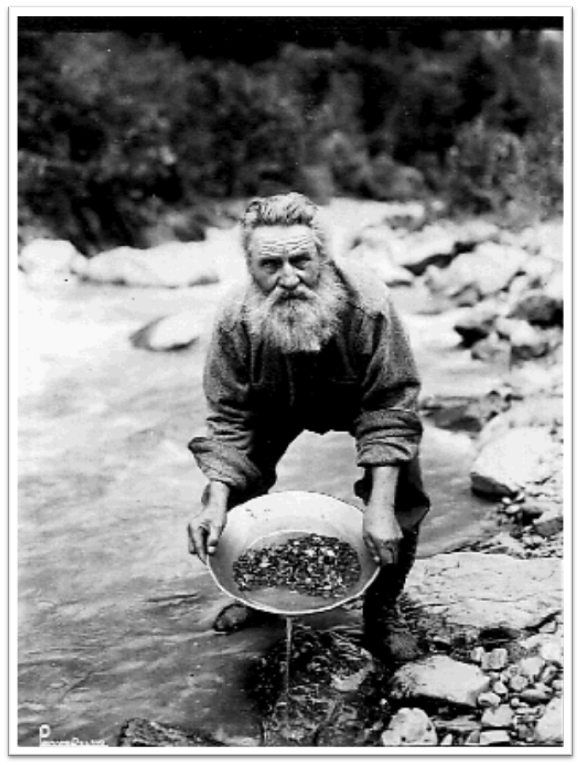
Tagish-Tlingit Packer Keish (Lone Wolf), commonly known as Jim, carried equipment and supplies for early prospectors over the mountain passes from the Alaskan seacoast to the headwaters of the klondike.previewYukon River. He earned the nickname “Skookum” (Chinook for big and strong) for his feat of carrying 156 pounds of bacon over Chilkoot Pass in a single trip. (You don’t pull the mask off the old Lone Ranger, And you don’t mess around with Jim.)

Eventually, tired of slogging other folk’s bacon, Skookum Jim formed a partnership with his sister Shaaw Tlaa (Kate), his cousin Dawson Charlie (Tagish Charlie), and Kate’s husband George Carmack (no nickname) to go look for the Big G.

On August 16, 1896, the Skookum party discovered rich gold deposits in Bonanza (Rabbit) Creek, Yukon.  Although Skookum Jim is believed to have made the actual discovery, George Carmack was officially credited for the gold discovery because the actual claim was staked in his name. The group agreed to this because they felt that an Indian’s claim would not be recognized because of the rampant racism of the time.

Well, you can just imagine what happened when word of their discovery got out. The Klondike was suddenly a “destination” for every would-be prospector who ever dreamed of the Big G. The exodus known as the Klondike Gold Rush (Yukon Gold Rush) (Alaskan Gold Rush) (The Gold Rush to End All Gold Rushes) was on.

Together our heroes worked what would become known as Discovery Claim (Look What We Found) and collectively earned nearly a million dollars. Skookum Jim built a home for his wife (the little woman) and daughter (junior) in the Yukon Territory (Tagish First Nation) where he spent the winters trapping, hunting and eating lots of bacon hauled in by others. George and Kate moved to California where he deserted her for another woman. You can’t trust anyone without a nickname.

AUGUST 14, 1619: THOU SHALT NOT

Those folks who think they have it pretty rough in Virginia these days should thank their reactionary stars things are not as they were back in 1619. The very first general assembly got together in Jamestown that year to pass laws that pretty much told everyone how they could and could not behave. The burgesses, as members of the assembly were called, were 30 old white men determined to dictate morality to everybody else, a tradition that hasn’t changed much over the years.

     Nor has the politics. The burgesses passed laws requiring all colonists to attend two religious services every Sunday and to bear arms (pieces, swords, powder and shot) while doing so – just in case religious fervor pushed someone over the edge.  Even those bearing arms were forbidden from gambling, drinking, idleness and “excesses in apparel,” (which probably didn’t mean too much clothing).  Not wishing to overlook any sin they hadn’t thought of, the burgesses also approved a stern enactment against immorality in general. In the eyes of the burgesses, one can imagine, that might cover a lot of territory (and the colonies had lots of territory). The planting of mulberry trees, grapes and hemp was also proscribed, for we all know that that seemingly innocuous flora is the first step on the road to degradation (spelled with a ‘d’ and that rhymes with ‘p’).

     The burgesses had only nice things to say about tobacco however. Colonists were urged to dedicate the times they were not in church to the growing of said crop. The colonists responded with enthusiasm, even to the point of growing tobacco in the streets of Jamestown – 20,000 pounds a year – despite His Royal Stick in the Mud King James calling it “dangerous to the lungs.”

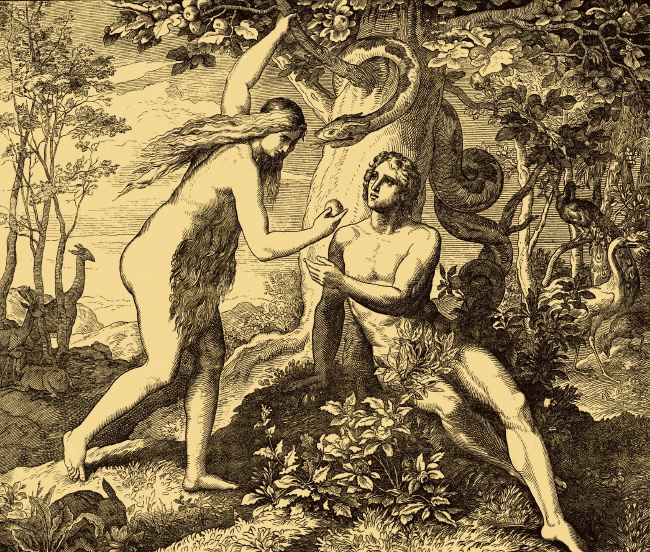
“Adam was but human—this explains it all. He did not want the apple for the apple’s sake, he wanted it only because it was forbidden. The mistake was in not forbidding the serpent; then he would have eaten the serpent.” ― Mark Twain

AUGUST 9, 1639: TIPTOE THROUGH THE BOROUGHS

Jonas Bronck was the Norwegian son of a Lutheran minister born sometime around 1600. Or he was a Swedish sailor in the Danish Merchant Marine. Or a Dutch Mennonite who fled the Netherlands because of religious persecution. Or German.

In any event, he was an immigrant to the Dutch colony of New Netherland during a time when the greetings-bronxDutch were trying to increase its colonial population by relocating folks who had gone broke during the bursting of the tulip mania bubble in 1637. The English, who didn’t give a whit about tulips, were copulating and populating the New World like so many limey rabbits, and the Dutch were urged to get out of those wooden shoes and get with it.

Thus, Jonas Bronck arrived in New Netherland in 1639 aboard a ship ostentatiously named The Fire of Troy, whereupon he purchased himself a large tract of land from the local Lenape tribe for 400 beads. (You will remember that Dutch wheeler-dealer, Peter Minuit, who snapped up Manhattan for 26 bucks.)

Bronck’s 500 acres was just across the river from the village of Harlem, an easy commute to the Apollo Theater even then. Although Bronck traded with the locals, relations were not good, thanks to the Dutch practice of frequently murdering large numbers of them. Eventually, the they told Bronck to take his 400 beads and shove them, then killed him to reinforce the point.

Eventually, those populating English took over the Dutch lands. Jonas Bronck might have been completely forgotten, but for the river that retained Bronck’s name, mangled a bit to become the Bronx River. By extension, the land around it became The Bronx (and living there known as Bronxitis). This is fortunate, for the original Lenape name was Rananchqua.

We’ll have Manhattan, Rananchqua and Staten Island, too?

AUGUST 6, 1874: SAVING BODY PARTS II, THE EARS OF TEXAS ARE UPON YOU

Western justice once more prevailed when law officers killed one Jim Reed, a black hat of minimal notoriety who would probably have passed quietly into desperado oblivion had he not married Myra Maybelle Shirley. Myra Maybelle came from a once prosperous family whose business in Carthage, Missouri, had been wiped out by the Civil War. The family moved to Texas when she was 16 years old, and it was there that she fell in love with Jim Reed, a family acquaintance from Missouri who had served as a Confederate mercenary. They were married in 1866.

Reed was a lousy husband, more into horse racing and gambling than farming. He gravitated toward a nasty Cherokee named Tom Starr, who led a brutal gang of thieves. Starr (who wore a string tie fashioned from the ears of the men he had killed) mentored Reed in the art of rustling and running whiskey (and possibly a murder here and there).

Myra Maybelle, or Belle as she was now called, was the mother of two children. Nevertheless, she began to take part in her husband’s career, attending several robberies as though they were fancy dress balls, wearing velvet skirts and plumed hats. As fame and the law began to dog them, the Reeds went back to farming in Texas where they could give their children a more respectable upbringing. Too respectable for Reed evidently, for he soon grew antsy and returned to crime, holding up a stagecoach.  And once again they had the long arm of the law all over them.

With a hefty reward offered for Reed’s capture – dead or alive – bounty hunters joined the hunt. Reed was able to elude them for a bit, but on August 6, 1874, one of his fellow gang members killed him for the reward money. Two years later, Belle married Sam Starr, the son of Reed’s Cherokee partner, and became famous as the Bandit Queen, Belle Starr. Sam Starr died in a gun battle, and three years later Belle too cashed in her ill-gotten gains, bushwhacked by hombres unknown.


AUGUST 5, 642: SAVING BODY PARTS I, ARM AND THE MAN, I SING

A lock of hair from Elvis’ head, a scrap of material from something worn by a Beatle – we know how these things are sought, treasured, and fought over by modern day groupies. We should not be surprised to learn that it was always thus, although, if anything, this practice was far less civilized in the past. Take the case of Saint Oswald, English King of Northumbria, son of the pagan King Aethelfrith, the Ravager of Bernicia.

     Though both pagan and Ravager Jr., Oswald was a benefactor of the poor. Legend has it (as legend will) that Oswald was sitting at meal one day when a throng of beggars came to his gate for relief. This generous man sent them the meat from his own table, and there not being enough to feed them all, had one of his silver dishes cut into pieces to distribute among the rest. Aidanus, a Scottish bishop visiting Oswald, upon witnessing this gesture, took Oswald by the hand and said: “Nunquam inveterascat haec manus!” (“May this hand live forever”).

     Nice thought, but this being the Dark Ages, forever lasted only until August 5, 642, when Oswald was killed in battle by a neighboring king. Oswald’s comrades, remembering Aidanus’ blessing, sorted through his body parts and took care to preserve his arm. The arm was saved and treasured and eventually sold to a wealthy collector of saints’ arms. Rumor has it that it eventually found its way to a secret private collection where it stands alongside a lock of Elvis’ hair and a scrap of skivvies once worn by a Beatle.