JUNE 19, 1885: BEWARE THE FRENCH BEARING GIFTS

In 1885, the French ship Isere sailed into New York Harbor carrying 214 crates filled with 350 libertypieces of a 305-foot high jigsaw that had been crafted in France and would, over the next four months, be re-assembled on an awaiting pedestal on Bedloe Island (now called Liberty Island) – there to stand for the next 134 years (so far).

Once constructed, this would, of course, be the Statue of Liberty or “Liberty Enlightening the World,” to those not on a first-name basis. It was a gift from France to the United States back during the two countries’ honeymoon days.   Actually it was something of a joint enterprise, the French providing the statue and the U.S. the pedestal on which it would stand.

French sculptor Frederic Auguste Bartholdi began designing the statue in 1876, working with Alexandre Gustave Eiffel, the designer of the Eiffel Tower. Richard Morris Hunt, designer of New York City’s first apartment building, designed the pedestal. Given his background, one might have expected his pedestal to house several luxury apartments, a missed funding opportunity: “Give me your tired, your poor, your huddled masses yearning to rent 3BR LUX APT, LWR FLR, UNF, HRBR VIEW.”

As it was, funding of the statue was a bit of an issue. Both countries faced challenges in getting money for the project. The French charged public fees, held fundraising events, and used money from a lottery to finance the statue. One notable fundraising method in the U.S. was a traveling arm. The statue’s torch-bearing arm was displayed at the Centennial Exposition in 1876.  After the exhibition closed, it was transported to New York, where it remained on display in Madison Square Park for several years before being returned to France to be reunited with its torso. The French, in a bit of Gallic oneupsmanship, exhibited the head at the 1878 Paris World’s Fair.

The plan to display Lady Liberty’s breasts in Boston was banned before it got off the drawing board, and a nationwide tour of her feet failed to muster sufficient enthusiasm.

The Statue of Liberty is no longer saying, ‘Give me your poor, your tired, your huddled masses.’ She’s got a baseball bat and yelling, ‘You want a piece of me?’ Robin Williams

When Mexico sends its people, they’re not sending the best. They’re sending people that have lots of problems and they’re bringing those problems. They’re bringing drugs, they’re bringing crime. They’re rapists and some, I assume, are good people. –Donald Trump

JUNE 12, 1349: IF YOU OUTLAW BOWS AND ARROWS . . .

Only knaves will have bows and arrows.  In a letter dated June 12, 1349, England’s King Edward III wrote how the people of his realm, archboth rich and poor, had in previous times exercised their skill at shooting arrows and how that practice had brought honor and profit to the kingdom. But, he continued, that skill had been laid aside in favor of other pursuits. Therefore he commanded sheriffs throughout the realm to proclaim that every able citizen in their leisure time use their bows and arrows, and learn and exercise the art of archery.   And furthermore, they should not in “any manner apply themselves to the throwing of stones, wood, or iron, handball, football, bandyball, cambuck, or cockfighting”  or any other such trivial pursuits (that includes golf).


A hundred years later, Edward IV continued the tradition, decreeing that all Englishmen, other than clergymen or judges, should own  bows their own height, keeping them always ready for use and providing practice for  sons age seven or older. Fines were levied for failing to shoot every Sunday.


Sir Wayne of LaPierre complained that the law did not go far enough, that it lacked a provision that citizens should carry concealed bows and arrows and quivers with more than a ten-arrow capacity.  And a ban on background checks for potential archers, of course.


Face Down in a Cranberry Bog, Part 1: two bicycles passing

A person pushing sixty pretty hard probably has no business on a bicycle in the first place. Like skis, surfboards and roller skates, they are the dominion of those young enough to have more vigor than common sense. And if people pushing sixty are foolish enough to bicycle the six miles to ‘Sconset, they tend to tire about halfway. If they’re at all smart, they’ll stop and rest, rather than continue on until the bicycle just rolls to a stop and plops over sideways. Which is what I did, and why I’m in this mess.

There’s a particularly good resting spot that’s almost exactly halfway. You reach it about two minutes before your heart and lungs give out completely. It’s where, on the side of the road opposite the bike path, a dirt pathway takes off through the tangles of scrub oak and meanders a quarter mile to the bogs. And it’s also where, if you’ve timed it just right, she emerges from that very dirt path. She’s young enough that she probably doesn’t have to stop and catch her breath and pretty enough that she takes mine away. At least she did.

For the past week, she appeared and captured my fantasies. She’d cross the road, stop, her bicycle nuzzling mine, and devour me with big brown eyes and a seductive smile. We’d laugh, touch and – she didn’t really stop, of course; she gave me a quick smile as she passed me and headed off in the direction from which I’d just come.

Until today, that is. I arrived at the same time as usual and waited for her appearance. But it didn’t happen. I waited for five, ten minutes and, yes, I worried. I don’t know why. Obviously, I should have forgotten my disappointment and, with hope she’d be there tomorrow, just continued on to ‘Sconset. Instead I pushed my bicycle across the road, rested it behind a large bush and trudged off down the dirt path. I walked the full quarter mile without seeing anyone, and rounding a patch of heath, reached the first bog, an oasis of dark green foliage pregnant with bright red cranberries girded by a sandy dike. Every twenty yards a sign reminded me that the bogs were private property and the picking of cranberries illegal. Each bog forms the center of a man-made crater and the dikes between craters form a meandering path. At harvest time in October, the crater is flooded and with a little prodding the cranberries just float right up to the surface for easy scooping.

It’s a fascinating process, and I guess in my fascination my mind wandered off somewhere – they do that when you’re pushing sixty. I don’t know how long it was gone, but when it returned I was standing at the edge of the second bog. Looking down, I saw it – him. A man, clad only in red boxer shorts, lying face down in the cranberry bog.

continued


JUNE 10, 2000: ALL TOGETHER NOW, STEP TO THE RIGHT

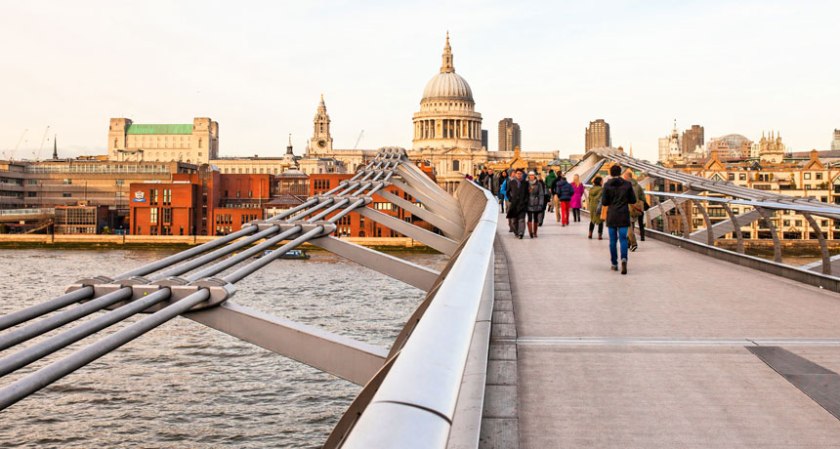
An air of excitement certainly gripped London on June 10, 2000, as 90,000 people queued up to cross the first new bridge to span the Thames River in over a hundred years, a bridge for pedestrians only, stretching from the Globe Theatre to St. Paul’s Cathedral, aptly named the London Millennium Footbridge. It didn’t take long for the bridge to become more known by its nickname, the Wobbly Bridge.
     Seems the designers had not given enough attention to a phenomenon with the catchy title, synchronous lateral excitation. Even if you’ve never heard of it, it doesn’t sound like anything you’d want to be on a bridge with.
     People, according to engineers, sway when they walk. People walking and swaying cause sideways oscillations in lightweight bridges. These, in turn, cause the people (some two thousand on the bridge at any given time) to sway even more to keep from falling over. And they all sway at the same time. It’s as if two thousand Londoners were doing the tango above the Thames. Result? Wobbly.
     Access to the bridge was limited later in the day, and on June 12 the bridge closed for modifications.  It reopened in 2002 (with tango forbidden).  It was again closed in 2007 because of strong winds and a worry that pedestrians foolish enough to cross might be blown off the bridge.
     The footbridge was not the only British millennial faux pas: a little number called the Millennium Dome elicited this derision from MP Bob Marshall-Andrews: “At worst it is a millennial metaphor for the twentieth century. An age in which all things, like the Dome itself, became disposable. A century in which forest and cities, marriages, animal species, races, religions and even the Earth itself, became ephemeral. What more cynical monument can there be for this totalitarian cocksure fragile age than a vast temporary plastic bowl, erected from the aggregate contribution of the poor through the National Lottery. Despite the spin, it remains a massive pantheon to the human ego . . .”

At the Zoo

Originally created as a royal herb garden in the 1600s, the Jardin des Plantes opened in 1793. During the following year a ménagerie was added, the world’s first and, still in existence, today the world’s oldest.  The 58-acre botanical garden and zoo is located in the center of Paris, next to the Seine.

The zoo was founded during the height of the French Revolution and the Reign of Terror. The National Assembly decreed that exotic animals  in private hands – rare antelopes, tigers, Louis XIV, and the like — were to be donated to the menagerie or guillotined, stuffed and donated to the natural scientists of the Jardin des Plantes . The Jardin was free for all visitors and tourists right from its inception.

While the menagerie at first was just provisional, it grew in the first three decades of the 19th century to be the largest exotic animal collection in Europe – as they describe it in France (or somewhere): monkey honnete, girafe pas sincere, elephant plein mais stupide, orang-outang sceptical, zebre reactionaire, antilope missionaire.

A well-run place, but this being France the menagerie gardiens are usually quite fond of their aperitifs.

Someone told me it’s all happening at the zoo.Paul Simon


JUNE 5, 1850, 1878, 1895: THRICE UPON A TIME IN THE WEST

When the sheriff of Lincoln County, New Mexico, resigned in 1880, the county appointed Pat Garrett, a former bartender known as something of a gunman to replace him.  Garrett was immediately given the task of apprehending a friend from his saloon keeping days, jail escapee Henry McCarty, aka Henry Antrim, aka William Harrison Bonney, but more widely known as Billy the Kid.  The Kid had supposedly killed 21 men, one for every year of his life, but no one could actually name more than nine.

Later that year, Garrett captured the Kid and his companions at the posh New Mexico spa, Stinking Springs, but the Kid escaped from the Lincoln County Jail, killing his two guards. Garrett learned that the Kid was hiding out at the house of a mutual friend, Pete Maxwell. Late one night, Garrett went to Maxwell’s house while the Kid was sleeping.  Accounts differ as to what happened next. Either the Kid woke up and entered Maxwell’s bedroom, where Garrett, standing in the shadows, shot him as he asked “Who is it?” (“It is I” or even “It’s me,” being the more gentlemanly response). Or Garrett went into Maxwell’s wife’s room and tied her up, and when the Kid walked into her room (for what purpose, we can only guess), Garrett blasted him with a single rifle shot. Either account pretty much tarnished Garrett’s reputation as a straight shooter.

Conspiracy theorists maintain that Billy the Kid was not killed at all and that Garrett staged it all so the Kid could escape. They also insist that Garrett was born (on June 5, 1850) in Kenya.

At about the same time (1878, to be exact) Pancho Villa was born on this same day a bit farther south in the northern Mexican state of Chihuahua. During the early 20th century, he pretty much ran the state.  He and his supporters played Robin Hood, seizing haciendas and land for distribution to peasants and soldiers. They robbed and commandeered trains, and printed their own money to pay for the 1910-20 revolution.

After Villa’s rather infamous incursion into New Mexico in 1916, U.S. Army General John J. Pershing pursued Villa for nine months unsuccessfully (probably because he refused to ambush him in a lady’s bedroom) before turning his attention to World War I. Villa retired in 1920 on a large estate where he could have spent a gracious hero’s retirement, sipping Margaritas in comfort, had he not decided to get back into politics, whereupon he was assassinated.

A few years later, back in the US, William Boyd (born June 5, 1895), was making a name for himself as a straight shooting, white-hatted good guy, that name being Hopalong Cassidy.  Hoppy, as his friends called him, eschewed the role of  a hard-drinking, rough-living wrangler, opting instead to be the very model of a cowboy hero, one who did not smoke, drink or swear and who always let the bad guy strike the first blow (and never ever ambushed a bad guy in a lady’s bedroom).

Conspiracy theorists maintain that Boyd was not a real cowboy, that Hoppy was a fictional character. They point to the 66 Hopalong Cassidy films and the memorabilia such as watches, comic books, dishes, Topps trading cards, and cowboy outfits as proof.  Next they’ll say he was born in Kenya.

There’s always a man faster on the draw than you are, and the more you use a gun, the sooner you’re gonna run into that man. — Gunfight at the O.K. Corral

JUNE 1, 1869: TOM SWIFT AND HIS ELECTRIC THINGUMAJIG

With over a thousand inventions, many of which have touched the lives of nearly everyone in the world, Thomas Alva Edison is considered by many to be the greatest inventor of the modern era. But it wasn’t always thus. Al, as he was known, was a lousy student whose mother finally decided to home-school him. Edison’s first job was operating a newsstand on a train that ran from Port Huron to Detroit. To make the trips more interesting, he put together a chemistry lab in a boxcar (On the Atchison, Topeka and the Kaboom!). Then working as a telegraph operator, he continued to do scientific experiments in his free time. In 1869, he decided to devote himself full time to inventing.

     His first invention was patented that same year on June 1, a voting machine for use by legislative bodies such as Congress. Having heard that both the Washington, D.C., City Council and the New York State legislature were planning to install electric vote recorders, he stepped up to the plate. Edison’s somewhat Rube-Golbergish system, started with a switch that each legislator could move to either a yes or a no position. The vote would then be transmitted by a signal to a central recorder that listed the names of the legislators in two columns of metal type headed “Yes” and “No.” A recording clerk would then place a sheet of magic paper over the columns of type and move a metallic roller over the paper and type. As an electric current passed through the paper, chemicals in the paper decomposed, leaving the imprint of the name in a manner similar to that of chemical recording automatic telegraphs. Dials on the machine recorded the total number of yeas and nays.

     A fellow telegrapher bought a stake in the invention for $100 and took it to Washington, D.C. to demonstrate it before a Congressional committee. The chairman of the committee less than enthusiastically told him that “if there is any invention on earth that we don’t want down here, that is it.” It seemed legislators liked the slow pace of voting which allowed them to lobby or trade votes or do those other fun legislative things. Edison’s vote recorder was never used.

     Edison persevered, resolving never again to invent something that would not sell. His next invention, an improved stock market tickertape machine, earned him a tidy $40,000. And he went on to invent such other clever devices as the electric light bulb.

And today in 1880, another inventor’s bright idea gone awry, the first pay telephone was made available to the public in the New Haven office of the Connecticut Telephone Company. No “deposit ten cents for another ten minutes” here. A proud attendant stood next to the phone collecting those dimes.

MAY 26, 1755: READ HIS FRENCH LIPS

Louis Mandrin was to France what Robin Hood was to England and Rob Roy to Scotland. Having served in the war of 1740 in a light brigade noted for undertaking dangerous missions to surprise the enemy, he was left idle and without income by peace, which made a remarkable appearance in 1748. He had no way of supporting his life other than by continually risking it. Thus he came up with the idea of assembling a corps of men like himself with himself as their leader and waging war against the fermiers, collectors of royal revenues from taxes  levied on salt, tobacco, and farming. The fermiers paid an agreed upon amount to the king, but could exact unspecified sums themselves. They naturally became fat and rich in the process – and hated.

Mandrin became the master of a portion of central France, pillaging public treasuries to pay his troops, whom he also put to work forcing the wealthy to buy his stolen merchandise. He successfully warded off the many detachments of government troops sent against him, instilling fear among their numbers and in the government itself. Eventually the people came to consider him their protector against the oppression of government revenue officers.

Finally, a regiment did attack and destroy his corps, but Mandrin himself escaped into the Duchy of Savoy. From there, he continued to make forays across the border and a terrible nuisance of himself. The French government was not not happy. The fermiers entered the Duchy illegally, disguising 500 men as peasants. Mandrin was betrayed by two of his men, seized, and whisked across the border. When the King of Savoy, learned of the French intrusion into his territory, he immediately wrote to the French King, demanding that the prisoner be turned over to him. But before the message arrived, Mandrin was hurriedly tried, condemned to be broken at the wheel, and executed on May 26, 1755.


MAY 24, 1626: FOR TWO GUILDERS MORE, WE’LL THROW IN QUEENS

In what is often called the greatest real estate deal ever, Peter Minuit bought Manhattan from native Americans on May 24, 1626, for goods valued at 60 guilders. Popular history identifies these goods as baubles, bangles and bright shiny beads (celebrated in song by Alexander Borodin in his String Quartet in D, routinely hummed on special Dutch occasions, since the words were not written until 1953 for the musical Kismet which in Dutch means “we could have bought the Brooklyn Bridge for a wedge of cheese had it been built.”)


The actual figure of 60 guilders was determined in the seventeenth century using a Dutch version of Generally Recognized Accounting Practices (GRAP) – known back then as Chicanery (C). In 1846, a New York historian converted this figure to dollars and came up with an amount of $24. Since then, people have regularly tried to update the $24 amount to today’s dollars. But as Edwin G. Burrows and Mike Wallace pointed out in their history of New York,”[A] variable-rate myth being a contradiction in terms, the purchase price remains forever frozen at twenty-four dollars.” Nevertheless people continue to point out what those baubles were worth in today’s dollars, euros or guilders. All the results are rather boring.


The transaction is often viewed as one-sided and beneficial to the Dutch, although some evidence suggests that Minuit actually purchased the island from a traveling beaver hide salesman who happened to be passing through and who had never heard of, let alone owned, Manhattan. At about the same time, Minuit was involved in another land purchase, that of Staten Island, for much more mundane goods such as kettles and cloth and garden tools (hence the phrase “we’ll buy Manhattan, the Bronx and Staten Island too.”)

Strangely enough, the aforementioned Brooklyn Bridge (remember that?) was opened to traffic on this very day in 1883.  And a Dutch tourist bought it for 100 guilders from a New York cabbie who claimed to be a full-blooded Manhattan Indian.